
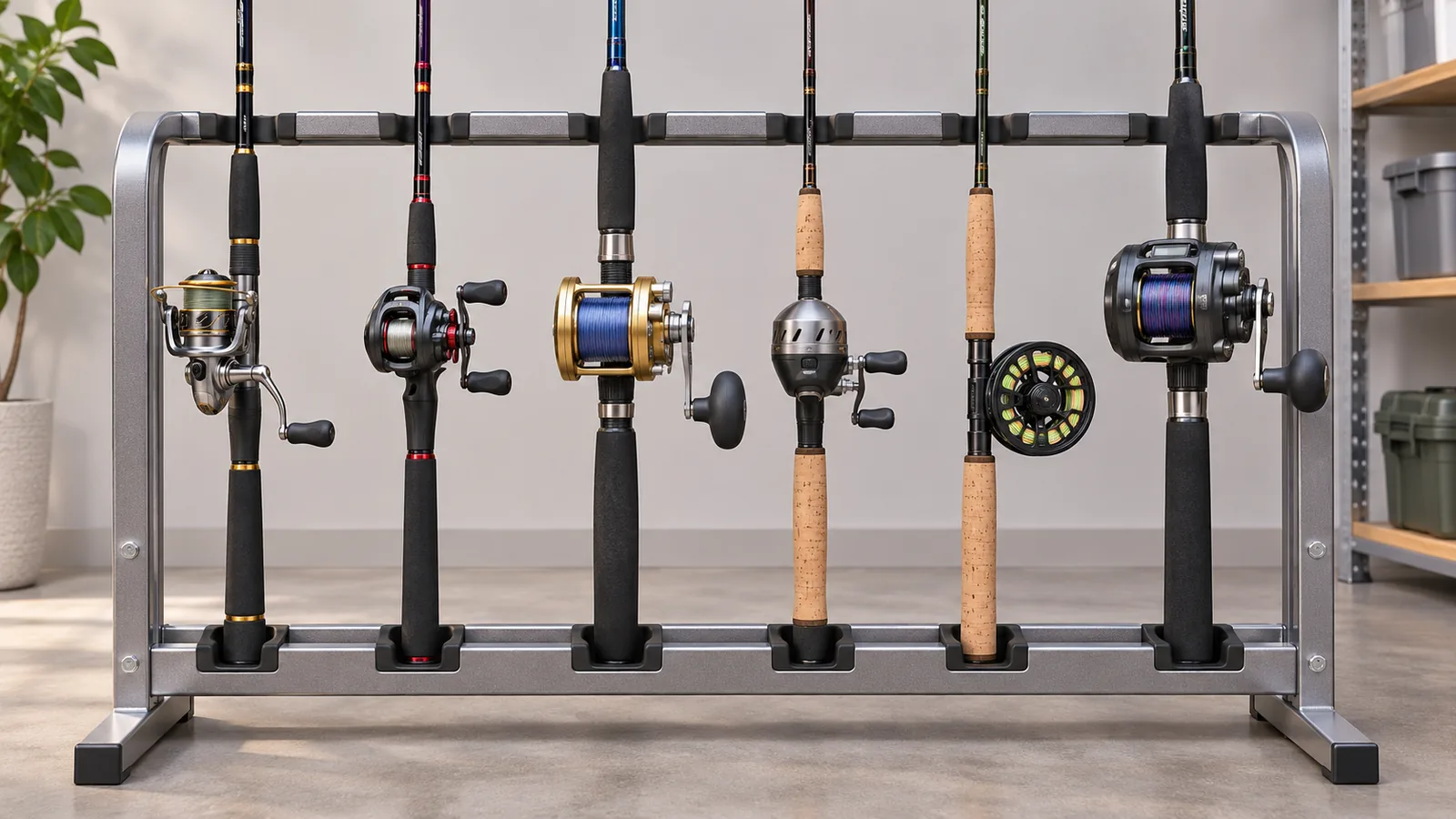
Fishing rod rack reel clearance should be approved with the reel, handle and relevant guides attached, because bare-rod fit does not establish that a rigged combination will sit in the rack or come back out cleanly. Buyers should name the reference rod and reel models, identify the lower butt support and upper rest, then observe the entire intended set with adjacent positions occupied. A successful sample-fit review is about geometry and retrieval; it does not prove a structural load rating, safe installation or resistance to outdoor exposure.
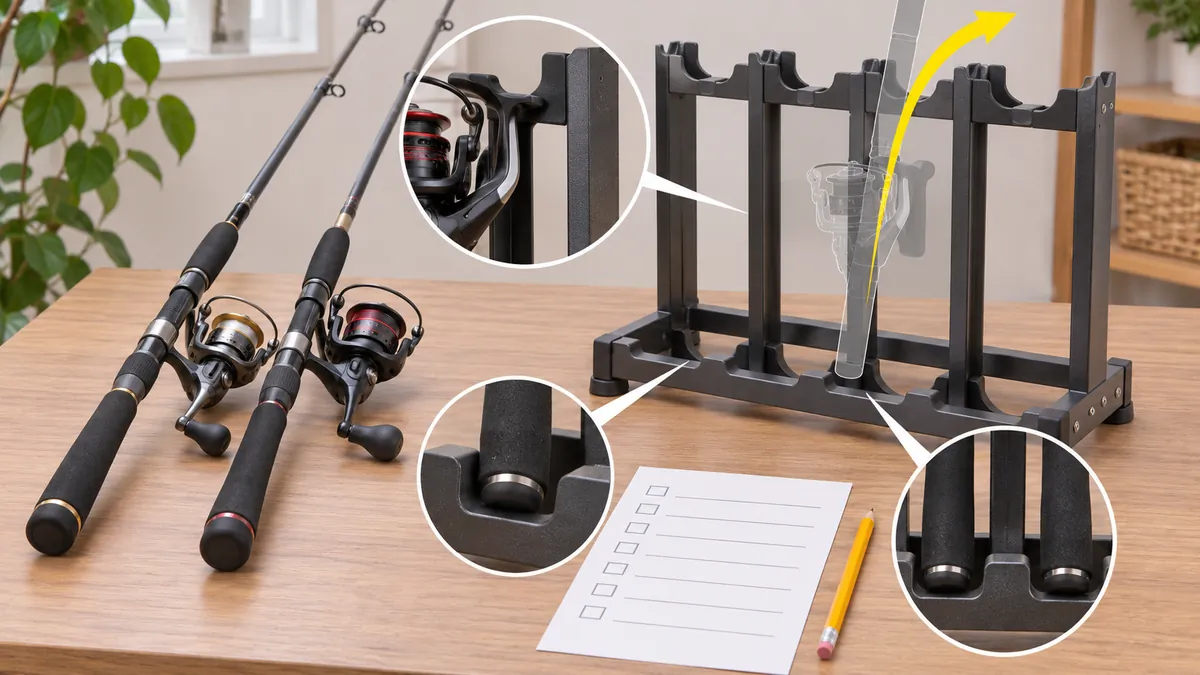
Why Is a Bare-Rod Fit Check Incomplete?
A rod’s reel can project sideways or downward from the blank, and its handle may extend beyond the rack’s support zone. Guides, line, a trigger grip, butt cap or accessory can also affect how the assembly rests. Two rods with similar overall length can have different reel-body widths or handle orientations. A rack may accept the rod shaft while the reel hits a neighboring rod, shelf, frame upright or wall.
Product examples in the market show several stationary storage architectures. A steel rack listing from StoreYourBoard describes multiple rod positions and separate support elements. Another rod-rack listing explicitly notes that the number of rods depends on reel size. A two-part arrangement separates butt support from upper rod retention. These examples show why assembled gear and support positions matter; they do not independently verify the products’ advertised count, load, durability or weather resistance. A product image is not a dimensional drawing, and no competitor’s values should be copied into a buyer’s specification.
The buyer’s decision is not just “how many rods fit?” It is which actual combinations fit the support geometry, how they sit next to one another, and how the user inserts or retrieves them. If a rack includes a shelf or accessory area, confirm whether tackle boxes or other items interfere with the rods. If the product is freestanding, stability and structural review remain separate from slot fit. Do not imply an indoor rack is suitable for marine, vehicle or outdoor use without specific evidence.
| Fit question | Buyer should define | Separate approval still needed |
|---|---|---|
| What goes in the rack? | Rod model, reel, handle and relevant accessories | Intended use and actual support scope |
| Where does it contact? | Butt bearing and upper-rest positions | Structural strength and verified allowable load |
| Does the set fit together? | Neighboring occupied bays and reel orientation | Rack stability or attachment suitability |
| Can each unit be removed? | Insertion, lift and withdrawal sequence | User-specific ergonomics or safety assessment |
| Does an accessory shelf fit? | Actual box sizes and access needs | Any product claim about storage quantity |
This is a product-specific example of storage assortment planning. For manufacturer and OEM project scope, use the home-storage hardware manufacturing page; this article does not imply that Koitor currently offers a fishing rack.
Which Rod-and-Reel References Should an Importer Select?
Choose references from the real assortment rather than an idealized generic rod. Include the combinations expected to be stored: different reel styles, handle directions, rod lengths or butt shapes when they affect the rack. Record the brand/model only where the buyer has permission and needs it for identification. The product specification can use neutral reference IDs in broader supplier circulation while keeping the internal source record.
Photograph each assembled combination from the side and the reel-facing side. Record total stored length and the maximum projection at the reel, handle and any guide likely to interact with the rack. Identify which end rests at each support and whether the rod is stored with its reel attached. A single “rod length” measurement cannot define the complete stored envelope.
For a two-support design, map the butt contact and upper rest separately. Confirm that the lower support does not obstruct the reel foot or handle and that the upper rest does not force the rod into a bend or place a delicate guide against an unintended edge. This is a fit observation, not a recommendation to support a specific rod feature or a claim that a rack protects equipment. The buyer and product designer must decide acceptable contact surfaces for the intended product.
If the supplier offers inserts, clips, gates or pads, record their actual part number, revision and inclusion in the quotation. A purchased pad or retainer may change the usable opening or release path. Confirm how it is installed and whether the sample includes production-intent parts. Do not assume a soft-looking insert is non-marking or that a holder’s appearance proves retention under movement.
How Should Buyers Check Reel and Neighboring-Bay Clearance?
Start with one assembled rod-and-reel combination in the first support position. Observe whether it settles into the intended contacts without being forced or resting on an unintended guide, reel handle or accessory. Then fill the next position with the actual neighboring reference. Repeat until the intended rack quantity is represented. The interaction between adjacent reels may govern spacing even when each rod can fit alone.
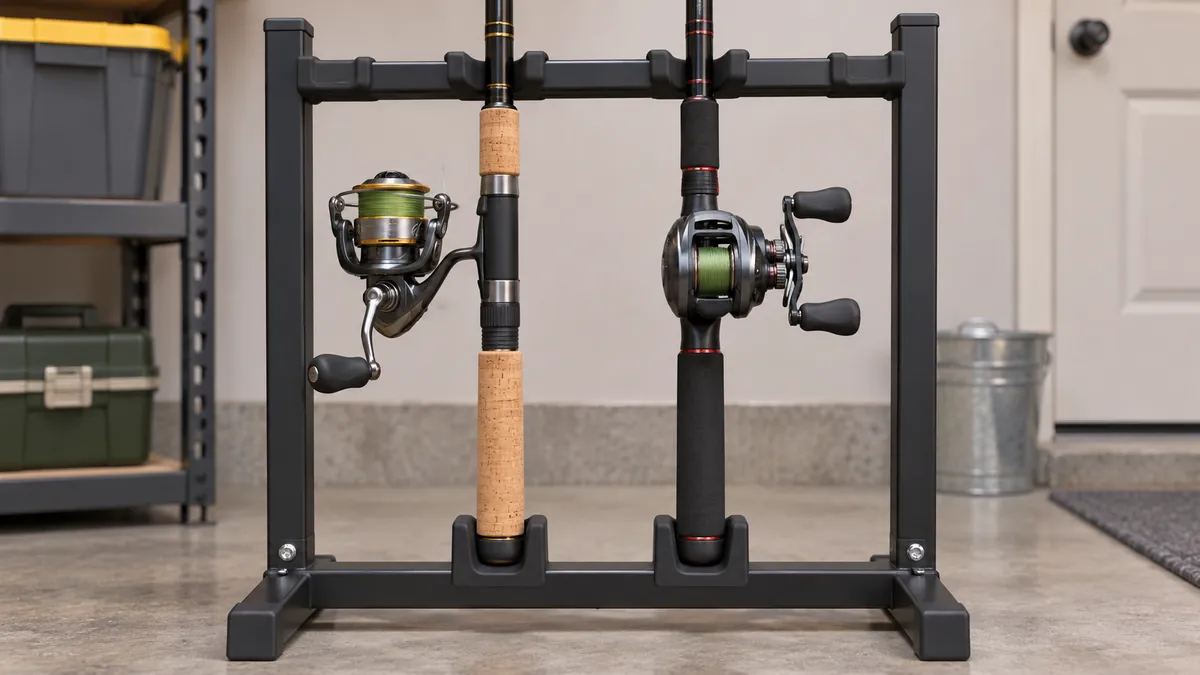
Record which directions the reels face. Alternating reel orientation can create clearance, but it may also complicate retrieval or cause the rods to cross. Do not assume the user will arrange equipment in a particular pattern unless the product instructions and display show it. If a capacity statement depends on alternating directions or a specific reel type, disclose that basis and tie it to the tested sample configuration.
Review the full insertion and withdrawal path. Ask whether the user can lift or slide a rod out without colliding with neighboring reel handles, shelves or rack uprights. Determine whether the last position can be accessed once all other rods are present. If access requires temporarily removing other equipment, that limitation should inform the product’s intended use and buyer claim.
Also note the overall envelope. The rack may occupy a small footprint while handles project into a passage or door swing. Site fit is a separate buyer decision. Provide the intended location and constraints to whoever is responsible for the storage area; this guide does not prescribe turning space or safe clearances. For stationary units, follow product-specific instructions and obtain qualified review for any anchoring or structural decision.
How Should a Buyer Define Capacity and Fit Claims?
Use conditional language that matches the evidence. A fit statement can refer to named rod/reel combinations, a stated orientation and the sample revision evaluated. It should not silently expand to all rod lengths, reels or users. If a rack’s capacity is limited by reel dimensions, identify that condition where the buyer presents the count. Do not turn a product listing’s advertised number into a verified universal capacity.
Separate four different statements:
- Slot count: how many support locations the rack has.
- Geometric fit: how many defined assembled combinations physically fit in a stated arrangement.
- Usability: whether the intended user can insert and retrieve the items in that arrangement.
- Structural or load performance: what a qualified product-specific test or supplier evidence supports.
These statements require different evidence. A rack with several slots might only fit a subset of large reels. A complete set might fit but prevent access to the innermost unit. A fit trial does not establish the rack’s permissible load or anchoring requirements. If the product is marketed for a specific environment, the buyer should also request the evidence relevant to that environment rather than infer it from a finish photograph or material name.
Do not claim “no interference,” “scratch-free,” “secure,” “all reels fit” or “outdoor proof” on the basis of one sample arrangement. If a buyer wants to make a broad claim, product engineering and regulatory reviewers should define the representative range, conditions and evidence. Keep the approved claim linked to the test record and product revision.
What Should the Sample Approval Matrix Contain?
| Matrix field | Entry to preserve | Why it supports repeatable review |
|---|---|---|
| Reference combination | Rod and reel ID, model and revision | Establishes what the fit result covers |
| Assembly state | Reel attached, handle position and accessories | Captures the complete stored geometry |
| Support location | Butt contact and upper-rest position | Shows how the rack holds the reference for fit review |
| Projection | Reel body, handle and guide envelope | Identifies potential neighboring interference |
| Occupancy | Adjacent bays and accessories filled | Tests the intended arrangement, not one isolated item |
| Retrieval | Insertion and removal path for each position | Records access assumptions |
| Rack identity | Drawing, sample and insert revision | Connects observations to the offered product |
| Exclusions | Unchecked equipment, environment or mounting claims | Prevents unsupported extrapolation |
| Approval owner | Reviewer, date and next action | Identifies who accepts the buyer’s requirement |
For a simple product line, each row can represent one reference combination and its storage orientation. If the assortment is large, group only combinations with genuinely comparable envelopes and contacts. State the basis of the grouping. Do not reduce all rods to a single “small/medium/large” label unless that classification is defined and meaningful for the rack.
Keep the sample, images and drawing revision together. A photo can show arrangement but cannot reliably establish exact dimensions, material or hidden construction. Mark the intended orientation and show both supports. If a new reel, retainer or shelf is introduced, review the affected clearance and retrieval questions before applying the old approval to the revised product.
What Are Common Sourcing Mistakes?
- Approving a bare rod while the product is intended to store assembled combinations.
- Measuring overall rod length but not reel, handle or guide projection.
- Checking one slot without filling neighboring positions.
- Counting open slots as equivalent to a usable storage count.
- Assuming alternating orientations are obvious to every user.
- Treating a successful fit trial as proof of rack strength or stability.
- Copying a competitor’s advertised quantity, load or weather statement.
- Ignoring shelf access, wall projection or retrieval sequence.
- Assuming a pad or clip protects a finish without evidence.
- Carrying approval across a product revision without reviewing the changed interface.
Before an RFQ, send the supplier a non-confidential drawing, a list of representative assembled references, intended quantity and any storage-location constraint. Ask the supplier to confirm what the sample will include and which questions are outside its scope. Koitor Hardware’s approved experience includes buyer drawings, samples, metal forming, joining, finishing, assembly and packaging for bathroom and home-storage hardware. Its current fishing-rack capability, plastic inserts, marine test scope, rod-specific engineering and sports-product history are not established here. A feasibility discussion should be based on the buyer’s own lawful product brief and confirmed manufacturing scope.
Buyer Checklist Before Sample Approval
Use the phrase fishing rod rack reel clearance as a fit question in the sample record, then identify the actual rod-and-reel references being checked.
Confirm fishing rod rack reel clearance for the assembled reference combinations and the approved neighboring-bay arrangement.
- Select real assembled rod-and-reel combinations from the target range.
- Record model, configuration, handle orientation and accessories.
- Identify both support contacts and any guide or reel interference concern.
- Fill neighboring positions to the intended quantity.
- Demonstrate insertion and retrieval from every position.
- Review shelves, overall projection and the intended storage location.
- Identify all pads, clips or retainers included in the production-intent sample.
- Separate fit, usability, load, stability and environmental claims.
- Link the result to a drawing/sample revision and named reviewer.
- Recheck changed reels, accessories or rack components before repeating a claim.
الأسئلة الشائعة
Does a rod rack’s slot count prove that a reel will fit?
No. Slot count describes support locations, while reel and handle projection can affect actual fit and access. Check the assembled combination.
Should sample approval include reels?
Yes, when the rack is intended to store rods with reels attached. Use the actual representative references and record which configurations were reviewed.
Can a fit sample prove load capacity?
No. Geometric fit is separate from structural evidence and installation review. Use the supplier’s product-specific evidence for those claims.
Is alternating reel direction an acceptable capacity solution?
It may be one configuration to evaluate, but the buyer should confirm access, instructions and the actual sample. Do not treat it as a universal rule.
Does an indoor rod rack work outdoors?
Not automatically. Environment suitability depends on the complete product, materials, finish, components and evidence for the intended exposure.
Discuss a Metal Storage Product Brief
Bring a lawful drawing, assembled reference items and a clear storage brief to discuss metal manufacturing feasibility within confirmed scope.
OEM / العلامة التجارية الخاصة
حوّل دليل التوريد هذا إلى موجز منتج
يرجى إطلاعنا على المنتج المستهدف، والحجم، والتشطيب، وكمية الطلب، ومتطلبات التغليف. وسيتلقى فريقك تقييمًا عمليًّا لإمكانية التصنيع قبل تقديم عرض الأسعار.



 English
 Español
 Português
 Français
 Deutsch
 العربية