
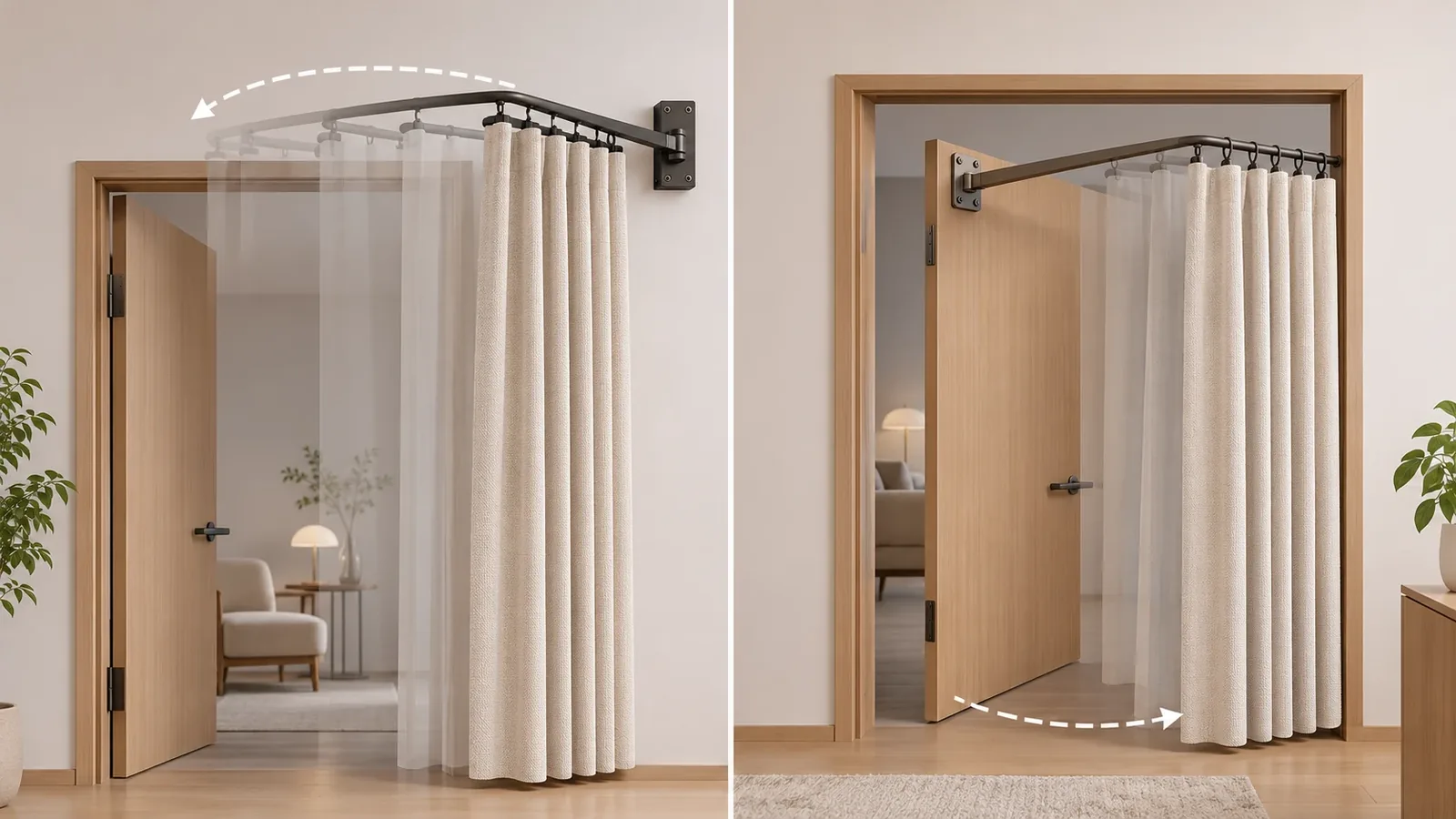
Short answer: A swing arm curtain rod may swing independently from a wall bracket, or it may be connected to a door so the curtain moves with the door. The product name alone does not establish which architecture is being quoted. Before ordering, identify the intended motion, the bracket and door connections, the components included in the kit, and the maker’s current instructions. A rod marketed for use near a door is not necessarily coupled to that door.
This guide compares two purchasing architectures, not every type of drapery hardware. It does not prescribe hinge dimensions, mounting locations, screw patterns, load, maximum travel, clearances, installation procedures or weather performance. Those details must come from current documentation for the selected maker’s model and from qualified project review. The term “portiere” also varies across commercial descriptions, so the buyer should specify the connection and motion rather than relying on the category word alone.
Two maker sources show the distinction. Urbanest describes a specific swing-arm rod with individually hinged arms, wall brackets and an adjustable rod package. Jim Lawrence’s guide to its made-to-measure portiere rods describes a bracket at the frame and a support on the door so the rod and curtain move with the door. The former documents an independent arm arrangement; the latter documents a door-linked one. The Urbanest product page و Jim Lawrence portiere guide are examples for those named products only. Jim Lawrence’s diagrams were not visually inspected; no measurement, handing or installation geometry is derived from them.
Define the movement relationship before selecting the rod
The first question is not how far a rod swings. It is what is connected to what. An independently hinged arm is attached to a wall-side bracket and moves relative to the wall. A door-coupled assembly has a connection to both the frame or wall and the door, linking the curtain’s movement to the door. Those relationships produce different installation and operating questions.
A product described as suitable for French doors or a doorway is not automatically a door-coupled portiere. It may simply be a separately mounted arm used near a door. The cited Urbanest description identifies a hinged arm and wall brackets; that description does not establish a connection between the rod and the door leaf. The Jim Lawrence guide explicitly describes support at the frame and at the door, which is the relevant distinction. The buyer should request a drawing or written maker description for the exact model rather than infer the architecture from the application photograph.
Write the intended operation in plain language. Should the curtain move when the door moves? Should the rod swing by hand while the door remains still? Is the user expected to park the arm at a defined side? Is there a paired installation on both sides of an opening? Are the rod and curtain intended to stay supported during door movement? These are requirements for the buyer and project designer to confirm. They are not implied by “swing arm” or “portiere.”
Identify whether the application is a window, doorway, French door, bed alcove or another opening. The opening’s physical arrangement can affect the kit and its responsibilities. Avoid reusing the same product description across different openings unless the selected manufacturer has confirmed the configuration. A name such as “door rod” may refer to different hardware packages from different suppliers.
Compare independent-arm and door-coupled kits
An independent swing-arm product has its own pivot relationship to the wall or wall-side bracket. The buyer should identify the arm, bracket, supplied rod or extension, any finial or ring, and the direction in which the assembly is intended to move. Urbanest’s product description includes an adjustable rod package and wall brackets for its named model. Those details are useful for its own quote and BOM; they do not set a universal kit standard. The buyer should verify exactly what is included in the selected SKU.
A door-coupled system has a second interface at the door. The buyer should identify the frame-side and door-side components, their supplied references and the maker’s intended relationship. The door’s movement may carry the rod or curtain in a way that an independent arm does not. The current Jim Lawrence guide describes that connection architecture, but its diagrams were not inspected and its installation instructions cannot be reconstructed from prose. Ask the maker for the exact current technical package before preparing an installation brief.
The two architectures should not be ranked as universally better or worse. The appropriate option depends on the intended opening and how the buyer expects the curtain and door to behave. An independent arm may be selected when the curtain is to move separately from the door. A door-linked kit may be selected when the buyer wants the curtain movement coordinated with door movement. Those are conditional statements about design intent, not promises about every layout.
The kit boundary should be explicit. Is the rod supplied with the brackets? Are rings, finials, return pieces or door supports included? Are screws or other fasteners included, and are they approved for the project substrate? Who supplies the curtain and fabric? Who selects the door or frame attachment? A product image can show accessories that are optional or purchased separately. Let the BOM and quote define the ordered package.
| Buyer decision | Independent swing arm | Door-coupled portiere | Evidence to request |
|---|---|---|---|
| What moves? | Arm moves relative to its wall bracket | Rod or curtain relationship is linked to door movement | Maker description and current model drawing |
| Which interfaces matter? | Arm, wall-side bracket and supplied rod package | Frame-side and door-side support relationships | Exact component list and instructions |
| What must be coordinated? | Parked/deployed arm path and nearby boundary | Door movement, curtain path and both mounting zones | Project opening reference and maker review |
| What should not be assumed? | Door coupling from nearby application | Universal handing or geometry from the word portiere | Model-specific written confirmation |
| What belongs in the quote? | Bracket, rod, rings, finial and fasteners as applicable | Rod, frame support, door support and related parts | SKU-level included/excluded list |
Map the operating path and opening boundaries
After selecting the movement relationship, map the path in the intended opening. Identify the frame, door leaf, adjacent wall, handle, trim, curtain, floor and nearby furniture that may affect the movement. The buyer should state whether the curtain hangs on one side or crosses the opening, and whether the door opens inward or outward where that matters. These details help the maker or project designer review the intended configuration; they are not values that this guide can prescribe.
For an independent arm, draw the parked position and the operating arc as supplied by the maker. If no documented arc or dimensions are available, mark them unresolved rather than estimating from a photograph. Check whether the curtain and rings move with the rod or are separately repositioned. Confirm whether the arm can reach the intended position without crossing another fixture. The selected manufacturer should confirm any required envelope or stop condition.
For a door-coupled arrangement, show the door in its relevant positions and identify the frame-side and door-side attachments. The project team should ask how the curtain and rod are expected to move as the door operates. Do not infer the handedness, bracket geometry or support path from a catalog thumbnail. Because the cited diagrams were not visually inspected, they cannot be used to prescribe a particular bracket position or dimension.
A useful review sheet separates opening identity from hardware identity. Record the door or frame reference, opening direction, side of attachment, rod or arm model, curtain reference, bracket set and maker instruction revision. If the opening or door changes, check whether the hardware package remains applicable. A visually similar doorway may have different trim, swing or surrounding conditions.
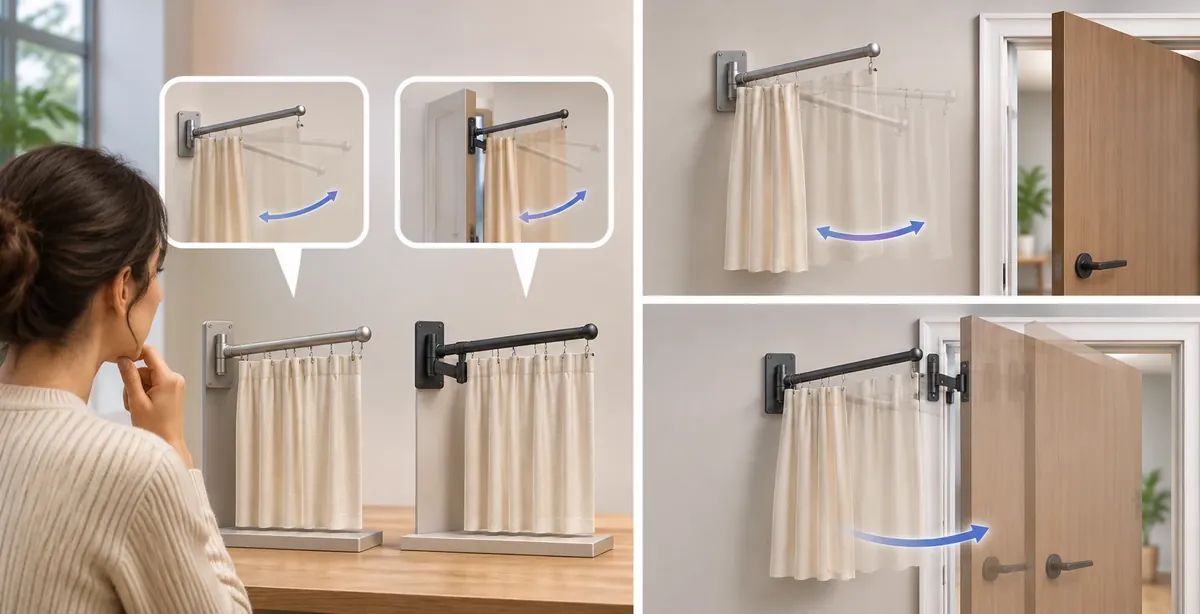
Keep fabric and rod claims separate. A rod that fits the opening does not automatically establish that a particular curtain, ring spacing, fabric weight or lining is suitable. The buyer should identify the curtain and any accessories that form part of the intended system. The maker’s stated compatibility should be used only for the exact model it covers.
Specify the supplied components and finish scope
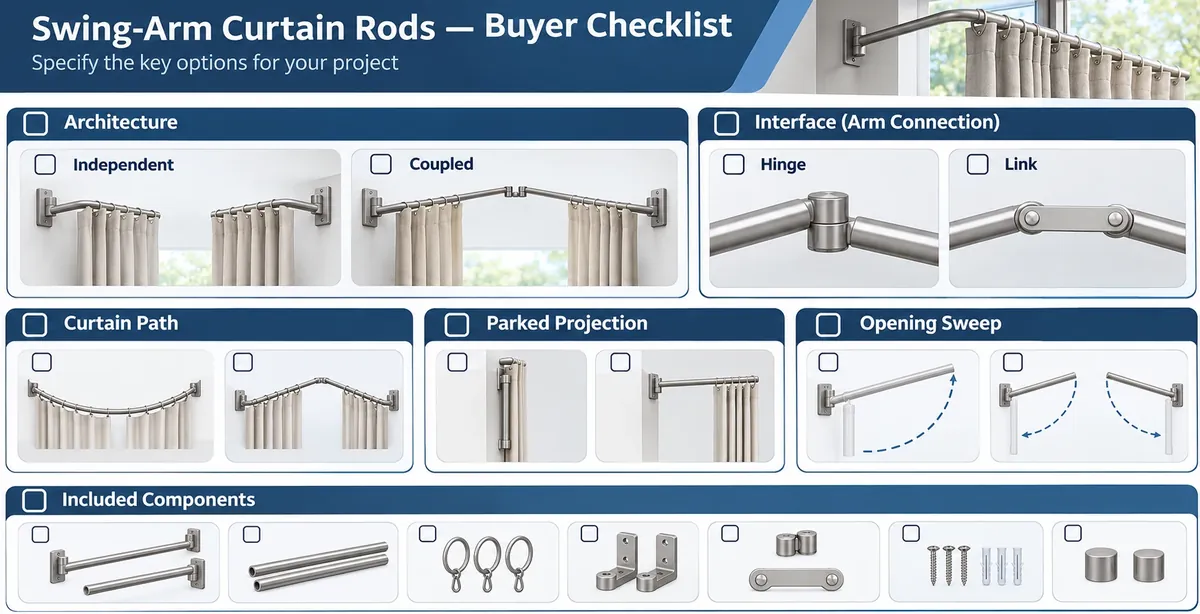
An RFQ for a swing-arm or portiere kit should list the expected components. For an independent arm, name the arm, wall bracket, rod section or adjustment, rings, finial, fasteners and any cap or stop where those items are part of the offer. For a door-coupled kit, list the frame-side support and door-side support separately along with the rod, rings and any related fittings. If the supplier sells a “set,” ask for its itemized contents and part references.
Identify material and finish requirements without inventing process details. A buyer may specify the visual finish, color reference or corrosion environment for the project, but the supplier must confirm which part and substrate the finish applies to. If an accessory is made from brass, wood or another material, identify which supplier owns it. Do not infer that Koitor manufactures a complete curtain system, a cast finial or a specialist hinge from its general metal-hardware experience.
If the buyer requests a customized length or finish, ask which component changes and what approval is required. A length adjustment could involve a supplier-specific part or a different package; this guide does not predict its engineering or cost effect. A finish change may apply only to selected metal components. Keep the quote clear about what the supplier can make and which bought-in components remain standard.
The packing list should also reflect the architecture. Door-coupled pieces can be mistaken for independent brackets if loose components are not identified. Group components by reference or include a parts list that helps the installer associate each item with the approved drawing. This is a packaging and identification question, not a claim that the current examples have a particular packing method.
Review the sample, drawings and change record
A sample approval should record the intended opening, model reference, revision, movement relationship and supplied kit. Photograph or document the independent arm in its parked and deployed states, or document the door-coupled movement using the maker’s instructions and a clearly identified sample. If the sample cannot represent the intended opening, state what was not assessed. Do not mark fit or operation as approved solely because the rod has the desired finish.
The buyer’s sample checklist should separate visual approval from installation approval. Visual approval can record finish appearance, component identity and the observed shape. Installation approval requires the responsible party to review the current maker instructions against the actual frame, wall and door. The product supplier may provide hardware but not inspect the site. The installer or project designer must own substrate suitability and attachment decisions unless the supply agreement states otherwise.
When a supplier proposes a substitute, compare the movement relationship first. A replacement that has a wall bracket but no door connection is not the same as a door-coupled kit even if the rod looks similar. Then compare the model references, supplied parts, instructions, finish and opening conditions. Keep any unverified alternative outside the approved BOM until the project owner accepts it.
Control changes by the affected interface. A new opening or door may require renewed layout review. A changed bracket or door support requires current instructions and a mounting review. A different rod or ring family may change the curtain interface. A finish-only change may have a different review scope. Record the supplier’s change notice, buyer disposition and updated drawing or sample identity rather than relying on a verbal statement that “the set is the same.”
No sample meeting can establish universal life, load or draft-proofing performance. If the program needs a specific test or performance claim, the buyer should write a separate requirement and agree the test method with the responsible manufacturer or qualified specialist. Do not infer energy, insulation, weather or safety outcomes from the presence of a curtain rod or from a maker’s general marketing phrase.
Prepare the RFQ and product information
The RFQ for a swing arm curtain rod should state whether the buyer needs an independent arm or door-coupled hardware. Attach an opening sketch, door or frame reference, intended curtain, selected model if known, finish, quantity and packaging requirement. Ask the maker to confirm its current model name, revision, component list and instructions. If the buyer is still deciding, request two distinct proposals rather than one blended quote that leaves the connection unclear.
For a door-coupled system, explicitly ask which components attach to the frame and which attach to the door, and which party confirms their placement. For an independent arm, ask the maker to identify the wall bracket and documented movement. In both cases, request the current installation document. Do not accept a copied instruction for a similar style or a scanned diagram whose model and revision cannot be identified.
Separate maker facts from buyer requirements in the record. The maker can identify its own included bracket set and operation. The buyer supplies the opening and desired movement. The site installer confirms substrate and installation conditions. The curtain supplier identifies fabric and accessory references. A quote should not imply that one party approved another party’s responsibilities.
Product descriptions should use precise architecture terms. If the rod swings independently, say that only when the selected maker describes that movement. If the rod is linked to the door, state the exact model-specific relationship. Do not call every hinged rod “door-coupled,” and do not promise a particular opening angle or draft reduction unless current model-specific evidence supports the statement.
For an importer, the movement architecture should appear consistently in the item master, quotation, carton identification and instruction set. A supplier can use a broad collection name, but the buyer’s purchase order should identify whether the quoted item is the independent wall-mounted arm or the door-linked kit. If a supplier’s catalog uses “swing arm” and “portiere” in overlapping ways, ask it to describe the actual connections and supply a current model drawing. Terminology should be resolved before the artwork or sales listing is released.
The curtain itself is another supply boundary. Some programs purchase rod hardware and fabric from separate suppliers. The hardware buyer should name the curtain reference, rings or other interface parts that have been approved, but should not infer fabric suitability from a rod listing. If the manufacturer claims that its rod is suitable for a stated fabric or use, preserve the exact conditions and evidence for that model. A generic curtain photograph does not establish a load or movement qualification.
Packaging can affect how a kit is checked at receipt. Frame-side and door-side supports may be separate pieces; rod sections, rings and finials may be packed individually. The buyer can request a parts schedule inside the carton or clear references on component bags. This is a labeling and scope-control recommendation, not evidence that any cited manufacturer currently uses a particular packing method. At receiving, compare the component count to the approved BOM and record any discrepancy with the model and lot information available.
If the kit is intended for repeat orders, preserve the buyer-approved opening and connection record with the supplier’s current instruction revision. A future project may use the same general doorway style but have a different frame, trim or door relationship. The old configuration can be a useful starting point, but it does not automatically approve a new site. Reconfirm the selected references and responsible installer’s review for each changed opening.
Avoid combining a product fact with an unverified benefit. An independent arm may be documented to swing; that alone does not establish that it improves privacy, reduces drafts or allows every door to operate freely. A door-coupled rod may move with the door according to the maker’s description; that alone does not establish thermal performance or eliminate interference. Keep marketing language anchored to the observed or documented mechanism and leave broader outcomes to evidence designed for them.
Buyer checklist before approval
- State whether the curtain rod is independent or connected to the door.
- Identify the exact maker, model and document revision.
- Name the frame-side and door-side connections where applicable.
- Record the intended opening, door direction and curtain reference.
- Request current maker instructions; do not derive geometry from unseen diagrams.
- List rod, brackets, rings, finials, fasteners and other parts separately.
- Confirm finish and material scope for each component.
- Assign site substrate and installation review to the qualified party.
- Document the sample in its parked and operating states.
- Hold substitutes until motion and interfaces are confirmed.
Does every swing arm curtain rod move with a door?
No. An independently hinged arm can swing relative to a wall bracket. A door-coupled system has a separate relationship to the door. Confirm the exact model.
Does portiere always mean the same hardware arrangement?
No. Commercial usage can vary. Specify the connections and movement in the RFQ and request the selected maker’s current drawing.
Is arm length enough to select a kit?
No. The buyer should also identify the opening, attachment relationship, supplied bracket set, curtain interface and required operating path. Model-specific instructions govern.
Can a ring or finial from another collection be substituted?
Do not assume compatibility based on appearance. Use the selected maker’s current references or obtain a written confirmation for the exact combination.
Does Koitor manufacture the complete curtain-rod system?
This article does not establish that. Buyers should identify the specialist mechanism, bracket, curtain and any bought-in component suppliers and confirm the actual metal scope before requesting a quotation.
For broader project context, see Koitor’s OEM home-storage hardware scope. Buyers may share the opening reference and proposed metal scope for a defined discussion.
Review a Defined Metal Hardware Scope
Share the opening reference, intended movement, selected instructions, metal-component scope, finish and packaging. Koitor can first confirm whether the defined metal work fits its current capabilities before quotation.
OEM / العلامة التجارية الخاصة
حوّل دليل التوريد هذا إلى موجز منتج
يرجى إطلاعنا على المنتج المستهدف، والحجم، والتشطيب، وكمية الطلب، ومتطلبات التغليف. وسيتلقى فريقك تقييمًا عمليًّا لإمكانية التصنيع قبل تقديم عرض الأسعار.


 English
 Español
 Português
 Français
 Deutsch
 العربية