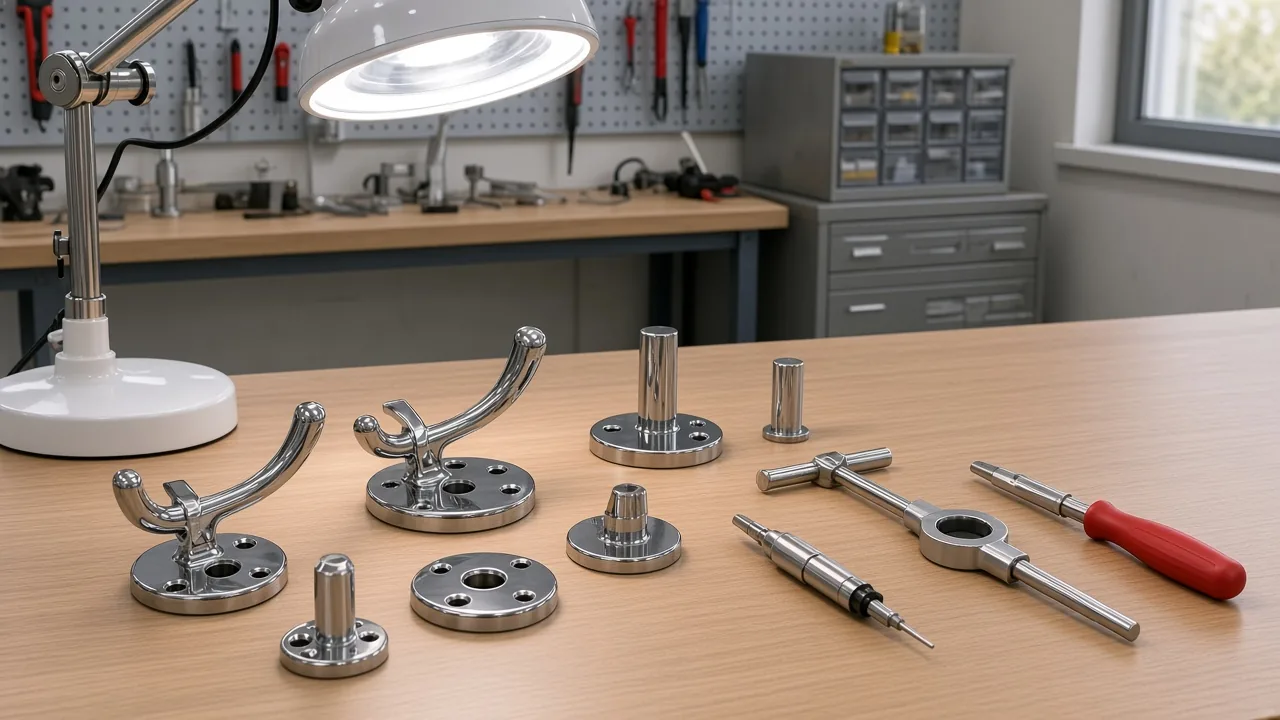
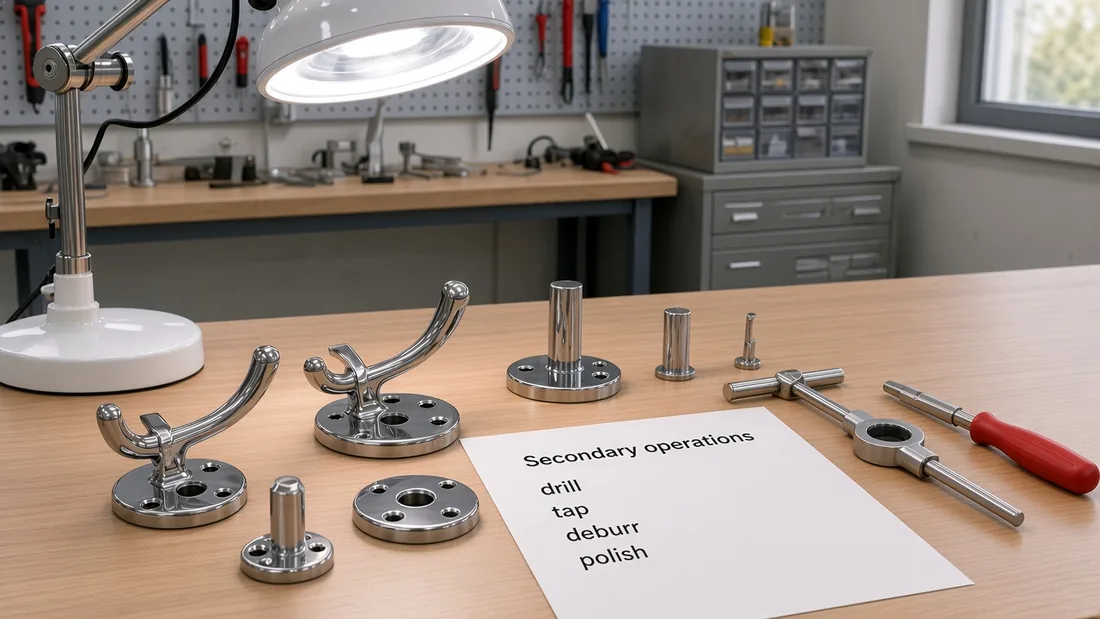
A secondary operations bathroom hardware RFQ should freeze drill, tap, deburr, and polish after form as named line items, so two suppliers are quoting the same after-form work rather than assuming it is “included.” Importers who leave those steps in a comment or in a sample photo will receive prices that look comparable and processes that are not.
This page owns the RFQ list and the habit of writing after-form work in the inquiry. It does not choose the polish route; that decision belongs in the hand-versus-automated polish file. It also does not replace a complete drawing package. Preparing drawings or samples for a custom hardware factory remains the file-prep neighbor.
Custom bathroom hardware manufacturing is the general factory conversation. Use this page when the inquiry is otherwise complete, but drill depths, tap sizes, deburr quality, or post-form polish are still implied rather than stated.
Which after-form steps must appear as RFQ lines?
Drill and hole position belong on the RFQ when the hole is added after forming, bending, or welding, or when a buyer might assume a pierced hole is already finished to size. Write the diameter, the depth when it is a blind hole, and whether the hole is structural or cosmetic.
Tap and thread class belong on the RFQ when a set screw, a post, or a metric or inch fastener will be installed. Write the thread, the depth, and whether a thread locker, a patch, or a drive type is part of the same kit. A tap that is “as sample” is not a comparable line.
Deburr belongs on the RFQ for hole exits, sawed ends, stamped edges, and any face a hand will touch during install. Write whether a sharp edge is unacceptable on a visible or handled face, and whether a functional edge may remain elsewhere.
Polish after form belongs on the RFQ as a named step when forming, welding, or machining will leave a surface that must be dressed before finish. The RFQ line says that the step exists and is included in the quote. The route—hand, automated, or mixed—is decided in the polish file, not invented here as a cost slogan.
How should the RFQ be structured so quotes stay comparable?
Give each after-form step its own line or its own clearly labeled block, even if one factory will do all of them. A single “machining included” sentence hides whether tapping is in or out, and it hides whether deburr is a pass or a serious edge standard.
Attach the drawing or a marked photo that shows hole positions, thread callouts, and faces that must be deburred or dressed. If a sample is the master, say which features on the sample are binding and which are incidental. Drawing and sample preparation explains how to make that package readable; this page says which secondary operations must not be left out of it.
| RFQ line | Minimum information to freeze | What goes wrong if it is only implied | Owner of the later method decision |
|---|---|---|---|
| Drill or hole after form | Diameter, depth or through, position, and whether it is added after weld or bend | One quote pierces before form, another drills after, and hole position drifts | The drawing; the RFQ only forces the step to be priced |
| Tap and thread | Thread size, depth, and any drive or patch note tied to the hole | A set-screw post arrives with a shallow or untested thread | The fastener standard; kit drive size is a later accessories file |
| Deburr | Which edges and hole exits must be safe to handle or visibly clean | One shop breaks every edge, another leaves a sharp hole exit on a handled face | The visible and handled-face list |
| Polish after form | That dress after form or weld is included, and which faces it covers | A quote omits dress, then adds it later as a surprise charge | The polish-route file decides hand versus automated |
| Any other after-form work | Name it: countersink, ream, slot, stamp a mark, or cut a drain opening | The cheapest quote simply never planned the step | The drawing or the product standard |
What should stay out of this RFQ page?
Do not use this page to negotiate MOQ, exclusivity, or a standing lead time. Those are commercial and stay with the buyer. Do not use it to pick a polish machine. Do not use it to redesign a hole pattern that should have been frozen in a finish-family architecture file.
What the factory can quote honestly, and what it cannot infer
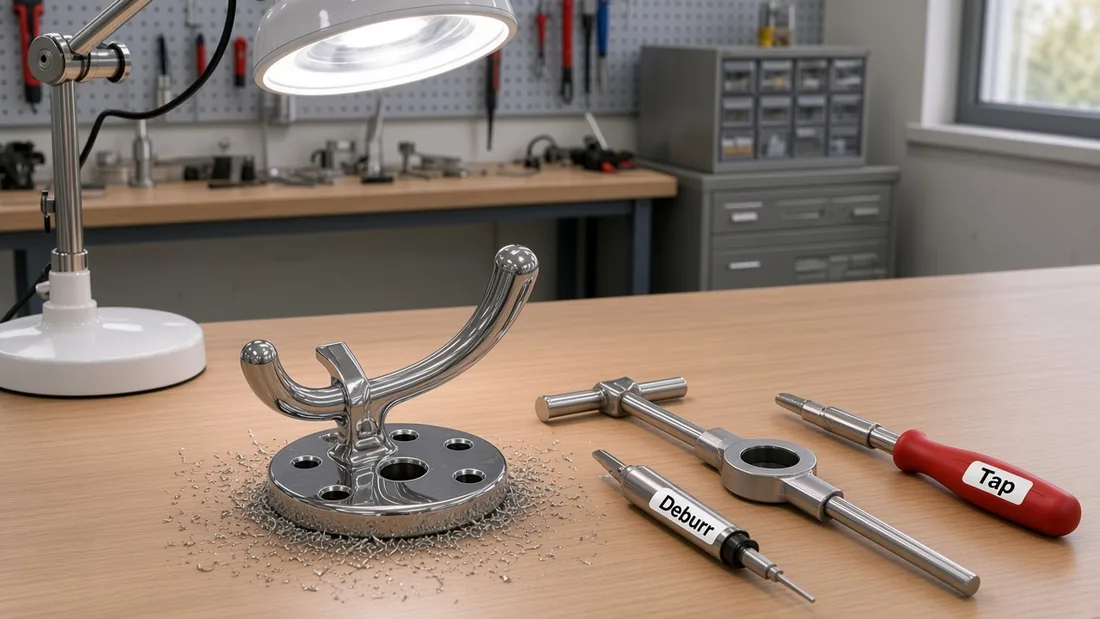
A factory can quote named after-form steps when the drawing or the marked sample makes them visible. It cannot honestly infer a tap depth, a hidden deburr standard, or a full polish after form from a lifestyle photo. If a step is missing from the inquiry, a complete-looking price may still be incomplete.
Koitor can help review an RFQ list as a family-owned China OEM manufacturer of bathroom and home-storage metal hardware. Whether a specific step is included in a given project quote depends on the inquiry you send, not on a default promise in this article.
Buyer checklist for a secondary operations bathroom hardware RFQ
Walk this list before you send the inquiry, and again when you compare two quotes.
- List drill or hole-after-form work with size, depth, and position references.
- List tap work with thread, depth, and any related fastener or patch note.
- List deburr for handled edges, hole exits, and visible faces that must be clean.
- List polish after form as a priced step, and point the route decision to the polish file.
- Name any other after-form work, such as countersink, slot, or a stamped mark.
- Attach a drawing or a marked photo; do not rely on a lifestyle image.
- Ask each supplier to confirm which listed steps are in the quote and which are excluded.
- Reject a comparison that only shows a unit price with “machining included.”
- Keep commercial terms out of this technical list.
- Update the RFQ when a hole, a thread, or a visible-face list changes.
Blind holes in a post or a flange are a frequent missing line. A through hole and a blind hole with a remaining wall are not the same drill step, and they are not the same risk for a later tap. If the remaining wall matters to strength or to finish bleed, write the remaining wall or the depth from a datum, not only “tap inside.”
Holes added after welding can drift if the weld pulls the plate. The RFQ should say whether the hole is drilled or pierced after weld, and the drawing should give a datum that still makes sense after weld. A hole dimensioned only on a flat blank may not survive the weld sequence.
Tube drilling for a set screw should state both sides if the screw must break through to bite a bar, or only one side if it is a closed post. “Add a set screw hole” without that note produces two different shops and two different posts.
Deburr on the exit of a drilled tube is often the edge an installer will feel. A quote that only tumbled the outer stamping may still leave a sharp tube exit. Write the exit as a handled edge when it is one.
Sawed or laser-cut ends on a bar that will be visible should be listed for dress. A polish-after-form line may cover that dress, but only if you say the end is a visible face. Otherwise a shop may leave a cutting texture that later shows through a bright finish.
If a drain slot or a long hole is cut after form, name the cutter and the edge condition at a practical level. A slot that is only shown in a rendering may be quoted as a simple punch by one shop and as a machined slot by another.
Thread gauges belong in the project method, not as a slogan. If you will check a tap with a gauge, say so in the inspection plan. The RFQ still needs the thread and the depth, or the gauge has nothing honest to accept.
Do not hide secondary operations in a tooling charge. A drill fixture may be needed, and that can be a tooling or setup line, but the per-piece drill and tap work should still be visible in the piece price or in a clear operation list. Mixed hiding makes the next reorder hard to compare.
A sample that was carefully hand-tapped and hand-deburred can mislead a production quote if those steps are not listed. Ask the factory to write the production method for each RFQ line, even if that method is still a workshop note rather than a brochure claim.
When two factories bid, send the same after-form list to both. A buyer who adds a tap line to only one inquiry will think the other factory is cheaper. Comparable RFQs are part of honest sourcing, not a courtesy.
Secondary operations can also include a stamped logo, a date, or a lot mark. If you want that mark, write the face, the size, and whether it may sit under a finish. An unstated mark is either omitted or placed on a visible face you did not intend.
If a plastic tip, a cap, or a rubber foot is added after metal work, that is usually a later assembly or kitting line, not a metal secondary operation. Keep it off this list unless the metal is machined to receive it. Mixing kitting into metal secondary work makes both quotes harder to read.
Re-tapping after plating is a special case and should be named if you expect it. Some threads are masked, some are re-chased, and some are left as plated. The RFQ should not assume a shop will re-tap for free after finish.
For a family of SKUs that share a post, write the shared tap once and list the unique holes per SKU. That habit matches a finish-family architecture file: shared work stays shared, unique holes stay unique, and the RFQ does not bury a one-off hole in a family price.
If a supplier returns a quote with “secondary operations as per sample,” ask them to convert that sentence into the same lines you sent. Until they do, the quote is not comparable and should not be used as the lowest-price line in a summary table.
Keep inspector instructions aligned with the RFQ lines. An inspector who only measures the body and never checks a tap depth or a hole exit will pass a lot that the installer later rejects. The inspection plan should point at the same named steps.
When a revision adds a hole or changes a thread, the RFQ and the effectivity file both need a date. This page does not own lot cut-in, but it should not keep an obsolete hole list in a living inquiry template.
Write the after-form list in the same language your purchasing sheet uses, so a secondary operations bathroom hardware RFQ can be copied into a comparison workbook without being rewritten into vague “machining” language that hides the work again.
Countersinks for screw heads are easy to forget on a flange that looks simple in a photo. If a flat head must sit flush, write the countersink as its own line, including which side is cut. A shop that only drills through will leave a head standing proud, and the later complaint will sound like a “wrong screw,” not a missing secondary operation.
A slot for a hanging bracket or a keyhole should be named with length, width, and which face is the entry. Keyholes cut after form can wander if the part is not held. The RFQ does not have to dictate the fixture, but it should not leave the slot as a decoration in a rendering.
Tube-end sizing, if a plug, cap, or bar must enter the tube, is an after-form operation when it is done after bending. Write the fit intent—press, clearance, or adhesive-assisted—without turning this page into a cap-specification file. The metal work still has to be listed.
If a surface is to be left as-formed because it will be hidden, say so. Otherwise a conscientious shop may polish or deburr a hidden back and charge for work you did not need, while a second shop leaves a handled front sharp. The list should be about required work, not about keeping everyone busy.
Thread inserts, helicoils, or captured nuts, when used, belong on the RFQ as named hardware and named installation steps. They are easy to hide in a sample and easy to omit from a piece price. If they are not used, say that the thread is a direct tap, so no one assumes an insert.
A drain hole in a soap or sponge cup is a small feature with a large quote gap. One shop will punch it in the blank; another will drill it after form so the hole stays round on a curved wall. Write when the hole is made and what edge condition you want on the inside of the cup.
Spot-facing a pad so a post sits flat is another line that disappears in lifestyle photos. If the post must land square on a stamped pad, name the face and the area. A later wobble is often a missing spot-face, not a “bad weld.”
When a factory uses a combined machining center to drill and tap in one setup, you can still keep two RFQ lines. Combined setup is their method. Your comparison still needs both features acknowledged and priced.
Ask for a short confirmation table in the quote: each RFQ line, included or excluded, and any assumption. That table is more useful than a paragraph of sales language. If a supplier refuses to fill it, treat the quote as incomplete.
Prototype shops and production shops often treat deburr differently. A prototype may be carefully hand-filed; production may rely on a brush or a tumble. If you approved a prototype feel, write the production deburr method as a project note, or the first lot will feel sharper than the sample.
Do not use “ISO standard deburr” as a substitute for a face list. Those words do not tell a shop which hole exit an installer will touch. Name the faces.
For powder-coated parts, say whether holes must be kept clear of coating, and whether that clearance is a masking step or a post-coat chase. Masking is usually a finish line, but a post-coat tap chase is still a secondary operation and should be visible if you expect it.
If your inquiry already includes a packing list, keep secondary metal work ahead of packing in the document. Buyers who bury drill and tap under carton marks cause reviewers to sign a packing page and miss an unstated thread.
A revision cloud on a drawing should trigger a matching change on the RFQ list the same day. A hole added in revision C but missing from the inquiry template is how a third lot loses a feature that the second lot had.
When the named lines, the confirmation table, and the drawing or marked sample travel together, quotes become comparable even when factories use different internal process names. That is the whole point of writing the after-form work down before the price is treated as a fact.
If your comparison workbook has a single cell for “processing,” split it into the same lines as the RFQ before you rank factories. A workbook that hides drill, tap, deburr, and polish after form will recreate the incomparable quote, even after the inquiry was written carefully.
For a first inquiry on a simple hook, the list may be short—perhaps only a set-screw tap, a hole exit deburr, and a weld dress before finish. Short is fine. Missing is not. A short honest list is easier to confirm than a long list that still forgets the handled edge an installer will actually touch during unpacking or during later wall mounting on the install site.
الأسئلة الشائعة
Can we just write “machine as sample” and get comparable quotes?
No. Samples hide depth, which exits are deburred, and whether polish after form is included. Name the steps, then let the sample illustrate them.
Does listing polish after form choose hand or automated polish?
No. Listing the step makes sure it is priced. The route and the consistency method belong in the polish-route file.
What if a factory already includes these steps in its standard process?
Ask them to confirm each listed line in the quote anyway. A standard process that is not written down will not help you compare a second factory.
Should kitting of screws and hex keys be on this RFQ?
Usually not. This list is metal after-form work. Kit contents belong in a packing or hex-key-kit file, unless the metal is machined to receive a specific insert.
Do we need a full 3D file before we can send this RFQ?
A clear drawing or a marked sample is enough to name the steps. A 3D file helps, and the drawing-prep neighbor explains formats, but missing software is not an excuse to omit drill, tap, or deburr lines.
Can Koitor promise these operations are always included in a unit price?
No. Inclusion depends on the inquiry and the project quote. This page only tells you to name the steps so a quote can be honest and comparable.
اعمل مع شركة «كويتور» للأدوات
Need an after-form RFQ list reviewed before you compare factory quotes?
Send Koitor the drawing or marked sample and your current inquiry list. Our team can help check whether drill, tap, deburr, and polish after form are actually named, and can also discuss the hardware construction and small-batch OEM options.
OEM / العلامة التجارية الخاصة
حوّل دليل التوريد هذا إلى موجز منتج
يرجى إطلاعنا على المنتج المستهدف، والحجم، والتشطيب، وكمية الطلب، ومتطلبات التغليف. وسيتلقى فريقك تقييمًا عمليًّا لإمكانية التصنيع قبل تقديم عرض الأسعار.
 English
 Español
 Português
 Français
 Deutsch
 العربية