
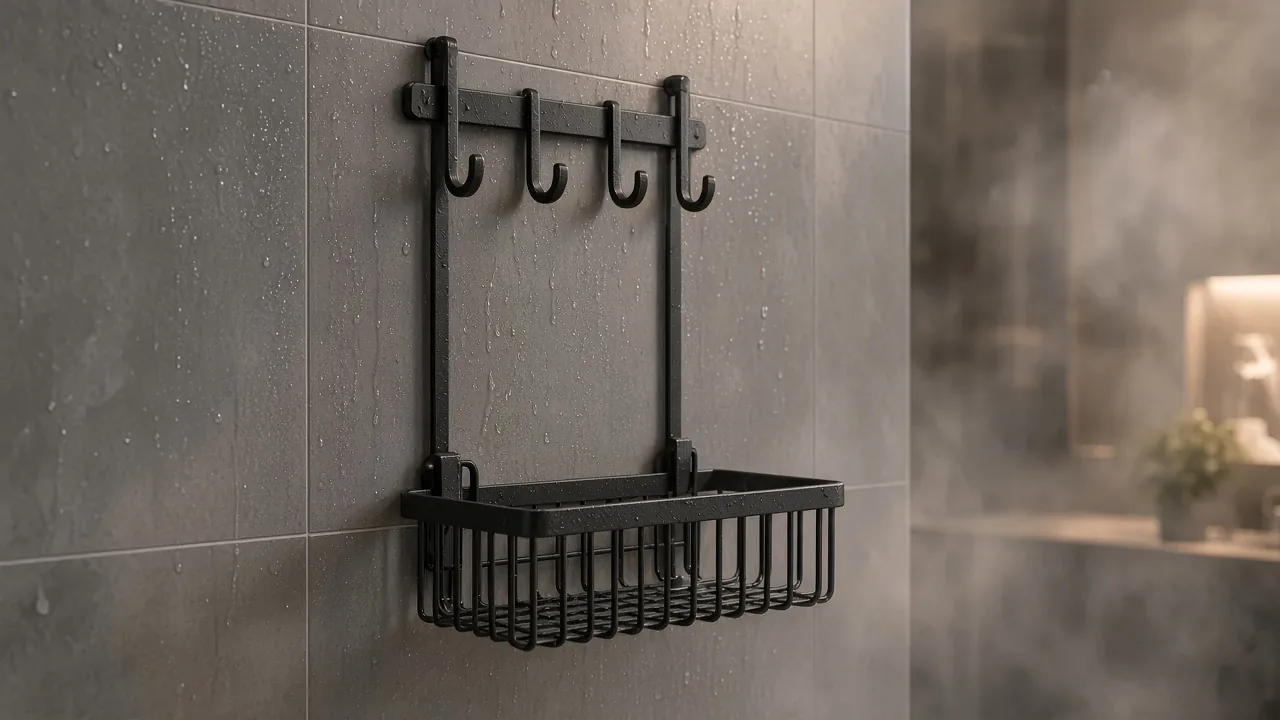
A peel test does not clear a mineral-spot line. A matte black bathroom hardware hard water claim should stay off artwork until the file separates removable mineral film from a sheen change and from a permanent etch, names the water condition or an exclusion, and records a project observation that can be repeated on the same finish family.
This guide is for importers and private-label teams writing finish language for wet-zone matte black towel bars, posts, hooks, and similar accessories. It does not rewrite adhesion, fingerprint texture, cleaner chemistry, or field touch-up. Koitor Hardware, a family-owned China OEM manufacturer of bathroom and home-storage metal hardware, can review a mineral-appearance brief with a drawing or a sample; the buyer still has to name the claim and the evidence bound.
Why adhesion, fingerprints, and touch-up do not close a hard-water claim
Adhesion answers whether the coating stays attached to the metal. A crosshatch can pass, and a shopper can still see a white ring at a flange after standing droplets dry. Those are different files. Do not treat a peel result as permission to print a line about spotting or etching.
Fingerprint and texture pages deal with oil marks and how a low-sheen surface shows touch. Hard-water marks are mineral deposits left when water evaporates, not skin oil. A finish that hides fingerprints can still show a dull chalky film after a shower.
Field touch-up is a spare-finish control: how a spare bottle or pen is approved, stored, and used after a nick. It does not tell you whether a mineral film will wipe off, or whether a mark is a permanent etch. Keep touch-up language on that page and keep this page on appearance claims in hard water.
Worked example: artwork says the matte black post “hides water spots.” Incoming adhesion photos look clean. After a week in a hard-water bathroom, white rings sit at the flange and along the underside of a hook arm. The coating did not peel. The listing line still overreached, because mineral appearance was never in the claim file.
Worked example: a category team points to a lifestyle photo of a dry, wiped bar and treats it as proof. The photo was taken after a rinse with soft water and a cloth. That is a styling choice, not an observation against a named water condition. Do not file a beauty photo as substantiation.
Retail pages often discuss taste, fingerprints, and dust on dark finishes. That consumer conversation is not an OEM evidence file. If a listing will mention spots, film, or etching, write the claim and the method before artwork is locked.
How should mineral film, sheen change, and etch be separated?
Write three buckets on the sample card, not one word such as “stain.” A removable mineral film is a deposit that sits on the surface and can be lifted with the agreed cleaner and method, leaving the approved sheen. A sheen change is a lasting difference in gloss or uniformity after the deposit is removed, even if the coating is still attached. An etch, for this file, is a lasting mark in the finish or topcoat that remains after the agreed cleaning and cannot be dismissed as leftover film.
The first question is not “is it ugly.” The first question is whether the mark is still there after a documented wipe, and whether the remaining appearance is inside the retained visual standard. If you skip the cleaning step, you cannot tell film from etch, and you cannot defend either a “wipes clean” line or an “etch-resistant” line.
Name the water used in the observation. “Hard water” is not a laboratory value unless the project says what was actually used: a named municipal source, a mixed solution agreed by both sides, or an exclusion that the listing will not claim performance in hard-water regions. Do not invent a Koitor hardness number or a universal milligram-per-liter limit.
Worked example: droplets stand on a horizontal hook arm and dry overnight. A white ring appears. The agreed wipe with the approved non-abrasive cleaner lifts the ring, and the sheen matches the retained panel. That event is film, not etch. If artwork said “will not show spots,” the line is still too broad, because the film was visible before cleaning.
Worked example: the same ring is wiped, and a dull patch remains that does not match the retained panel, even though the coating has not peeled. Record that as a sheen change or as a suspected etch, depending on how the project defined those terms. Do not relabel it as a fingerprint so it can be ignored.
Abrasive powders and rough pads are a separate risk. They can change sheen on a low-gloss black finish even when no mineral film was present. If a shopper “cleaned spots” with an abrasive, the resulting dull patch is not automatically proof that the water etched the coating. The observation method should forbid unapproved abrasives, or should record them as a deviation.
What may the listing say, and what must stay off artwork?
A listing line about matte black bathroom hardware hard water is a substantiation problem. Advertising claims need a reasonable basis before they are made; the U.S. FTC Policy Statement Regarding Advertising Substantiation is a useful reminder of that duty, not a Koitor laboratory result. The file should say which appearance was observed, on which finish and part geometry, in what water condition, and which words are then allowed.
Safer lines describe care or a bounded observation: mineral deposits may be visible on a low-sheen black surface if water is left to dry; wipe with the approved cleaner; do not use abrasives. Those lines do not promise that spots will be invisible, and they do not promise that every mark will be only a film.
Broad lines need evidence that usually does not exist at RFQ. “Hides water spots,” “hard-water proof,” or a slogan that the finish will not show mineral marks are not earned by a dry beauty photo or by an adhesion pass. An “etch-resistant” line is not earned by a salt-spray hour figure invented for this page, and it is not earned by a mid-span tube coupon that never saw standing droplets on a flange.
Exclusions belong in the file even if they never appear as a badge on the pack. Typical exclusions include: unapproved cleaners and abrasives; water conditions other than the one observed; horizontal ledges or cup-like geometry that hold standing water if only a vertical bar was observed; mixed-metal contacts that were not in the specimen; and any promise of years in service. salt-spray report interpretation can help a team read a cabinet method when rust or coating corrosion is in a different file; it does not set a mineral-spot hour or a service-life year for matte black appearance.
Worked example: a private-label brief wants “resists hard-water etching.” The only evidence is a wiped photo after a one-night droplet trial in one bathroom, with no named water and no retained panel. That is not enough to print “etch-resistant.” The honest options are to run an agreed observation, to narrow the line to care language, or to stay silent on etching.
Do not borrow rust-resistant collection names as a substitute. A coating can be specified for wet-zone rust resistance and still show mineral film. Keep rust observation, where it exists, in its own claim file, and keep this page on spotting and etch appearance.
How can a project observation be written without inventing hours?
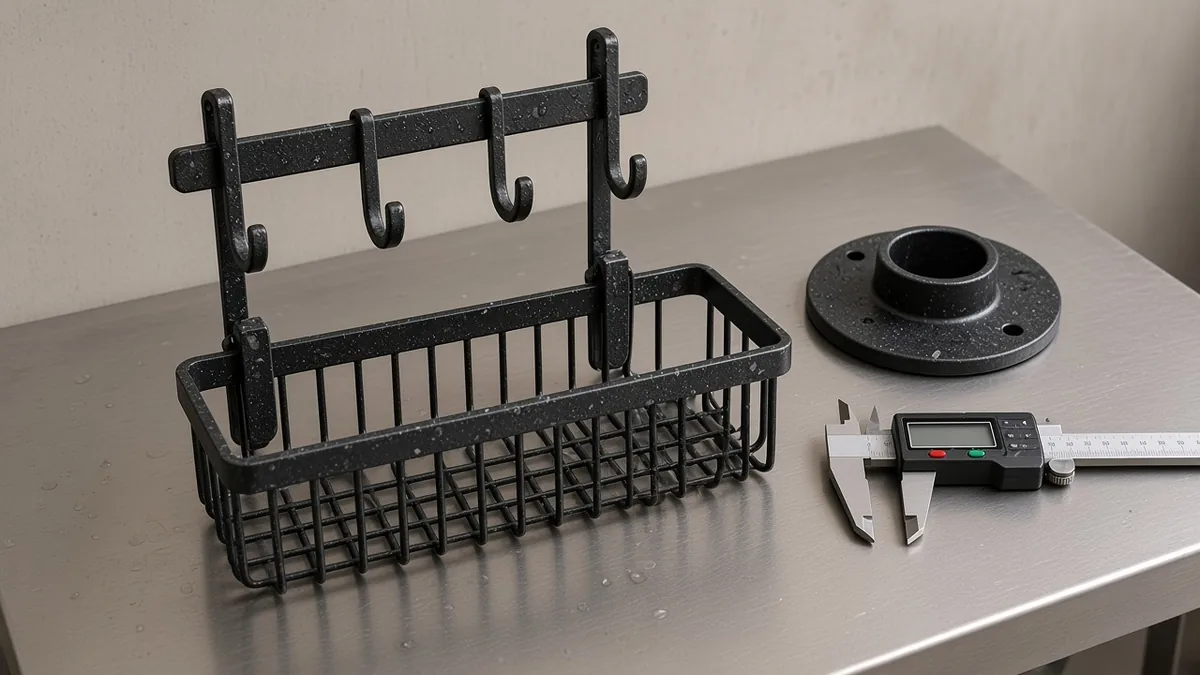
Write a method the factory and the importer can repeat, not a calendar of invented cabinet hours. The method should name the parts (for example, a hook arm, a flange, and a short length of bar or post in the installed attitude), the finish revision, the water or the exclusion, how droplets or a film are applied or allowed to dry, the wait, the cleaning step, and how the result is compared with a retained visual standard.
Include geometry that actually holds water. A vertical towel-bar mid-span is easy to photograph and often sheds droplets. Flanges, set-screw recesses, hook saddles, and the underside of a horizontal arm are where rings form. If those sites are missing from the specimen, the observation does not support a claim about the installed product.
Split measurement from sampling. The method says where to look and how to judge film versus sheen change. A later lot plan may say how many pieces in a shipment are observed, using a scheme such as ISO 2859-1 if both sides want a sampling standard. That scheme does not tell you what a mineral mark is, and it does not replace the visual standard.
Do not convert a one-night bathroom trial into a year of service, and do not convert a salt-spray hour into an etch result. If a project later adopts a named laboratory method, record the method and the specimen attitude as project evidence. This article does not invent a Koitor hour figure, a hardness grade, or a universal pass/fail millimeter of film.
Worked example: the brief says “stand a defined droplet map on the flange and the hook arm, allow to dry for the agreed wait, photograph, wipe once with the approved cleaner, photograph again, and compare both states with the retained panel under agreed light.” That is a claim file. “Looks good in our sink” is not.
Worked example: two regions have different municipal water. The listing will be sold in both. Either observe both conditions, or write an exclusion for the condition that was not observed. Silent nationwide artwork is how a “hides spots” line fails in the harder-water region first.
Keep a retained panel from the approved finish lot. Without it, later arguments about “a little duller” cannot be settled. The panel should be stored so it is not itself filmed or scratched, and it should be the same color, texture, and cure revision as the parts being judged.
Cleaner chemistry is already a neighbor file, and it should stay a neighbor file. cleaner compatibility for powder-coated bathroom hardware deals with whether an agreed cleaner attacks the coating. This page only needs to name which cleaner is used to lift a mineral film so film can be distinguished from etch. Do not turn this article into a chemical compatibility matrix, and do not treat a cleaner pass as a hard-water appearance pass.
The two files meet at one sentence: the observation should use only the cleaner already allowed for the finish, or should record a deviation. If a team uses a new descaler to lift spots, that descaler belongs in the cleaner file first. Otherwise you cannot tell whether a remaining dull patch is mineral damage or cleaner damage.
Worked example: a retailer wants to recommend a common bathroom descaler on the pack. The cleaner file has not approved it on this matte black texture. Do not print the descaler here as a “spot solution,” and do not use it as the only wipe in the mineral observation until the cleaner file is updated.
Abrasive cleaning is the usual way the two problems get tangled in returns. A shopper sees a film, scrubs it with a powder, and then reports an “etched” finish. The claim file should say whether abrasives are excluded, and after-sales review should ask what was used before a finish complaint is classified as etch.
Koitor can review both briefs together when a buyer is preparing تصنيع تجهيزات الحمامات حسب الطلب for a matte black wet-zone program, but the questions stay separate: what the coating can tolerate, and what mineral appearance the listing is allowed to say.
What should the importer freeze before artwork is approved?
Freeze a short claim file that a new teammate can use without guessing. This list is specific to mineral appearance on matte black wet-zone accessories; it is not a generic finish laundry list.
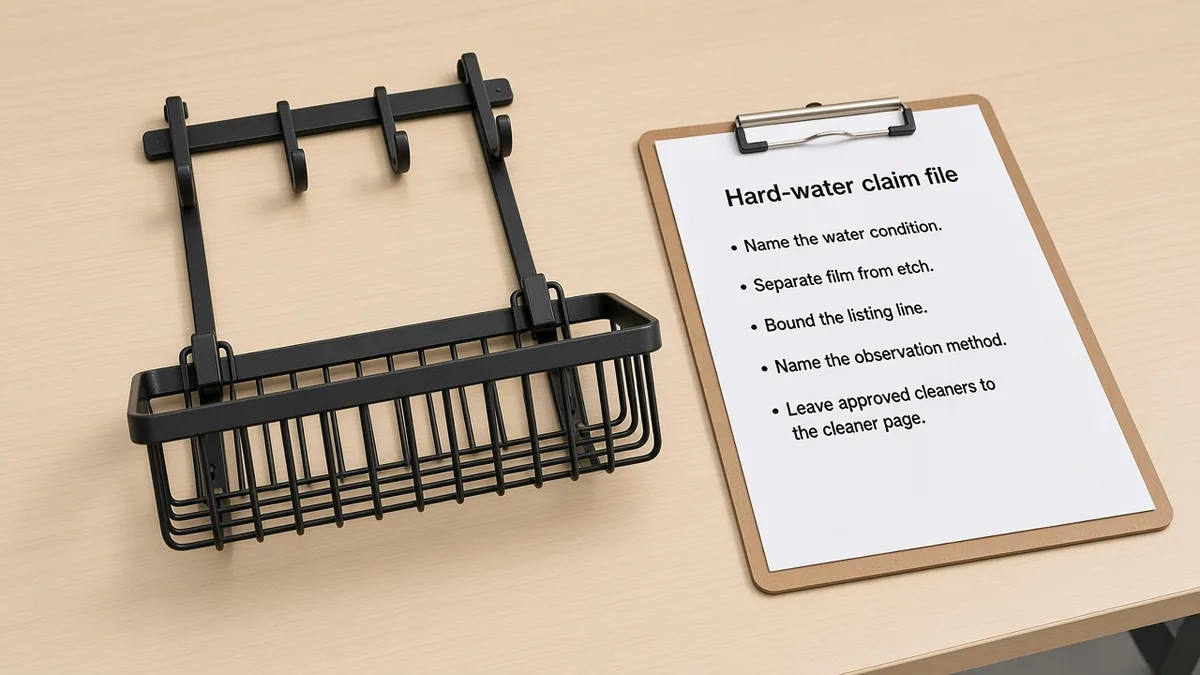
- The exact listing phrase, or an explicit decision to stay silent on spots, film, and etch.
- The finish family, color, texture, and revision that will actually be sold.
- Which parts and attitudes are in the specimen, including flanges and other water-holding geometry.
- The water condition used in the observation, or a regional exclusion.
- The wait, the wipe, and the approved cleaner, with abrasives excluded or recorded as a deviation.
- How removable film, sheen change, and lasting etch are distinguished against a retained panel.
- What care language, if any, will appear on the pack or the listing.
- What will not be printed: hiding spots, unbounded etch resistance, or service-life years.
- How lot observation will be sampled later, written separately from the visual method.
- Whether adhesion, fingerprint, cleaner, and touch-up files exist as neighbors and are not being asked to carry this claim.
If any of those lines is missing, keep matte black bathroom hardware hard water language off artwork. A request that only says “matte black should look good in hard water” is not yet a claim file.
| Claim impulse | What to freeze | What the sample should show | What to keep off artwork until then |
|---|---|---|---|
| Removable film / “wipes clean” | Named water, wait, approved wipe, and a before/after photo rule | Film lifts and the sheen matches the retained panel after the agreed wipe | A line that spots will not be visible before cleaning |
| Sheen change after droplets | Visual standard and lighting for dull patches once film is gone | Any remaining sheen difference is judged against the retained panel, not memory | A statement that the finish is unchanged after hard water |
| Etch language | A definition that is not just “we disliked the mark,” plus the same wipe and standard | A lasting mark remaining after the agreed cleaning, recorded as such | An unbounded “etch-resistant” badge |
| Care-only language | The approved cleaner and the abrasive exclusion | The pack words match the cleaner file | A descaler or powder that was never approved on this texture |
| Regional or geometry exclusions | Which water, which parts, and which attitudes were not observed | The file lists the gaps in plain language | Nationwide artwork based on one bathroom sink |
How can a family-owned OEM review the mineral-spot file?
Koitor Hardware can review a drawing or a physical sample together with the intended listing phrase and the observation outline. The useful conversation is construction and acceptance: which surfaces will hold droplets, how the finish will be retained as a visual standard, and whether the words on the listing are broader than the brief. That is not the same as promising a laboratory result this page does not have.
Small-batch customization is often where this file matters most. A first program may use an existing matte black texture; a later color or sheen change can behave differently with mineral film. If the finish revision changes, the observation should be repeated on the new revision rather than inherited from a previous pack photo.
MOQ can start from about 100 pcs depending on the product. Samples usually take 5–7 working days after details are confirmed. Bulk production usually takes 4–6 weeks depending on the project, finish, quantity, and packaging. Those figures are planning ranges, not a commitment that a mineral-appearance study is included unless the brief asks for it.
When you send the claim file and a sample to Koitor, include the finish callout, the intended sentence or an explicit decision to stay silent, the parts you want observed, and any water condition you already use in a target market. Koitor can then discuss whether the construction and the acceptance brief are clear enough to quote, without treating this article as a test certificate.
الأسئلة الشائعة
Can a matte black bathroom hardware hard water line be based on adhesion photos alone?
No. Adhesion shows whether the coating stayed attached. Mineral film, sheen change, and etch are appearance questions on a wet-zone surface. Use an adhesion file for peel, and use this file for spotting and etching language.
Is a “hides water spots” claim acceptable if the sample looks clean when dry?
Not on that basis alone. A dry, wiped beauty photo does not say what happened after standing droplets, in what water, or whether a film was visible before cleaning. If you want a hiding or resistance line, bound it with a named observation or choose quieter care language.
How is this different from the cleaner-compatibility page?
The cleaner page is about chemistry between an agreed cleaner and the coating. This page is about mineral deposits and whether a listing may talk about spotting or etching. The two meet only in the wipe used to separate film from a lasting mark.
Do we need a salt-spray hour to talk about etching?
Not from this article, and not as an invented Koitor figure. Salt-spray methods are methods, not service-life years, and they are not automatically a mineral-etch protocol for a matte black flange. If a project later adopts a named method, record it as project evidence; do not borrow hours from another SKU.
What if we sell into both soft-water and hard-water regions?
Either observe the conditions you will claim, or write an exclusion for the condition you did not observe. Silent nationwide artwork is how a bounded trial in one bathroom becomes a return in another market.
Can Koitor write the listing sentence for us?
Koitor can review the sentence against the brief and the sample, as a construction and acceptance discussion. The buyer still owns what is printed. If the evidence is not there, the safer path is to narrow or drop the line.
اعمل مع شركة «كويتور» للأدوات
Need a matte-black mineral-spot brief reviewed?
Send Koitor your drawing or sample, the intended listing phrase, and the observation outline you want used. Our team can review finish geometry, a retained-panel approach, and claim wording as a construction and acceptance brief before quotation. MOQ can start from about 100 pcs depending on the product; samples usually take 5–7 working days after details are confirmed; bulk production usually takes 4–6 weeks depending on the project.
OEM / العلامة التجارية الخاصة
حوّل دليل التوريد هذا إلى موجز منتج
يرجى إطلاعنا على المنتج المستهدف، والحجم، والتشطيب، وكمية الطلب، ومتطلبات التغليف. وسيتلقى فريقك تقييمًا عمليًّا لإمكانية التصنيع قبل تقديم عرض الأسعار.

 English
 Español
 Português
 Français
 Deutsch
 العربية