
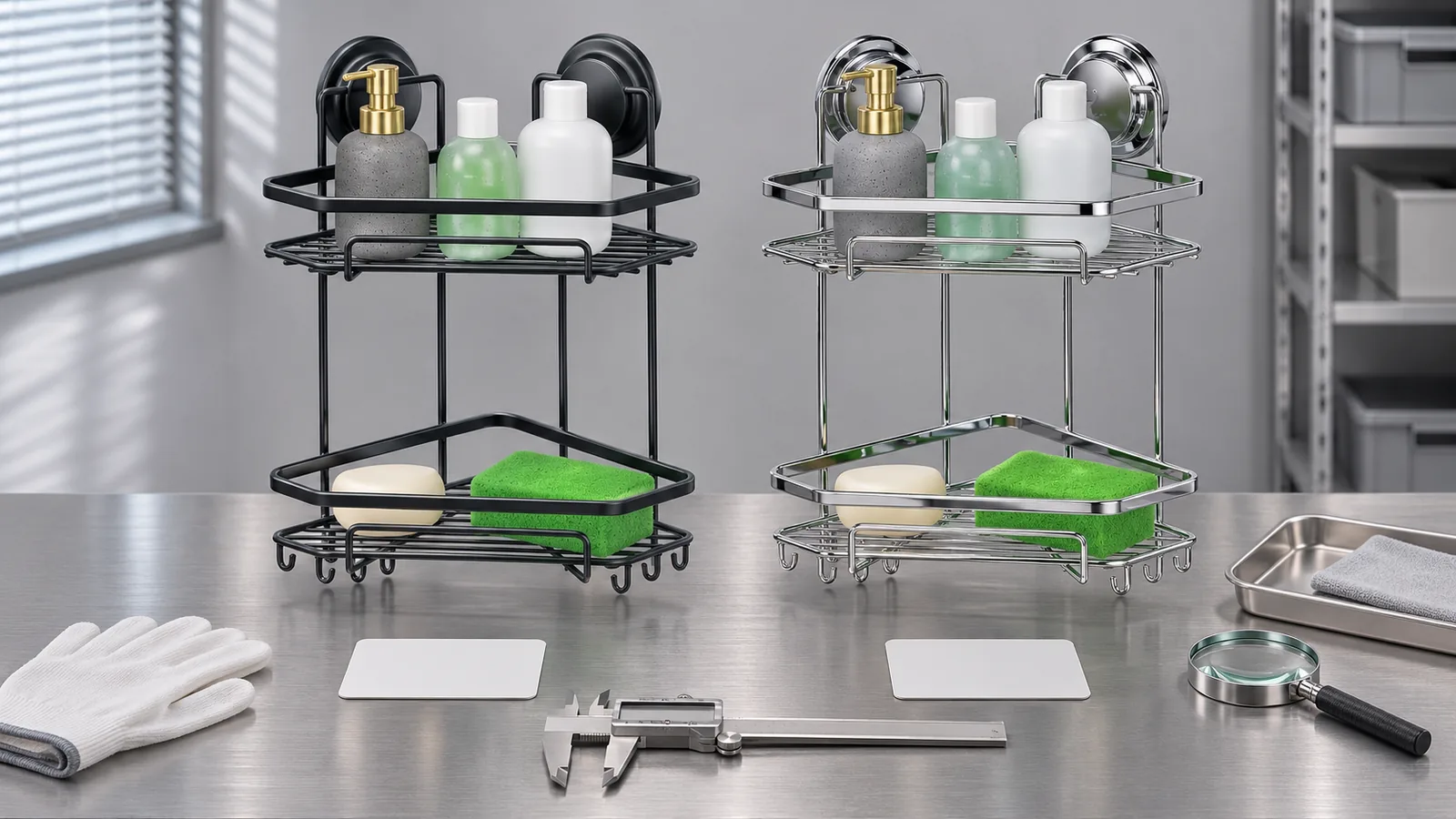
E coat vs electroplating is a comparison between an organic paint film deposited by electrical current and a metallic layer deposited onto a conductive substrate. A buyer should compare them against the same part drawing, substrate, intended use, visible finish, assembly interfaces, and acceptance evidence; neither process is universally better for bathroom hardware. Before requesting prices, define whether the requirement is corrosion protection, a metallic appearance, a primer beneath another finish, dimensional fit, or a combination, then ask qualified finishers to quote the same scope.
What does e coat vs electroplating mean for a buyer?
The phrase e coat vs electroplating can be misleading if it is treated as a choice between two interchangeable coatings. E-coat, also called electrodeposition coating, uses electrical current to deposit paint particles onto a conductive part. The resulting coating is an organic film that is cured. Electroplating deposits a metal layer from an electrolyte onto a conductive surface. The deposited metal may be selected for appearance, function, or as a layer in a larger finish system. These are different material systems, not simply two names for a protective finish.
That distinction changes the buyer brief. If a product specification calls for a metallic surface color such as a defined chrome appearance, a buyer needs to establish whether a plated stack is intended, whether a coating designed to imitate that appearance is acceptable, and how the finished sample will be approved. If the goal is a paint-like protective film on a concealed steel component, e-coat may be worth evaluating with an experienced coater. If the part needs both a protective base and a particular top appearance, a multilayer system could be proposed. The supplier must state what each layer is and what it is intended to do.
The buyer should not compare process names in isolation. A process label omits the substrate, its preparation, the chemistry or coating material, layer sequence, application method, curing or post-treatment, rack or fixture contact, masking, and final inspection. Two quotations that both say “plating” can describe different layer stacks. Two quotations that say “e-coat” can differ in resin type, pretreatment, color, cure, supplier, and intended service. Ask for the full system description and approval sample rather than assuming the label defines the result.
For an importer or private-label product manager, the comparison is therefore a controlled specification and sourcing exercise. Start with the part that will actually be finished: a wire basket, bracket, towel accessory component, or other defined metal item. Identify which surfaces are exposed, which contact other parts, which are seen by the user, and which must remain clear for threads, holes, joints, or assembly. Add the environment and cleaning expectations supplied by the product owner. Only then can the buyer ask whether a particular finish family is a plausible candidate.
A useful short answer is: e-coat deposits a cured organic film; electroplating deposits metal. The buyer should choose by required appearance and function, compatibility with the substrate and geometry, process evidence, supplier scope, and total commercial terms. Appearance alone does not demonstrate corrosion performance, and a process name alone does not establish suitability. A qualified finish supplier should review the actual part and requirements before the buyer approves production.
How do the process routes and coating stacks differ?
A typical e-coat route includes cleaning and pretreatment, immersion in an electrically controlled bath, post-rinsing, and thermal curing. PPG describes this sequence for its own electrocoating service and explains that e-coat uses electrical current to draw paint particles to metal parts. The exact pretreatment, coating formulation, bath conditions, cure schedule, and acceptance plan depend on the material and supplier’s qualified process. The details on one supplier’s page should not be copied into a universal purchase specification.
Electroplating also depends on preparation and process control, but its deposited layer is metallic. A plated product may have one or several layers, each with a specified purpose. Depending on the substrate and product brief, the system may include preparation or activation steps and one or more underlayers before the visible layer. Buyers should not assume the word “chrome” alone identifies the substrate, base layers, thickness, or process. Ask the finishing supplier to identify the layers and explain which one provides the visible appearance and which ones contribute to other functional goals.
The process route affects geometry and handling. E-coat is applied from a bath and can reach many recessed or complex surfaces, but a buyer should ask how the part will be electrically contacted and oriented, where rack marks may appear, whether trapped liquid or air pockets are possible, and whether mating faces need masking. The coating association explains that electrical contact and part configuration matter in bulk electrocoating. This is a reason to review the real component and fixture plan, not proof that every recess or hidden surface will receive an identical film.
Plating likewise needs a geometry review. Current distribution, part orientation, racking, recesses, edges, and contact points can affect the result. The buyer should ask the vendor which surfaces are controlled, which are cosmetic, where contact marks may be acceptable, and how the design is fixtured. A deep cavity, tight joint, small opening, or assembled component can create different process constraints from a simple flat coupon. A brochure image of a similar product cannot establish coverage on the buyer’s configuration.
Layer build matters to fit. Any coating or plated stack can affect dimensions at mating surfaces. A rod that slides into a bracket, a screw thread, a telescoping member, a snap interface, a mounting plate, or an assembly clearance may need a defined allowance. Ask the supplier and product engineer to identify critical interfaces on the drawing. Do not add a generic thickness allowance without knowing the process stack and where it accumulates. Review a production-intent sample after the specified finish, not only a raw or unfinished prototype.
| سؤال من المشتري | E-coat discussion | Electroplating discussion |
|---|---|---|
| What material is deposited? | Organic paint film, cured on the part | Metallic layer or defined metallic layer stack |
| What appearance is possible? | Depends on coating formulation, color, gloss and topcoat | Depends on selected metal layers, finishing and final surface |
| What should be specified? | Substrate, pretreatment, e-coat type, color, cure scope, masking and evidence | Substrate, layer sequence, finish target, masking and evidence |
| What geometry deserves review? | Recesses, drainability, electrical contact, trapped air or liquid, rack marks | Recesses, edges, current access, contact points and rack marks |
| What does the process name prove? | Only the named process family, not the finished performance | Only the named process family, not the complete layer system |
The table is a comparison framework, not a process guarantee. The finisher should confirm the feasible route for the actual material and part. A sample made on a different substrate, geometry, or finish stack may not predict the production item closely enough for approval.
Which finish should a buyer specify for a bathroom hardware part?
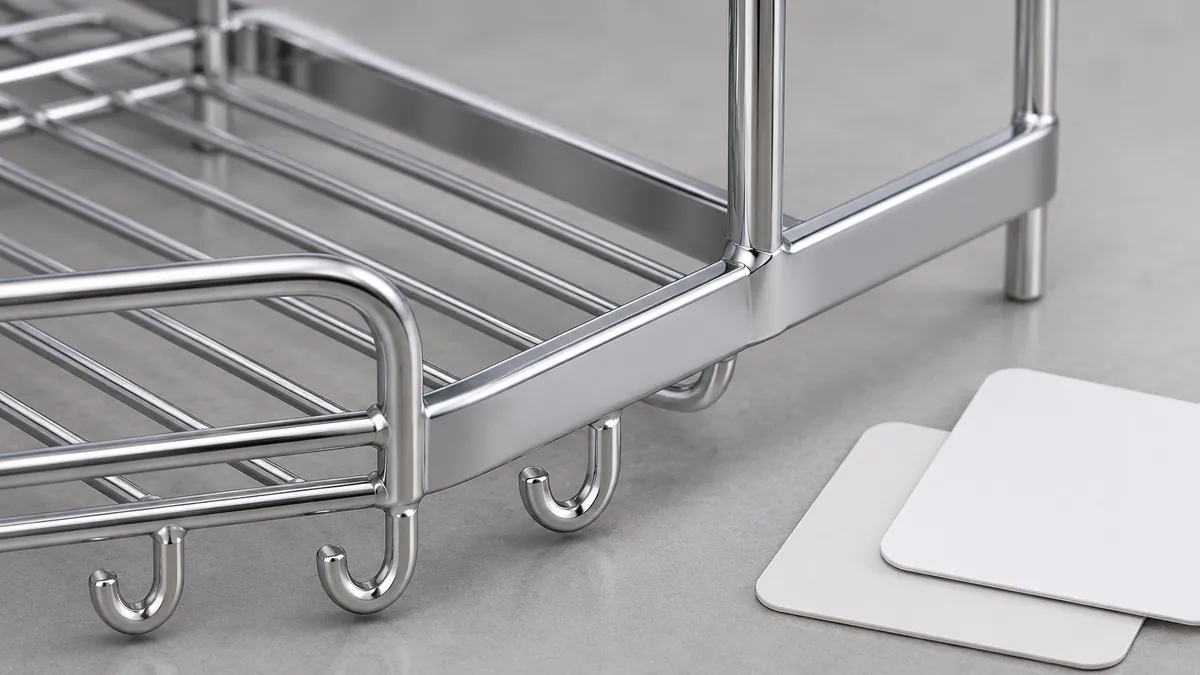
Begin with the desired outcome, not the technology name. Separate appearance from protective function. A buyer may want a metallic look, a consistent color across a product family, a hidden protective coating, a particular cleaning response, or an interface that remains dimensionally usable. Write each requirement separately and state which one is mandatory and which one is negotiable. “Good quality,” “rust proof,” “premium chrome,” and “durable finish” are not measurable specifications by themselves.
For visible surfaces, assemble controlled visual references. Identify the approved color, gloss level or visual character, texture, grain direction where applicable, and viewing conditions for comparison. State whether the standard is a physical master sample, a signed finish plaque, or a documented color target. If the product contains multiple components, review them together under the intended lighting because individually acceptable parts can look inconsistent as an assembled set. Record acceptable variation and the decision owner rather than relying on verbal approval.
For protective performance, define the actual exposure and the proof required by the project. A bathroom environment can include intermittent water, cleaning agents, humidity, salts or other contaminants depending on use and location. The buyer must identify the expected setting and care instructions rather than treating every bathroom as identical. Ask the coating specialist which test, method, specimen, conditioning, evaluation criteria, and failure definition are relevant. A test duration or pass result without the method and scope is not enough to infer product life or suitability for every market.
For geometry and function, mark surfaces that must remain free of coating or remain within a controlled finished envelope. Include threads, grounding or contact points if relevant, sliding fits, mounting surfaces, adhesive locations, drain openings, mating faces, and assembly slots. Confirm whether finish build affects clearances, screw engagement, or assembly force. If a design is being changed from one finish family to another, treat the change as an engineering revision and review the interfaces again. Do not assume that an accepted raw sample validates a differently finished mass-production sample.
Substrate should be stated precisely to the extent the buyer’s drawings and approved material documents support it. “Metal” is not enough for a responsible finish review. A substrate change can affect pretreatment, adhesion, appearance, and process feasibility. The finisher should confirm the preparation route and any restrictions for that material. If a product includes more than one substrate or joined materials, ask whether the same finish can be applied across the assembly and whether differential appearance or process exposure needs consideration.
Finally, assign responsibility. The metal hardware supplier may fabricate the component while a specialist vendor applies a finish. The purchase documents should show who owns finish selection, who approves the sample, who controls the process, who reports test evidence, how finished goods are protected in transit, and who authorizes changes. Koitor’s confirmed role as a custom metal hardware manufacturer does not establish in-house e-coating or electroplating capability. Buyers should discuss the relevant part drawing and required finish with the responsible manufacturing and finishing suppliers; the article does not claim that Koitor runs either process.
How should buyers compare samples and finish evidence?
A meaningful sample comparison uses controlled inputs. Label each sample with supplier, part revision, substrate, finish stack, date or lot reference where available, and any known process deviations. Keep the reference sample protected and identify the surfaces that determine acceptance. Photographing samples can support traceability, but photographs do not replace physical color and surface evaluation because screens and lighting can alter appearance.
First check whether the sample is representative. Is it the same geometry, substrate, fabrication condition, preparation, coating stack, and assembly state intended for production? If a sample was made on a flat coupon or a different material, note what it does and does not demonstrate. An early prototype may answer fit or color questions while omitting production finishing steps. It should not silently become the approval standard for corrosion protection or production appearance if those conditions were not present.
Next inspect the product-specific criteria. For appearance, compare color, gloss, texture, coverage, visible defects, transition at edges, and consistency across parts. For fit, assemble the finished part with its mating components and check the functional interfaces identified on the drawing. For handling, inspect the surfaces most likely to contact protective packaging, separators, screws, or adjacent parts. Record defects with location and disposition rather than writing “finish bad.” A shared vocabulary helps the buyer, fabricator, finisher, and inspector discuss the same issue.
Ask for process and test documents that match the actual order. The document should identify the method, standard or internal procedure if applicable, sample or lot, conditioning, inspected features, results, and acceptance criteria. If a supplier references a recognized method, confirm the current revision and whether it is appropriate to the intended product and market. Do not treat an unrelated automotive, architectural, or industrial data sheet as a direct guarantee for a bathroom accessory. A source document can explain a process, but it does not prove that a particular batch followed that process.
A side-by-side quote and sample review should separate three decisions: process feasibility, commercial feasibility, and product approval. A process may be technically feasible but commercially unsuitable at the buyer’s order volume. A low quote may omit pretreatment, masking, handling, testing, or packaging. A visually acceptable sample may still lack evidence for a specified exposure requirement. Track these separately so that a price decision does not accidentally substitute for technical acceptance.
When a failure occurs, request evidence before assigning cause. A finish problem can involve substrate condition, fabrication residue, cleaning, process control, coating formulation, handling, packaging, or use conditions. The buyer should provide the affected lot, photos, storage and installation context, cleaning history if known, and the exact acceptance requirement. The supplier should investigate within its process scope. Avoid declaring that a particular finish family caused the issue based on appearance alone.
How should an RFQ compare e-coat and electroplating quotes?
Send the same drawing revision and part sample to every supplier being compared. Define the component material and the current manufacturing condition before finishing. If welds, grinding, polishing, or assembly occur before coating, state those steps. If finishing is applied to subcomponents before assembly, show the sequence and interfaces. An RFQ that says “quote black coating” but omits material, appearance target, coverage, and functional surfaces invites suppliers to price different interpretations.
Ask each supplier to return a complete finish proposal with the proposed process family, named coating or plating system, layer sequence where applicable, preparation assumptions, masking plan, rack/contact locations, cure or post-process scope, and excluded operations. If a supplier proposes an alternative, require it to identify differences from the requested system and what evidence would be available for buyer review. This makes the alternative explicit and prevents a silent substitution based only on price.
Separate setup and recurring costs. The buyer may see line setup, minimum batch, racking or fixture costs, special masking, development samples, testing, inspection, packaging, and freight listed in different ways. Ask which costs repeat for each order and which are one-time or conditional. Do not infer an industry-wide cost ranking from one quote. The Electrocoat Association notes that e-coat cost depends on factors such as part design and production rate and that systems involve significant capital; PPG also describes outsourcing as potentially cost-effective for low-to-moderate volumes in its service context. These observations explain why volume, line loading, and supplier structure matter, but they are not a price quotation for a bathroom hardware part.
Compare practical order conditions. Confirm minimum quantity per part, finish, color, or batch; order multiples; mixed-SKU rules; lead-time assumptions; sample lead time; and how a forecast affects a quote. Ask whether a small trial run is possible and what changes if the volume grows. A finish supplier’s line economics may differ from the fabricator’s assembly economics. The buyer should understand both without assuming that any supplier will accept a particular MOQ.
Clarify who bears the cost and responsibility of rejected output. Specify what evidence is required before dispatch, how nonconforming items are segregated, how rework or replacement is authorized, and whether stripping and refinishing are allowed for the part. Not every finish can be removed and reapplied without risk to substrate, geometry, or appearance. Require the responsible specialist to advise on repairability for the actual system. Include packaging responsibility because a sound finish can be scratched or contaminated after inspection if parts rub in transit.
Use a comparison sheet that captures the actual offers rather than a vague total:
| RFQ field | Supplier A | Supplier B | Buyer approval needed |
|---|---|---|---|
| Substrate and drawing revision | Yes | ||
| Finish process and complete stack | Yes | ||
| Visible surfaces and finish master | Yes | ||
| Masking, rack marks and critical fits | Yes | ||
| Test method, scope and acceptance | Yes | ||
| Minimum lot and order multiples | Confirm | ||
| Setup, piece price and excluded costs | Confirm | ||
| Sample, inspection and packaging plan | Yes |
Do not rank suppliers until missing fields are resolved. A quote that does not name the finish stack is not directly comparable with one that does. If the suppliers use different systems, document the trade-off and let the product owner or qualified engineer approve the change. Maintain a clear link from quotation to approved sample and production purchase order.
What are common sourcing mistakes?
The first mistake is treating the finish label as the requirement. “E-coat,” “chrome,” “nickel,” “electroplated,” or “black finish” does not define the complete material stack, appearance, functional purpose, or acceptance evidence. Translate the label into the desired result, then ask the responsible finisher to define its route. If the product has an established specification, do not change it without approval.
The second mistake is claiming one process is always cheaper, more protective, more uniform, or more suitable. Cost depends on geometry, quantity, line setup, material, masking, finish requirements, supplier location, inspection and logistics. Performance depends on the system and evidence. Some e-coat systems are used as primers and some can serve as a single coat in defined applications; the Electrocoat Association explains these distinctions and also describes variation by resin type and exposure. That does not mean an arbitrary e-coat is appropriate for a bathroom product. Electroplating also encompasses multiple metals and layer constructions. The decision must be specific.
Third, buyers sometimes approve a sample without recording its identity. A sample with no supplier, drawing revision, substrate, finish code, or approval date is difficult to use later. A photograph alone can miss tactile appearance, edge coverage, and assembly fit. Keep one controlled reference and record what was approved. If the supplier changes the material or finish source, require notice and assess whether reapproval is needed.
Fourth, an RFQ may omit surfaces and interfaces that matter. A supplier cannot infer which face is most visible, where a contact mark is acceptable, which hole must remain clear, or whether a thread is critical unless the drawing or written brief says so. Mark these features and provide section views when useful. If a complex shape creates a drainage, trapping, or contact concern, raise it during DFM rather than waiting for inspection.
Fifth, buyers can confuse a test result with a guarantee. A test demonstrates results under a defined method, specimen, preparation, and endpoint. It does not necessarily predict service life under different cleaners, installation conditions, use frequency, or maintenance. Ask what the test establishes and what it does not. Do not convert hours in a test chamber into a claimed number of years in a bathroom without validated correlation.
Sixth, a buyer may compare piece prices while overlooking the total landed and quality cost. A cheaper quote can leave out masking, test reports, small-lot handling, protective separators, or reinspection. A higher quote can include services the buyer does not need. Normalize the scope and compare expected ordering conditions. The purpose is not to select the most elaborate coating; it is to purchase the defined outcome with sufficient evidence.
Finally, do not assume that a visually smooth surface proves adhesion, cure, thickness, or corrosion performance. Those need suitable methods and evidence from the responsible specialist. Likewise, an invisible defect is not automatically present because a test report is missing; instead, distinguish what the buyer has verified from what remains unverified and decide whether additional evidence is necessary for the project.
What changes should trigger a new finish review?
Reopen the review when the substrate, part geometry, fabrication sequence, finish supplier, process stack, color, cure condition, masking plan, or assembly interface changes. A change that appears small in a drawing can affect how a part is held, cleaned, coated, cured, or assembled. The buyer should ask the engineering and finishing teams which requirements remain valid and which need confirmation.
A change in material is especially important. A process that is qualified for one metal cannot be assumed to transfer unchanged to another. A change from a solid rod to a hollow tube, a different alloy, a different casting, or a new surface condition may change cleaning and pretreatment needs. Keep the released material callout aligned across drawing, purchase order, supplier quotation, and inspection plan.
A change in geometry may also alter access and coverage. Adding a recess, closing a gap, moving a weld, changing a bend, or introducing a longer concealed surface can affect drainage, electrical contact, fixturing, masking, and visual inspection. Ask the finisher to review revised drawings before production rather than relying on the old approved sample. If the finish build affects dimensions, recheck the mating parts and assembly sequence.
A supplier change should prompt a comparison of actual capabilities and process controls, not just a new name on the purchase order. Ask whether the proposed source uses the approved system, whether existing samples can be matched, what documents can be supplied, and how nonconformities are reported. A source change may require a new sample approval depending on project risk and customer requirements. Record the decision and any limitation.
After approval, link the accepted sample, specification, quote, and inspection method to the order revision. A short change record should identify who requested the change, why it was proposed, who reviewed technical effects, what samples or tests were performed, and who authorized release. This is useful for importers managing private-label assortments and repeat orders, where the finish must remain consistent even as product sizes or quantities change.

Buyer checklist before requesting a quotation
Use the following checklist to make an e-coat vs electroplating request concrete. Tailor it to the actual product and ask the responsible technical supplier to confirm process feasibility.
- Identify the part number, drawing revision, substrate, fabrication condition, and planned assembly stage.
- State the product environment, market, cleaning expectations, and intended service conditions supplied by the product owner.
- Describe the required appearance with a controlled sample, finish reference, color, gloss, texture, and viewing method where relevant.
- Identify visible surfaces, concealed surfaces, contact points, edges, recesses, threads, holes, and mating fits.
- State whether the request is for e-coat, electroplating, a proposed complete stack, or an evaluated alternative; do not use one term to imply an entire system.
- Ask the supplier to identify pretreatment, coating or metal layers, curing or post-treatment, masking and rack/contact locations.
- Define what evidence is needed: sample, inspection record, method-specific test, report, or buyer review.
- Ask how the supplier will control dimensional fit, coverage, appearance variation, and handling protection.
- Request setup charges, per-piece price basis, minimum batch, order increments, sample cost, lead-time assumptions, exclusions, packaging and freight scope.
- Record who approves samples, who authorizes changes, and which document controls the production order.
- Confirm whether the finish can be repaired, stripped, or reworked and what risks apply to the specific part.
- Keep technical approval separate from commercial approval; price acceptance does not replace finish validation.
These items help the buyer compare like with like. Where the buyer lacks a test criterion or finish definition, ask a qualified product engineer or coating specialist to propose options and explain limitations. Do not copy another supplier’s numerical parameters into the specification without confirming their relevance.
الأسئلة الشائعة
Is e-coat the same as electroplating?
No. E-coat deposits an organic paint film using electrical current and then cures it. Electroplating deposits a metallic layer onto a conductive substrate. Both require surface preparation and controlled processing, but they create different material systems and may serve different appearance or functional purposes.
Is e-coat always cheaper than electroplating?
No universal cost comparison is supportable without a defined part and quote scope. Volume, geometry, preparation, finish stack, masking, line loading, setup, inspection, packaging, and freight can all affect the commercial result. Request comparable quotations for the same drawing and acceptance requirements.
Does e-coat always protect every recess?
Do not assume complete and identical coverage from the process name alone. E-coat can reach many recessed geometries, but access, electrical contact, orientation, trapped air or liquid, and part design remain relevant. Have the finisher review the actual geometry and identify any limitations.
Does a plated finish always look more metallic?
A metallic layer can provide a metallic surface, but the actual appearance depends on the materials and finishing sequence. A coating may also be formulated to provide a particular appearance. Approve the actual sample and state the intended visual target instead of relying only on a process label.
Can the buyer use a supplier’s automotive e-coat data sheet for a bathroom accessory?
It can provide background about a process or product family, but does not automatically establish suitability for a different part, exposure, substrate, or market. Ask the finisher to confirm applicability and provide evidence tied to the actual specification.
Does passing a corrosion test establish the product’s service life?
No. A test result applies to its defined specimen, method, conditioning, and evaluation criteria. It should not be translated into a universal lifespan without validated evidence and a relevant use correlation.
Should a buyer choose the finish before the design is finalized?
A preliminary finish direction can inform design, but the final requirement should be confirmed against the released geometry, substrate, interfaces, and supplier process. Review the finish and mating clearances on a production-intent sample.
Does Koitor offer in-house e-coating or electroplating?
The current approved capability information does not confirm that Koitor operates either process in-house. The buyer should confirm the responsible finish supplier and scope for a specific project. Koitor can discuss metal hardware drawings, samples, and sourcing requirements within verified capabilities.
Technical references
- PPG: Electrocoating process overview — process description and supplier-specific examples.
- PPG: E-coat process specifics — process stages and technology distinctions in PPG’s service context.
- The Electrocoat Association: FAQ — cost factors, process considerations, and e-coat/powder-coat comparison.
For related factory sourcing context, see Koitor Hardware’s OEM manufacturing information. For a project-specific review, اتصل بـ «كويتور».
Discuss Your Finish and Hardware Specification
Share the controlled drawing, substrate, intended use, visible finish target, mating interfaces, and evidence requirements so the appropriate hardware and finishing suppliers can review the project scope.
OEM / العلامة التجارية الخاصة
حوّل دليل التوريد هذا إلى موجز منتج
يرجى إطلاعنا على المنتج المستهدف، والحجم، والتشطيب، وكمية الطلب، ومتطلبات التغليف. وسيتلقى فريقك تقييمًا عمليًّا لإمكانية التصنيع قبل تقديم عرض الأسعار.


 English
 Español
 Português
 Français
 Deutsch
 العربية