
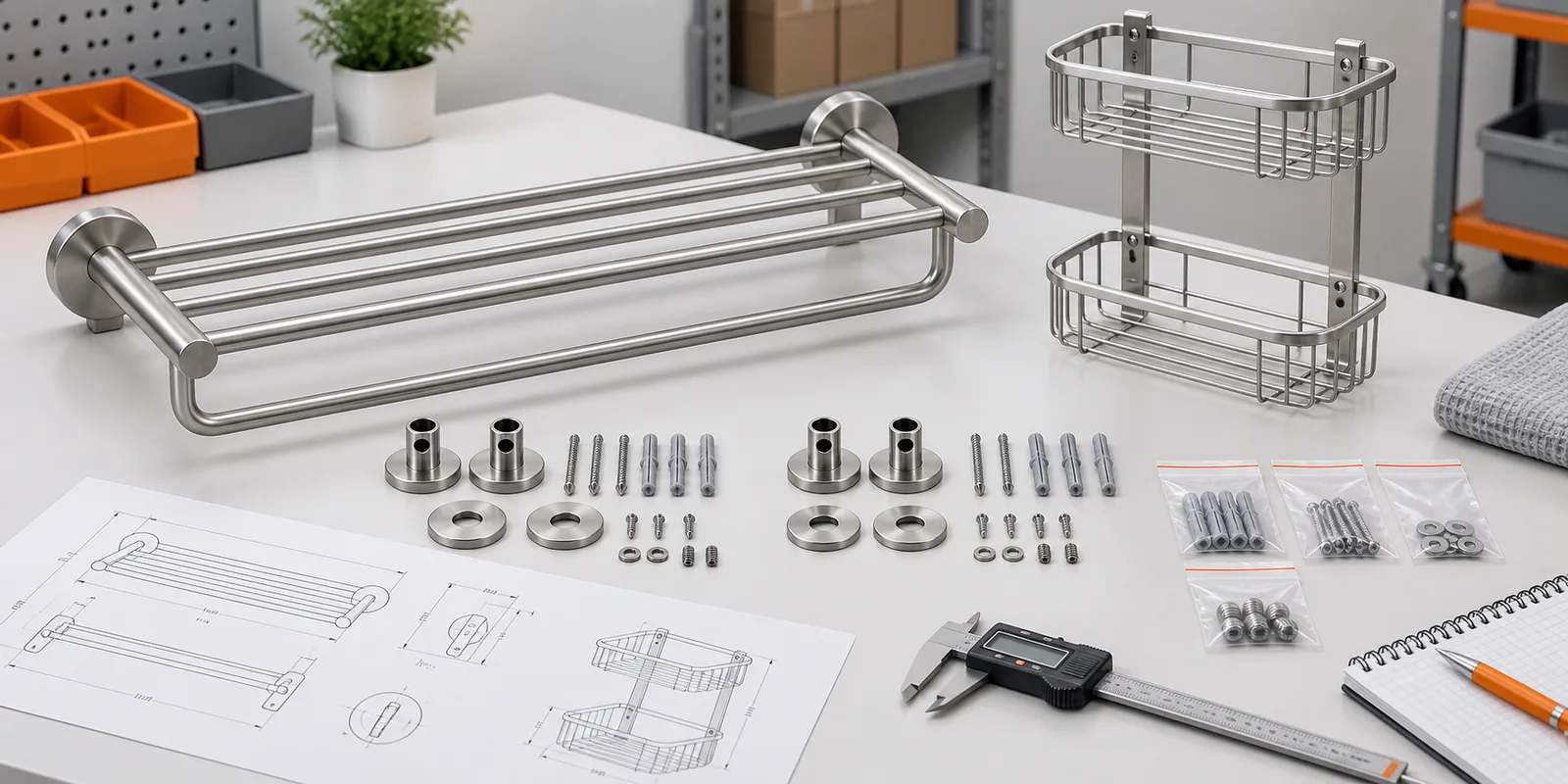
Bathroom hardware replacement parts planning should begin before the main purchase order, not after customers report missing screws or damaged covers. A workable plan identifies which components can be replaced, gives each service part a stable code, confirms compatibility with the approved product revision, defines protective packaging, and sets an initial quantity based on installation loss, service risk, reorder lead time, and sales volume.
What Counts as a Replacement Part for Bathroom Hardware?
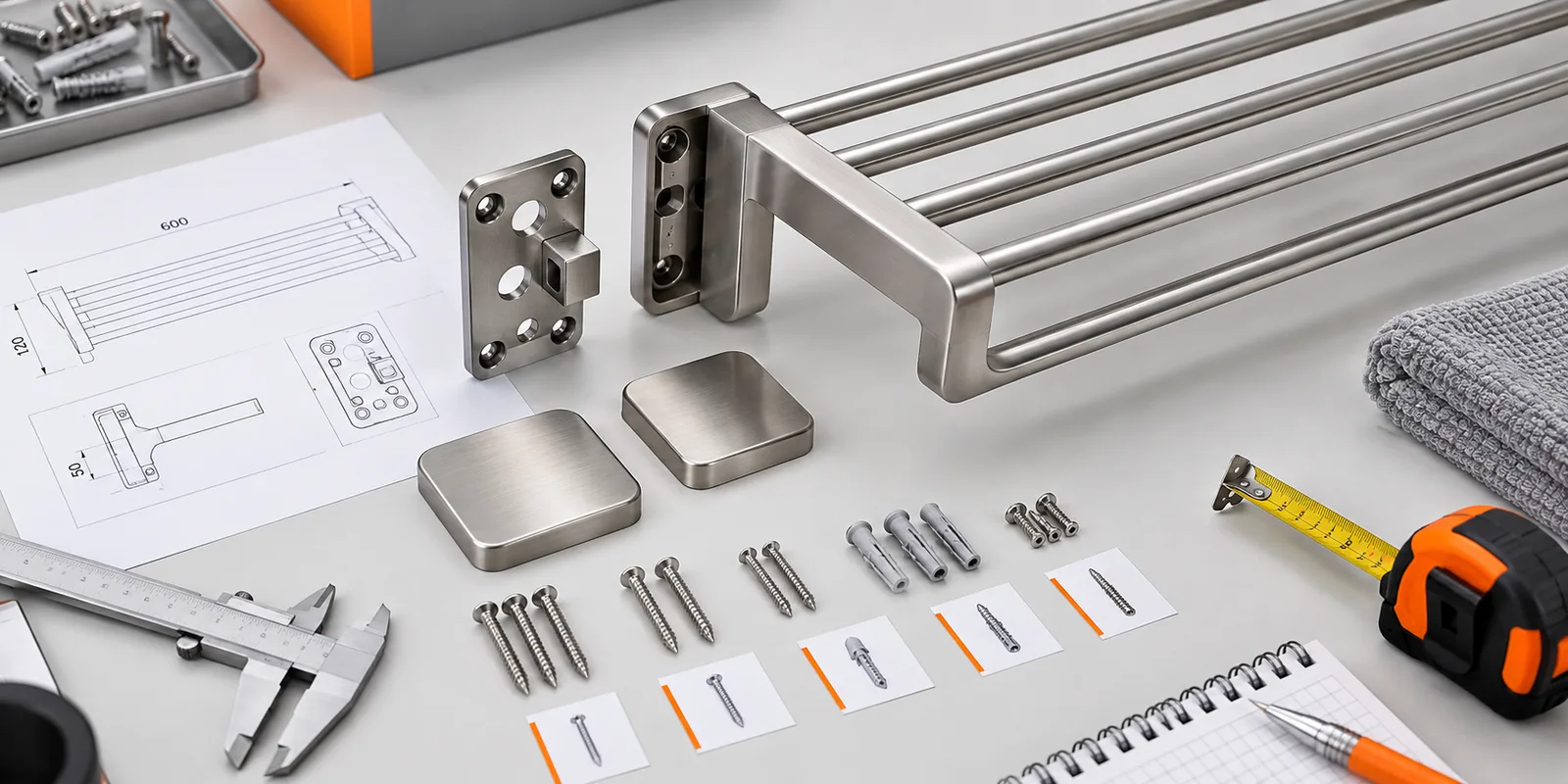
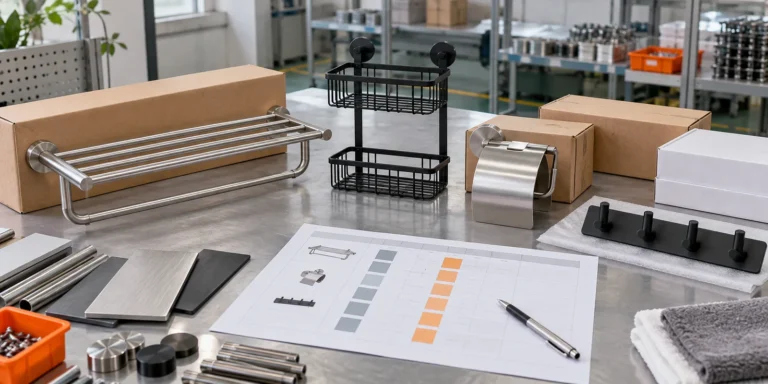
A bathroom hardware replacement part is any separately supplied component used to install, repair, refresh, or return a finished accessory to service. The category includes more than spare screws for bathroom accessories; it may also include brackets, cover plates, end caps, hooks, feet, pads, connectors, removable baskets, and complete replacement units.
Divide parts into four practical groups:
- Installation parts: screws, wall plugs, washers, mounting plates, set screws, and assembly tools supplied with the product.
- Service parts: removable components that may be lost, worn, damaged, or incorrectly fitted after sale.
- Appearance parts: caps, covers, trims, and other visible pieces that must match the finish and geometry of the original item.
- Complete-unit spares: finished towel racks, shower caddies, baskets, tissue holders, or other products retained for cases where component-level repair is impractical.
This classification helps a buyer decide what should be packed inside every retail unit, what belongs in a service inventory, and what should be reordered as a complete product. It also prevents a common mistake: treating every small metal component as interchangeable because it has a similar shape.
Replacement mounting hardware must match the product interface. Thread diameter, thread pitch, screw length, head shape, bracket thickness, hole position, and tightening access can all affect compatibility. Wall anchors also depend on the installation substrate. A factory-supplied plug may be one option for a stated wall assumption, but local installers should select anchors suitable for the actual wall and applicable project requirements.
Buyers developing a product family can ask a شركة متخصصة في تصنيع تجهيزات الحمامات حسب الطلب to review whether brackets, screws, caps, or other components can be standardized. Standardization can simplify service inventory, but it should not compromise structure, installation clearance, or product appearance.
Why Should Parts Planning Start During Product Development?
Parts planning should start during product development because design decisions determine whether repair is simple, confusing, or impossible. Once tooling, welding, finishing, assembly, and packaging are fixed, changing a hidden bracket or visible cover may create compatibility problems across existing stock.
During drawing review, identify every separable component and ask three questions: Can it be replaced without damaging the installed product? Does replacement require a special tool or instruction? Will future production remain compatible with earlier units? The answers influence product coding and service promises.
For example, a concealed wall plate may look like a generic stamped part. However, a small change in slot length, tab angle, plate thickness, or set-screw position can stop an older rail from fitting. A visible cap may fit mechanically but differ in color because it was produced in another finish batch. A replacement basket may share the same outside dimensions but use different connection points after a design revision.
Create a component bill of materials that links each finished SKU to its approved parts. The bill does not need to expose factory-confidential costing. For buyer control, it should show the finished product code, component code, description, quantity per unit, finish where relevant, drawing revision, and replacement status.
Private-label programs also need clear ownership of service information. The packaging team, customer-service team, warehouse, and factory should use the same terms. Koitor Hardware’s إكسسوارات الحمام ذات العلامة التجارية الخاصة page explains the broader product-development context in which product details and packaging are reviewed together.
Early planning does not mean stocking every component forever. It means deciding intentionally which parts are serviceable, which can be standardized, which require batch matching, and which should be handled through complete-unit replacement.
Effective bathroom hardware replacement parts planning therefore becomes part of product architecture and service design, rather than a separate warehouse task added after launch.
How Should Buyers Classify Spare-Part Risk?
Buyers should classify spare-part risk by failure impact, likelihood of loss or damage, compatibility sensitivity, and replenishment difficulty. The highest-priority part is not always the most expensive; a low-cost set screw can make an otherwise complete towel rail impossible to install.
| Part type | Typical issue | Compatibility concern | Practical stock approach |
|---|---|---|---|
| Screws and washers | Lost during unpacking or installation | Diameter, length, head, and finish | Pack a complete kit per unit plus service kits |
| Wall plugs | Wrong substrate or installer preference | Wall material and hole size | State the assumption; allow local selection |
| Concealed brackets | Bent, misplaced, or revised | Hole pattern, tabs, plate thickness | Code by product revision and verify fit |
| Set screws | Very small and easily lost | Thread and point style | Use sealed labeled mini-bags |
| Decorative covers | Scratched or dented | Shape, retention method, finish batch | Protect individually and retain finish reference |
| Plastic or rubber pads | Lost or aged in storage | Dimensions and material behavior | Store cleanly with code and date control |
| Removable basket or tray | Damaged in use or transport | Connection geometry and product revision | Confirm interchangeability before listing as a spare |
| Complete product | Structural or finish damage | SKU, dimensions, and finish | Hold limited stock for rapid service cases |
Use a simple criticality rating. “A” parts stop installation or normal use. “B” parts affect appearance or convenience. “C” parts are rarely requested or can be sourced locally without changing product function. Review the rating with service and installation data after launch.
Estimate initial stock from expected sales, number of parts per unit, handling risk, product complexity, project type, and replenishment lead time. Do not apply one percentage to every part. Small fasteners may justify a higher unit count because they take little space and are easily lost. Finish-matched visible parts may justify careful batch retention even when the expected request rate is low.
Avoid unsupported service promises. A buyer should not claim indefinite parts availability unless its inventory and supplier agreements genuinely support it. Use a defined review period, keep revision records, and communicate when a newer part is not backward compatible.
How Do Product Codes and Revisions Prevent Mismatches?
Product codes and revision records prevent mismatches by connecting each service request to a known product configuration. A customer description such as “the silver bracket for our bathroom rack” is not enough to select an OEM hardware spare part reliably.
Give the finished product a stable SKU and each controlled replacement component a separate part number. Add a revision identifier when form, fit, function, mounting, or appearance changes. The part label, service database, purchase order, and factory drawing should use the same identifier.
A practical record contains:
- Finished SKU and sales description.
- Component code and plain-English part name.
- Applicable product revisions or production dates.
- Dimensions, thread details, or drawing reference.
- Finish code when appearance matters.
- Quantity used per finished unit.
- Packaging quantity for service supply.
- Notes on backward compatibility.
Photographs can support identification, but they should not replace dimensions or revision data. Place a scale reference beside the part and photograph connection features, not only the visible face. For threaded items, record the specification instead of asking staff to judge it from an image.
Change control is equally important. When a factory improves a bracket or substitutes a fastener, the buyer should decide whether the change is fully interchangeable. If yes, update the approved record. If no, create a new revision or part code and prevent mixed fulfillment.
Maintain a retained sample or verified fit set where practical. A replacement bracket can be trial-fitted to the mating component before a new batch ships. For appearance parts, compare color and gloss against the approved reference while recognizing that production-batch differences may remain.
Common mistakes include reusing one generic code for several screw lengths, renaming parts in the customer-service system, deleting old drawings after a revision, packing loose metal parts against finished surfaces, and accepting an “equivalent” component without a fit check.
What Packaging and Inventory Controls Are Needed?
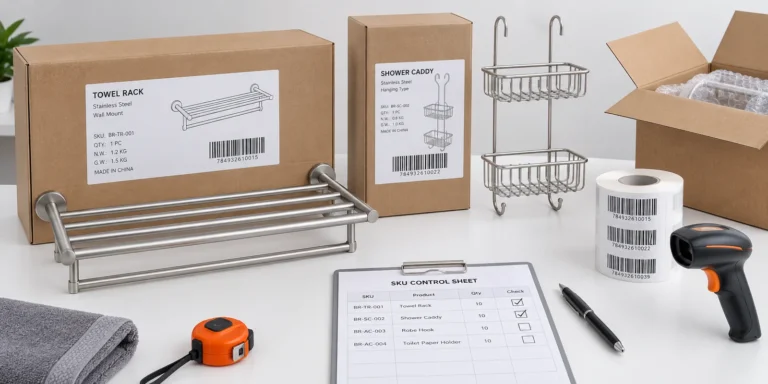
Replacement parts need packaging that protects small quantities, preserves identity, and supports accurate picking. A correct part sent without a readable label can still become an expensive service failure.
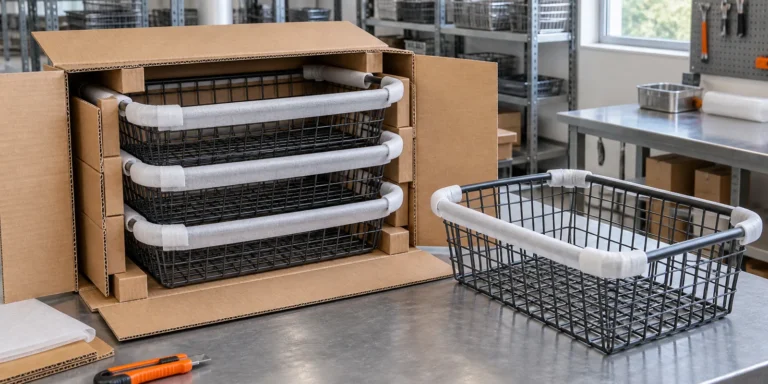
Use sealed bags or small boxes sized to the part. Keep sharp threads and metal edges away from finish-sensitive covers. Include a label with part code, description, quantity, applicable SKU or revision, and finish code when relevant. A simple line drawing can help installers distinguish similar components without inventing technical claims.
Service kits can be more practical than individual loose parts. An installation kit might contain the exact screws, washers, set screws, and tool required for one unit. A bracket kit might include both brackets and their matching covers. Define kit contents and control them as a bill of materials so one missing item cannot pass unnoticed.
At receiving, count sealed packs rather than opening every tiny bag when the supplier’s pack quantity and inspection method are agreed. Sample-check contents, labeling, dimensions, and fit. Store finish-matched components away from moisture, dust, abrasion, and mixed bins.
For inventory planning:
- Set a starting quantity by part criticality and sales forecast.
- Record which finished units consume each part.
- Track service issues by reason, not just quantity shipped.
- Establish a reorder point that includes production and transport time.
- Review slow-moving parts after product revisions or discontinuation.
- Preserve old-revision stock only where service demand justifies it.
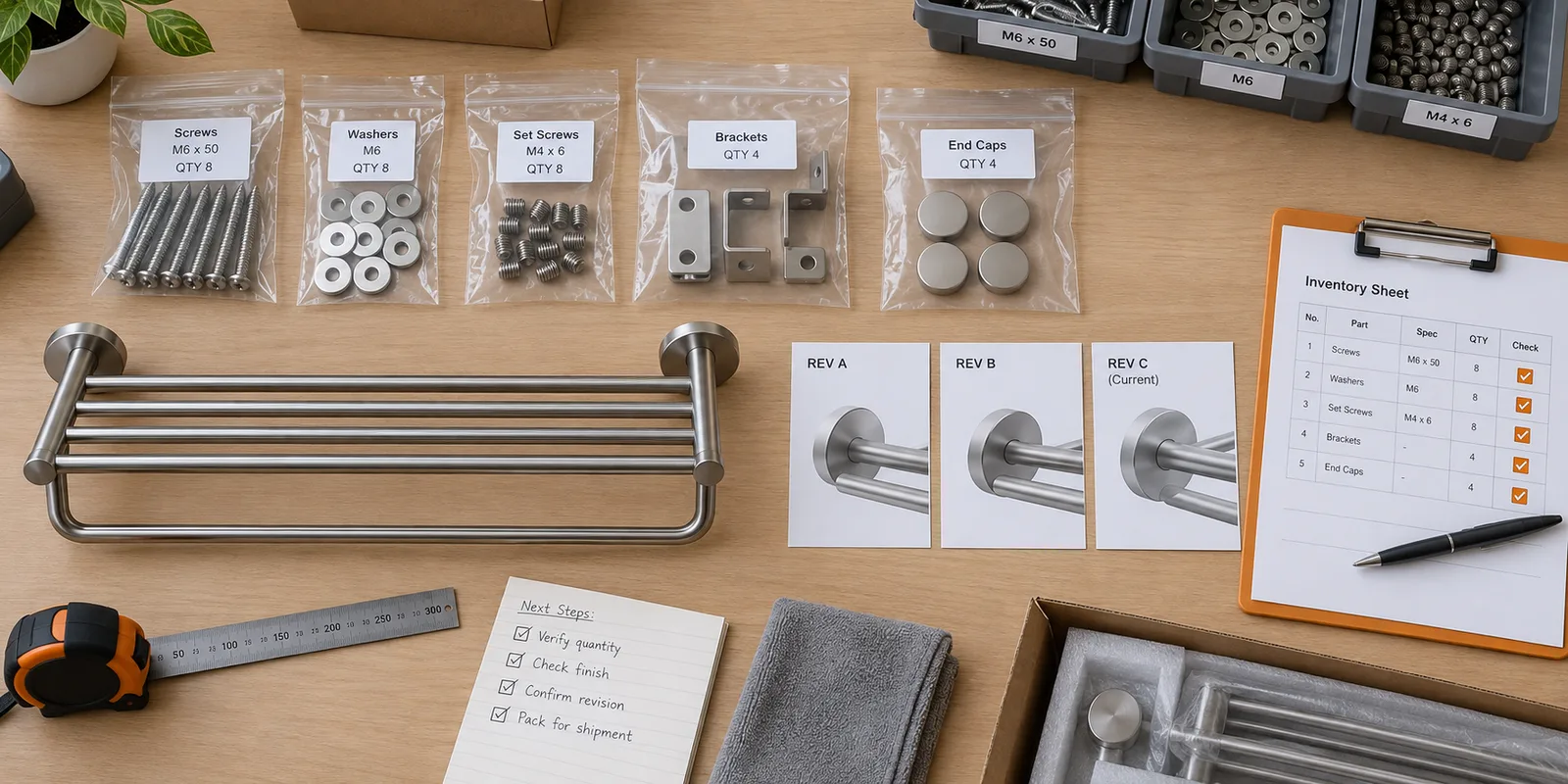
Inventory data should improve the product. Repeated requests for missing set screws may indicate that the retail pack needs better retention. Frequent bracket damage may show a packaging or installation-instruction problem. A high number of wrong-part shipments may signal weak coding rather than a manufacturing defect.
What Should Be on the Replacement Parts Buyer Checklist?
The replacement parts buyer checklist should confirm identification, fit, finish, quantity, packaging, and long-term record control before the main order is released.
- ☐ Every finished SKU has a current approved drawing revision.
- ☐ All separable installation and service components are listed.
- ☐ Critical small parts have unique, stable part codes.
- ☐ Thread, length, head, material, and finish details are recorded.
- ☐ Wall-anchor assumptions are separated from product-side hardware.
- ☐ Backward compatibility has been checked after every revision.
- ☐ Appearance parts have an approved finish reference.
- ☐ Replacement parts can be fitted without unintended damage.
- ☐ Service kits have controlled content and pack quantities.
- ☐ Labels show code, quantity, applicable SKU, and revision.
- ☐ Metal parts cannot scratch finished components in storage or transit.
- ☐ Initial stock is based on risk, forecast, and replenishment time.
- ☐ Reorder points and responsible owners are assigned.
- ☐ Service requests record the actual reason for replacement.
- ☐ Obsolete and current revisions are physically separated.
Review the list at sample approval and again before shipment. For additional planning topics, visit Koitor Hardware’s OEM bathroom hardware resources. The best service-parts system is understandable to the buyer, factory, warehouse, installer, and customer-service team.
Frequently Asked Questions About Bathroom Hardware Replacement Parts Planning
Which spare parts should be included in every retail package?
Include every component required for the product-side assembly and the intended installation method, subject to the stated wall assumption. Count small parts carefully and keep them in a sealed, labeled kit. Do not add unrelated “universal” hardware that could confuse installers.
Are wall plugs universal for bathroom accessories?
No. Anchor suitability depends on concrete, masonry, hollow wall, board, tile, and other substrate conditions. The product supplier can state what is provided, while the installer or project engineer should confirm the appropriate site anchor.
Can one mounting bracket be shared across several products?
It can be shared only when the load path, dimensions, hole pattern, cover method, tightening access, and installation requirements are compatible. Verify the assembly rather than judging from appearance.
How should visible replacement parts be color matched?
Keep the approved finish reference and, where practical, retain some visible parts from the original production batch. When producing later, compare substrate, color, gloss, texture, and geometry, and agree on realistic acceptance criteria.
What information should customer service request?
Request the finished SKU, purchase or production reference, product revision if shown, part location, clear photos, relevant measurements, finish, quantity, and reason for replacement. This information reduces wrong-part shipments.
Should buyers stock complete units as well as components?
Usually yes for selected SKUs. Component repair may not be economical for structural damage, welded parts, or severe finish damage. The correct balance depends on product value, volume, service expectations, and replenishment time.
اعمل مع شركة «كويتور» للأدوات
Need a Clear Spare-Parts Plan for Your Bathroom Hardware?
Send Koitor your product drawing, sample, mounting kit, finish requirement, packaging idea and expected quantity. Our team can review practical component coding, replacement compatibility and small-batch OEM options before quotation.
OEM / العلامة التجارية الخاصة
حوّل دليل التوريد هذا إلى موجز منتج
يرجى إطلاعنا على المنتج المستهدف، والحجم، والتشطيب، وكمية الطلب، ومتطلبات التغليف. وسيتلقى فريقك تقييمًا عمليًّا لإمكانية التصنيع قبل تقديم عرض الأسعار.
 English
  Español
  Português
  Français
  Deutsch
  العربية