
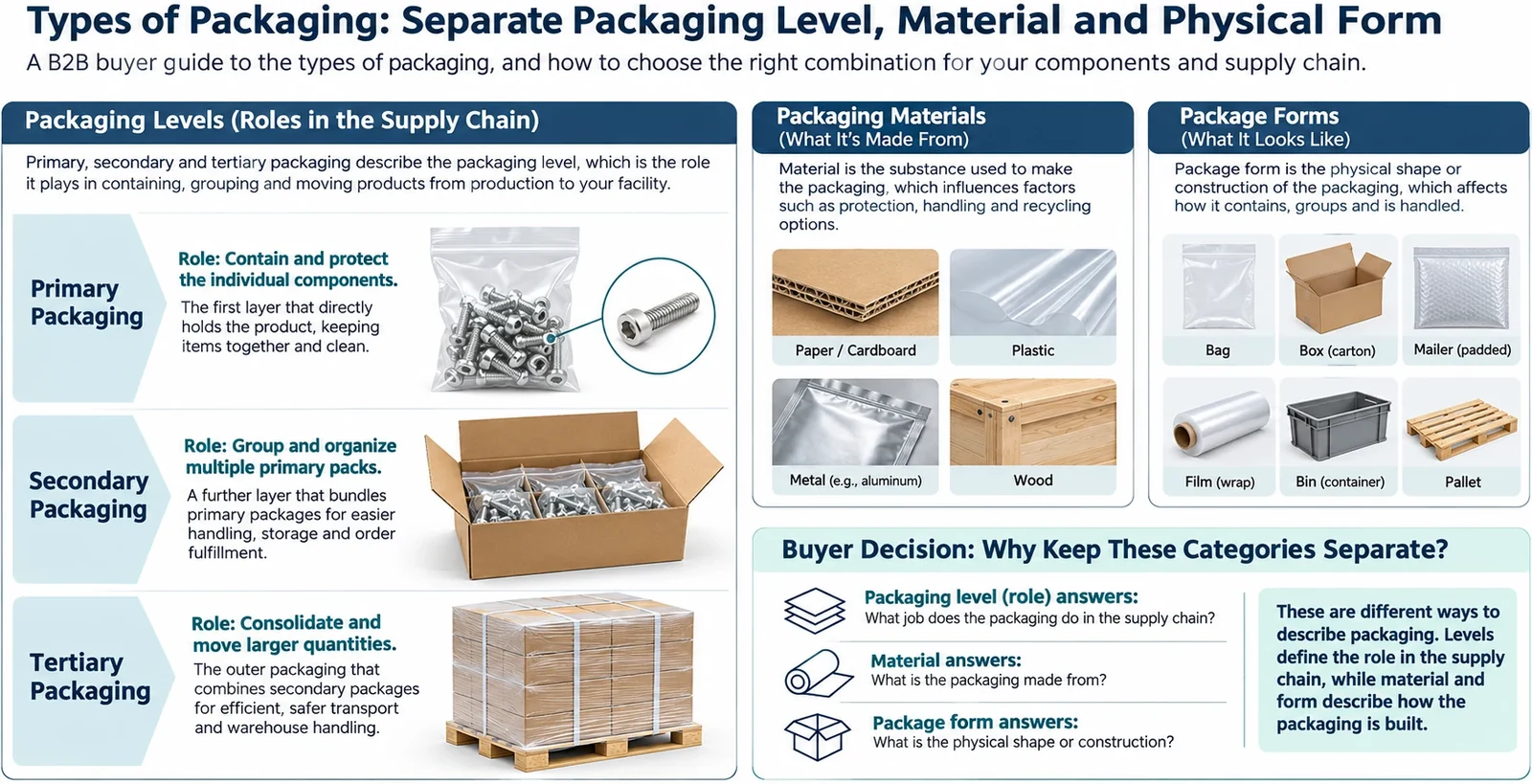
Types of packaging are easier to specify when a buyer separates three different questions: what role a package plays in a distribution chain, what material it is made from, and what physical form it takes. “Primary,” “secondary,” and “tertiary” commonly describe packaging roles or levels. Paperboard, plastic, metal, and wood describe materials. A bag, tray, carton, wrap, crate, or pallet describes a form. These labels can overlap in a real pack-out, but they are not interchangeable. A carton is not automatically secondary just because it is a box, and the name of a material does not identify where a package sits in a shipment.
For an importer buying metal bathroom or home-storage hardware, this distinction makes an RFQ, sample review, and shipping handoff clearer. State the product unit, the components grouped together, and the transport unit; then describe each item’s material and form. A packaging name alone does not prove protection, load suitability, direct product contact, labeling obligations, or regulatory classification. Those questions require the actual configuration and the responsible specification or jurisdiction.
What does “type of packaging” mean in a buyer conversation?
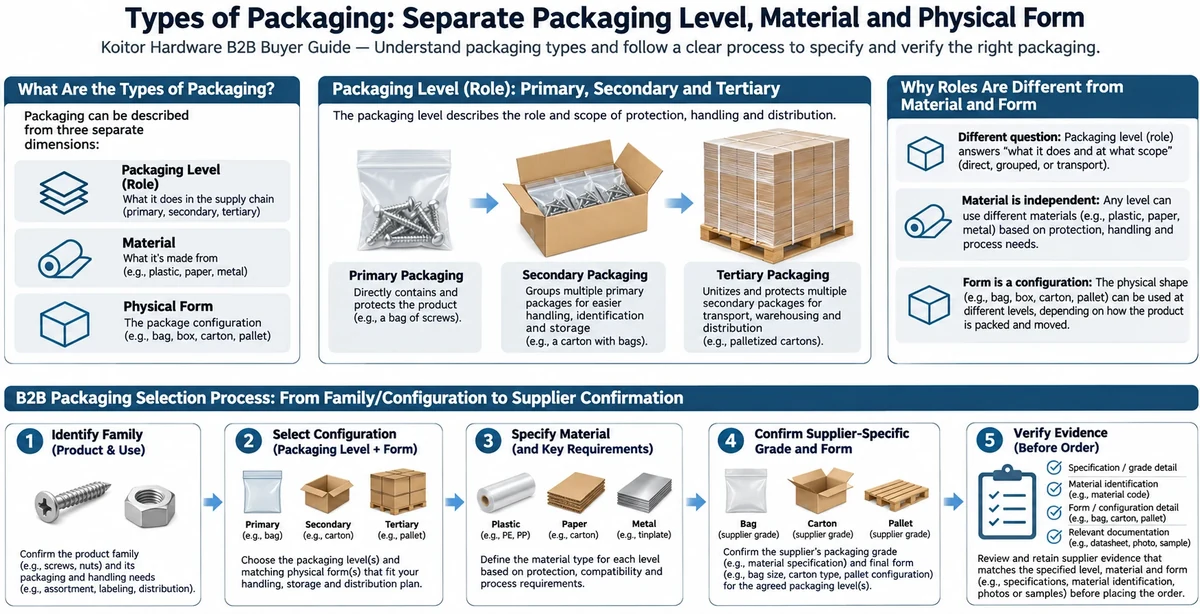
The word “type” is ambiguous unless the speaker names the attribute being classified. A buyer might be asking about packaging level, material family, physical format, closure, protective insert, or the way a load is consolidated. A supplier replying “carton” answers only one possible part of that question. It identifies a form, but it does not say whether the carton contains one retail unit, groups multiple inner packs, or serves as the shipping case for a consolidated order.
Three descriptive axes help make the conversation specific:
| Axis | What it describes | Examples | What it does not establish by itself |
|---|---|---|---|
| Packaging level or role | How an item functions in the pack-out | Primary, secondary, tertiary | A legal definition, protective rating, or required layer count |
| Material | The substance or material family used | Paperboard, plastic, metal, wood, mixed materials | The package’s role or whether it is suitable for a particular product |
| Physical form | The shape or construction supplied | Bag, tray, carton, wrap, crate, pallet | The exact specification, dimensions, strength, or handling method |
The same physical form can serve different roles in different arrangements. A carton may contain an individual product for sale, group several inner packages, or be part of a transport unit. A pallet is a physical handling platform and often participates in tertiary or unit-load arrangements, but its presence alone does not define every package around it. A stretch film can secure cartons on a load, while a film bag may enclose an individual item. The form does not settle the role without the relationship to the rest of the shipment.
When someone asks for the “types of packaging,” first ask which decision they need to make. Are they trying to describe how products are grouped, identify a material for a specification, compare package formats, or determine a legal reporting category? These are related questions, but they use different evidence. Keeping them separate reduces the chance that a shorthand term is mistaken for a complete requirement.
How do primary, secondary, and tertiary packaging differ?
In common logistics explanations, primary packaging is associated with the individual product or sales unit; secondary packaging groups or organizes units; and tertiary packaging consolidates packages for bulk handling, storage, or distribution. The terminology is useful as a functional description, but actual systems do not always show three separate layers. Some products may have only one package before entering a transport unit, while others may have multiple bags, trays, cartons, protective materials, and grouped cases.
Primary packaging: identify the relevant product unit
Primary packaging often describes the closest package around a product or the package associated with its individual sales or consumption unit. For small hardware, an illustrative arrangement might place one set of screws in a bag, with the main metal accessory protected separately. Whether a particular layer directly contacts a product is a separate factual question. The term “primary” in a commercial logistics description should not be treated as a universal legal contact-material test.
For a buyer, identify the exact item being packed: a finished rack, a kit with mounting hardware, a replacement component, or a bundled set. If inner bags or protective sleeves are used, record what each contains and whether the components are separated to avoid movement or surface contact. Do not infer that a bag, foam sleeve, or film is food-contact or chemically compatible from its packaging role.
Secondary packaging: explain what is grouped
Secondary packaging commonly organizes or groups primary units. A master carton may contain multiple boxed products; a display tray may group individual retail units; or a larger case may collect several component packs for one order. The grouping relationship matters more than the cardboard material. A carton is not inherently secondary in every configuration.
State the quantity and relationship: “one export carton contains four retail boxes, each with one accessory and its mounting set” is clearer than “use secondary packaging.” The exact quantity in this example is illustrative only. The approved pack-out should identify the real product configuration, carton dimensions, and relevant separation or cushioning features.
Tertiary packaging: describe the consolidated handling unit
Tertiary packaging commonly relates to larger quantities consolidated for handling, storage, and transport. Pallets, unit loads, stretch wrap, and other consolidation elements may appear in this stage. Yet a palletized load is not automatically safe for every route, compatible with every warehouse, or classified identically by every legal scheme. Those outcomes depend on the load design, receiving requirements, shipment conditions, and applicable rules.
For purchase and shipment records, distinguish the carton-level pack-out from the pallet-level arrangement. State carton count, arrangement, pallet type and dimensions where agreed, restraint method where specified, and labels or documents required by the receiving party. A role label alone is not a handling instruction.
Logistics sources such as the National Motor Freight Traffic Association’s overview of primary, secondary, and tertiary packaging و Interlake Mecalux’s packaging-level guide offer general explanations. Their commercial descriptions do not replace the applicable legal definitions or the buyer’s product-specific package specification.
How are packaging material and physical form different from level?
Material answers “what is it made from?” A packaging component may be paper or paperboard, plastic, metal, wood, or a combination. The material description can be broad or highly specific, depending on the procurement need. “Plastic” is a broad family; it may not identify a resin, gauge, structure, supplier grade, or any performance property. Similarly, “wood” does not identify board dimensions, construction, condition, or a required treatment. Ask the supplier for the exact material detail relevant to the agreed specification instead of assuming that a broad name answers every technical question.
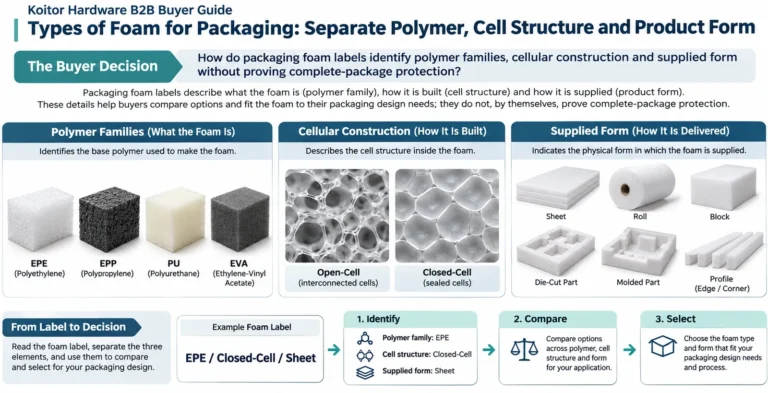
Physical form answers “what shape or construction is supplied?” Common forms include pouches, bags, trays, sleeves, cartons, cases, wraps, crates, and pallets. A custom die-cut insert is a form and a configuration; foam, paperboard, or molded pulp may describe its material. The same material may be supplied as a sheet, roll, formed insert, or protective wrap. The form and material should therefore be recorded independently when either affects assembly, fit, handling, appearance, or procurement.
Role is relational. It describes how a package component functions in the particular pack-out. A corrugated carton can act as a sales-unit package, a grouping case, or an export carton. Plastic film may be an individual sleeve, a grouped bundle restraint, or a pallet wrap. A pallet is a platform used to consolidate and handle a load; it does not tell the receiver how many product units each carton contains or what material those cartons use.
This three-axis view also prevents accidental legal conclusions. Packaging regulations may define terms for a specific program, jurisdiction, reporting obligation, or product-contact question. A general commercial distinction between primary, secondary, and tertiary packaging does not determine an extended producer responsibility category, declare material composition or weight, or establish whether a component contacts the product under a particular rule. The relevant authority and responsible compliance owner must apply the current definition to the actual item and market.
How should a buyer map a hardware pack-out?
Consider a hypothetical metal bathroom organizer shipped with mounting hardware. The example is a thinking aid, not a description of a Koitor order or a tested packaging design. A buyer might list the organizer, screws, protective separators, retail box, grouping carton, and pallet as separate components. For each one, record its form, material where known, role in the intended shipment, contents or relationship, and responsible supplier. If the same carton is used at more than one distribution stage, identify that arrangement explicitly.
| Pack-out component | Possible role in the arrangement | Material or form questions | Buyer clarification |
|---|---|---|---|
| Protective sleeve around a finished part | May form part of an individual product package | Film, paper wrap, sleeve, or another form | Which surfaces or components are separated, and which revision controls? |
| Bag or small container for screws | May package mounting items as a kit component | Bag, envelope, box, or compartment | What quantity and kit relationship are required? |
| Inner retail box | May be a product or sales-unit package | Paperboard carton, insert, divider | Is it the unit presented or sold to the customer? |
| Grouping or export carton | May group multiple units for handling | Carton material, size, closure, contents | How many inner packs are included and how are they arranged? |
| Palletized unit load | May consolidate cartons for transport or storage | Pallet construction, dimensions, restraint | Which receiver requirements and handling interfaces apply? |
Avoid assigning role solely from appearance. An inner box may be visible to a buyer but still function as a component of a grouped shipping arrangement. A shipping carton could also be the retail box for a direct-to-consumer order. Trace what it contains, what it groups, and how it moves through the distribution plan.
Next, identify the decision each detail supports. A material field may support a buyer’s composition record; a package form may support a packing-line or storage discussion; a level or role field may help coordinate units and responsibilities. If a buyer needs package protection evidence, point to the complete package configuration and the evaluation required by the project. Do not treat a list of materials and forms as proof of damage protection.
The same logic applies to labels. Product identifiers, carton identifiers, and pallet identifiers have different purposes. Keep a carton’s contents and quantity separate from the identifier assigned to the carton or larger handling unit. For shipment readiness and carton-count reconciliation, see Koitor’s container loading inspection checklist; this article’s packaging taxonomy does not replace it.
What information belongs in an RFQ or packaging specification?
The buyer should describe the actual pack-out at the level of detail needed for quotation, sample review, or shipment handoff. A practical record can include:
- Product name, SKU, drawing revision, and any related kit or accessory configuration.
- The individual item or unit being packaged, including the number of pieces and components.
- Each package component’s role in the described arrangement, using primary, secondary, or tertiary only where the relationship is clear.
- The material name and exact supplier or grade information required by the project.
- The physical form and key dimensions, such as bag, sleeve, tray, carton, or pallet configuration.
- The quantity grouped in each box or other unit, and a clear arrangement or pack-out drawing where needed.
- Separators, protective elements, closure method, labels, and documents that are actually required.
- Who provides each packaging component and who approves a proposed substitute.
- Which sample, drawing, bill of materials, or packaging revision controls the purchase.
Use a drawing or annotated pack-out image when prose could be read in more than one way. Mark dimensions, orientation, item count, and the intended relation between inner and outer packages. If a buyer uses a test or acceptance criterion, identify its method, sample configuration, and responsible party; do not rely on an undocumented claim such as “export package” or “heavy-duty carton.”
A sample review should compare the sample to the same approved product and packaging revision. Record whether the pieces fit, whether the quantity matches, whether the closure or assembly sequence is understood, and which issues remain unresolved. A visual fit check may answer those questions without proving protection in transit. Any package-level performance decision requires the agreed evidence and project criteria.
For a product-specific material and corrugated test discussion, see the corrugated Cobb water absorption packaging specification. That article addresses a defined packaging question; the present guide focuses on the broader vocabulary used to describe levels, material, and physical form.
Does every shipment have three packaging levels?
No. The three-level vocabulary is a useful way to describe many arrangements, but it does not require a shipment to contain three visibly separate layers. A product may be shipped in a single carton that performs more than one commercial role, or a shipping unit may include multiple nested packs. The buyer should describe the real arrangement rather than add an artificial layer to fit a taxonomy.
Is a cardboard box always secondary packaging?
No. “Cardboard box” describes a material and a physical form. Its role depends on what the box contains and how the unit is treated in the sales and distribution arrangement. It could contain an individual sale unit, group smaller packages, or serve as a larger shipping case. State the contents and purpose.
Does a packaging level establish a legal reporting category?
No. A logistics role description does not automatically establish the definition or reporting treatment under a local packaging law or program. The relevant compliance owner must identify the applicable scheme, jurisdiction, material, weight, market, and reporting rules. Koitor’s UK packaging EPR data guide covers a defined regulatory context; do not generalize it to other jurisdictions.
Does the word “primary” prove direct product contact?
Not in every legal or commercial context. It is often used for the closest or individual product package in general logistics explanations, but a specific law may apply its own contact test and definitions. Identify the actual material layer and consult the applicable rule when contact status matters.
Can one package component have several roles?
In a real distribution chain, a component’s function can vary with the arrangement. A box can be a unit package for one channel and an inner package within a grouped shipment for another. Describe the specific channel and relationship instead of treating a generic package label as permanent across every route.
How can a custom hardware factory support the packaging handoff?
Koitor Hardware is a family-owned custom metal bathroom and home-storage hardware factory. Approved company scope includes customization from buyer drawings or physical samples, metal forming and joining, finishing, assembly, and packaging preparation. In an OEM discussion, a buyer can share the relevant product drawing, sample, component list, and pack-out requirements so the parties can review how the purchased hardware is expected to be arranged and handed off.
That support should remain within the confirmed order and supplier responsibilities. These facts do not establish that Koitor manufactures every bag, foam insert, carton, pallet, label, or third-party packaging component named in a pack-out. Nor do they establish package test results, transport protection, legal classification, material declarations, or a guaranteed distribution outcome. The buyer should identify which materials are supplied by Koitor, which are supplied by a packaging vendor, and who approves the complete configuration.
For a quotation, provide the current drawing or sample, the exact item and accessory count, package quantities, known receiver requirements, and any controlled reference. If the buyer has a packaging standard or destination-specific rule, share it and identify the person responsible for confirming applicability. A factory can discuss the scope it actually supports; the buyer or qualified compliance owner remains responsible for the applicable legal determination unless the contract expressly assigns it otherwise.
The key practical outcome is a common pack-out record. Name each component, describe its role in that arrangement, state its material and form where required, and reference the controlled revision. If a component changes, record who proposed the change, what attribute changed, and which review or evidence the buyer requires before approval. This keeps a packaging conversation actionable without overstating what the general categories prove.
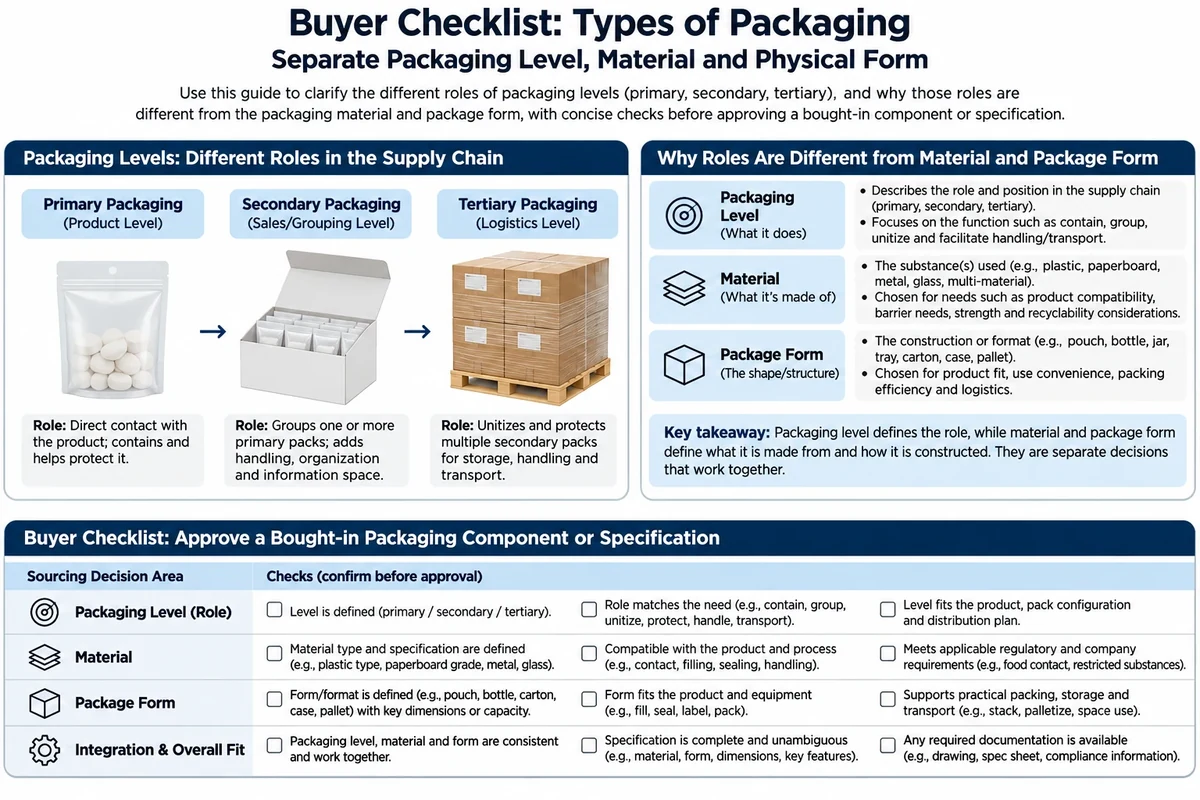
Buyer checklist for describing packaging types
- Have you named the exact product or kit and the revision being packed?
- Is the individual product unit clear, including accessories and quantities?
- Does each packaging-level term describe a real role in this distribution arrangement?
- Have you kept role separate from material and physical form?
- Are dimensions, quantity per inner pack, quantity per carton, and pallet arrangement stated where relevant?
- Is the responsible supplier identified for each packaging component?
- Are material designations exact enough for the purchasing or compliance decision?
- Are receiver, carrier, warehouse, or retailer requirements confirmed with the responsible party?
- Are identifiers for products, cartons, and unit loads handled as distinct data fields?
- Does the sample or drawing match the approved pack-out revision?
- Is any claimed performance tied to an actual package configuration and agreed method?
- Are regulatory definitions checked for the correct country and program rather than inferred from common logistics vocabulary?
- Does the change-control record say who approves a material, form, quantity, or arrangement substitution?
الأسئلة الشائعة
What are the main types of packaging?
In common logistics language, primary packaging relates to an individual product or sales unit, secondary packaging groups units, and tertiary packaging consolidates packages for larger-scale handling or distribution. Material and physical form are separate ways of describing the same pack-out.
Is “packaging type” the same as “packaging material”?
No. “Type” can refer to a role, material, or form. A useful RFQ names the attribute directly—for example, role, paperboard material, or carton form—then gives the exact specification needed.
Is a pallet itself tertiary packaging?
A pallet is a handling platform commonly used in a unit load and often described in tertiary packaging discussions. The exact role and requirements depend on the arrangement and applicable context. Specify its dimensions, construction, entry geometry, and receiver interface where relevant.
Does tertiary packaging always provide the highest protection?
No general label guarantees a protection level. The complete product and package configuration, materials, handling conditions, and any applicable evaluation determine what protection is supported. Ask for the evidence required by the project rather than inferring it from “tertiary.”
What should an importer send with a packaging RFQ?
Send the product or kit configuration, item and pack quantities, drawing or sample revision, package materials and forms where known, destination or receiver constraints, labeling requirements, and any defined acceptance evidence. Mark illustrative assumptions separately from approved requirements.
Clarify a Hardware Pack-Out Before Quotation
Share the product drawing or sample, accessory count, packaging revision, and receiving requirements to discuss the confirmed OEM packaging scope.
OEM / العلامة التجارية الخاصة
حوّل دليل التوريد هذا إلى موجز منتج
يرجى إطلاعنا على المنتج المستهدف، والحجم، والتشطيب، وكمية الطلب، ومتطلبات التغليف. وسيتلقى فريقك تقييمًا عمليًّا لإمكانية التصنيع قبل تقديم عرض الأسعار.

 English
 Español
 Português
 Français
 Deutsch
 العربية