
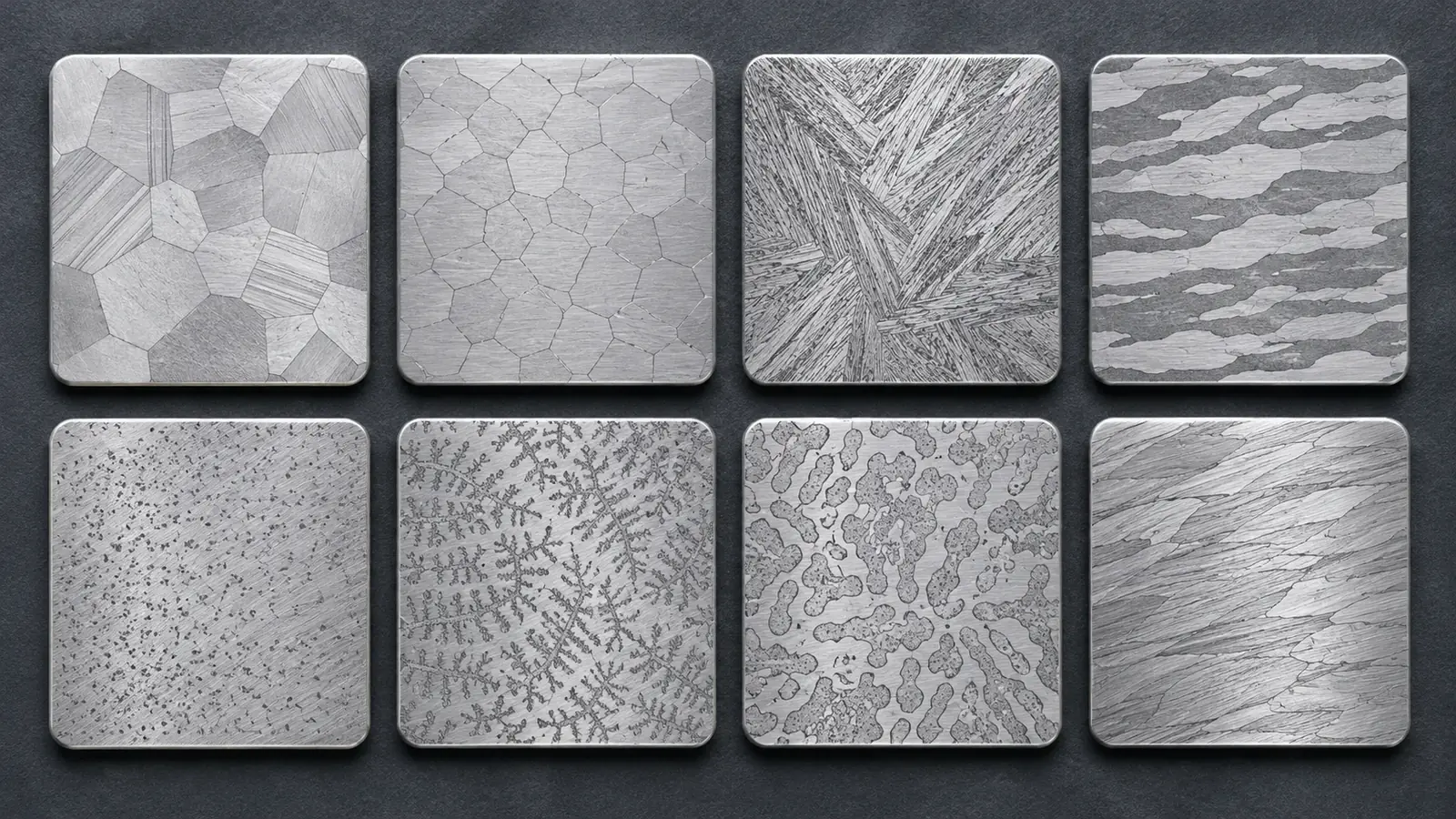
Stainless steel grades identify controlled compositions within broader metallurgical families, but the name alone is not a complete product specification. An introductory family map includes austenitic, ferritic, martensitic, duplex and precipitation-hardening stainless steels. Familiar designations such as 304, 316, 430, 410, 420, UNS S32205 and 17-4 PH are useful examples, not a universal ranking. A buyer should separate family, exact designation, applicable standard, product form, condition, finish and component requirements before comparing supplier quotations.

What do stainless steel grades mean to buyers?
The term “grade” is often used casually in quotations, product listings and technical conversations. A buyer may see a familiar number, a common name, a family label or an international designation and assume they all identify the same thing. They do not always. Stainless steel has multiple naming and specification systems, and a common commercial name may not be a complete cross-reference to another designation unless the applicable source supports that relationship.
A family is a broad way to group alloys by metallurgical structure or related characteristics. A grade is a more specific material identity within a designation system. A supplied condition may further define the state of the material. Product form, dimensions, surface finish and manufacturing history are separate attributes. The purchase requirement must make clear which of these items matter for the part.
The wording on a supplier’s quote should therefore be read as a chain of identifiers, not one magic label. A buyer may see a family name in an early discussion, a common grade number on a drawing, a UNS designation on a material record, and a finish name in the product specification. Each field answers a different question. If those fields conflict or one is absent, the right next step is to ask the supplier to reconcile them against the controlling purchase document. Do not silently assume that the familiar name takes precedence over the written requirement.
It is also useful to distinguish the material identity from the evidence that accompanies it. A supplier declaration, material certificate, heat or lot record, handheld screening result and laboratory analysis are not interchangeable forms of evidence. Which record is required depends on the purchase specification and the attribute the buyer wants to establish. If the buyer expects a certain certificate or verification method, the request should say so before production and the supplier should confirm availability. The document should then be matched to the item or lot it covers, rather than filed as a generic proof that every part meets every requirement.
For a buyer sourcing a metal storage fitting, a drawing note that says only “stainless steel” or “304 type” may leave important questions open. Is the part cut from sheet, formed from strip, made from wire, machined from bar or supplied as an extrusion? What exact designation and condition are required? Which finish is visible? Are there critical bend, hole, weld or cosmetic requirements? Which documents will connect the incoming material to the approved specification?
This article provides a buyer-oriented family map. It does not reproduce a complete normative composition chart, substitute for a standard, rank the families by quality or rust resistance, or approve an alloy for a particular part. Use the exact controlling material specification and supplier evidence when a purchase decision depends on precise chemistry or properties.
What are the main stainless steel families?
Five broad families are commonly used in introductory explanations: austenitic, ferritic, martensitic, duplex and precipitation-hardening. The names identify different structural groupings, not a single performance ladder. The examples below are for orientation and must be matched to the actual controlled designation and condition.
| Broad family | Example designations or names | What the family label helps organize | What a buyer still needs |
|---|---|---|---|
| Austenitic | 304 and 316 are familiar examples | A major family that includes many widely used grades | Exact designation, product form, condition, finish and application-specific evidence |
| Ferritic | 430 is one familiar example | A family distinct from austenitic grades, even though both may appear in 400-series designations | The exact grade, form, surface condition and requirements for forming or assembly |
| Martensitic | 410 and 420 are common examples | A separate family from ferritic stainless, despite both being represented in 400-series examples | Exact grade, heat-treated or supplied condition where applicable, and product requirement |
| Duplex | UNS S32205 is a familiar duplex example | A family with a distinct designation context from common 300- or 400-series examples | Exact UNS or governing designation, form, condition and project evidence |
| Precipitation-hardening | 17-4 PH is a familiar example | A family often identified by the precipitation-hardening designation | Full designation, condition and supplier documentation required by the design |
This table intentionally avoids a full composition or property chart. Industry family guides can help a buyer orient the terminology, but only the exact controlling specification should be used for a purchase, certificate review or acceptance decision. Check the source’s current table and designation scope rather than copying a general web chart into a drawing.
One important classification point is that “400 series” does not equal “ferritic.” Both ferritic and martensitic examples appear in the broader set of commonly used 400-series designations. Similarly, a common family name does not establish one magnetic response, corrosion performance or forming behavior for every grade and condition. The actual material and product must be considered.
How should a buyer read a grade number or common name?
Start by identifying the naming system. A designation such as 304 may be recognized in a familiar commercial context, but the purchasing document should say which system or specification governs and what exact material the supplier is offering. A UNS designation, national standard designation, common grade name or supplier product code may convey related information, but do not assume a one-to-one equivalence without a reliable cross-reference and the appropriate scope.
The same principle applies to “304 equivalent” or “316 equivalent.” The phrase may be a supplier shorthand, a proposed substitution or a marketing description. Ask the supplier to state the exact designation, standard, product form and condition in its offer. If two designations are proposed as equivalents, the technical authority for the product should review the comparison and decide whether it is acceptable. A commercial similarity statement alone does not authorize a material change.
| Record field | Example of the information to capture | Why it should be separate |
|---|---|---|
| Family | Austenitic, ferritic, martensitic, duplex or precipitation-hardening | Provides broad orientation without acting as the full order specification |
| Exact grade designation | A stated grade or UNS designation as required by the buyer | Identifies the material under a specific system |
| Governing source | Applicable standard, registration or buyer specification | Defines the authority used to interpret the designation |
| Product form | Sheet, strip, wire, tube, bar or other form | Connects material identity to the supplied stock and manufacturing route |
| Supplied condition | The condition stated in the controlling specification | Can affect what material is being offered and accepted |
| Finish / surface | Specified finish and approved visual reference where needed | Keeps surface appearance separate from the grade name |
| Component requirement | Dimensions, tolerances, bends, joints, cosmetic faces and acceptance | Defines the actual finished product, not just the incoming material |
This record structure also helps with repeat orders. If a supplier changes its source, proposes a different standard, or offers another common name, the buyer can compare the actual designation rather than relying on old email language. The approved drawing and purchase order should match the material requirement that was reviewed.
Consider a hypothetical change request where a supplier proposes a different grade because its preferred stock source has changed. The buyer should first compare the exact designations and the product form, then review whether any condition, manufacturing route, finish or supplied document changes. The material authority may need to decide whether the alternate is acceptable for the product. Procurement should record the decision, its evidence and the affected drawing or purchase revision. A supplier’s claim that the substitute is “close” or “commonly used” is not enough to close that review.
For a formed wire or sheet component, the review should also connect the material to the actual geometry. A buyer may need to inspect bend consistency, weld location, cosmetic surface and fit, but those checks do not prove the complete chemical identity. Conversely, a material record does not show that the finished component matches the drawing. A well-defined plan uses the correct evidence for each attribute and does not ask one test or certificate to stand in for all the others.
Does a series number rank stainless steel quality?
No. A family label or a larger-looking number does not create a universal quality, corrosion-resistance or strength ranking. A common misconception is to treat one series as categorically superior to another. In reality, the buyer has to match a specific grade and condition to the product requirement, environment, fabrication route and evidence needed. Different families exist because alloy systems and design purposes differ, not because every number is on one simple scale.
The 200- and 300-series groupings often include austenitic grades. The 400-series includes both ferritic and martensitic examples. These are broad classification observations, not a complete composition table or an automatic rule for evaluating a particular component. The actual designation and applicable specification matter more than a shortcut based on the first digit or family label.
Magnetic response also should not be used as a standalone quality test. It depends on the exact material and product condition; fabrication can affect the response in some cases. A magnet check cannot prove the complete alloy composition, origin, batch traceability or fitness for an application. If material identity must be verified, use the buyer’s agreed documentation and an appropriate method selected by a qualified party. A visual or handheld screening result is not a replacement for the governing material requirements.
Corrosion performance is likewise conditional. It depends on the material, finish, geometry, exposure, care and other factors. No family name makes a finished hardware product “rust-proof.” The buyer should define the environment and any needed evidence, then evaluate the actual product and finish under the agreed requirements. An illustrative family table cannot establish field life or guarantee that a component will not corrode.
For a product-specific forming example, the site article on ferritic stainless surface changes during forming addresses one conditional manufacturing question. It does not turn a family name into an acceptance criterion. Likewise, fastener galling is a joint and use issue, not a universal rank of stainless families.
How do grade and condition affect a hardware drawing?
The material callout should support the actual geometry and manufacturing method. A wire shelf, formed sheet bracket, tube assembly and cast fitting can require different material and process discussions. A common grade number does not define which product form is intended or how the part will be cut, formed, joined, finished, inspected or packed.
When reviewing a drawing, identify the features that depend on material or condition. These may include bend locations and radii, hole positions, weld or joint locations, cosmetic surfaces, threaded interfaces and finishing allowances. The supplier should review the actual drawing and sample rather than infer capability from a grade label. If a proposed material change affects forming, joining, finish, dimensions or acceptance, record it as an engineering change and obtain approval before it reaches bulk production.
Material traceability should be proportionate to the buyer’s actual requirement. If the project calls for material documentation, state the required record and how it should identify the supplier, lot, designation and product form. Do not assume every transaction includes an identical certificate or that a document automatically proves every property. The quality team should check whether the record corresponds to the purchase order and whether the inspection plan includes the attributes that matter.
Surface finish should be controlled separately. A drawing may specify a polished or coated appearance, but that requirement should identify the visible faces and approved sample where appearance matters. A coating or finish can alter the surface that a buyer sees without changing the underlying grade designation. If the product includes a welded joint or formed region, the appearance and inspection criteria should account for those features rather than rely on a generic phrase like “stainless finish.”
For example, a hypothetical bathroom storage bracket may require a particular grade, formed profile, hole pattern and visible finish. The material callout identifies one part of the requirement. The drawing still needs dimensions and tolerances; the finish specification needs its own reference; and the receiving plan needs to state what documentation or checks are required. No single one of these fields replaces the others.
How can a buyer compare stainless steel quotations?
Normalize the offers before comparing price. Ask each supplier to quote the same drawing revision, material designation, product form, finish, order quantity, packaging and inspection scope. If the supplier proposes another grade or source, list that proposal separately and identify the evidence and approval needed. A lower unit price is not comparable if the offer changes the material or removes a requirement.
When quotations use different naming systems, create a side-by-side comparison before awarding the order. Record each supplier’s exact terminology and the source it cites, then ask both to confirm the offered material in writing. If the buyer cannot confirm equivalence, keep the offers marked as different rather than merging them into one line item. This prevents the purchase team from accidentally choosing a material change while thinking it is only a price change.
The following questions can be used in an RFQ review:
- What exact designation and governing specification are included in the offer?
- Does the offer identify the product form and supplied condition?
- Does it include the drawing’s dimensions, tolerances, bends and surface requirements?
- Which finish is included, and which surfaces are treated as cosmetic?
- What material records will accompany the shipment, if any are required?
- Are any substitutions, alternate standards or subcontracted operations proposed?
- What sample or document must the buyer approve before production?
- How will a material or process change be notified and controlled?
For geometry-specific review, the live guide to a stainless steel corner-guard angle specification illustrates why section shape and dimensions belong in the component description alongside the grade. The article is not a universal grade chart; it is a focused example of translating a product into measurable requirements.
What should buyers avoid when selecting a stainless grade?
- Choosing from the family name alone. The full designation, condition and product form may still be missing.
- Treating 400-series as one family. Ferritic and martensitic examples both occur in commonly used 400-series grades.
- Ranking grades by number. The number is a designation, not a universal score for quality, corrosion resistance or strength.
- Equating common names without a source. Cross-reference the exact designation and governing standard before approving a substitution.
- Using a magnet as proof. Magnetic response is not a complete chemistry or traceability check.
- Assuming “stainless” means never corrodes. The material, finish, exposure and product design all matter.
- Omitting condition and form. A wire, sheet, tube and cast part are not described fully by the grade name.
- Accepting a generic certificate without matching it to the order. Check identity, scope and lot connection against the purchase requirement.
- Confusing the material requirement with the finish requirement. They should be specified and inspected as separate attributes.
- Allowing undocumented substitutions. Require change approval when the material or process changes from the reviewed offer.
The safest purchase record is not the longest chart. It is a concise controlled callout that names the applicable designation and form, followed by the part geometry, finish, documentation and acceptance requirements needed for the product. When the buyer is unsure, ask the supplier to identify its exact proposal and route the decision to the responsible technical reviewer.
Buyer checklist before approving stainless steel grades

- [ ] Is the broad family recorded only as orientation, with the full designation specified separately?
- [ ] Does the drawing or purchase order identify the controlling designation system or source?
- [ ] Are product form and supplied condition clear?
- [ ] Are dimensions, finish, cosmetic surfaces and critical features described independently?
- [ ] Are requested material documents matched to the order and lot?
- [ ] Are supplier alternatives documented and reviewed before acceptance?
- [ ] Is the inspection method suitable for the attribute being checked?
- [ ] Are material and process substitutions subject to written change approval?
- [ ] Are corrosion, strength or durability claims tied to defined application evidence?
- [ ] Does the approved sample correspond to the current drawing and material record?
Frequently asked questions about stainless steel grades
What are the main families of stainless steel?
Common introductory classifications include austenitic, ferritic, martensitic, duplex and precipitation-hardening families. An authoritative source may use a different teaching scope or omit a family for its intended context, so consult the exact source and specification relevant to the purchase.
Are 304 and 316 types of stainless steel grades?
They are familiar grade designations commonly associated with austenitic stainless steel. A purchase specification should still identify the governing designation system, product form, condition and other requirements needed for the actual component.
Are all 400-series stainless steels ferritic?
No. Common 400-series designations include both ferritic and martensitic examples. The actual grade and family should be identified rather than inferred from the series number alone.
Is 304 always better than 430?
There is no universal answer from the grade numbers alone. The appropriate comparison depends on the exact product, environment, fabrication, finish, requirements and evidence. A buyer should define those conditions before selecting a material.
Does a magnet test identify stainless steel grade?
No. A magnet response cannot establish full alloy composition, product history, traceability or suitability. Use the material documents and any agreed verification method for the decision being made.
Does a higher grade number mean better corrosion resistance?
No universal ranking follows from the number. Corrosion behavior depends on the actual alloy and condition, surface, exposure and product design. Define the intended environment and evidence rather than inferring performance from the designation.
What is the difference between a stainless family and a grade?
A family groups alloys at a broad level. A grade is a more specific designation within a recognized system. The supplied condition, product form, finish and finished-part requirements are additional information.
What should an importer request from a stainless supplier?
Request the exact designation and governing source, product form and condition, finish scope, drawing compliance, required material records, substitution rules and any project-specific inspection evidence.
اعمل مع شركة «كويتور» للأدوات
Koitor Hardware is a family-owned custom metal bathroom and home-storage hardware factory. It supports approved drawing and sample customization, finish discussion, inspection communication and packaging preparation within confirmed project scope. Share the actual material callout and component drawing so the proposed sourcing and manufacturing scope can be checked without assuming an unverified grade supply or certification service.
Review a Stainless Hardware Specification
Send the drawing or sample, exact material designation if known, finish requirement and the unresolved sourcing or inspection question. Product scope and documentation are confirmed project by project.
OEM / العلامة التجارية الخاصة
حوّل دليل التوريد هذا إلى موجز منتج
يرجى إطلاعنا على المنتج المستهدف، والحجم، والتشطيب، وكمية الطلب، ومتطلبات التغليف. وسيتلقى فريقك تقييمًا عمليًّا لإمكانية التصنيع قبل تقديم عرض الأسعار.


 English
 Español
 Português
 Français
 Deutsch
 العربية