
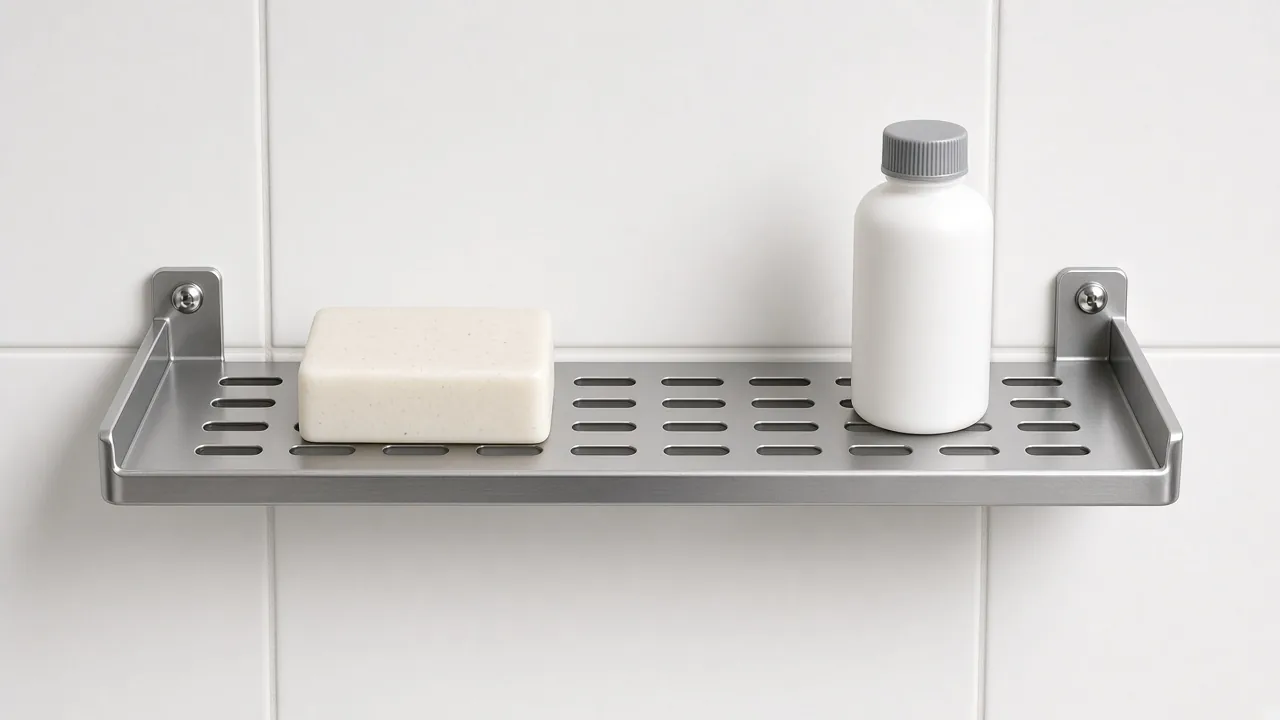
Bathroom shelf drain slots vs solid tray is a blank-architecture choice, not a generic “good drainage” slogan. Buyers should freeze the tray opening pattern before tooling the sheet, because a slotted shelf and a solid tray keep and dry items in different ways and fail in different ways.
Open slots help rinse water leave the shelf, but they also let small soaps, cotton pads, and jewelry drop through or catch in the openings. A solid tray holds small items and looks cleaner from below, but it can pond water unless the user wipes it or the design includes a planned lip and empty path.
This page is written for a screw-mounted sheet-metal bathroom or shower shelf with wall flanges. It is not a wire soap basket, not a pull-out cabinet basket, not a glass shelf, and not a kitchen dish rack. It also does not own front-lip height for bottle retention; that is a separate decision and is not expanded here.
What do the two tray blanks actually change?
A slotted blank has punched or cut openings in the tray, large enough that rinse water can fall through. The openings may be long slots, a grid, or a few wide cutouts. Water leaves faster, and the underside of the shelf is more visible, including burrs and finish at the cut edges.
A solid tray is a continuous sheet, sometimes with a slight dish or a rear drain notch, sometimes truly flat. Small items stay on the surface. Drying then depends on wipe-down, evaporation, or a controlled path off one edge. A finely perforated blank sits between the two: holes small enough to keep a bar of soap, large enough to pass some water. Treat perforation as its own option in the RFQ, not as “slots, only smaller.”
The assortment on the shelf decides the opening size more honestly than a catalog adjective. If the program photographs tall bottles, the blank still has to hold the bottle base, but the risk is usually pooling and marks, not drop-through. If the program also sells loose cotton pads, hair ties, or travel soap, drop-through becomes the first failure.
Cleaning follows the same split. Slots need a brush or a rinse that actually goes through the openings; film can sit on the land between slots. A solid tray is easier to wipe, but a corner that does not drain will hold soap scum. Trial both with the real item set and a typical rinse, not with an empty shelf under a studio light.
Sheet-metal RFQ file formats matter here because the blank is a cut path. A PDF rendering can hide slot radii and burr direction. A DXF or STEP of the tray, plus a note on which face is visible, is a better start than a lifestyle photo of “a bathroom shelf.”
Tube-end drainage is a different question. Sealed versus drainable tube ends applies to tubular posts and bars, not to the tray blank of a sheet shelf. Do not copy a tube-end decision onto this SKU, and do not treat a slotted tray as proof that a tubular collection already drains.
How should buyers weigh drying against small-item retention?
Start with what must not fall through. List the smallest item the shelf is allowed to hold, including accessories that will appear in listing photos even if they are not in the core kit. Then list how the shelf is cleaned: rinse in place, wipe, or occasional removal. Those two lists usually pick the blank before aesthetics do.
Drying is not only about open area. Airflow under bottles, the slope of the tray, and whether water can escape at the back wall all matter. A heavily slotted shelf that sits dead flat against a tiled return can still hold a film at the wall line. A solid tray with a slight pitch and a rear notch can dry better than a flat slotted grid that traps beads between lands.
Finish access at the openings is part of the same choice. Slot edges are extra faces to plate, coat, or powder. Bare cut edges, sharp burrs, and thin coating at a punched land are common reasons a “well designed” slotted shelf looks rough in the room. A solid tray has fewer cut edges, which can make finish more consistent, but any drain notch still needs the same edge care.
| Decision factor | Open drain slots usually help when… | A solid tray usually helps when… | RFQ check that changes |
|---|---|---|---|
| Small-item retention | The assortment is limited to bottles and large soaps that cannot fall through the stated slot width | The shelf must hold cotton pads, jewelry, travel soap, or other small accessories | Smallest retained item versus minimum opening; photo set must use that assortment |
| Drying after a rinse | Users rinse the shelf in place and need water to leave without a wipe | Users will wipe the tray, or a planned pitch and notch empty the surface | Slope, rear path, and a wet trial with the real item set |
| Cleaning | A through-rinse is expected and a brush can reach the lands | A smooth wipe is expected and corners can be reached with a cloth | Crevice map at lands, corners, and the wall line |
| Finish at openings | Cut edges can be dressed and coated to the agreed visible standard | Fewer cut edges are wanted on the visible face and underside | Burr direction, edge radius, and coating coverage at each opening |
| View from below | An open look is wanted and the underside can be finished honestly | A closed underside is wanted in a tight room or over a visible vanity | Underside finish grade and whether slots are acceptable when seen from below |
| Tooling and blank risk | Punch or laser slots can be held without distorting the tray or the flanges | A simpler blank reduces distortion and edge-finish work | Flatness after cutting, flange fit, and first-article edge samples |
What should a wet trial and a first-article blank include?
A wet trial should use the intended bottles or soaps, a measured rinse, and a set wait time agreed in the project file. Photograph standing water, drip paths, and any item that moved or dropped. Do not invent a universal dry-time claim. If a listing will say the shelf “dries quickly,” the file needs a method and a result, or the claim should stay out.
First-article blanks should include at least one slotted or perforated unit and one solid unit if both are still in play, or the single chosen blank if the decision is already closed. Check flange hole positions on the same part, because a punched slot pattern can pull a thin tray and move a hole. That is a fit issue, not a drainage slogan.
Slot width, length, and corner radii belong on the drawing with a measurement method. Keep that method separate from any sampling-plan numbers. A caliper across a slot is not an incoming AQL sentence. Record burr direction: a downward burr may be hidden in use and still be sharp to a cleaning cloth; an upward burr is a visible and tactile fail.
If a fine perforation is chosen, state hole diameter, pitch, and whether the holes are punched or otherwise formed. Check that a wet cotton pad or a sliver of soap cannot work through after sitting. Perforations that look “safe” when dry can funnel a softened soap scrap after a shower.

What the factory can control, and what stays a project agreement
A factory can cut either blank, dress edges, apply the agreed finish, and hold flange geometry if the drawing and the first article are clear. Custom bathroom hardware manufacturing can also keep a retained shelf as the visual and fit standard for later lots.
The factory cannot honestly name a universal best pattern, a rust-proof slot edge, or a dry-time that was never measured. Koitor can review both blanks as a family-owned China OEM manufacturer of bathroom and home-storage metal hardware; the buyer still chooses the assortment-versus-drying trade-off.
Incoming inspection should follow the blank. Slotted lots need opening size, edge, and underside checks plus a wet trial on a defined sample. Solid lots need flatness, pitch or notch function, and a wipe-dry trial. Keep those methods out of the same sentence as a sampling plan.
For quotation, send the item assortment, the preferred blank, and the wall-mount flange drawing. MOQ, sample timing, and lead time remain project-specific under careful approved wording. Do not assume a slotted and a solid version share the same pack size or the same first-article outcome.
Sheet thickness, powder or plating at cut edges, and whether the underside is a visible face should be written in the same inquiry. Changing thickness later can change both slot stiffness and how a solid tray dishes after forming.
Buyer checklist for bathroom shelf drain slots vs solid tray
Use this list before the tray blank is tooled or the listing photographs are shot.
- State the product as a screw-mounted sheet bathroom or shower shelf, and exclude wire baskets, glass shelves, pull-out cabinets, and dish racks from this file.
- List the smallest item that must stay on the shelf, including accessories used in listing photos.
- Choose open slots, a solid tray, or a defined perforation, and write the opening sizes on the drawing.
- Define how the shelf is cleaned: rinse in place, wipe, or occasional removal.
- Trial the wet behavior with the real item set, and record standing water, drips, and any drop-through.
- Check burr direction, edge radius, and coating coverage at every opening and at any drain notch.
- Check flange holes and tray flatness on the same first-article part, because cutting can pull a thin blank.
- Decide whether the underside is a visible face and finish it to that grade.
- Keep front-lip bottle retention in a separate decision; do not hide it inside this blank choice.
- Use a DXF or STEP of the tray, not only a PDF or a lifestyle photo, when requesting a quote.
- Keep measurement methods and any sampling plan in separate clauses, and do not invent a dry-time claim.
- If both blanks are offered as colorways or options, treat them as two variants with two inspection lists.

Wall returns change the wet result. A shelf set tight into a tiled corner can block the rear notch that a solid tray relies on, and can also hide the last row of slots. Trial the shelf on a board that mimics the intended return, not only on an open bench.
Powder coating and electrolytic plating do not fail the same way at a slot. Powder can build at a land and narrow an opening, or leave a thin corner at a punched edge. Plating can show a darker or thinner edge if the racking or the current density is poor at a dense slot pattern. Edge samples should use the production finish, not a bare blank only.
Acoustic and drip noise show up in showers more than in dry powder rooms. Water falling through wide slots onto a tub floor can be noticeable. That is not a reason to forbid slots, but it is a reason to trial the opening size with a rinse if the shelf hangs over a quiet space.
Packing a slotted shelf needs corner and face protection that does not leave pad marks in the openings. A solid tray can pick up a scuff on a large face. Both need a pack trial of the finished part, because a lifestyle photo will not show a crushed flange or a bent slot land.
If the collection includes a matching soap basket or a dish rack, do not force the same opening story onto the sheet shelf. Each product has its own item set. Honesty in the family catalog means saying which SKU drains through openings and which SKU is a solid tray.
Laser-cut slots can hold a tighter radius than some punched tools, but the heat tint and the dross still need dressing before finish. Punch tools can leave a die break that is visible from below. The process choice belongs in the RFQ only as a means to the agreed edge, not as a marketing word.
Load still sits on the flanges and the back of the tray, regardless of openings. Do not treat a slotted shelf as automatically weaker or a solid tray as automatically stronger. If a load figure is required, it must be a project agreement with a stated method and a stated item set.
Retail copy should follow the blank. “Open drainage shelf” is false if the production tray is solid with a tiny notch. “Holds small accessories” is false if the slots are wider than the travel soap in the hero image. Align the words with the first-article blank.
Replacement and colorways should share the blank unless the order says otherwise. A second color that switches from slots to a solid tray will surprise installers who already drilled and who expect the same underside look. Write the blank in the colorway remarks.
Condensation in a closed powder room can wet a solid tray even when no one rinses it. If the program is aimed at that room type, a wipe path or a very fine perforation may matter more than a wide shower-style slot. State the room use in the inquiry.
When the assortment, the blank, the edge finish, the wet trial, and the flange geometry are written together, bathroom shelf drain slots vs solid tray is ready to quote. If the file still says only “bathroom shelf with good drainage,” the blank is open and the photo sample should not be sealed.
Hardware kits shipped with the shelf should not fight the blank. A decorative screw cap or a glass-look insert that drops through a slot during install is a returns problem, not a user error. If a kit card or a small wrench is packed on the tray, confirm it cannot fall through the openings in the carton or in the room.
Install height changes what people put on the shelf. A high shower shelf tends to hold bottles; a low vanity shelf tends to hold small tools and soaps. The same blank can be right for one height and wrong for the other. Write the intended height band in the inquiry so the assortment assumption stays honest.
Forming a lip or a short upstand is allowed in this file only as an edge that keeps water or items from running off the sides, not as a substitute for a front-lip height study. If bottle tip-over is the real worry, park that in its own specification rather than widening slots or raising a hidden wall in this drawing without comment.
First-article photos should include a plan view of the openings with a scale, an underside view, a flange close-up, and a wet-trial frame. If the factory only sends a front three-quarter beauty shot, ask for the blank shots before any seal. The architecture lives in those views.
Rust language stays out of this comparison. A slot edge can later corrode if coating is thin, and a solid tray can hold water against a scored finish, but those are finish and water-hold issues for their own files. This page only asks which blank you are building and how it is trialled wet.
A shared wall-plate family should still declare the tray blank per SKU. Matching flanges do not mean matching openings. Buyers who already approved a family mounting plate can still reject a new shelf if the blank was swapped after the photo sample. Keep the opening pattern in the family remarks for every later color, length, or later production repeat.
الأسئلة الشائعة
Is there a single winner in bathroom shelf drain slots vs solid tray?
No. Slots win when in-place rinsing and open drying matter and the assortment cannot fall through. A solid tray wins when small items must stay put and the user will wipe or the tray has a planned empty path. The table is a map, not a ranking.
Are fine perforations the same as slots?
No. Treat hole diameter and pitch as their own specification. A perforation can keep a soap bar and still pass some water, but it can also cake with film and needs its own wet trial.
Does a slotted shelf always dry faster?
Not always. A flat slotted tray can hold beads between lands and at the wall line. A slightly pitched solid tray with a rear notch can empty more honestly. Measure the design you will ship.
Can one SKU offer both blanks?
Yes, as two explicit variants. Do not pack them as the same SKU with a footnote, and do not shoot only the open look if half the volume will be solid.
How is this different from soap-basket or dish-rack drainage?
Those products use wire or different blanks and different item sets. This file is only the sheet bathroom-shelf tray. Neighbor drainage pages remain useful as design reminders, not as copy-paste specifications.
Should a kit card or wrench be packed on a slotted tray?
Only if it cannot fall through the openings in the carton or during install. Pack small kit parts in a bag or on a card that is wider than the slots.
What should a first sample include?
The chosen blank or both candidates, the flange geometry, an underside view, and the wet-trial result with the intended small items. A dry beauty shot of an empty shelf is not enough.
اعمل مع شركة «كويتور» للأدوات
Need a sheet bathroom shelf quoted as a slotted or solid tray?
Send Koitor the intended item assortment, preferred blank, and flange drawing. Our team can review the sheet-shelf construction and small-batch OEM options before quotation.
OEM / العلامة التجارية الخاصة
حوّل دليل التوريد هذا إلى موجز منتج
يرجى إطلاعنا على المنتج المستهدف، والحجم، والتشطيب، وكمية الطلب، ومتطلبات التغليف. وسيتلقى فريقك تقييمًا عمليًّا لإمكانية التصنيع قبل تقديم عرض الأسعار.
 English
 Español
 Português
 Français
 Deutsch
 العربية