
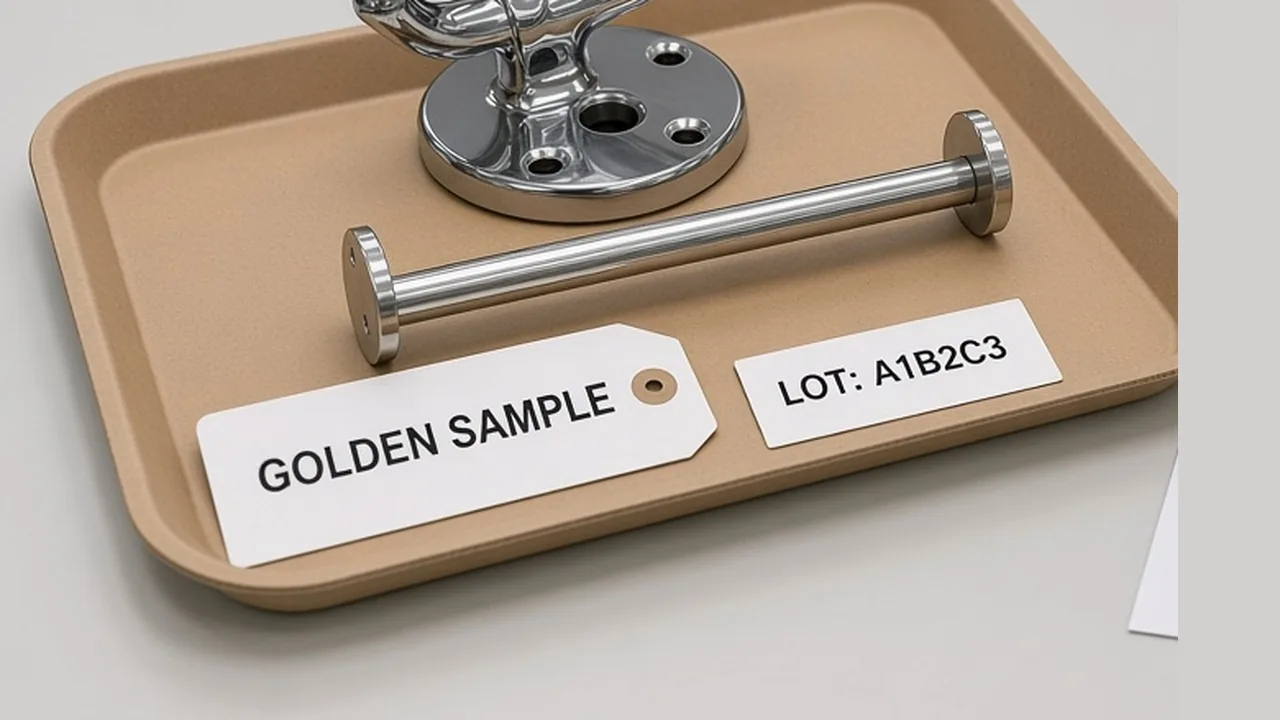
Bathroom hardware ECO reapproval after golden sample is a trigger question, not a promise of a free new sample or a fixed factory cycle time. Importers should decide, before the first sealed unit is stored, which later engineering changes require a new first-article look and a new sealed reference, and which changes can stay on paperwork.
A sealed golden sample is the physical standard the next lots are compared with. An engineering change — often called an ECO, ECN, or similar in factory files — is a proposed change to the part, the process, the pack, or the kit after that standard exists. If the change can alter what a buyer sees, fits, or installs, the sealed unit is no longer a fair referee until it is reviewed and, when needed, replaced.
This page is written for bathroom and home-storage metal accessories such as towel bars, hooks, baskets, and racks. It does not own hotel FF&E schedules, and it does not rewrite lot cut-in or BOM effectivity, which belong in a separate production file. It also does not invent Koitor review days or offer complimentary re-samples.
What should “sealed sample” and “reapproval” mean in the purchase file?
Sealed means the buyer and the factory have agreed that this physical unit, with a mark or a bag label and a retained photo set, is the reference for appearance, fit, and construction. It is not a marketing display piece that can be quietly swapped. Preparing drawings and samples for a custom hardware factory remains the right place to build that first reference; this page starts after the seal exists.
Reapproval means the parties look at a proposed change against that reference and either keep the old seal, issue a new sealed unit, or reject the change. It is not a rubber stamp on an email that says “small change, same as before.” If the part, the finish, the pack mark risk, or the kit contents will be different in the next lot, the old unit cannot answer questions it was never built to represent.
Paperwork-only updates still need a written trail, but they do not always need a new physical seal. Examples include a typo on an internal work instruction that does not change the part, or a language variant of a carton mark when the artwork and the meaning are agreed as equivalent. The test is whether a later inspector could be misled by the old sample.
A delta review is allowed when both parties agree the change is local — for example, a new polybag print on an otherwise unchanged hook. A full first-article is the safer path when form, finish, material, or tooling moved. Do not let “delta” become a habit that skips photos of the changed area.
Which change classes should trigger a new sealed reference?
Use classes, not vibes. Tooling, material, finish, process route, pack, and kit contents each have a different risk of making the old sample a poor referee. The following table is a decision map for bathroom hardware ECO reapproval after golden sample, not a claim that every factory uses the same form names.
| Change class | Usual trigger | Evidence to refresh | Typical seal outcome |
|---|---|---|---|
| Tooling or fixture | New cavity, punch, weld fixture, or a repair that changes form or a visible joint | New first-article photos, dimensions, and a side-by-side with the old seal | New sealed unit in most cases |
| Material grade or thickness | Base metal, thickness, or a substitute coil or wire that can change stiffness, weld, or finish | Material certs plus a finished sample for look and fit | New seal if form, feel, or finish moved; paperwork plus a retained off-cut if the finished unit is proven identical |
| Finish system or color | New bath, coat, color recipe, or process route that can shift shade, texture, or edge cover | Finished sample under the agreed light, and a retained chip or unit | New seal in most cases |
| Process route | Polish method, racking, weld schedule, or a line move that can change marks or joints | Process note plus samples of the visible faces and hidden faces | New seal when marks, joints, or texture can change; written note only when both parties can show no visible or fit change |
| Pack method | New carton, tray, or wrap that can crush, polish, or mark the part | Pack trial of the finished SKU, not only a carton drawing | Often no new product seal if the part is unchanged, but a new pack standard should be retained |
| Kit contents | Screws, anchors, inserts, or leaflets that the user will treat as part of the SKU | Kit photo and a count list against the sealed kit | New kit seal or an updated kit photo set; the metal part seal stays only if the part is unchanged |
A supplier change on a component — a different hook sleeve, a different plastic insert, a different pad — should be treated as a material or kit class, not as a silent purchase-order swap. Supplier-requested changes around third-party inspection booking is a neighbor reminder that inspection plans also move when the part or the date moves. This page only asks whether the golden sample still represents the SKU.
WIP already in process is a disposition question, not a reason to skip re-seal. If parts were made under the old standard, the buyer and the factory should say whether those pieces may ship, must be reworked, or must be held. The detailed lot cut-in belongs in an effectivity file; mention it here only so a change request does not forget that units are already in the line.
What evidence should travel with a proposed change?
Every request should name the current sealed-sample ID, the drawing revision, the change class, and the reason. Attach before-and-after photos of the area that will change, and say whether a new physical sample is being offered. An email with no photos and no class is not a complete request.
If the change is in finish or polish, include a sample under the same viewing light used for the original seal. If the change is in a hidden face, still photograph that face; later claims often start there. If the change is in pack, ship a packed example, not only a dieline.
Keep measurement methods and any sampling plan in separate clauses. A new dimension on a hook tip is a method-and-result question. It is not automatically a lot-accept number. The seal decision can refer to those results without swallowing the sampling plan.

What the factory can control, and what stays a project agreement
A factory can log the change, build a comparison sample, and hold or replace the sealed unit when the buyer agrees. Custom bathroom hardware manufacturing can also keep photos and the physical reference so later lots have a referee.
The factory cannot honestly promise a fixed reapproval time, a free extra sample, or a rule that “small changes never need a new seal.” Koitor can review change classes as a family-owned China OEM manufacturer of bathroom and home-storage metal hardware; the buyer still has to name the trigger rules in the program file.
Incoming inspection after a change should use the current seal, not the retired one. Retired units should be marked so they are not pulled from a cabinet by mistake. If a distributor still has the old photo set, send the update with the revision, or field teams will judge new lots against an obsolete picture.
For quotation or a running order, send the change class, the current sealed-sample status, and the drawing revision. Commercial terms for extra samples, tooling, or timing remain project-specific under careful approved wording.
Buyer checklist for bathroom hardware ECO reapproval after golden sample
Use this list when a change is proposed after the first seal.
- Record the sealed-sample ID, photos, and drawing revision at the original seal, before any later change arrives.
- Classify the change as tooling, material, finish, process, pack, kit, or paperwork-only.
- Ask whether a later inspector could be misled if they still use the old unit.
- Require before-and-after photos of the changed area, plus a packed example when pack is in scope.
- Choose a delta review or a full first-article in writing, and photograph the changed area either way.
- Issue a new sealed unit when form, finish, feel, or kit contents moved, and mark the old unit as retired.
- Keep pack standards and kit photo sets even when the metal part seal does not change.
- State WIP disposition in a short note, and point detailed lot cut-in to the effectivity file.
- Update distributor photo sets so field checks use the current reference.
- Keep measurement methods and sampling plans in separate clauses.
- Do not treat a cycle-time claim or a complimentary re-sample as part of this technical file.
- Refuse a silent supplier swap on a component that the sealed unit was meant to represent.

Colorways need the same discipline. A new matte-black lot of a hook that was sealed only in chrome is a finish-class change, even if the drawing outline is unchanged. Do not let a color extension inherit the chrome seal as if shade and texture were irrelevant.
Private-label logo marks and carton prints are artwork changes. If the metal part is untouched, you may keep the part seal and still retain a new print standard. If a logo is stamped or etched into the metal, treat it as a tooling or process change and expect a new part seal.
Replacement parts sold later as spares should follow the current seal, or the spare will not match the unit in the room. When a change is approved, say whether spares stay on the old revision for a period or switch immediately. That is a short effectivity note, not a full lot-cut-in manual.
Inspection companies need the current packet. If a third-party visit was booked against the old drawing, the booking file should be updated with the new revision and the new seal photos. The neighbor page on inspection-booking changes can carry the booking mechanics; this page only insists the referee in the packet is current.
Do not use “equivalent” as a shortcut for material or finish. If a mill cert shows a different grade or a bath is new, a finished sample under the agreed light is cheaper than a later dispute. Equivalence is a conclusion after evidence, not a first sentence in the request.
Hidden-face changes still matter on hooks and bars because installers and later buyers photograph the underside. A new racking mark, a new weld dress, or a new set-screw finish can be “only on the back” and still become a claim. Photograph hidden faces in the original seal so later ECOs have a baseline.
If several small paperwork notes accumulate, pause and ask whether the physical part has drifted through unofficial tweaks. A cluster of “tiny” process notes is a reason to pull a current unit and compare it with the seal, even if no single note was written as a major change.
When the change class, the evidence, the delta-or-full path, and the seal-or-paperwork outcome are written, bathroom hardware ECO reapproval after golden sample is ready to run as a program rule. If the file only says “any change must be approved,” the trigger is still vague and lots will drift.
Worked example: a towel-bar set-screw finish is changed from a bright hex to a black hex after the chrome bar was sealed. The bar body may still match the seal, but the visible screw in a lifestyle photo will not. Classify it as a kit or finish-class change for the fastener, photograph the installed screw, and decide whether the sealed kit photo set must be replaced even if the bar body seal stays.
Worked example: a robe-hook weld fixture is repaired and the back joint moves one millimetre. The front face may still “look like” the seal in a casual photo. A first-article against the original unit will show the shift on the hidden face and may show a new rock when the hook is tight to the plate. That is a tooling-class change and a new seal, not a line-side tweak.
Worked example: a basket carton is changed to a tighter tray because freight cost moved. The metal is unchanged, so the product seal can stay, but a pack trial may show a new rub on a wire land. Retain the new pack as a standard and, if the rub is visible, either fix the pack or treat the mark as a new acceptance question. Do not ship the tighter tray only because the metal seal is still valid.
Photo protocol for the original seal should already include front, side, hidden face, mount interface, kit layout, and pack. If those views were never taken, a later ECO is harder to judge. When you are still unsealing the first unit, add the views now. When you are years into a running SKU with a thin photo set, take a new baseline of the current seal before you approve a change.
Drawing revision hygiene helps the seal. The sample bag should quote the revision that the unit was built to. If the drawing moves for a paperwork typo, say so on the bag or in the log so a later inspector does not think the metal moved. If the drawing moves because a radius changed, the bag must not still quote the old revision beside an old unit.
Distribution centers and marketplace photos drift. A seller image from the first season can outlive two finish tweaks. After a re-seal, send the new hero and detail set to every channel that still uses the SKU, or customer messages will quote the old shade as the “real” product. That communication step is part of closing the ECO, not a marketing afterthought.
Do not use the sealed unit as a daily working gauge on the line if handling will wear it. Keep a working comparator if needed, and protect the sealed unit in a bag or a box with the ID visible. A worn seal is a poor referee and a reason to re-photograph or replace the reference even when no ECO is open.
Training new inspectors should use the current packet, including the list of retired units. A new inspector who finds a shiny old sample in a drawer will use it. Label the drawer, the bag, and the log the same way.
If a change is rejected, write that down too. A rejected finish or tool repair should not reappear in the next lot as an unofficial experiment. The file is a history of what may not be done, as well as what was approved.
Family SKUs that share a hook body but differ in post length or finish still need per-SKU seals or a clearly marked family reference with listed exceptions. A change to a shared body tool can force a review of every SKU that uses it. List the family when the ECO is opened so no colorway or length variant on that shared tool is forgotten.
Claims and returns sometimes reveal that the seal and the shipped lot already diverged before anyone wrote an ECO. If a pattern of marks or fit issues appears, pull a current lot against the seal first. If they differ, stop and open a change or a corrective path; do not argue the claim only from a retail photo.
Language in the purchase file should stay in buyer terms: sealed reference, change class, new first-article, retired unit. Avoid internal severity labels as a substitute for the trigger table. The buyer needs to know what happens to the referee, not which factory code was ticked.
الأسئلة الشائعة
Does every typo on a work instruction need a new sealed sample?
No. If the part, pack, and kit will not change, a written correction can stay on paperwork. If the typo hid a real process change, treat the process class and look at a unit.
Can a pack change leave the product seal in place?
Often yes, if the part is unchanged. Still retain a new pack standard and run a pack trial, because crush and rub marks are how pack changes reach the customer.
Is a delta review always enough for a finish tweak?
Usually not. Finish and color almost always need a new sealed unit under the same light as the original. A verbal “close enough” will not help a later inspector.
Who keeps the retired golden sample?
Keep it marked as retired, not on the same hook as the current seal. The file should say where the current unit lives and who may retire it.
Does this page set a Koitor review time or a free re-sample?
No. Timing and any extra sample terms are project agreements. This page only maps which changes should reopen the seal.
Should a worn sealed unit be replaced even without an ECO?
Yes, if handling has changed the look or the edges of the reference. Re-photograph or re-seal so the referee still represents the agreed standard.
What if marketplace photos still show the old finish?
Update the channel set when you close the ECO. Old lifestyle images will otherwise become the unofficial standard in customer messages.
How is this different from BOM effectivity?
Effectivity says which lots and which WIP follow the new revision. This page says whether the sealed referee itself must be replaced. Use both, and do not let one file stand in for the other.
اعمل مع شركة «كويتور» للأدوات
Need a change reviewed against a sealed bathroom-hardware sample?
Send Koitor the change class, the current sealed-sample status, and the drawing revision. Our team can review the evidence path and small-batch OEM options before any new sample is discussed.
OEM / العلامة التجارية الخاصة
حوّل دليل التوريد هذا إلى موجز منتج
يرجى إطلاعنا على المنتج المستهدف، والحجم، والتشطيب، وكمية الطلب، ومتطلبات التغليف. وسيتلقى فريقك تقييمًا عمليًّا لإمكانية التصنيع قبل تقديم عرض الأسعار.
 English
 Español
 Português
 Français
 Deutsch
 العربية