
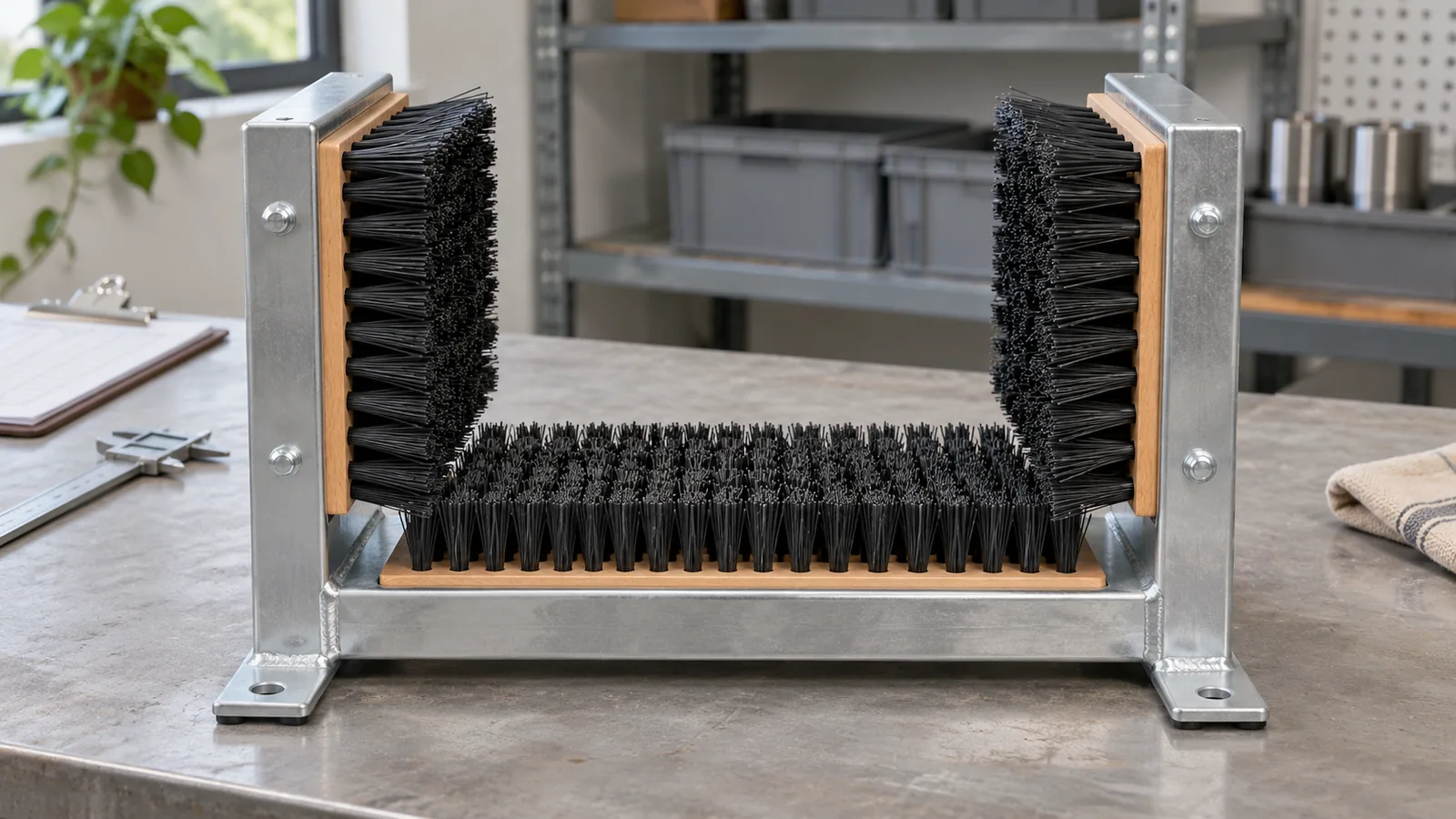
Boot scraper replacement brush compatibility depends on the interface at each position, not on the product name or overall frame width. Before ordering a frame or spare blocks, buyers should identify the side and base positions separately, record each block’s mounting face and attachment, and confirm that the intended parts can be removed and refitted on the actual assembly. A sample review can establish the fit and access that were observed; it cannot establish bristle performance, stability, outdoor life, or a safety rating.
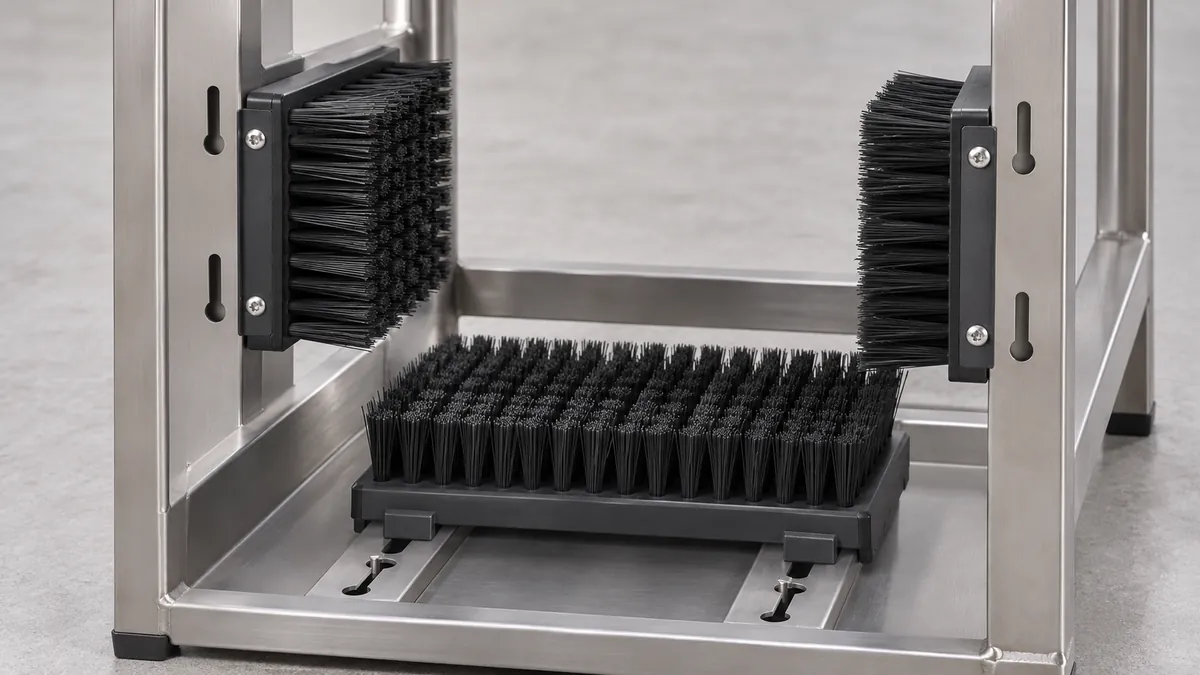
Why does boot scraper replacement brush compatibility depend on position?
A boot-cleaning frame may use brush blocks on its sides, across a base, or in another arrangement. Those positions do not necessarily share one block size or fastening method. A catalog description such as “replacement brush” may identify a family or model without telling a distributor whether the replacement is intended for the left side, right side, or floor-facing position. Buyers need a position-level parts record tied to the frame model and revision. In practice, boot scraper replacement brush compatibility is checked against this complete position-and-interface record, not inferred from a similar product name. A second useful check is whether the frame revision and replacement pack code appear together on a supplier-approved cross-reference.
This distinction is visible in commercial products. Malish lists a metal chassis and separately identified replacement brush blocks, while Hurstbourne Forge describes a steel frame with individually replaceable wooden brushes. A sports-equipment catalog distinguishes side brushes from a horizontal brush and gives them different lengths. These are examples of product-specific configurations, not universal dimensions or proof that components from different brands interchange. The manufacturer’s currently approved drawing and instructions remain the controlling references for a quoted product.
For an importer, the question affects more than an initial spare-parts order. A replacement that cannot be mounted may create an unusable service item; a block installed in the wrong position may change contact or clearance; and a kit containing an ambiguous mixture can complicate picking and customer support. These are risks to investigate, not claims that a particular failure rate exists. The practical response is to associate each spare with a named frame, position, attachment revision, and quantity per assembly.
What information should an RFQ include?
Begin with the product identity: frame model, drawing revision, intended installation condition, and the requested supply scope. State whether the quotation covers a complete frame, a replacement block, fasteners, or a service kit. Then create one row for every distinct brush position. Do not combine different positions simply because their blocks look similar in a photograph.
For each row, provide the block’s length, width, thickness, mounting face, and a drawing or sample reference. If a supplier has not confirmed one of these values, mark it “to be proposed” or “unconfirmed.” Do not turn a rough image estimate into a controlled dimension. Show the frame-side interface as well: visible holes, slots, threaded features, backing plates, access openings, or other attachment details that the responsible supplier has actually documented.
Fastener identification is useful only when it is specific. Record the approved screw or other fixing reference, quantity, and tool access if these are part of the supplied assembly. If those parts are bought in, identify their supplier and revision in the BOM or approved component list. A generic note such as “hardware included” is not enough to show that the service pack contains the same fixing needed by the frame.
The buyer should also define what is expected from the brush block itself without inventing a performance test. A drawing may identify the bristle envelope, block body, backing, and orientation. It does not by itself prove a particular cleaning outcome, slip resistance, hygiene result, or durability. If those claims are needed, the product owner must specify the relevant evidence and responsible test method separately.
| RFQ field | What to record | Why it matters |
|---|---|---|
| Frame identity | Model, revision, and assembly drawing | Connects the spare to a controlled product |
| Position | Side, base, or named location | Prevents mixing unlike interfaces |
| Block geometry | Supplier-confirmed dimensions and drawing reference | Supports fit review without guessing from photos |
| Attachment | Mounting face, fixing pattern, and approved fastener | Identifies how the block mates with the frame |
| Service access | Tool access and removal direction on the installed frame | Shows whether replacement can be performed as intended |
| Pack quantity | Blocks per position and per service kit | Aligns purchasing, warehouse, and customer-facing descriptions |
How should a buyer review the physical sample?
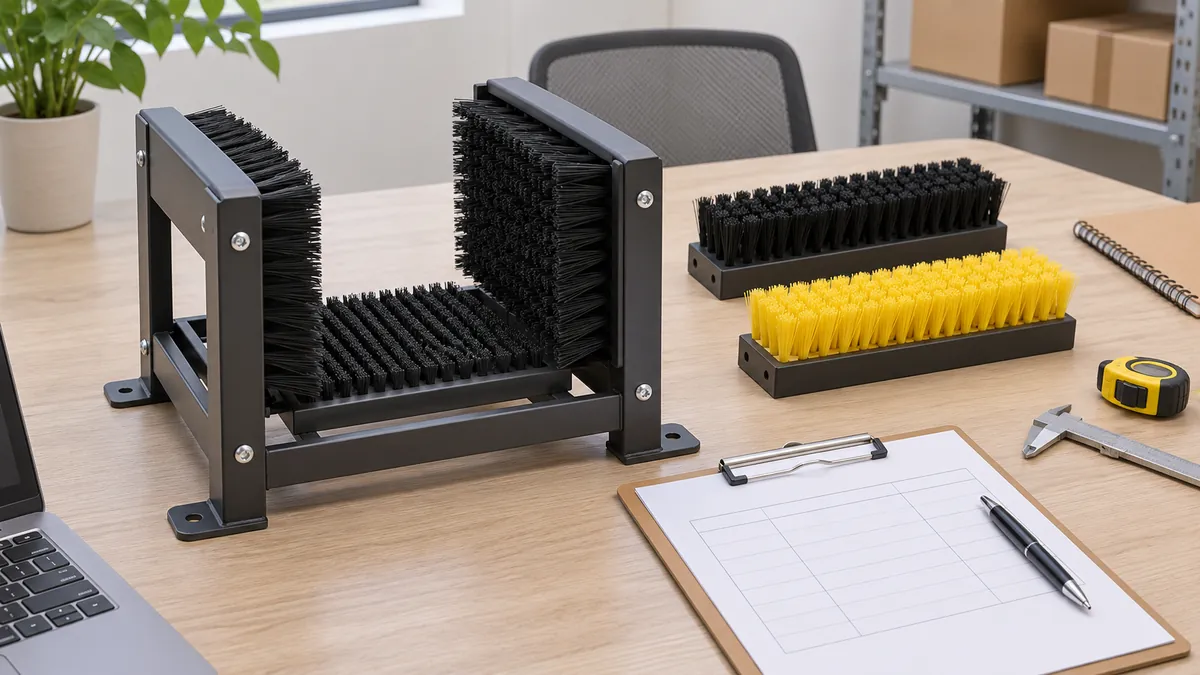
Use a frame and brush samples that represent the quoted configuration. First verify part identity against the drawing and labels. Then place each block in its assigned position and observe whether its mounting face, holes, backing, and fasteners correspond to the approved interface. Record the result by position rather than writing a single “fits” note for the entire unit.
If the frame is intended to remain installed while a block is serviced, review access in that state. A loose sample on a workbench can make every screw easy to reach; a frame close to a wall or another fixture may present a different access path. The sample procedure should follow the product maker’s authorized instructions. Do not force a block, drill a new hole, substitute a fastener, or infer an unapproved repair method merely to make a mismatched part fit.
Observe removal and refitting for the positions included in the sample. Note which tool is used, what surrounding parts obstruct access, and whether a second person or a disassembly step is required according to the documented method. If there is no approved procedure, raise the question before the component is released for sale as a replacement. This review is about interface and service access; it is not a cycle-life test unless a separate, qualified method defines the number of cycles and acceptance criteria.
Check the intended block envelope and neighboring clearances. A longer side block may project differently from a base block, and bristle height can affect what contacts a boot. The sample tells the buyer what the observed configuration does; it does not establish a universal boot size, cleaning result, or safe-use condition. Keep the observation, sample identification, and open questions together so later changes can be compared against the same baseline.
How do revisions and replacement packs affect compatibility?
Compatibility is a relation among the frame, block, position, and attachment, not just a shared marketing name. A frame revision may change a mounting face or access opening. A block revision may change its body or fastener arrangement. A spare pack may bundle several positions or omit a component that the complete assembly includes. Each change deserves an explicit review rather than an assumption that “same model family” means identical service fit.
Set up a simple revision cross-reference. For example, list the frame model and revision in the first column, the approved block identity for each position in the second, the attachment or fastener revision in the third, and the replacement pack code in the fourth. Mark superseded parts and approved substitutions only when the responsible manufacturer has provided evidence. Similar appearance does not prove equivalent fit or material.
For distribution, define whether the spare is sold as one block, a pair, a full position set, or a complete service kit. The product page, carton label, and warehouse code should use the same naming convention. If side and base blocks differ, show their quantities independently. If a complete kit is packed, the kit definition should specify every included block and fastener. This reduces ambiguity in replenishment and makes it easier to detect when an order line describes only part of a set.
Where buyers manage several frame models, do not assume a single “universal” spare based on one shared dimension. Require the supplier to name the approved compatible models and revisions. If the list is not documented, label compatibility as unconfirmed and request a paired sample or drawing comparison. This is a more reliable basis for a catalog claim than using a broad phrase that has not been substantiated.
Which sourcing mistakes create avoidable ambiguity?
The first common process mistake is ordering by product category alone. “Boot scraper brush” does not describe the frame interface, the specific position, or the service pack. A close-up image can help identify a visible feature, but the controlling details belong in a drawing, component specification, or approved sample record.
The second is treating all brush blocks as one interchangeable part. Side and base positions may have different dimensions, orientations, attachment details, or required quantities. Even if two blocks appear similar, buyers need the supplier’s confirmation before combining them under one SKU.
The third is confusing a replacement listing with an installation instruction. A supplier may offer a replacement part without publishing a complete procedure for every frame revision or installed condition. If the buyer needs service at a particular site, request the currently applicable instructions and verify access using the intended frame arrangement. Do not infer undocumented hole patterns or assembly sequences from a photograph.
Another mistake is assuming that a metal frame proves a particular load or stability level. The frame material alone does not establish performance. Structural claims require product-specific design inputs and appropriate evidence. Similarly, a sample that accepts the block does not prove the frame’s anchorage, bristle effectiveness, corrosion resistance, slip behavior, or outdoor exposure life.
Finally, buyers sometimes change a component late in the process without updating packaging, service codes, or web descriptions. A substitute block, backing, or fastener can create a mismatch between what the drawing says and what the spare kit contains. Route changes through a written approval with the part identity, affected positions, and updated revision recorded.
How can a metal OEM discussion support the buyer decision?
An OEM discussion can help translate a buyer’s frame drawing and purchased brush references into a manufacturable metal interface, but the discussion must stay within confirmed scope. Koitor Hardware is a family-owned custom metal hardware manufacturer focused on bathroom and home storage hardware. Its relevant experience is metal fabrication and project-specific drawing or sample communication; the current manufacture of boot-cleaning frames, brush blocks, molded components, bristles, or this exact adjacent product is not confirmed.
For a project inquiry, send the lawful frame drawing or physical reference, identify which components are supplied by the buyer or another supplier, and state whether the request concerns a metal structure, joining, finish, assembly, or packaging handoff. Ask the supplier to confirm the proposed production route and purchased-component responsibilities before treating a concept as an available product. A frame supplier cannot substantiate bristle performance if the bristle assembly is outside its tested scope.
A small-scale production factory may review a sample or drawing for a defined metal part, but that does not automatically mean it owns the complete product system. Clarify who approves the block, fastener, and replacement pack; who controls changes; and who provides the evidence behind any product claim. If the metal route is not feasible or the component interface is outside the supplier’s capability, that limitation should be resolved before commercial commitments are made.
The right outcome of an RFQ is therefore not simply a unit price. It is a controlled description of the offered frame revision, included components, sample state, surface requirements, packaging, and evidence responsibility. Buyers can then compare supplier responses on an equivalent scope and identify unresolved dependencies instead of discovering them during replenishment.
What should buyers include before requesting a quotation?
- Frame model, drawing revision, overall concept, and intended installation state.
- One identified row for every side, base, or other brush position.
- Confirmed block references, dimensions, attachment drawings, and sample identifiers.
- Fastener quantity, identity, access requirement, and responsibility for supply.
- Complete frame versus replacement block versus service-kit supply scope.
- Quantity per assembly and per spare pack, with SKU and revision conventions.
- Finish, corrosion environment, carton, protective packaging, and labeling expectations where applicable.
- Claims that need substantiation, with the evidence owner identified.
- Target order quantity, sample needs, market, and any buyer-controlled approval criteria.
- Open questions clearly marked as unconfirmed rather than filled with assumed values.
الأسئلة الشائعة
Can one replacement brush fit every boot scraper frame?
Do not assume so. The frame position, block dimensions, mounting face, and attachment must match. Ask the responsible manufacturer for compatible model and revision references.
Are side and base brushes usually the same size?
Product configurations vary. Some catalogs distinguish side and horizontal blocks, so specify each position separately and use the current product drawing rather than a generalized size assumption.
Does a successful sample fit prove a replacement kit is ready to sell?
It proves only the observed pairing and procedure under the sample conditions. Confirm pack contents, labeling, revision control, and any separate performance claims before releasing the kit.
Can the sample prove cleaning effectiveness or slip safety?
No. Physical interface review does not establish cleaning outcomes or slip performance. Those claims require defined, product-specific methods and responsible evidence.
Does Koitor currently manufacture this boot-cleaning product?
No current Koitor boot-cleaning SKU or brush-block capability is confirmed here. A buyer may share a lawful concept for a project-specific metal feasibility discussion; availability and scope require confirmation.
Discuss a Defined Metal Hardware Brief
Share a lawful drawing, reference components, finish direction, and packaging needs to discuss project-specific metal feasibility within confirmed scope.
OEM / العلامة التجارية الخاصة
حوّل دليل التوريد هذا إلى موجز منتج
يرجى إطلاعنا على المنتج المستهدف، والحجم، والتشطيب، وكمية الطلب، ومتطلبات التغليف. وسيتلقى فريقك تقييمًا عمليًّا لإمكانية التصنيع قبل تقديم عرض الأسعار.


 English
 Español
 Português
 Français
 Deutsch
 العربية