

Boston shaker tin compatibility is a property to approve for a named pair, not an assumption based on two vessels sharing a capacity label or product category. Identify the exact upper and lower tins, supplier models, revisions, finishes, and intended pairing. Then review the complete assembled offer for the maker-declared joining method, intended liquid-retention evidence, and release behavior under a supplier-approved procedure. A dry fit, similar diameter, or compatible-product list has a limited scope and must not be expanded into a universal seal or performance claim.
Here, boston shaker tin compatibility refers to the exact buyer decision and product scope described in this guide.
What does boston shaker tin compatibility mean for a buyer?
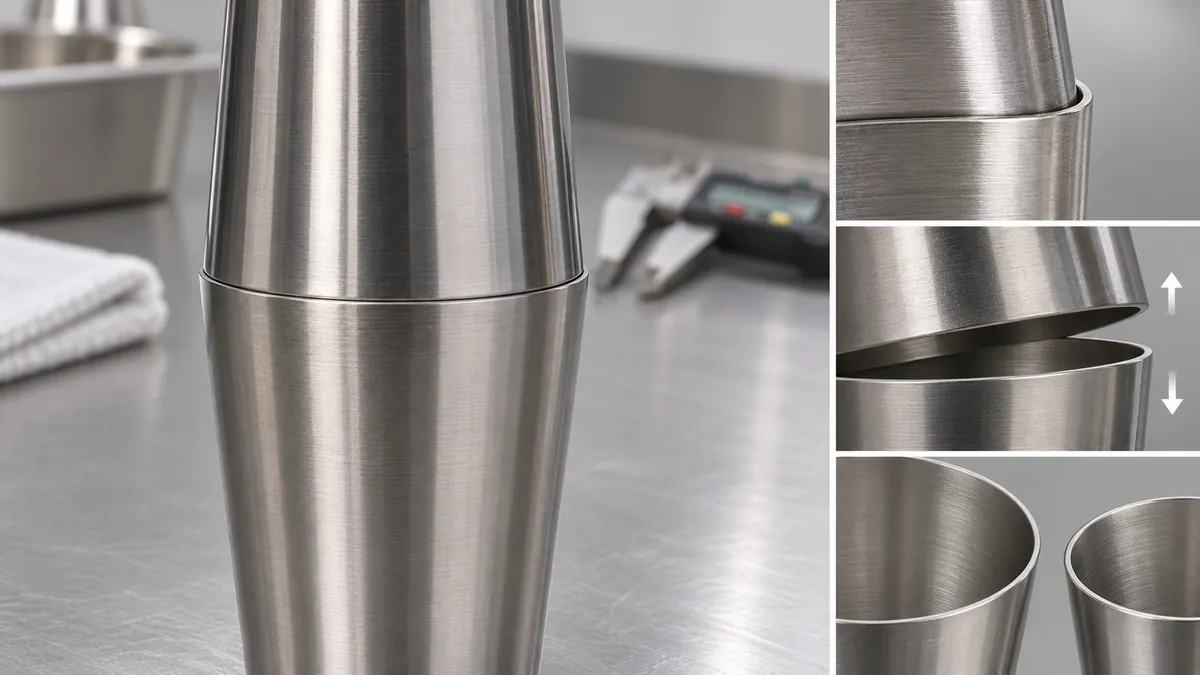
A two-piece shaker is a matched interface. The upper and lower vessels meet at defined rim or body regions, and their interaction depends on the exact shapes and product design. Two individual tins may each have a capacity description while still lacking evidence that the pair was designed and evaluated together. Capacity does not describe the contact geometry or establish how the assembly behaves in its intended use.
Manufacturer catalogs show that suppliers distinguish complete pairs from single mixing tins and replacement cups. A 2022 American Metalcraft supplement separately identified a paired shaker set and replacement cups, while also listing mixing tins with a pour spout. This is a historical catalog example of product-scope distinctions, not current availability, universal fit, or a leak-performance rating. A current UrbanBar listing names specific compatible cups for its UB20 tin. That compatibility statement belongs to that maker and model list; it does not establish that every cup of comparable capacity will fit.
The buying question should therefore start with the purchase unit. Is the buyer ordering a complete set, a lower tin, an upper tin, or a replacement component intended to pair with an existing product? If only one piece is being purchased, the complementary model must be named. If a set includes two pieces, the quotation and package list should identify each reference and confirm they are intended to be used together. A photo of a pair is not a controlled bill of materials.
Keep functional volume and stated vessel capacity separate. The capacity printed for each tin does not mean their values should be added to predict a usable fill volume. Follow the maker’s instructions for fill and use. Do not derive a safe fill level or usage limit from the sum of catalog capacities. Those values can refer to different measurement conventions or vessel regions and do not establish the assembled use condition.
What should an importer include in the approved pair record?
Record both components independently. Include maker, model or item code, revision if available, nominal capacity as declared, material and finish as supplied, and whether the unit is sold as a set or individually. Identify which part is upper and which is lower, and link the supplier’s compatibility statement or controlled assembly reference. If a seller names compatible partners, preserve the exact model names and any limitations rather than copying only the broad product family.
The record should also state the intended use and evidence required. Joining behavior, liquid retention, and release are related but distinct questions. A pair might seat together but lack evidence for the intended liquid-handling procedure. A pair might retain liquid under one defined setup without establishing that it releases appropriately for all users. Do not assign universal forces, temperatures, cycle counts, tolerances, or leak limits unless the responsible supplier has defined and supported them for that product.
| Pair record field | What the buyer should capture | Why it matters |
|---|---|---|
| Upper component | Exact maker model and revision | Names the mating part and its identity |
| Lower component | Exact maker model and revision | Prevents an assumed substitute |
| Purchase scope | Set, single tin, or replacement piece | Aligns quote, order, and package contents |
| Finish and material | Supplier-declared specification | Keeps changes visible for review |
| Pairing basis | Maker compatibility statement or approved sample record | Limits the claim to supported models |
| Intended use | Product instructions and buyer application | Defines which evidence is relevant |
| Joining evidence | Supplier-approved method, result, and limitations | Separates fit from broader performance |
| Release evidence | Named procedure and scope | Avoids assuming tight fit means usable release |
| Excluded combinations | Models not approved or not reviewed | Stops accidental extrapolation |
A maker compatibility list is valuable because it names specific references, but it remains a supplier declaration unless independently tested. Record its date and source. If the buyer needs a model not listed, request a written response from the manufacturer rather than treating similar dimensions as inclusion. If no response is available, label that pairing unverified.
How should buyers evaluate joining, retention, and release?
Start with the current manufacturer instructions and the exact product pair. Confirm that the sample corresponds to the model and revision named in the quote. The supplier should explain the intended assembly procedure and the conditions under which its product claims apply. The buyer can then decide whether the supplier’s evidence addresses its required use and whether further qualified testing is necessary.
A visual fit check can document whether the identified pieces appear to seat as shown in the product instructions and whether visible damage or mismatched parts are present. It does not establish liquid retention. Likewise, observing one successful use does not establish performance across production lots, alternate partner models, temperature conditions, or different operating techniques. Keep the method and conclusion paired: report exactly what was inspected and what remains unknown.
Do not develop a hazardous or improvised test from this article. Avoid striking, heating, substituting glass or other vessels, or shaking a pair outside manufacturer directions. If liquid retention or release evidence is commercially important, the supplier and buyer should agree an appropriate protocol and responsible owner. A controlled test should use the exact approved pair, follow maker instructions, and state the environment, method, sample quantity, and limits of interpretation. No test result is available in the research pack for the example products.
Separate leak-related wording from joining terminology. “Fits,” “mates,” “forms a pair,” and “retains liquid under a defined procedure” are not interchangeable claims. If the product listing says “compatible with” named cups, retain that exact partner list. Do not change it to “fits all standard cups” unless that broader claim is independently substantiated and approved by the manufacturer. The term “standard” is particularly vague unless a specific standard or controlled interface is defined.
How do finish and replacement choices affect approval?
Finish changes can require a review of the mating interface, appearance, care instructions, and any contact-related statements. Do not assume every change in finish alters fit, and do not assume a visually similar finish preserves all use claims. Ask the supplier whether the proposed finish is covered by the same product references and instructions. Record the actual finish on each paired component, especially when the buyer is mixing generations or replacing only one tin.
A replacement part should have a named complementary partner. If an existing lower tin is retained, the buyer must identify its maker and model as precisely as possible and ask whether the proposed upper tin is listed for that partner. If the original model is discontinued or undocumented, a sample may help start a feasibility review, but the buyer should not infer brand equivalence from a dimensional resemblance. The supplier can assess the request within its legitimate capability and intellectual-property boundaries.
If a replacement cup changes the rim, body shape, weight, finish, or nominal capacity, review whether the original pair record still applies. The new component may require a separate item code and instructions. A private-label buyer should also check that package contents, product title, product images, care copy, and spare-parts table all refer to the same pair. Avoid combining a current cup with an old compatibility statement unless the responsible supplier approves the combination.
No universal compatibility can be inferred from “18 oz,” “28 oz,” or another capacity label. The dimensions and geometry may vary by brand or model. This article does not offer cross-brand conversion rules or replacement recommendations for a particular maker. Preserve the maker’s exact pairing information and ask for written approval where the buyer’s intended combination is not explicitly covered.
What evidence belongs in a sample approval?
A useful approval package begins with controlled sample identification. Label the upper and lower components, record the source and date, and tie each item to a quote or model code. Compare the sample with the current product specification and instructions. Note visible differences and unresolved questions. Do not mix separately sourced tins in a shared sample set without preserving their identities.
The buyer’s checklist can include whether the components supplied match the approved pair, whether the maker’s named pairing is documented, whether the intended assembly is described, and whether evidence for required retention and release claims has been provided. If the order is for a single replacement tin, the approved partner must be stated in the purchase record and customer instructions. If the order is for a complete set, both parts and all package accessories should match the bill of materials.
A sample can identify obvious mismatches, missing components, damaged rims, or discrepancies between the product and its documentation. It cannot prove food-contact compliance, hygiene suitability, dishwasher safety, corrosion life, or performance for every user. Those are separate claims requiring the responsible supplier’s documents and appropriate qualified review. Do not copy marketing language from another product or finish to fill an evidence gap.
Document approval wording with scope. A statement such as “the two listed model references are the supplier-approved pair for the stated instructions” is narrower and more useful than “compatible shaker tins.” If a buyer’s own evaluation supplements the supplier’s claim, identify the method and its limits. Do not represent a sample observation as a certified test or guarantee.
How should the RFQ distinguish a complete set from a mixing tin?
Describe the required tool action and offer. A mixing vessel with a pour spout may be a useful adjacent item but is not automatically a complete two-piece shaker. A standalone tin can be sold as a replacement or as part of a named pair. The quotation must say which product is being priced, what parts are included, and whether the supplier identifies a compatible partner.
Ask for the supplier’s exact item code for each component, the complete set configuration, package quantity, current instructions, care details, and replacement-part mapping. If the buyer expects individual replacement sales, ask whether each part is available separately and what pairing restrictions apply. Do not assume that a component shown in a catalog is sold individually or that the manufacturer will continue supplying it. These are commercial facts to confirm in the current quotation.
Compare supplier offers only after normalizing scope. One quote may include a complete pair and another a single tin; their prices do not describe the same offer. A third may include a named glass partner or a specific finish. Separate optional accessories and confirm which evidence supports each pairing. If the supplier proposes a substitute, reopen the pair review rather than accepting an equivalent capacity label.
| RFQ question | Supplier response to retain |
|---|---|
| Is this a complete pair or a single component? | Item codes and bill of materials |
| Which exact parts are intended to mate? | Model-specific compatibility declaration |
| What instructions govern assembly and use? | Current manufacturer document and version |
| What evidence covers required retention or release? | Method, result, scope, and limitations |
| Which replacements are available? | Separate codes and named partner references |
| What changes would require reapproval? | Supplier change-control conditions |
What should buyers avoid claiming?
Do not promise a universal leakproof seal, spill prevention, perfect fit, or interchangeable use without product-specific evidence. Do not claim that any two tins with similar capacity are compatible. Do not imply that a particular finish, weight, or “weighted” construction guarantees mixing quality, durability, or release. These statements would require evidence that the cited research does not provide.
Do not turn a maker’s compatibility list into a cross-brand standard. A listed partner applies to the named product and may be revised. Do not rely on a historical catalog as proof of current inventory or current instructions. If a source is dated, retain that date and verify the present offer before writing a live commercial listing.
Do not use customer forum anecdotes as verified failure reports or frequency data. Search-result discussions can reveal questions about fit and release, but the cited discussions were not fully accessible and are not technical evidence. They do not establish a defect cause or a Koitor customer experience. Product decisions should follow actual maker documentation and controlled buyer requirements.
Koitor’s confirmed scope is bathroom and home-storage metal hardware. The adjacent barware examples in this article do not establish that Koitor manufactures shaker tins, glassware, food-contact products, or leak-tested vessels. Any inquiry must be assessed against the actual drawing or sample and approved capability facts before making a feasibility commitment.
Buyer checklist before ordering a Boston shaker pair
- Record exact upper and lower model codes, revisions, materials, and finishes.
- Confirm whether the order is a complete pair, individual tin, or replacement part.
- Save the current maker compatibility statement and instructions.
- Identify the exact partner for every single-component offer.
- Separate fit observation from liquid-retention and release evidence.
- Agree any required test method with the responsible supplier before testing.
- Record sample identity, method, date, reviewer, result, and limitations.
- Align quotation, bill of materials, package, product listing, and care copy.
- Reopen approval after a model, finish, rim, or partner change.
- Keep unsupported universal claims and adjacent-category capability assertions out of copy.

الأسئلة الشائعة
Does matching capacity prove two shaker tins are compatible?
No. Capacity does not establish the mating geometry or assembled behavior. Use the maker’s exact compatibility statement for the named models.
Is a mixing tin automatically one half of a shaker set?
No. Catalogs may distinguish mixing tins from complete paired sets and replacement parts. Confirm the supplier’s item scope and named partner.
Does a dry fit prove that the pair retains liquid?
No. A dry visual fit is limited evidence. Retention and release claims need supplier-defined, product-specific evidence under an agreed method.
Can a replacement tin be selected by ounce capacity alone?
No. Model identity and interface matter. Request a named compatible reference rather than assuming equal nominal capacity means fit.
Can a buyer perform its own shake test to approve an unknown pairing?
Use the manufacturer’s instructions and qualified review. This guide does not recommend improvised tests or combinations outside the maker’s stated use.
Does Koitor currently manufacture Boston shaker tins?
No such capability is asserted. Koitor’s confirmed scope is bathroom and home-storage metal hardware; project feasibility requires a separate review.
المصادر
- UrbanBar Boston shaker tin UB20 — current model-specific maker compatibility declaration; not universal performance evidence.
- American Metalcraft 2022 supplement — dated catalog distinction between shaker pairs, mixing tins, and replacement cups; not current availability proof.
- Cocktail Kingdom Koriko shaking tins — named paired-product example; no independent seal or performance conclusion.
- Koitor tube-end swaging and joint-fit guide — separate structural storage-rack joint topic, not a shaker compatibility test.
- Koitor vessel and insert specification guide — separate vessel-role topic; does not qualify a shaker pair.
اعمل مع شركة «كويتور» للأدوات
How should changes move through a distributor’s product lifecycle?
Pair approval should remain connected to the item master after launch. A new supplier, revised rim, new finish, updated package, or discontinued partner can change what the buyer is authorized to sell together. The category owner should link each component code to its approved partner and keep the effective date. If a part is replaced, the old record should remain available for service and historical order questions instead of being overwritten without trace.
A distributor that sells a complete set and replacement tins should distinguish the order units in its systems. A complete pair can have one retail code with two component references beneath it. Individual replacement parts need their own codes and a partner note. This reduces the chance that a customer receives one tin with no known mate. The buyer should validate the mapping across purchase orders, warehouse labels, product feeds, and customer service documentation. The exact structure depends on the buyer’s systems; this guide does not prescribe an ERP configuration.
If a supplier revises a component, ask what changed and whether the earlier pairing declaration still applies. A change may be purely administrative, or it may affect geometry, finish, instructions, or available partners. The buyer should not decide that the impact is trivial without understanding the revision. Keep the old and new sample references distinct and route any required technical review to the responsible owner. Update product copy only after the new scope is approved.
Where the original pair is no longer available, a buyer may need a transition decision. Options can include selling only complete new sets, identifying a verified replacement partner, ending replacement-part sales, or supporting a legacy item for a defined period. These are commercial choices, not technical conclusions. Do not promise interchangeability just to preserve a catalog listing. If the partner relationship is unknown, say so and avoid representing the part as a suitable substitute.
How should an importer phrase the final approval?
The approval should name the exact model references and state the evidence basis. For example, an approval record could say that a specified upper and lower model are the supplier-declared pair under the current instructions, with a sample identity and any additional buyer review noted. It should also state exclusions such as unreviewed third-party partners, untested alternate finishes, or unverified replacement revisions. This gives sales and operations a usable boundary.
Avoid shorthand such as “Boston standard,” “universal tin,” or “fits all cups” unless the supplier has defined and substantiated that scope. A product family name is not a dimensional standard. If the supplier’s own page lists certain cups, quote that list accurately and link the current document. When a buyer’s requested partner is not listed, obtain a specific written response and retain it with the quote. A verbal statement without model references can be difficult to apply to later reorders.
The final approval should identify who may authorize exceptions. A sales representative may know the catalog offer, but a technical or product owner may need to assess a changed mating part. Define the escalation route for a customer who asks whether a different tin can be used. Staff should be able to answer “not confirmed” and route the question rather than improvise from size labels. A careful limitation is better than an unsupported assurance.
This record also supports future content. Product listings and FAQ copy should use the exact pairing language that the buyer approved, not generic claims assembled from unrelated models. If a maker later updates its partner list, the buyer can review the impact rather than assuming the change applies automatically to every existing SKU. Maintaining that relationship between product evidence and published wording protects both accuracy and customer expectations.
Discuss a confirmed metal component scope
Share authorized component drawings or samples, the intended mating pair, finish, and order range. Koitor will first confirm whether the defined metal hardware scope fits its established bathroom and home-storage capabilities.
OEM / العلامة التجارية الخاصة
حوّل دليل التوريد هذا إلى موجز منتج
يرجى إطلاعنا على المنتج المستهدف، والحجم، والتشطيب، وكمية الطلب، ومتطلبات التغليف. وسيتلقى فريقك تقييمًا عمليًّا لإمكانية التصنيع قبل تقديم عرض الأسعار.


 English
 Español
 Português
 Français
 Deutsch
 العربية