
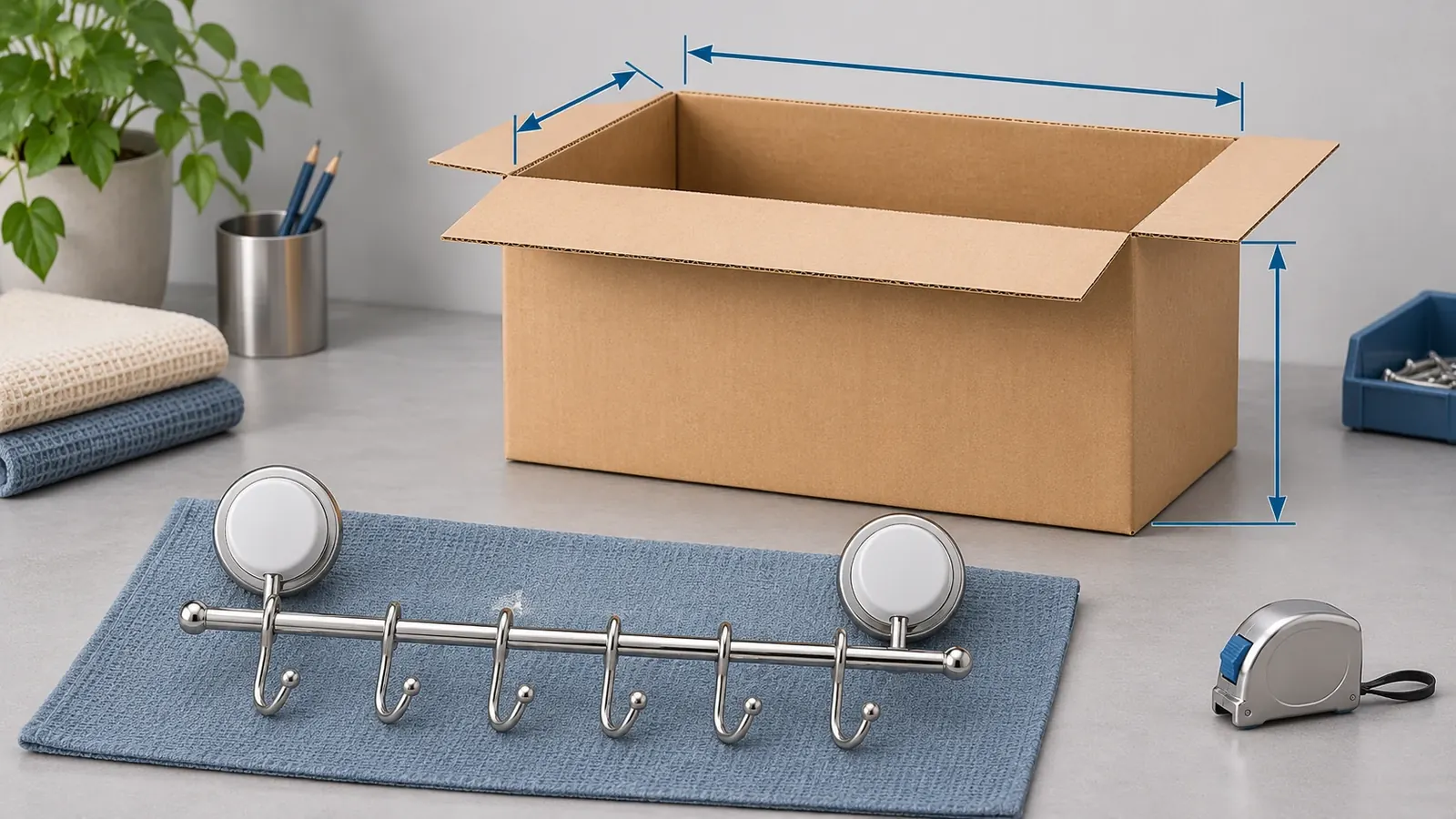
Box dimensions order is commonly written as length × width × height, but those three labels are useful only when the opening direction, units, and inside-or-outside basis are also clear. In Uline’s catalog convention, length and width describe the longer and shorter sides of the flapped opening, while height runs from the opening to the base; a tall carton can therefore have the largest number in the height position. For an importer specifying a bathroom rack carton, keep the supplier’s labeled box drawing separate from the packed product’s outside shipment dimensions. The source convention is documented in the referenced technical guidance.
What Problem Does This Article Help Buyers Solve?
A buyer can receive a box quote such as “30 × 10 × 10 cm” and still not know which face is the opening, whether those values are internal or external, or how the carton will be oriented during packing. That uncertainty matters when a metal towel bar, basket, or bracket has a long shape but a relatively narrow opening. A three-number string has magnitude, but without its axis definitions it is not a complete packaging specification.
The phrase box dimensions order usually refers to the sequence length, width, and height. It does not guarantee that every supplier uses the same physical reference for every carton style. Uline’s own guidance says its catalog dimensions are inside dimensions and defines length and width from the opening plane. Its FAQ also cautions that the order can depend on the product category; its box and bag listings use different conventions. These are the conventions of the named source, not a universal rule for every packaging supplier.
For a hardware importer, the practical goal is to preserve one unambiguous description from the product drawing through the carton sample, packing instruction, and shipment records. The carton supplier may be responsible for manufacturing the box, while the hardware buyer still has to approve how the product, protection, and inserts fit inside it. Confusing a catalog interior with a closed carton exterior can lead to a sample that is hard to load, a packing change late in development, or inconsistent dimensions passed to a logistics partner.
This guide answers the dimension-order question and shows how to document it. It does not determine carton strength, freight charges, carrier billing rules, allowable manufacturing variation, or whether a particular rack will fit. Those decisions require the actual carton construction, packing materials, product envelope, and service-specific instructions.
What Should Importers Check First?
Before reviewing the numbers, ask the supplier to identify the object being measured. “Box size” may mean an empty box’s inside opening, its inside depth, the closed outside dimensions, a flat blank, or the packed shipment after the product and cushioning are in place. These are not interchangeable measurements. Write the object and measurement basis beside the values.
Then identify the opening. In the Uline box-catalog example, the opening has a longer side called length and a shorter side called width. Height runs from that opening toward the base, excluding the flaps. A tall box may be listed as 4 × 4 × 12 inches, with height greater than both opening dimensions. Reordering that line into 12 × 4 × 4 because the largest number “must be length” would change the opening description.
Use this quick review before approving a quote:
- Units: state millimeters, centimeters, or inches explicitly. Do not infer units from a drawing scale or an earlier email.
- Reference surface: say inside dimensions or outside dimensions. If both are needed, list them as separate sets.
- Opening plane: identify which two values describe the open face and which direction runs from opening to base.
- Flaps and closure: confirm whether a stated height excludes flaps, includes an overlap, or refers to a closed carton measurement.
- Orientation: show which face is up or open when the product is inserted, and how it will be closed.
- Contents: list the product, loose components, protective wrap, dividers, and accessories included in the fit check.
- Drawing revision: attach the dated or revision-controlled carton sketch used for the sample and quote.
- Shipment record: collect the external packed dimensions separately when a carrier or forwarder requests them.
An authored example makes the orientation issue visible. Carton A has an inside opening of 30 × 10 cm and a height of 10 cm. Carton B is described as 10 × 10 cm at its opening with a 30 cm height. Both have a calculated internal volume of 3,000 cm³, yet their openings and loading paths are different. The equal volume is not proof that a particular towel rail fits either carton: the rail’s envelope, its insertion angle, padding, end protection, assembly state, and the actual box structure still need review.
Use a small sketch rather than an ambiguous email phrase. Draw the opening as a rectangle; label its long side L and short side W if that is the supplier’s convention; draw an arrow from opening to base and label it H. Add units and “inside” beside the three values. If the packaging supplier uses another convention, do not force its drawing into this sketch. Record its own axis labels and add a note explaining how the supplier’s drawing maps to the buyer’s packing plan.
How to use the box dimensions order reference
A short dimension record to copy into an RFQ
| Field | Example entry | Why it belongs in the record |
|---|---|---|
| Carton object | Empty regular slotted carton | Makes clear what is being measured |
| Measurement basis | Inside dimensions | Separates interior fit from the outer shipment envelope |
| Order and axes | L × W at opening × H to base | Preserves orientation instead of sorting numbers |
| Units | سم | Prevents inch/metric ambiguity |
| Flap treatment | Height excludes flaps per supplier drawing | Makes the closure reference explicit |
| Contents | One towel bar, two end pieces, wrap and insert | Defines what the fit check must include |
| Revision | Drawing C, sample approval dated ___ | Connects quote, sample and packing instruction |
The entry above is a documentation example, not a recommended carton size. A packaging supplier may define its products differently; the supplier’s current drawing and the buyer’s intended packing method govern the actual order.
How Do Materials, Structure, and Finish Affect the Product?
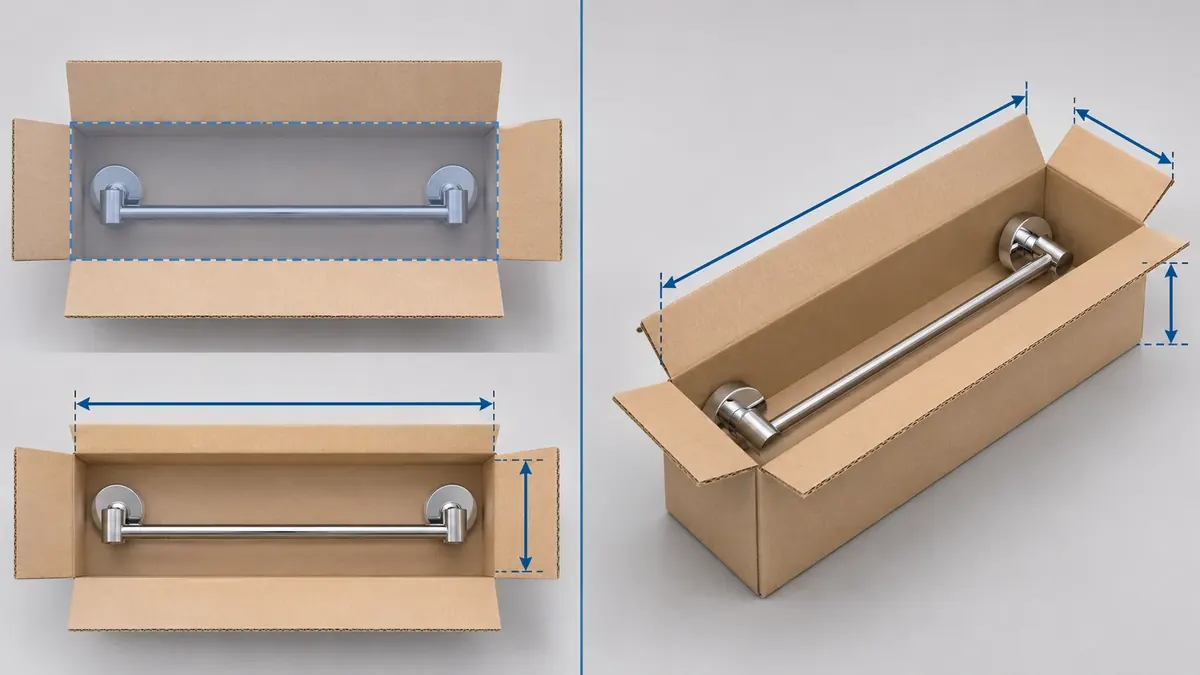
Carton dimensions are only one part of the package. A buyer should review the board construction, opening, joint, inserts, separators, and closure as a system with the actual hardware. This article does not assign a board grade or compression value because those depend on the packaging specification and evidence supplied for the particular carton.
A rigid towel bar and a wire basket present different packing shapes even when their outer product length is similar. One may have projections, hooks, rounded corners, or a mounting plate that can contact another part. The usable inside space must account for the product’s real maximum envelope and its protected state, rather than a nominal drawing dimension alone. If a rail is wrapped, the protection adds to the packed envelope. If a set is nested or assembled for shipment, the approved state must be stated and represented in the sample.
The box opening controls how a product enters. A long rail may have enough internal length but still be difficult to pass through a narrow opening if it cannot be rotated inside the carton. A basket may fit its length and width on paper but collide with a folded flap, insert, or adjacent kit bag. These are packing-path questions, not volume questions. A physical sample or a dimensioned mock-up can expose them more clearly than multiplying three values.
Inside and outside sizes also answer different questions. The interior is relevant to product clearance and protective inserts. The exterior is the closed package envelope. Board thickness, seams, flaps, folds, and external cushioning affect the relationship between them; no single fixed addition should be assumed for every carton design. Ask the packaging supplier to provide the relevant reference surfaces rather than deriving an outside size from an inside size with a universal allowance.
The finished metal surface also affects the way parts are protected and oriented. Polished, plated, or coated faces may need separation from sharp edges or contact points, depending on the product specification. A carton size alone cannot prove that the finish is protected. Ask the sample reviewer to check the actual contact surfaces, wrap, dividers, and closure after packing and after unpacking. For broader kit completeness and inspection steps, use the existing قائمة مراجعة لفحص تغليف مجموعة الأجهزة.
For multiple stock-keeping units, record whether carton dimensions apply to one model, a mixed assortment, or a master carton. Do not carry a retail carton’s inside dimensions forward as if they were the outer dimensions of a mixed-SKU shipping carton. The approved mixed-SKU load plan and quantity tally are separate documents; the existing container loading inspection checklist covers that distinct shipment-readiness task.
The useful principle is to keep a chain of separate, named measurements: product envelope; packed product envelope; empty-carton interior; closed-carton exterior; and, where relevant, the shipment measurement requested by the actual transport service. If any one of those numbers is reused for another purpose, record the conversion or measurement source explicitly. This creates traceability without implying that a dimension chart alone validates protection, stacking, carrier charges, or product condition on arrival.
What Are Common Mistakes When Sourcing This Product?
Sorting the three numbers by size. This may destroy the intended axis order. Under Uline’s box convention, height can be the longest value. Preserve the supplier’s opening orientation and drawing labels instead of reordering values to fit a preferred pattern.
Leaving off inside or outside. A quote that says only “30 × 10 × 10” does not establish whether the inside product space or outside carton envelope is meant. Ask for the measurement basis and draw both if both matter.
Treating volume as a fit guarantee. Multiplication gives a volume, not a usable shape. Two cartons can share the same calculated volume and have different openings, insertion paths, corners, and internal obstructions. A long product cannot necessarily be placed through a short opening even if the three dimensions multiply to enough volume.
Assuming every supplier uses the same convention. Uline’s own FAQ notes that dimension order can vary by product category. A supplier catalog convention is useful only when its source and context are named. Ask the actual carton supplier to define its labels on the drawing.
Using catalog interior values as carrier measurements. The reviewed FedEx Singapore FAQ defines length as the longest package side in its named context. That is not the same reference as a supplier’s opening-based carton catalog convention, and it does not establish rules for every FedEx service or region. Follow the current instructions for the actual service and shipment rather than transferring a catalog measurement into a freight form.
Adding a fixed allowance to convert inside to outside. Board, seams, overlaps, style, and closure affect the relationship. Use the supplier’s outside measurement or obtain a drawing; do not add one generic number to each axis.
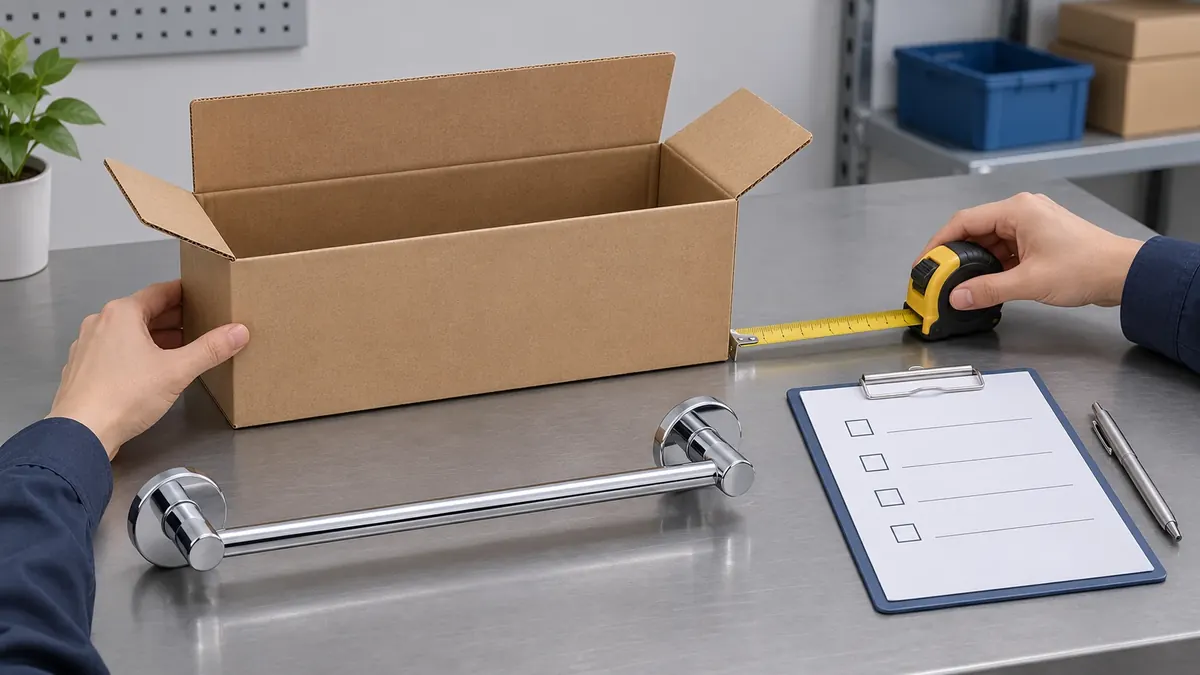
Approving an empty box without the product. The empty interior may look adequate while the wrapped product, accessories, mounting hardware, or divider makes loading difficult. Conduct the fit check with the approved product and packing materials in their shipment state.
Ignoring the opening and loading path. A product may fit after being placed inside but not pass through the opening in the planned sequence. Confirm whether it needs to be rotated, whether it is packed assembled, and whether the flaps or insert reduce access.
Revising the carton without revising the record. If the supplier changes the opening, insert, or orientation after sample approval, update the drawing revision and packing instruction. A verbal change can leave the buyer comparing a new sample to an obsolete set of dimensions.
Assuming a dimension sketch proves carton performance. A sketch communicates geometry; it does not prove compression resistance, drop performance, moisture behavior, or shipping outcomes. Those require their own agreed specification and evidence. Keep the box-size discussion within its evidence boundary.
How Can a Small-Batch OEM Factory Help?
For a custom bathroom or home storage hardware project, the factory-side review can focus on the product and its packing interface: the assembled or disassembled state, the longest and widest protrusions, the parts that need protection, and the information required for an accurate packing sample. That is different from claiming that the metal hardware factory makes cartons or certifies a packaging design.
Koitor Hardware is a family-owned custom metal hardware factory. For bathroom and home storage hardware, its approved work includes discussing product structure, samples or drawings, finish, basic assembly, and packaging preparation. A buyer can share the product drawing, physical sample, target packing state, and carton supplier’s dimensioned sketch so the team can review whether the proposed arrangement is clear for the hardware product. The carton itself and its technical performance remain subject to the packaging supplier’s scope and the buyer’s requirements.
Small-batch OEM development can make an early sample review useful before a larger order is confirmed. The buyer and factory can discuss a product configuration, protective separation, included fasteners, and the packing state to be represented in the sample. MOQ can start from 100 pieces depending on structure, material, finish, and packaging, but that is not an absolute minimum for every project. Sample timing and bulk timing also depend on confirmed design, materials, order quantity, finish, and packing requirements; dates should be quoted for the actual project rather than promised from a generic chart.
When the product is customized from a drawing or physical sample, agree on revision control. A packaging change may be needed after a product size changes, a bracket is revised, or a kit gains another component. The buyer can keep a simple revision table with the hardware drawing, packing layout, carton supplier drawing, and sample sign-off. That makes it easier to determine which change affected the quote and which sample should be checked next.
If you are developing a private-label towel rack, shower caddy, metal basket, or tissue holder, Koitor can discuss sample-based customization and small-batch OEM production within its documented product scope. A relevant starting point is the OEM home storage hardware manufacturer page. It is a commercial overview, while this article’s dimension-order explanation remains informational.
What to send when asking for a packaging review
- The product drawing or a clear physical sample, including revision.
- Product length, width, height and any protruding or fragile features, with units.
- The intended shipment state: assembled, partly assembled, nested, or separated into kit components.
- The actual carton supplier drawing, with its inside/outside basis and opening axes labeled.
- Photos or a simple sketch showing the loading sequence and closure.
- Protective wrap, dividers, bags, fasteners, instruction sheets, and any other items packed with the product.
- The target order quantity and whether the carton is for one item, a set, or a mixed assortment.
- The finish faces or parts that should not rub against one another during packing.
- Any agreed market, label, or private-label packaging requirements that the responsible supplier must confirm.
This information supports a practical discussion. It does not replace a carton supplier’s drawing, the buyer’s packaging approval, or a shipment service’s current measurement instructions.
Buyer Checklist Before Requesting a Quotation
Use this checklist to make a carton-size question answerable rather than relying on three unlabeled numbers:
- State the box dimension order used by the named supplier and mark the opening on a sketch.
- Identify inside dimensions, outside dimensions, or both.
- Specify units on every dimension set.
- Define the flaps, closure, seams, and direction in which height is measured.
- List the hardware model, included components, and shipment configuration.
- Show protective materials and inserts in the fit sample.
- Check the loading path through the actual opening, not only the final position in the box.
- Confirm the product and carton drawing revision used for the sample.
- Request separate external packed dimensions if a transport provider needs them.
- Keep packaging performance requirements separate from geometric dimensions.
- Record who supplies the carton, who approves it, and which evidence is expected for any performance claim.
- For mixed-SKU shipments, maintain a separate carton count and loading plan.
- Keep the approved packing sample or photographs with the final drawing revision.
- Recheck the packing plan after product, accessory, finish-protection, or order-configuration changes.
| Approval question | A useful answer | A weak answer |
|---|---|---|
| Which side is the opening? | A marked drawing with L/W arrows on the opening | “The first number is length” with no sketch |
| Are these interior values? | “Inside dimensions, in mm, between the inner board faces” | “Box size” |
| Which parts are included? | Product, hardware kit, insert and wrap listed | “One set” without contents |
| Does it fit through the opening? | The packed sample was loaded and closed as specified | Volume was calculated only |
| What goes in freight records? | Separately measured closed external package dimensions | The inside catalog size was copied |
الأسئلة الشائعة
Is the order always length, width, then height?
Length × width × height is a common notation, but it is not enough to define the physical axes unless the supplier’s convention is known. Uline’s own box guide uses the longer and shorter sides of the flapped opening for length and width, then measures height from opening to base; its FAQ notes that order depends on the product category. Confirm the actual supplier’s drawing and keep the opening direction visible.
Can height be larger than length?
Yes, under a convention where length and width describe the opening plane and height describes the opening-to-base distance. Uline’s 4 × 4 × 12-inch box example illustrates a carton whose listed height is the largest dimension. That example explains a named catalog convention; it is not a specification for a Koitor product or a universal box rule.
Are box dimensions inside or outside measurements?
It depends on the source and the item being described. Uline states that its catalog box dimensions are inside dimensions. Other suppliers may provide inside, outside, or different reference measurements. Put the basis in the RFQ and request a drawing. A closed shipment’s outside measurements should be measured and recorded separately when needed.
Does equal carton volume mean two cartons fit the same product?
No. Equal volume does not establish that the opening, internal shape, loading path, inserts, or protected product envelope will work. A long bar may have enough total volume but still be unable to pass through a short opening. Test the approved product and packing materials in the intended loading sequence.
Should I use the box catalog size for shipping dimensions?
Not without checking what the catalog size measures and what the actual transport service requests. An inside catalog size is not the same thing as a closed packed exterior. The reviewed FedEx Singapore FAQ’s longest-side definition is specific to that source context; it should not be generalized to every region or service. Follow the current instructions for the shipment at hand.
اعمل مع شركة «كويتور» للأدوات
Need a Clear Packing Plan for a Hardware Project?
Share your hardware drawing or sample, packing state, carton supplier sketch, finish requirements, and expected order quantity. Koitor can discuss product configuration, sample development, and practical packaging preparation within its bathroom and home storage hardware scope.
OEM / العلامة التجارية الخاصة
حوّل دليل التوريد هذا إلى موجز منتج
يرجى إطلاعنا على المنتج المستهدف، والحجم، والتشطيب، وكمية الطلب، ومتطلبات التغليف. وسيتلقى فريقك تقييمًا عمليًّا لإمكانية التصنيع قبل تقديم عرض الأسعار.
 English
 Español
 Português
 Français
 Deutsch
 العربية