

Brushed nickel vs stainless steel is not a like-for-like comparison until the buyer separates the substrate from the visible finish. In a sourcing discussion, brushed nickel vs stainless steel should be treated as a construction-and-appearance comparison, not as two interchangeable material grades. “Brushed nickel” can describe a supplier-specific finish appearance or coating route, while stainless steel identifies a family of base materials that may itself have a brushed surface. For an OEM or private-label order, specify the substrate, finish system, grain or texture, approved sample, care instructions, and use environment instead of selecting by color name alone.
What Is the Difference Between Brushed Nickel and Stainless Steel?
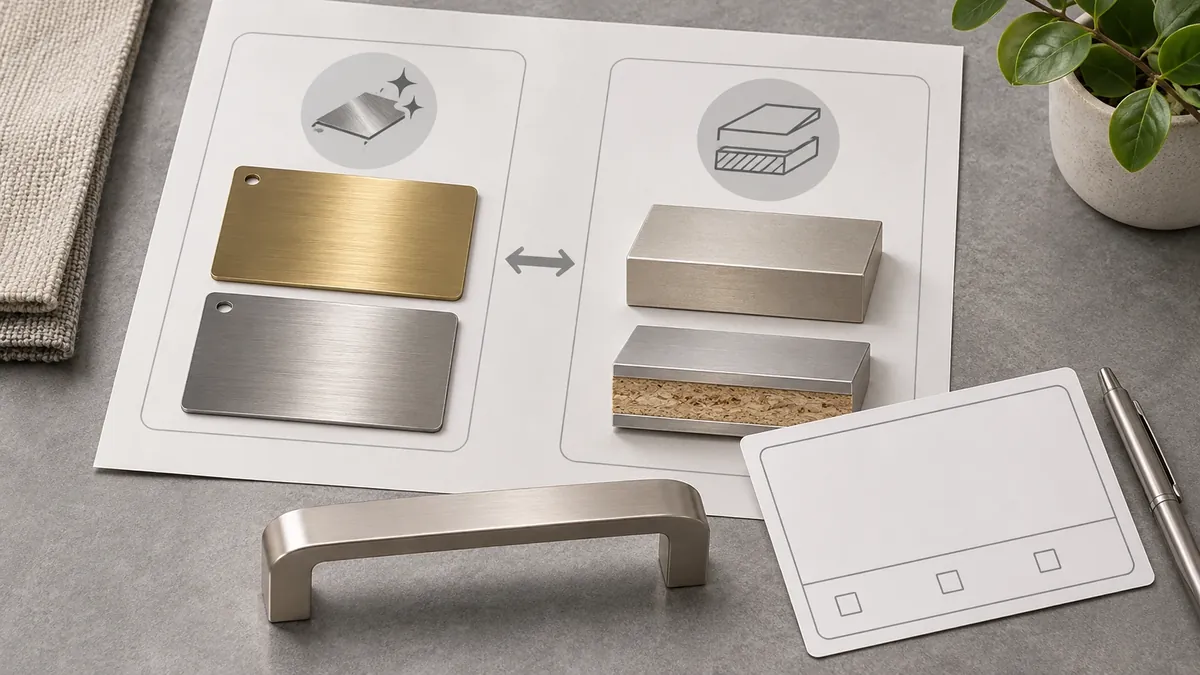
The most important difference is that the terms can describe different product attributes. “Stainless steel” typically identifies the base metal family or product material; the exact grade and construction still need confirmation. “Brushed nickel” often names a visible appearance or finish offered by a particular brand or supplier. That appearance may be produced on different substrates and through different processes. The label alone does not reliably tell a buyer the full material stack.
A brushed stainless-steel part can have a directional surface texture on stainless material. A brushed-nickel product may use nickel as part of a finish system on a different substrate, or the commercial name may refer to a particular appearance created by another specified route. Those are possibilities, not universal definitions. A current supplier document and sample should resolve what the name means for the actual SKU.
| سؤال من المشتري | Brushed nickel label | Stainless-steel label |
|---|---|---|
| What does the name identify? | Often an appearance or finish family; verify the supplier’s definition | A material family; obtain the actual grade and component construction |
| What is the substrate? | Could vary by product and supplier; do not infer it from the finish name | Stainless material may be the exposed body, but a product can include other materials or coatings |
| Is there a coating or plating? | Possible, but the exact route must be documented | A brushed surface may be bare stainless or may have an additional treatment; verify the specification |
| What does “brushed” describe? | A visual texture or grain associated with the named finish | A mechanical surface appearance on the stainless substrate; direction and roughness need definition when important |
| What determines care? | The actual finish system and product instructions | The grade, surface condition, any coating, and full assembly instructions |
The table is a buyer comparison, not a universal classification of every market label. A supplier may use a product-specific name, and two brands may use the same name for different constructions. Ask for the material declaration, finish specification, technical drawing, and sample reference that apply to the order.
A second use of the phrase brushed nickel vs stainless steel should lead to a more precise question: which product attribute is the buyer actually comparing? If the decision concerns corrosion, compare the declared material, finish system, exposure, and product evidence. If the decision concerns a coordinated bathroom collection, compare color, texture, reflectivity, and the approved reference. If the question is about fabrication, identify the substrate and process constraints for the component. One label cannot answer all three questions.
When a quote uses only a finish name, ask the supplier to annotate the drawing or quotation with the relevant assumptions. This makes it possible to compare competing quotes on the same construction and scope. Otherwise a buyer may compare one supplier’s plated or coated finish with another supplier’s stainless substrate and mistake the price difference for a like-for-like offer. The comparison should state any excluded finishing work, bought-in components, inspection, and packaging assumptions.
How Should Buyers Verify the Material and Finish Route?
Ask the supplier to state the substrate and surface-treatment sequence separately. The product record should identify the component material, grade where applicable, substrate preparation, any undercoat or topcoat, visible finish, and responsible processor. If the product contains multiple components, map the material and finish to each part rather than using one label for the entire assembly.
The Australian Stainless Steel Development Association (ASSDA) explains that stainless-steel grade selection depends on service conditions and corrosion factors. Its stainless-steel grade selection guidance reinforces why a buyer should not treat “stainless” as a guarantee that every grade and finish behaves identically in every environment. The substrate, exposure, surface condition, fabrication, and maintenance all matter.
Finish names also need supplier-specific confirmation. ABI Interiors’ guide to its own silver-finish range describes its brushed-nickel offering as a PVD finish on brass and its stainless offering as stainless grades. That is a useful example of one supplier’s terminology, not proof that every brushed-nickel product uses PVD or brass. Use the cited page only to show why a buyer needs the SKU-specific construction.
Request documents that answer:
- Which part is stainless steel, nickel-plated, brass, or another substrate?
- What grade or material declaration applies to each component?
- Is the visible brushed texture formed in the substrate, added by coating, or produced through another finish route?
- Is there a copper, nickel, chrome, PVD, lacquer, or other layer, and which specification controls it?
- Which supplier owns each finishing operation, including subcontracted work?
- Which sample and revision represent the production-intent color and surface texture?
- Which care instructions apply to the actual product and intended market?
Do not infer the answer from a catalog photograph, magnet, color chip, or marketing name. These can help identify questions, but they are not a controlled material record. If the supplier cannot confirm the stack, record the field as unknown and hold any performance claim that depends on it.
How Do Appearance and Grain Direction Affect Approval?
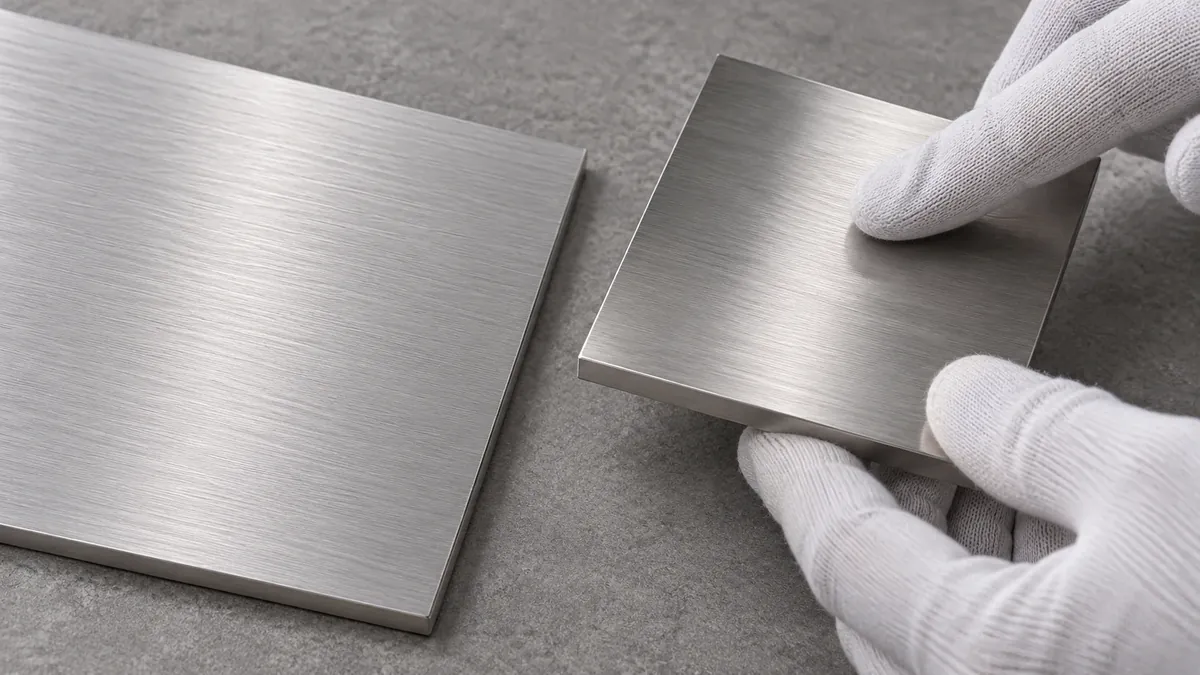
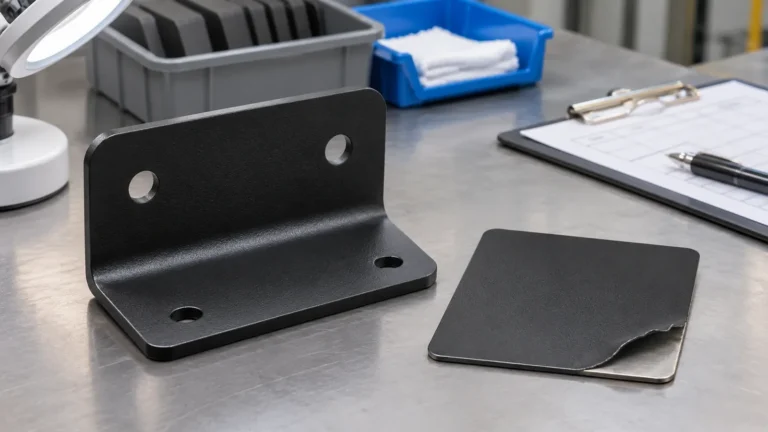
“Brushed” is a visual description that needs a reference. Buyers should define the intended direction, continuity, sheen, and visible faces where those details matter. A long towel bar, cabinet pull, bracket, and small cap may show grain differently because of their geometry and manufacturing sequence. A finish sample on a flat coupon can help compare color but may not represent a formed or welded product.
Approve an appearance sample using the actual component or a representative production-intent part. Record the product code, substrate, finish route, revision, and viewing conditions. Identify which faces are cosmetic and whether a joint, bend, weld, or assembly interface can affect the grain or reflectivity. If a visible texture mismatch is unacceptable, state the tolerance or comparison method rather than relying on “brushed nickel” as a complete instruction.
Use this review sequence:
- Compare the sample to the approved reference under consistent neutral lighting.
- Check color and surface texture separately; a similar color can hide a different grain.
- Review the finish on the complete part, including bends, ends, joints, and edges.
- Compare adjacent components that are meant to appear as one finish family.
- Record any supplier-specific variation allowed by the project.
- Retain the accepted physical sample or controlled image with the specification.
Do not create a claim that brushed nickel is always warmer, shinier, more durable, or easier to maintain than stainless steel. These descriptions depend on the specific finish and lighting. If the appearance is important to retail matching, include a sample approval and change-control requirement for later production lots.
Which Finish Is More Suitable for a Bathroom or Home-Storage Product?
Suitability depends on the actual material, finish route, design, exposure, cleaning practices, and buyer’s appearance target. A product in a dry vanity cabinet has a different exposure profile from a shower accessory or a frequently cleaned commercial washroom item. A coastal or chemically demanding environment may need additional review, but the finish label alone cannot determine the correct choice.
Ask the product owner to assess:
- Moisture, condensation, standing water, cleaning agents, and frequency of cleaning.
- Whether the product is indoors, in a shower zone, in a commercial facility, or near coastal exposure.
- Base material, grade, coating, edges, joints, and areas where liquid can collect.
- Finish damage risk during fabrication, assembly, packaging, transit, and installation.
- Replacement requirements and availability of matching components.
- Any project-specific test or evidence requirement and its scope.
Avoid absolute corrosion claims based on a material or finish name alone. The appearance and corrosion behavior of a finished product depend on materials, processes, maintenance, environment, and condition. ASSDA’s technical content is about its stated material and service context; a buyer should use the actual product specification and relevant evidence rather than converting a grade-selection article into a product guarantee.
For a coated or plated finish, review the layer sequence and which processor controls it. Koitor’s live article on copper undercoats in nickel-chrome plating covers one specific plating-stack question. It does not define the construction of every brushed-nickel product. The selected product’s technical documents remain the source of truth.
What Should Importers Compare in Cost and Replacement Planning?
Do not assume that one finish is always cheaper or more expensive. The quotation can depend on substrate, part geometry, finish route, number of components, order quantity, supplier scope, inspection, packaging, and required sample approval. A material label or color name does not provide a comparable price basis.
For a fair comparison, request two controlled specifications and ask the supplier to quote each scope separately. Each quote should state the substrate, finish process or supplier requirement, color reference, visible faces, sample or approval steps, packaging, and any inspection records included. If one quote changes material or finish details, label it as an alternative rather than comparing it directly with the original.
Replacement matching can be more difficult than initial selection. A replacement bar may need to match an existing bracket or handle from another supplier, and the original product’s finish stack may be unknown. The buyer can reduce that risk by saving the sample, supplier and finish data, part numbers, lot record, and care guide. For a retail program, identify which replacements are intended to match exactly and which are only coordinated in appearance.
The buyer should also consider whether components can be replaced individually. A product with a matching purchased fastener or end cap may simplify service, but only if the part numbers and finish compatibility are controlled. Do not promise that a new lot will visually match an old product without checking the approved sample and acceptable variation.
How Should the RFQ Define Brushed Nickel or Stainless Steel?
Put material and finish details into separate fields. For stainless, identify the grade or material declaration, component, surface finish, and any additional coating. For brushed nickel, state whether the name refers to a commercial color, a particular metal layer, a process route, or a supplier-defined finish. Include a drawing and approved sample; do not leave the construction as a color name when the buyer’s performance or replacement decision depends on it.
| RFQ field | Information to provide | Evidence to request |
|---|---|---|
| Component | Part number and drawing revision | Material mapping by component |
| Substrate | Grade or material declaration | Supplier record or agreed material document |
| Finish stack | Layer sequence and process owner where known | Finish specification and processor confirmation |
| Appearance | Color, grain direction, sheen, and visible faces | Approved production-intent sample |
| البيئة | Use location, cleaning agents, and exposure conditions | Product-specific care guidance and evidence where applicable |
| Change control | Supplier, material, or finish substitution rules | Written approval before the change enters production |
| التغليف | Surface protection and separation of contact parts | Packaging sample and handling requirements |
| Replacement | Part numbers and matching expectations | Replacement availability and sample comparison rule |
If the buyer has not yet selected a material or finish, treat the first quotation as a comparison exercise and specify the assumptions. Ask the manufacturer to identify which differences are confirmed and which need a processor or design-owner decision. Do not accept an unqualified “same color” statement as a substitute for a material and finish record.
How Can a Small-Batch OEM Factory Support This Decision?
A small-batch OEM factory can help review drawings and samples, map the finish to the correct component, coordinate questions for the responsible finishing supplier, and prepare a consistent product and packaging specification. Koitor Hardware is a family-owned custom metal hardware factory focused on bathroom and home-storage hardware. Approved company facts support customization from buyer drawings or physical samples, fabrication, finish requirements, assembly, and packaging-preparation discussions. They do not establish that Koitor operates every plating, PVD, or stainless-steel finishing process in-house.
For a project discussion, provide the current drawing, material and finish names, reference sample, target market, exposure conditions, quantity, packaging, and any matching or replacement need. The supplier can help distinguish the fabricated-part question from a bought-in finish component or specialist processing question. If an outside processor owns the finish route, ask how the specification and sample approval are transferred to that supplier.
Samples can help the buyer compare appearance and assembly before a small trial order. The sample should use production-intent material, finish, geometry, and packaging contact layers. A flat finish chip alone may not show how the grain appears around bends or joints. Depending on the product, MOQ can start from 100 pieces; samples usually take 5–7 working days after details are confirmed; bulk production usually takes 4–6 weeks depending on quantity, finish, and packaging. These are planning ranges, not a guarantee for a particular material or finish route.
Review the OEM home-storage hardware manufacturing scope and send the sample, drawings, and finish question through the project contact page. Keep the desired appearance, substrate, process route, and acceptance sample connected in the project record.
What Should the Buyer Check During Sample Approval?
A finish comparison becomes useful only when it is tied to the production-intent part. Before approving a sample, identify which surfaces a customer sees during normal use, which surfaces touch walls or fasteners, and which areas may be hidden after installation. This avoids spending review time on concealed faces while overlooking a handle, rim, or end cap that dominates the appearance on the shelf. The sample record should identify the part number and revision so that later photographs or comments cannot be attached to the wrong construction.
Ask the supplier to provide the sample with its material and finish declaration. If a specialist processor applies the finish, record the processor and specification revision, subject to the supplier’s confidentiality and traceability practices. The buyer does not need an unsupported claim about proprietary chemistry; the important control is that the approved finish route can be identified and that a change is reviewed before production. If the supplier proposes an alternate substrate or route, treat it as a new sample approval, even when the color appears close.
For a brushed surface, note grain direction and the areas where a direction change is acceptable. Bent, welded, or assembled components may not present the same grain continuously around every edge. Define the viewing distance and lighting for visual review where a project needs repeatable comparison. These conditions do not create a universal industry tolerance; they make the buyer’s own acceptance decision reproducible. A photograph can document an approved reference, but it may not capture reflection, texture, or color accurately enough to replace the physical sample.
Also review assembly and packaging. A surface that looks acceptable before assembly may be scratched where components contact one another in a carton. Ask how parts are separated, which surfaces receive protective film or sleeves, and whether fasteners can rub a visible face. Approve the packaging arrangement with the product sample when finish damage would affect retail presentation. For reorders, keep the sample identifier, revision, supplier, finish description, and accepted variation together with the purchase specification.
How Should Buyers Compare Replacement and Lifecycle Risk?
Replacement decisions often reveal why a color label is not enough. A distributor may need to replenish one accessory, replace a damaged component, or add a matching item to an established collection. In each case, visual similarity is only one part of compatibility. Confirm the substrate and finish family, dimensions, mounting interface, fastener type, and supplier reference. A nominally similar brushed-nickel item can differ in warmth, sheen, grain, or reflectivity; a stainless item can also differ by grade, surface preparation, and any additional treatment.
The project should state whether products must match exactly, coordinate within a defined range, or simply use a consistent finish family. Exact matching across suppliers or production periods may not be feasible without controlled samples and supplier agreement. Where a collection uses multiple manufacturers, request physical approval samples side by side under the same lighting and retain the accepted decision. Avoid promising interchangeability based on a marketplace finish name.
Care and service information should follow the actual construction. Provide the cleaning instructions approved by the product or finish supplier, and avoid generic chemical advice where the coating, substrate, or warranty conditions are unknown. If the buyer cannot obtain the relevant care instructions, record that as a supplier-documentation gap before making a consumer-facing durability statement. This keeps the comparison practical: choose a defined construction, verify the sample and service requirements, and control substitutions over the life of the SKU.
الأسئلة الشائعة
Is brushed nickel the same thing as stainless steel?
No. Brushed nickel is often a finish or appearance name, while stainless steel identifies a material family. The supplier must confirm the actual substrate and surface treatment for the specific product.
Is every brushed-nickel product nickel plated?
Do not assume so. Product names and supplier finish systems vary. Request the finish specification, material record, and sample for the exact SKU.
Can stainless steel also have a brushed finish?
Yes, stainless products may have a brushed or directional surface appearance. Define the grade, texture, direction, and any extra coating in the product specification.
Which is better for a bathroom, brushed nickel or stainless steel?
There is no universal answer based only on those labels. Compare the specific material and finish construction, exposure, maintenance, appearance, and replacement needs for the product.
Does stainless steel always resist corrosion better than a brushed-nickel coating?
That cannot be determined from the names alone. Grade, coating, process, design, and exposure conditions matter. Ask for evidence tied to the actual product and intended use.
How can I match a replacement bathroom accessory?
Use the original product number, material and finish records, approved sample, and supplier information. Compare both color and surface texture, and confirm dimensions and mounting interfaces separately.
What does “brushed” mean on a finish sample?
It usually indicates a directional surface appearance, but exact texture and acceptance depend on the supplier’s specification. Approve it on a representative component under consistent viewing conditions.
What should I include in a finish RFQ?
Provide the substrate by component, finish stack, color and grain reference, exposed faces, use environment, care expectations, packaging, sample approval, and substitution controls.
اعمل مع شركة «كويتور» للأدوات
Share the drawing, material and finish specification, reference sample, use environment, and replacement or appearance requirement. Koitor can help clarify the custom hardware and sourcing scope; the responsible finish supplier must confirm its process and product-specific data.
Specify the Surface, Not Just the Color Name
Send the drawing or sample, material details, finish reference, and intended environment for a project review.
OEM / العلامة التجارية الخاصة
حوّل دليل التوريد هذا إلى موجز منتج
يرجى إطلاعنا على المنتج المستهدف، والحجم، والتشطيب، وكمية الطلب، ومتطلبات التغليف. وسيتلقى فريقك تقييمًا عمليًّا لإمكانية التصنيع قبل تقديم عرض الأسعار.
 English
 Español
 Português
 Français
 Deutsch
 العربية