

Short answer: Hidden shelf supports should be selected together with the panel preparation and any required adjustment or locking access. A support variant that adds a wall bracket or locking feature can require a different panel drawing from the base version. Before approving a quote or sample, match the exact hardware family, model and revision to the preparation document used by the panel supplier. A similar-looking pin or a flush shelf face does not prove that two configurations use the same recess, holes or access openings.
For a buyer, “hidden shelf supports” is a search phrase covering several concealed support architectures. It does not identify a universal part or a standard preparation. The practical purchasing question is narrower: when a selected support gains an option, does the approved panel still provide the interfaces and access that the selected model requires? The answer must come from the responsible hardware maker’s current documentation and the panel supplier’s matching drawing, not from a generic dimension copied from another system.
This guide is about configuration control before ordering. It does not provide drilling instructions, structural design calculations, load values, wall-anchoring advice or woodworking specifications. Those decisions belong to the qualified designer and the suppliers responsible for the actual hardware and panel. The examples below explain how to coordinate the documents and sample without implying that Koitor manufactures a concealed shelf-support system.
The source example is Italiana Ferramenta’s Triade Pro family. Its manufacturer product page distinguishes named panel-thickness families, and the linked Triade Pro system brochure shows model-specific preparation references for selected support, bracket and locking options. These references apply to that system only; they are not universal machining instructions.
What buyers mean by hidden shelf supports
The term “concealed support” describes appearance more than a complete interface. A shelf may be carried by rods entering a panel, a concealed bracket, a routed groove, a cabinet-side wire system or another manufacturer-specific arrangement. Some systems include adjustment; others add a wall-side bracket or a separate locking component. A buyer therefore needs the family name and model reference before “hidden shelf supports” becomes an actionable line in a specification.
An apparently similar component may belong to a different system. A shelf-support pin can be retained in a bore and still differ from a bracket fixed to the wall. A slotted wall rail may carry an exposed bracket whose hook engages a slot. A concealed cabinet-side wire support may require a groove in the panel. These products can all be described informally as hidden or concealed supports, but their preparation and responsibilities are not interchangeable.
The word “hidden” also says nothing about what the buyer is expected to supply. A quote might cover only metal or polymer hardware, while the panel, machining, screws, templates, adjustment tool and installation service come from other parties. A complete scope records which supplier provides each item and which document controls the mating interface.
For example, Italiana Ferramenta’s Triade Pro family materials identify named support options and distinguish configurations with an optional wall bracket and locking access. That is evidence that one named family has variant-specific preparation implications; it is not a universal specification for concealed supports. Its part names, preparation drawings and geometry must not be copied to another brand or treated as a cross-compatible standard. The current model document is the authority for that model.
Why adding a bracket or lock can change the panel drawing
A change to the hardware can alter more than the visible metal part. An added bracket may occupy a different area behind the panel. A lock may need a separate opening or tool-access route. A changed support family may shift where a component seats or where an adjustment remains reachable. Whether any of these changes actually require different machining depends on the exact model and the supplier’s revision-controlled instructions.
The safe buyer question is not “Does this pin look the same?” It is “Does the preparation shown for this exact hardware option match the panel drawing and revision being ordered?” A pin diameter or nominal shelf thickness alone cannot answer whether a mounting plate, lock, recess, assembly path or service access is compatible. The buyer should identify the changed item, ask the hardware maker which preparation applies and obtain confirmation from the panel supplier before the production drawing is released.
The reverse is also important. Not every hardware change automatically invalidates the full panel design or requires a complete product retest. The responsible engineer should identify which interfaces are affected and what evidence is proportionate. The buyer should reopen the relevant drawing, fit or access checks whenever an option changes, without inventing a blanket “retest everything” rule.
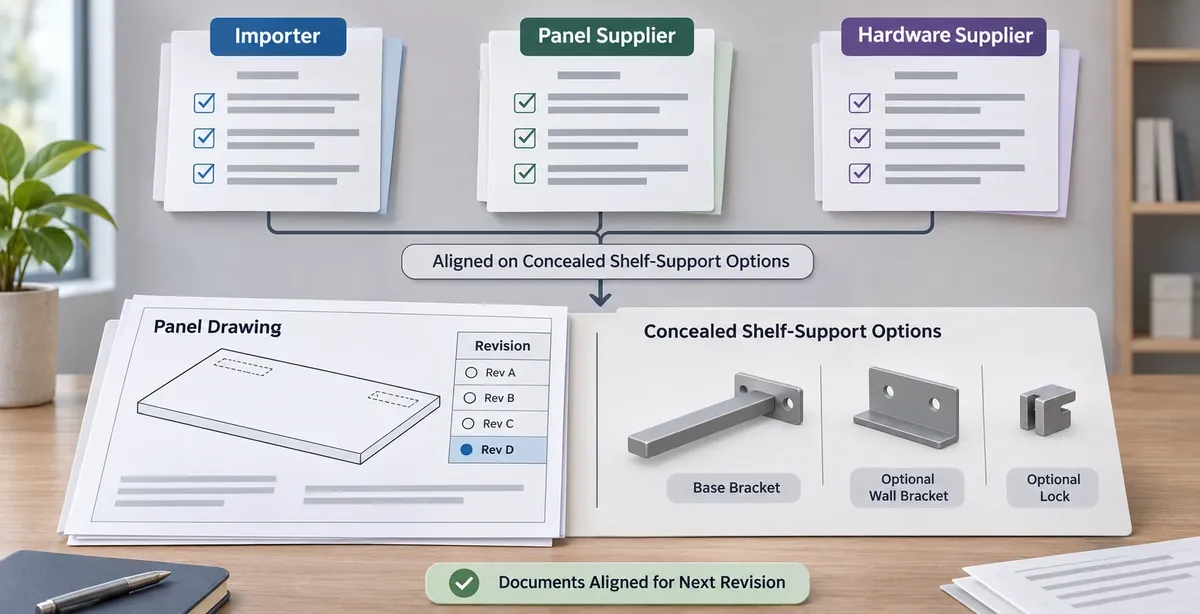
One useful distinction is between a part change and an interface change. A different finish may leave the panel interface unchanged, although coating thickness or fit still needs the manufacturer’s guidance. A bracket or locking variant can change the panel-side interface or access even if the shelf and external appearance remain similar. The supplier should state which drawings and checks remain valid rather than asking the buyer to infer that from a product photograph.
Match each hardware option to its controlled preparation
Before comparing quotes, freeze the reference information. Record the manufacturer, family, exact part number, variant, document title and revision date. If a supplier proposes an equivalent, keep the original and proposed references side by side until the actual maker confirms the relationship. Do not merge preparation data from an older Mini, a current Pro variant, a third-party product or a generic catalog simply because the names contain similar words.
For each option, ask the hardware supplier to identify the applicable preparation template or drawing. The panel supplier should then confirm that its manufacturing drawing references that same template or the exact dimensions and revision supplied by the responsible maker. If the hardware provider has a downloadable CAD file or setup sheet, confirm that it is for the quoted model rather than another item in the family.
The approval record should distinguish confirmed, changed و unresolved information. “Confirmed” means the responsible supplier has linked the specific part and panel revision. “Changed” means the option or preparation differs from the last approved version. “Unresolved” means a drawing, access point, included component or supplier responsibility has not been established. An open item should stay visible until the named party answers it; a blank cell must not silently become an assumed approval.
| Review item | Base support | Added bracket or lock | Buyer evidence to retain |
|---|---|---|---|
| Hardware identity | Exact family, part and revision | Exact option and any mating parts | Current supplier part list or quotation |
| Panel preparation | Applicable template or drawing | Confirmation whether the same or a different preparation applies | Maker-issued preparation reference |
| Access | Adjustment or service access shown for the base model | Lock or added adjustment access identified | Model-specific instruction or drawing |
| Panel revision | Released drawing and revision | Matching released drawing or documented no-change decision | Panel supplier’s controlled drawing |
| Sample | Representative hardware and panel combination | Option-specific sample where the interface changes | Sample record tied to both revisions |
| Responsibility | Hardware and panel suppliers identified | Change owner and approval party identified | Signed or otherwise traceable disposition |
The table is a record structure, not a set of dimensions. Do not fill it with universal pocket depths, bore sizes, screw lengths or spacing values. Enter only values and preparation instructions that belong to the exact approved model and revision.
Build a variant-to-preparation approval sheet
A single-page approval sheet helps procurement, engineering and the panel supplier work from the same option. Put one hardware configuration on each row: base support, support with wall bracket, optional lock and any supplier-proposed substitute. Do not combine two alternatives in one row, because approval of one option must not appear to approve the other.
Recommended fields include the hardware manufacturer; family and model; part number; drawing or instruction revision; supplied components; selected panel supplier; panel drawing number and revision; applicable preparation reference; adjustment or locking access; unresolved interface questions; sample identifier; approver; and approval date. Add a status for each interface rather than only one overall “approved” box.
The hardware supplier should identify which preparation applies. The panel supplier should confirm that its production drawing corresponds to that preparation. The assembler or product owner should verify that required access remains available in the intended assembly. A clean shelf face can conceal an incorrect or inaccessible interface, so appearance alone is not adequate evidence.
The record should also distinguish product components from services. The hardware supplier may provide parts and technical drawings but not machine the panel. A panel supplier may route or drill according to an approved drawing but not choose the support model. The buyer or designer controls the overall product revision. Naming those responsibilities prevents a quote from implying that one supplier has approved another supplier’s work.
For a replacement project, identify what is retained: panel, shelf, wall-side bracket, support, lock, adjustment tool or installation instruction. A “replacement support” may not be a replacement for the panel preparation. Confirm whether retained parts are part of the same documented family and whether the maker permits the selected combination. Similar dimensions are not proof of fit, retention or safe performance.
Approve the sample and production revision together
The sample should represent the actual selected hardware option and a panel prepared from the drawing intended for production. If the sample uses a different support, bracket, lock or panel revision from the order, record the difference and decide whether it affects the buyer’s approval. Do not call a sample a match merely because the shelf appears level or the fittings are hidden.
During sample review, verify identity before judging appearance. Match labels, part numbers and revision marks to the quotation and drawing. Confirm the panel-side preparation by the approved maker reference, then check that the named support seats as the manufacturer describes. Review any adjustment or lock access that the design claims to provide. If a required interface cannot be seen or reached, ask the responsible supplier to explain how it is confirmed; do not create a removal or installation procedure from an illustration.
After the sample is approved, connect the sample record to the released BOM, panel drawing, purchase order and supplier instruction. If the hardware option changes, log which panel drawing and access checks have been reopened. If the panel supplier changes but the hardware stays the same, confirm that the new supplier is using the approved preparation rather than an unreferenced shop copy.
This is change control, not a performance test. A sample review can show that two identified parts assemble in one observed configuration. It does not establish rated load, fatigue life, wall strength, structural safety, long-term retention or certification. Those require separate evidence from qualified parties under a defined project method.
What to put in the RFQ and how to handle changes
An RFQ should state the intended shelf system, exact known hardware family, panel material and supplier, drawing references, selected bracket or lock options, finish, package scope and who supplies each part. Attach the latest panel drawing and mark the support locations or access zones already approved. If the buyer has not selected a system, request option-specific documentation rather than inviting a supplier to choose silently.
Ask the hardware supplier: Which current part number is quoted? Which model-specific preparation document applies? Does the selected bracket or lock change the panel-side interface or access? Which components are included and which are bought separately? Which alternative part, if any, is formally documented as compatible? The request is for a supplier answer and supporting source, not a universal rule from the buyer.
Ask the panel supplier: Which drawing revision will be machined? What reference links the preparation to the selected hardware? Is a change clouded or otherwise identified? Who releases the drawing after the hardware supplier confirms the option? These questions are particularly useful when the panel is ordered before the final hardware kit or when a project substitutes a component late in development.
Treat a revision as a coordination event. If a lock is added, ask whether a new access feature is needed. If a bracket is removed, ask whether unused preparation remains and whether the maker permits it. If a near-equivalent support is proposed, compare the actual maker references and drawings rather than a verbal “same size” assurance. If the responsible manufacturer cannot confirm a required interface, keep the item open or select a documented alternative.
The RFQ should also say which document controls when the commercial description and a drawing disagree. A product name may remain unchanged while the maker revises a component or preparation. Record the drawing revision, date or version identifier that the quotation uses, and ask the supplier to flag any later revision before approval. A PDF received in an email is not automatically the governing version if the manufacturer has since replaced the document. Retain the source link or file reference and identify who is responsible for confirming currency.
For a multi-supplier program, include an interface responsibility table. List who selects the support, who supplies the bracket and lock, who prepares the panel, who provides any template, and who checks access in the assembled product. Use “buyer confirmation required” where nobody has accepted responsibility. This prevents a hardware quotation from being mistaken for approval of panel machining or installation, and gives procurement a way to compare bids on the same scope instead of comparing different combinations of parts and services.
Ask each supplier to return exceptions in writing. A proposed substitute should name its manufacturer, exact model and current drawing revision, then state which interfaces were checked against the approved panel. “Equivalent,” “same size,” or “fits the same shelf” is not enough to close the change. If a part number is unavailable, hold the substitution until the responsible designer and panel supplier confirm whether a new preparation or access review is needed. Do not transfer one maker’s approval to another system by implication.
Finally, distinguish quotation information from engineering sign-off. A supplier can quote the identified metal component or explain its supported scope; the buyer’s structural designer remains responsible for the shelf, wall and intended loading unless a separate engineering service has been agreed. A controlled RFQ can prevent late panel revisions without implying that the quotation certifies the complete shelf assembly.
The RFQ should also say which document controls when the commercial description and a drawing disagree. A product name may remain unchanged while the maker revises a component or preparation. Record the drawing revision, date or version identifier that the quotation uses, and ask the supplier to flag any later revision before the buyer approves it. A PDF received in an email is not automatically the governing version if the manufacturer has since replaced the document. The buyer should retain the source link or file reference and identify the person responsible for confirming currency.
For a multi-supplier program, include a simple interface responsibility table. List who selects the support, who supplies the bracket and lock, who prepares the panel, who provides any template, and who checks access in the assembled product. Use “buyer confirmation required” where nobody has accepted responsibility yet. This prevents an apparently complete hardware quotation from being mistaken for an approval of panel machining or installation. It also gives procurement a way to compare quotations on the same scope instead of comparing different combinations of hardware and service.
Ask each supplier to return exceptions in writing. A proposed substitute should name its own manufacturer, exact model and current drawing revision, then state which interfaces were checked against the approved panel. “Equivalent,” “same size,” or “fits the same shelf” is not enough to close the change. If a part number is unavailable, hold the substitution until the responsible designer and panel supplier confirm whether a new preparation or access review is needed. Do not quietly transfer approval from one manufacturer’s system to another.
Finally, distinguish information needed for a quotation from information that would imply an engineering sign-off. A supplier can quote the identified metal component or explain the scope it can support; the buyer’s structural designer remains responsible for the shelf, wall and intended loading unless a separate, explicit engineering service has been agreed. This distinction is useful in a small pilot as well as a large program. A short, controlled RFQ can still prevent an expensive late panel revision without pretending that the quotation itself certifies the complete shelf assembly.
Buyer checklist before order release
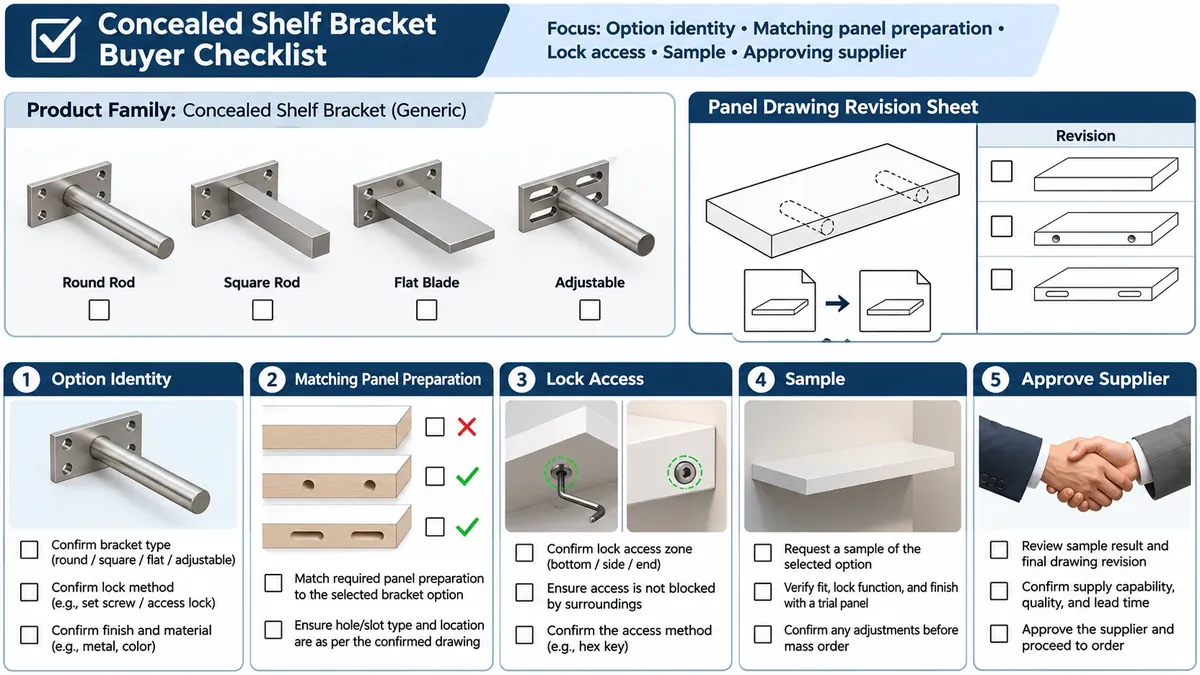
- Identify the exact support family, model, option and current revision.
- Separate the base support, optional bracket and optional lock in the BOM.
- Obtain the current maker-issued preparation reference for each selected option.
- Link the hardware reference to the panel supplier’s drawing number and revision.
- Mark adjustment, locking and service access as confirmed or unresolved.
- Identify who supplies hardware, panels, machining, templates and instructions.
- Make the sample reflect the same hardware and panel revisions as the planned order.
- Record changes from the previously approved panel or hardware configuration.
- Keep any proposed substitute separate until its maker documents the interface.
- Do not infer load, safety or long-term performance from a flush appearance or single sample.
For broader home-storage project context, buyers can review Koitor’s OEM home storage hardware scope. That page describes confirmed project categories; it does not claim Koitor produces concealed shelf brackets or panel machining. A buyer can share the selected hardware reference and interface drawing for a project-specific discussion of the metal scope.
Frequently asked questions about hidden shelf supports
Does a matching pin diameter prove the support is compatible?
No. Pin diameter is only one possible interface field. The bracket, panel preparation, retention method, lock and access requirements may still differ. Ask the responsible maker to confirm the exact model pairing and use its current drawing.
Can the same panel preparation be reused after adding a bracket?
Do not assume it can. Some named product families distinguish the preparation for a support alone from the preparation with an optional wall bracket. Confirm the selected family’s current documentation and obtain the panel supplier’s answer for the actual drawing revision.
Is a locking option just an extra loose screw?
That depends on the exact product. A locking version may involve a distinct part and access requirement. Identify the model and ask the maker which components and preparation belong to it; do not infer the design from a generic product name.
Does a flush shelf face prove correct assembly?
No. External appearance does not establish that the hidden part is seated, that a lock is engaged or that adjustment remains accessible. Verify the component identities and the maker-defined checks for the sample.
Does this guide provide a universal drilling template?
No. Preparation is model-specific. Use the selected supplier’s current drawing and have the responsible panel supplier confirm the production revision. This guide deliberately provides no generic drilling, spacing or load values.
Does Koitor currently manufacture the complete concealed-support system?
This article makes no such claim. Koitor’s approved scope supports discussion of custom metal hardware drawings and samples. Buyers should identify the specialist support and panel suppliers and confirm each party’s actual capability before placing an order.
Review a Defined Home-Storage Hardware Scope
Share the selected hardware reference, panel/interface drawing, option list, finish and packaging needs. Koitor can first confirm whether the defined metal scope fits its current capabilities before quotation.
OEM / العلامة التجارية الخاصة
حوّل دليل التوريد هذا إلى موجز منتج
يرجى إطلاعنا على المنتج المستهدف، والحجم، والتشطيب، وكمية الطلب، ومتطلبات التغليف. وسيتلقى فريقك تقييمًا عمليًّا لإمكانية التصنيع قبل تقديم عرض الأسعار.


 English
 Español
 Português
 Français
 Deutsch
 العربية