
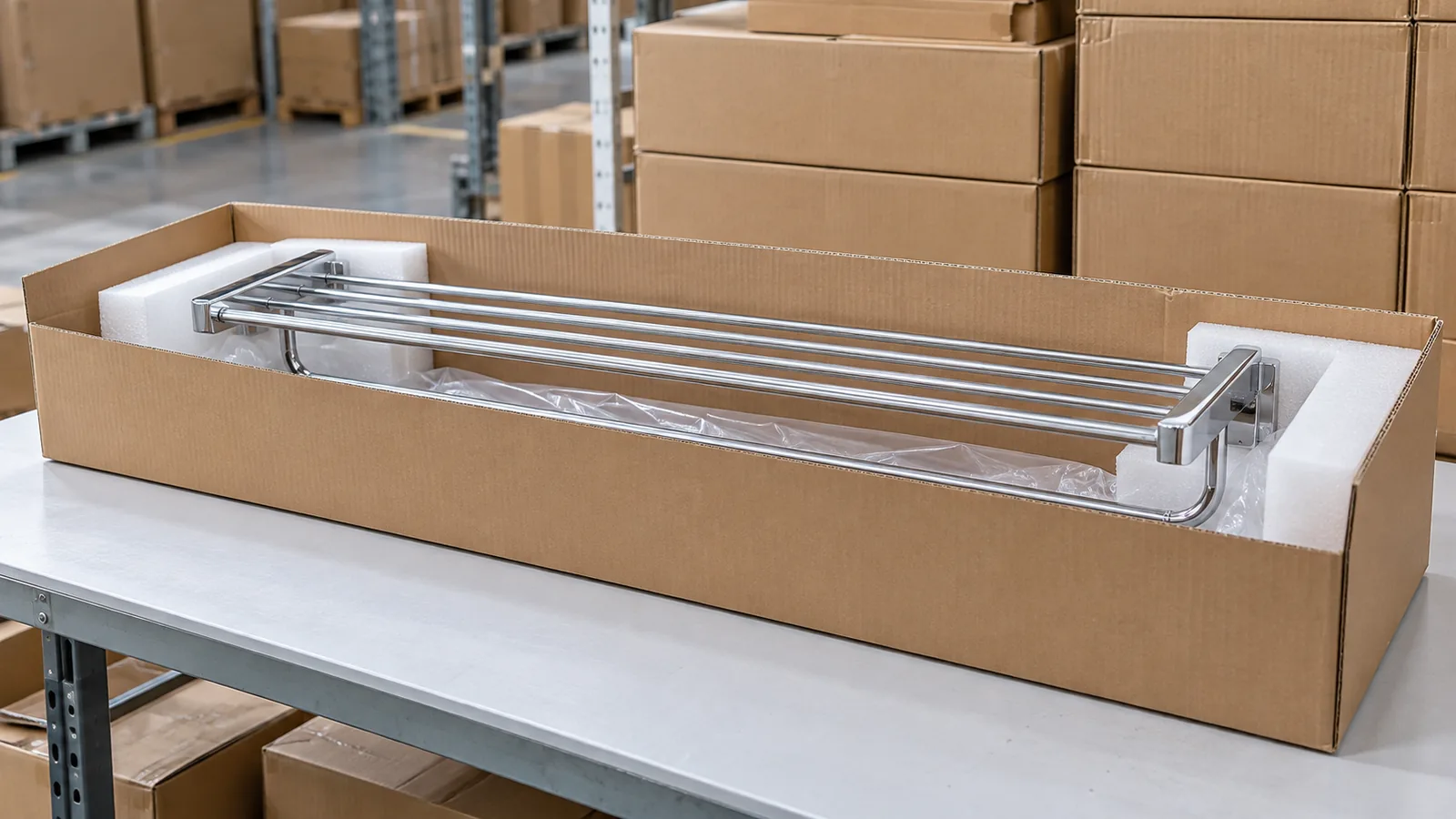
For importers shipping long metal racks or bathroom hardware, corrugated bending stiffness box compression panel bulging is a useful packaging-design question when cartons bow or lose shape under stacking. Bending stiffness describes a board panel’s resistance to bending; it helps explain why the central panels contribute to a box’s top-to-bottom compression behavior. It does not, by itself, predict whether a finished carton will survive a particular route. Buyers should compare the board property with box dimensions, flute direction, joints, closures, stacking support, product fit, and the actual packed configuration before changing a board grade or declaring a shipment risk resolved.
What bending stiffness tells a packaging buyer
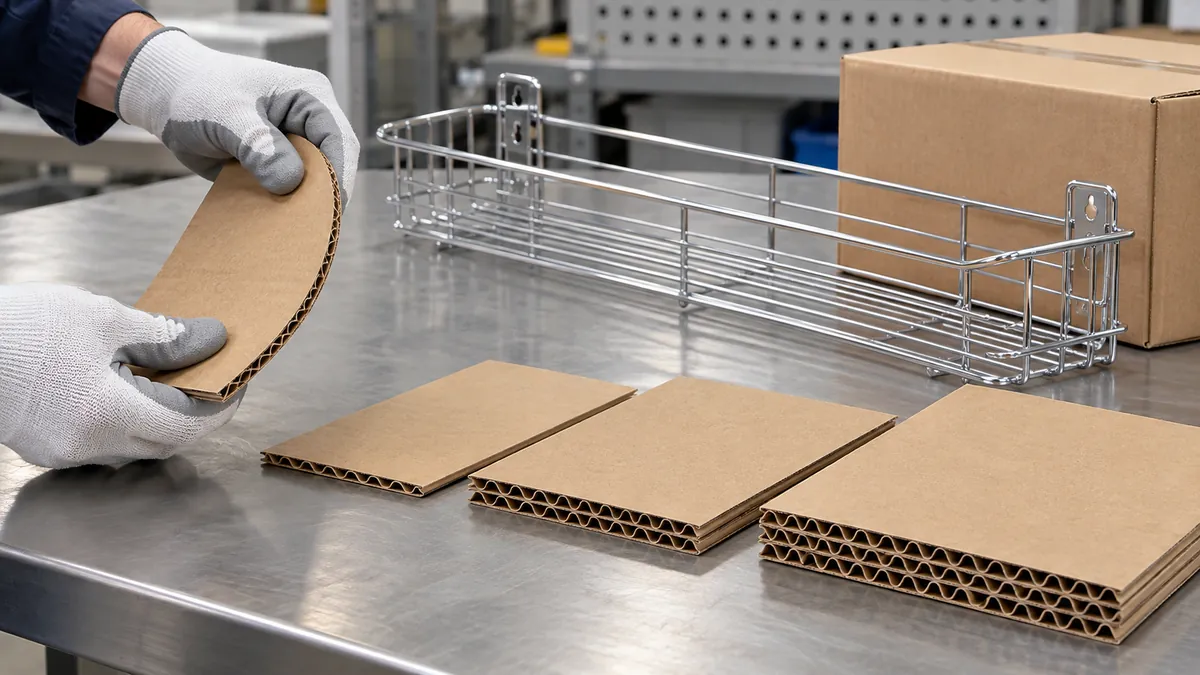
Corrugated board is a layered structure: flat liners are bonded to a fluted medium. A panel can bend when it spans between supported edges or carries a load across its broad face. Bending stiffness describes resistance to that bending under a defined measurement method. It is a board property, not a complete description of a carton’s strength and not a direct measure of damage to the metal product inside.
TAPPI/ANSI T 836 om-25 is the current listed four-point method for determining corrugated-board bending stiffness in the machine and cross directions. TAPPI explains that the central panel areas contribute to a box’s top-to-bottom compression strength and that panel bending resistance can affect stacking strength. The method is one input: TAPPI notes that bending stiffness combined with edge-crush testing and box dimensions can help predict top-to-bottom compression strength. A buyer still needs the applicable full method and a product-specific interpretation; this relationship is not a universal guarantee for every carton design.
For hardware shipments, a long carton may have broad panels that span a relatively large distance between edges or internal supports. If a panel visibly bulges, the observation is worth documenting, but it does not identify the cause on its own. Board stiffness, flute orientation, carton proportions, moisture exposure, pallet support, load distribution, joint placement, closure, and internal voids can interact. A bulge also may not mean the product has moved or been damaged. The buyer should record the location, load and stacking conditions, carton revision, and product protection before selecting a corrective action.
This is the practical meaning of corrugated bending stiffness box compression panel bulging as a buyer question: connect a board measurement to the panel and package that actually carry the load, then determine whether the observed shape change affects the agreed performance requirement.
The phrase corrugated bending stiffness box compression panel bulging captures several related but distinct questions. A buyer should ask which one is being investigated: a board material property, a finished-box compression response, visible panel deformation, or a transit damage outcome. Each needs different evidence. Treating them as interchangeable can lead to a costly board upgrade that does not address the actual support or packing issue.
Separate board stiffness, edge crush, and box compression
Edge-crush testing (ECT) evaluates a corrugated-board specimen loaded on its edge. Bending stiffness evaluates resistance to flexure of a specimen. A box-compression test evaluates the assembled carton as a system under a compression load. These measures can relate to each other, but none is a synonym for another. A carton’s dimensions, construction, flute direction, joints, score lines, closure, and condition affect the assembled result.
Panel bulging is an observed shape change. It may indicate that a panel is bending, but its severity and significance depend on geometry, support, load path, and the acceptance criteria for the packaging system. The same visible bow can be acceptable in one carton and unacceptable in another if the closure, stack stability, clearance, or product protection differs. A photograph can document location and appearance, but cannot establish a measured stiffness value or a compression rating.
| Evidence or observation | What it helps answer | What it does not establish alone |
|---|---|---|
| Board bending-stiffness result | How a conditioned board specimen resists bending in a stated direction and method | Finished-carton performance or route survival |
| Edge-crush result | How a board specimen responds to edgewise compression under its method | Panel flexure or complete-box compression by itself |
| Box-compression test | How an assembled carton responds to a defined compression setup | Performance under every stack, humidity, pallet, or transit condition |
| Observed panel bulging | Where deformation appears in the actual package | Root cause, remaining strength, or product damage without other evidence |
A buyer reviewing a supplier report should confirm specimen direction, sampling location, conditioning, method edition, and whether the sample came from the board or the finished carton. If a result is tied to a material grade, make sure the shipped carton uses that construction and revision. A result from a flat board swatch is not automatically evidence about a carton with a different blank, score pattern, joint, or size.
Why carton geometry and flute direction change the interpretation
The carton’s shape sets the spans and load paths its panels experience. Increasing a panel’s unsupported area, changing the carton’s length-to-width proportions, or moving an internal divider may change how it flexes. Long hardware such as towel bars, racks, or metal frames can require a narrow or extended package. The packaging team may need to balance product clearance, material use, handling, palletization, and stacking requirements rather than maximizing one board metric in isolation.
Corrugated board has directional structure. Machine direction, cross direction, and flute orientation can influence how a panel behaves. A carton blank cut or erected in a different orientation may not preserve the same panel response. If the supplier changes the board grade or blank layout, ask whether the orientation and package dimensions remain consistent with the approved construction. Do not assume that a higher value in one direction compensates for a weak configuration in another direction.
Score lines and folds are intentional features, but they can also alter local panel behavior. A test specimen taken too close to a score, joint, closure, or visibly damaged region may not represent undisturbed board. In the public TAPPI draft under review, sampling guidance explicitly calls for specimens from areas away from scores, joints and closures when using shipping containers as a source. That draft is not a substitute for the current licensed standard; it highlights why sample location and method details belong in the record.
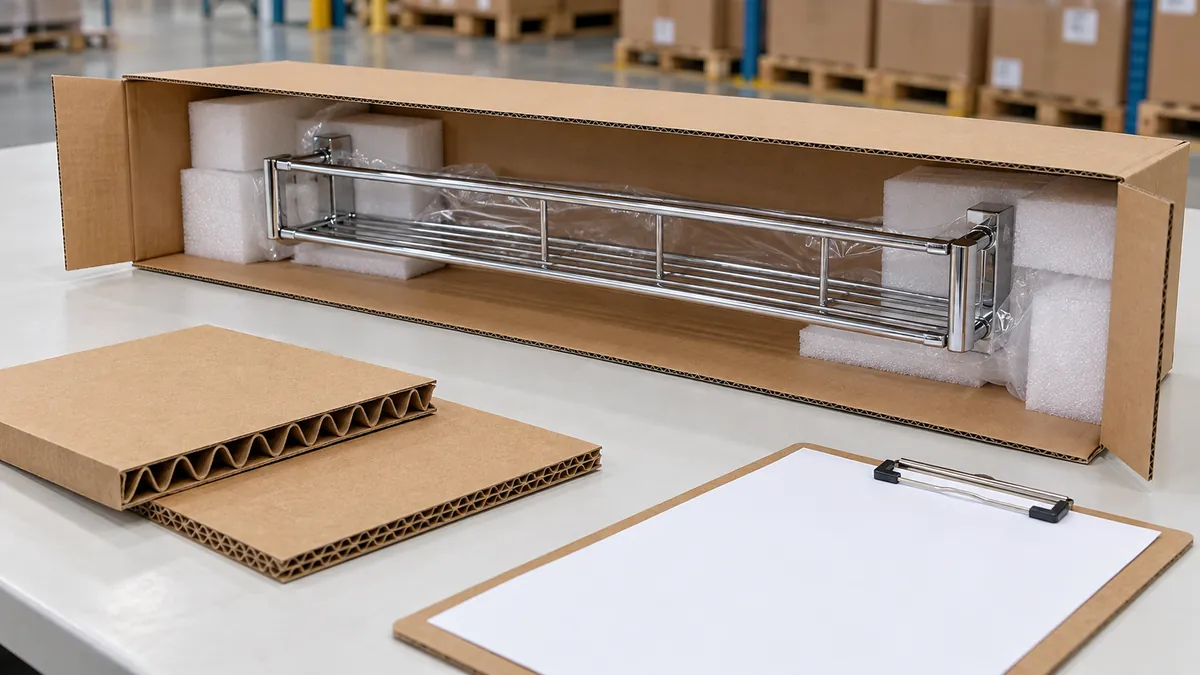
The product and its protective packaging also shape the load. A heavy metal component that is free to move can concentrate force against a panel. A divider or end cap can carry some load, but only if its position and strength are suitable for the actual design. Protective film may prevent scratches without stopping carton deformation. A buyer should review the package with the hardware loaded as intended and check whether the product, inserts, and carton remain in their planned relationship after handling or stacking.
Diagnose a bulging panel without guessing at the cause
Begin by describing the condition precisely: which panel is bulging, in which direction, at what point in the stack or pallet, whether it appeared before or after transit, and whether the carton was loaded or empty. Preserve a representative carton and photograph each side with orientation markers. Record the carton drawing or dieline revision, board specification, product configuration, closure method, and pallet support. If the product moved inside, record the observed position and any contact or damage separately from the carton’s appearance.
Next, compare the actual setup with the approved one. Check whether cartons overhang the pallet, whether the bottom layer is supported evenly, whether straps or stretch wrap apply local pressure, and whether the stack height or load differs from the packaging plan. A box may deform because it is unsupported at a corner even when the board material matches its specification. Conversely, a carton may be well supported but still show unacceptable panel deformation if its broad face or internal spacing is not suitable for the load.
Then choose evidence that matches the suspected mechanism. A board-property comparison may be useful when the material construction changed. A box-compression test may be relevant when the question concerns the complete carton under stacking. A transit or distribution test may be needed when the buyer’s concern is vibration, drops, impact, or handling sequences. Those tests answer different questions and should be specified with the package configuration, conditioning, load, and acceptance criteria clearly defined.
Avoid using a single result to declare a universal improvement. A change that increases board bending stiffness may add material cost, alter folding behavior, or shift stress to a different panel or closure. It may not prevent damage caused by poor pallet support or product movement. A corrective action should identify the observed failure mode, test the revised package under agreed conditions, and confirm that the shipped configuration matches the evaluated sample.
Define supplier evidence and change control in the RFQ
The RFQ should identify the product dimensions and mass supplied by the buyer, the packaging level being designed, expected carton orientation, closure method, and known stacking or pallet conditions. If the buyer already has a distribution-test protocol or retailer packaging standard, reference its current revision. Specify whether the supplier must propose a board construction, provide a material certificate or test report, or submit a packed sample for evaluation. Do not provide only a vague request such as “strong carton” or “no bulging”; define what evidence and conditions will be used to judge acceptance.
Where bending stiffness is a requested board property, identify the method, direction, conditioning, sample location, test source, and acceptance rule. Use the current controlled method edition. TAPPI’s T 836 om-25 listing describes the four-point procedure and its scope; the licensed standard supplies the detailed method. It is a buyer’s choice whether that measurement is needed for a particular carton. Do not add a numeric limit unless the packaging engineer or buyer has validated it for the actual system.
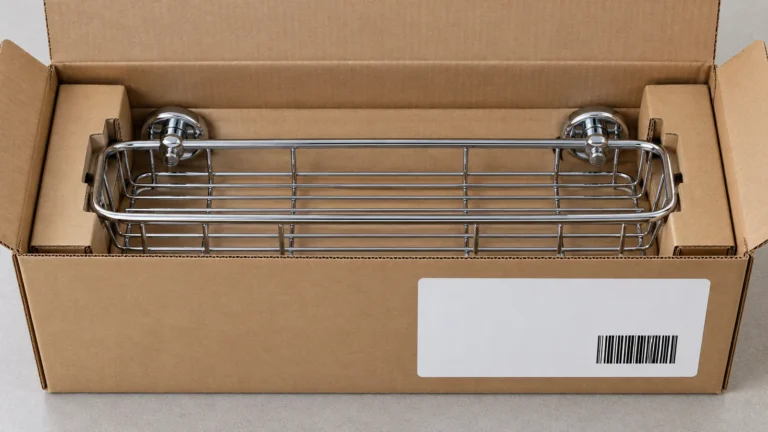
Connect the report to the package revision and supplier lot. If board construction, flute, carton dimensions, score positions, joint placement, insert geometry, or closure changes, ask which approvals need to be repeated. A sample carton should be identified and packed with production-intent hardware and inserts. Photograph the completed pack and retain the agreed reference so a later shipment can be compared against the same layout.
Keep corrugated bending stiffness box compression panel bulging tied to a defined carton, board direction, loading condition, and evidence source; otherwise different suppliers may answer different questions with unrelated figures.
For a metal rack or bathroom hardware set, package sourcing belongs in the same development conversation as part protection and assembly configuration. Koitor’s OEM home-storage hardware page provides a relevant starting point, while the final board specification and distribution validation should be agreed for the buyer’s route and product. A manufacturer should not claim that one board test alone guarantees delivery condition.
Buyer approval checklist
- Distinguish the board property, box-compression response, observed bulging, and transit-damage question.
- Identify the carton size, board construction, flute orientation, blank, closure, and revision under review.
- Record the loaded product, inserts, internal voids, pallet support, and stacking conditions.
- If using a board test, specify method edition, direction, conditioning, specimen source, and acceptance rule.
- If using a complete-box test, define the assembled carton, load, orientation, compression setup, and acceptance rule.
- Photograph bulging with carton orientation and condition; do not label an unverified root cause as fact.
- Reassess approval when board, carton geometry, insert, closure, or pallet configuration changes.
- Compare the approved sample and the actual shipment pack before treating results as transferable.
Frequently asked questions
Does higher bending stiffness always mean a stronger shipping carton?
No. Bending stiffness is one board property related to panel behavior. The complete carton response also depends on dimensions, construction, flute direction, scores, joints, closures, condition, and loading. A buyer should evaluate the packaging system rather than infer a universal result from one number.
Is panel bulging proof that the product inside is damaged?
Not by itself. Bulging documents a change in carton shape. Inspect the product, protective inserts, clearances, and package condition separately, and record whether the deformation affects closure, stack stability, or protection.
Can an ECT report replace a bending-stiffness report?
Not automatically. ECT and bending stiffness measure different board responses. Their relationship to box performance depends on construction and package geometry. Use the method that addresses the buyer’s defined question.
Should a supplier guarantee that cartons never bulge?
A blanket guarantee is not meaningful without a defined load, package construction, humidity and handling conditions, support configuration, and acceptance criteria. Specify the intended conditions and agree the evidence that demonstrates the package is suitable.
Does a board result apply after carton dimensions change?
It may still describe the tested board sample, but it does not automatically validate a new box design. Changes to panel span, flute direction, score pattern, joint, closure, or inserts can change the assembled package behavior and may require renewed evaluation.
Review packaging around the actual hardware configuration
Share the product envelope, carton drawing, board proposal, and shipment concern so the team can separate material evidence from complete-pack requirements.
OEM / العلامة التجارية الخاصة
حوّل دليل التوريد هذا إلى موجز منتج
يرجى إطلاعنا على المنتج المستهدف، والحجم، والتشطيب، وكمية الطلب، ومتطلبات التغليف. وسيتلقى فريقك تقييمًا عمليًّا لإمكانية التصنيع قبل تقديم عرض الأسعار.

 English
  Español
  Português
  Français
  Deutsch
  العربية