

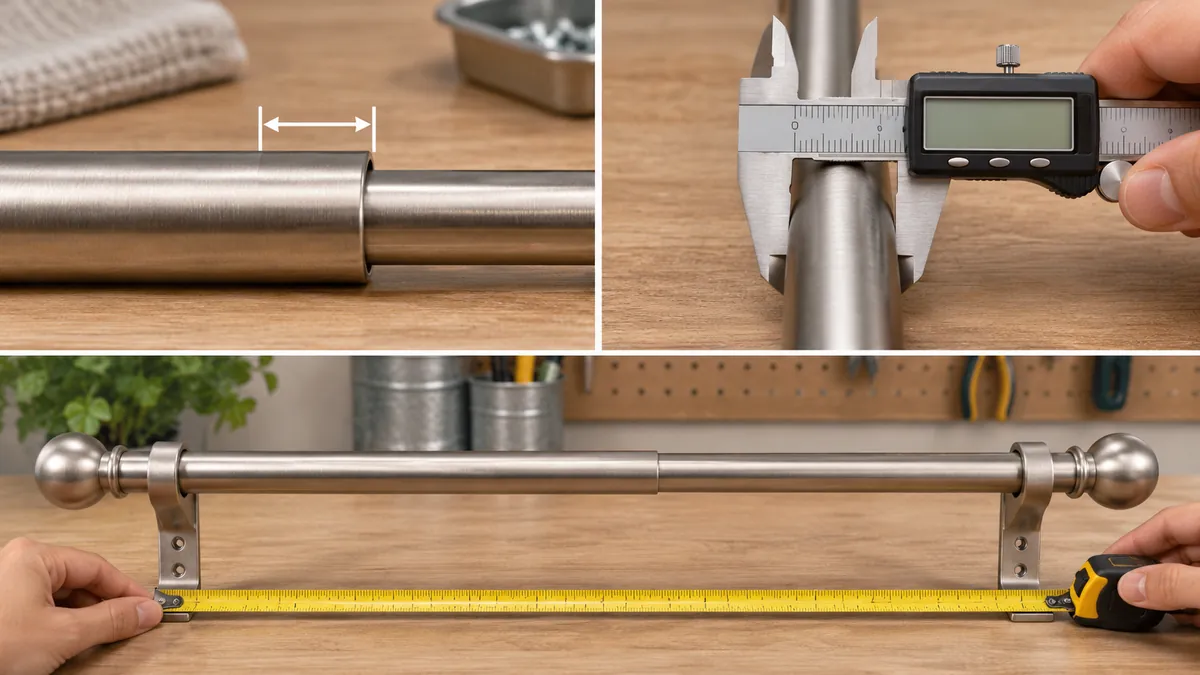
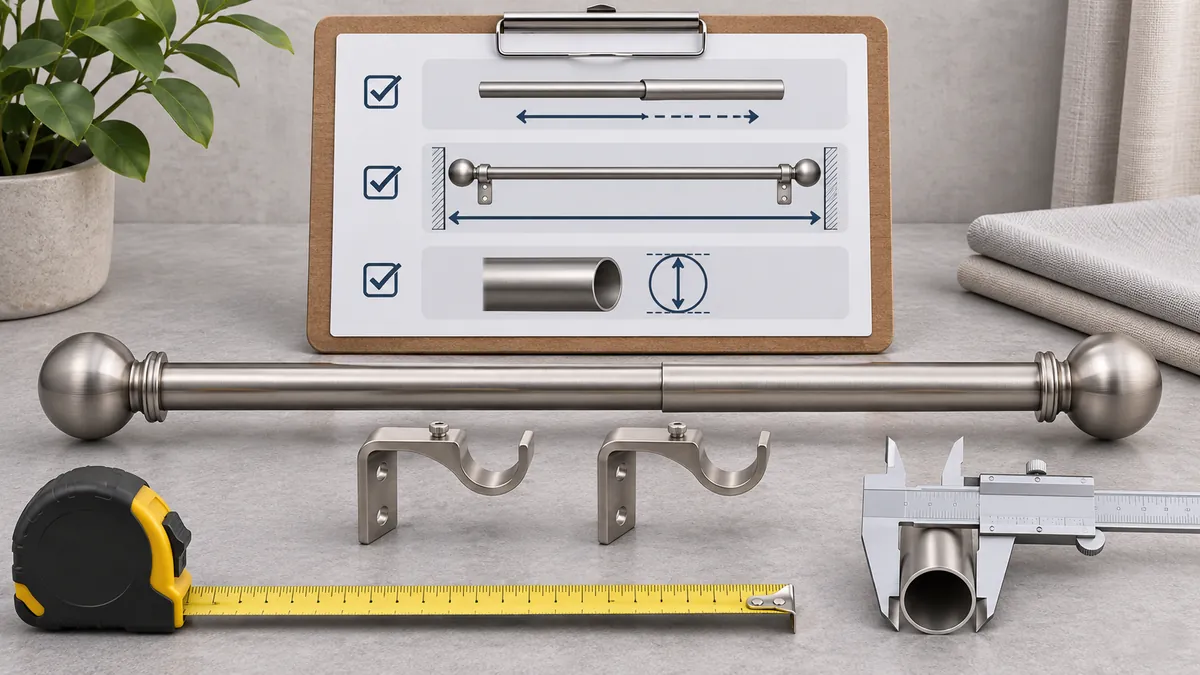
Curtain rod sizes include several measurements that should not be collapsed into one number: usable or adjustable pole length, pole diameter, and the complete assembly width including brackets and finials. The window opening is another measurement. An adjustable range is not itself the required window size, and a rod’s nominal diameter is not a load rating. Read the exact supplier definition and check the assembly with the intended curtains and mounting layout.
Curtain rod sizes: which measurements matter
A buyer comparing curtain rod sizes should separate the opening width from the pole length, diameter, and overall footprint. Each measurement describes a different part of the installation:
| Measurement | What it describes | Why it matters |
|---|---|---|
| Window opening | The width between the chosen measurement points around the opening | Provides the starting reference for the layout |
| Usable pole length | The working length of the rod body | Shows the span available for the curtain treatment |
| Adjustable range | The minimum-to-maximum range a telescoping rod is designed to cover | Helps identify whether a target layout falls within the supplier’s stated range |
| Pole diameter | The outside diameter of the rod section measured at a specified point | Helps identify compatibility with rings, brackets, and joining components |
| Overall assembly width | Pole plus end fittings and any relevant bracket footprint | Determines the full space occupied on the wall |
| Side extension | Space the rod projects beyond the opening on one or both sides | Depends on curtain stack-back, wall space, and the selected arrangement |
Catalog terms do not always define which measurement is being reported. A “48–84 inch rod” may refer to the telescoping pole’s adjustment range, while the finials add length beyond the pole body. A product listing may include brackets in the package without including their projection in the nominal rod measurement. Check the drawing or ask the supplier how the endpoints are defined.
Read an adjustable range correctly
An adjustable rod’s range tells you where the pole can be set within its intended configuration. It does not tell you the exact window opening to measure, the side extension to choose, or the final end-to-end width after adding finials. The source needs to state whether the range refers to the pole alone or to a larger assembly.
Supplier examples show why the exact catalog matters. Kwik-Hang lists common retail length bands such as 28–48 and 48–84 inches, while its own product examples also use ranges such as 24–48 and 48–86 inches. These are catalog-specific examples, not universal categories. Read the exact product’s maximum and minimum, and confirm whether the measurement includes end fittings.
Do not select a rod merely because the window width falls somewhere inside a printed range. First decide the desired layout, then check whether the pole can reach the needed working length while leaving enough usable span for the curtains. If the rods telescope, understand how overlap or the central joint is treated in the supplier’s range. The nominal range alone does not establish a structural rating or performance at every extension.
A useful measurement note can say, for example: “Opening measured 60 inches between the chosen reference points; target pole-body length is to be confirmed after selecting curtain stack-back; selected product listing states an adjustable pole range of X–Y inches, excluding finials.” The values should come from the actual room and catalog rather than a fixed extension formula.
Measure the window and decide on side extension
Measure the opening using consistent reference points. A buyer may need the inside width, the outside trim width, or a wider wall-to-wall span depending on the curtain plan. State which one was measured. A number without its reference points is difficult to reproduce.
Next decide how much space the curtain needs at each side when open. The stack-back is the area occupied by the gathered or drawn curtain. It depends on the fabric, number of panels, heading, fullness, and how the curtain is operated. A fixed percentage or a fixed number of inches should not be treated as universal. The usable wall space may also limit how far the rod can extend.
The measurement map is:
- Record the opening width and the points measured.
- Identify the curtain panels and how they will open.
- Estimate or measure the space the open fabric occupies at the sides.
- Check the wall, trim, and any adjacent obstruction.
- Determine the pole-body length needed for the chosen arrangement.
- Compare that target with the supplier’s stated adjustable range.
- Add the end fittings and brackets to check the complete assembly footprint.
A curtain can cover the opening while still blocking part of the glass when drawn open. Conversely, an extended rod may conflict with a cabinet, door, adjacent wall, or neighboring window. Mock up the actual curtain or use a sample panel when appearance and movement are important.
Understand rod diameter without overreading it
Diameter is usually the outside measurement across the tube or pole, but a buyer should confirm where the measurement is taken, especially if the rod has multiple telescoping sections. A stepped system can have different diameters at different segments. Rings, brackets, connectors, and finials need to match the specified interface.
Highland Forge lists its own 3/4-inch, 1-inch, and 1-1/4-inch diameter options. Those are examples from its catalog; they do not establish that every rod uses those sizes or that a particular diameter is right for a given curtain. The intended system and the manufacturer’s compatibility information govern.
Diameter alone does not establish how much weight a rod can support, how far brackets may be spaced, or how much it will deflect. Material, wall thickness, construction, joint design, span, support locations, and curtain load can all matter. A buyer should not turn a larger diameter into an unsupported capacity claim. If capacity is relevant, request data for the exact product and installation arrangement.
Include brackets, finials, rings, and connectors
A rod is part of a system. The visible pole may be accompanied by wall brackets, ceiling supports, finials, rings, connectors, screws, or telescoping joints. These pieces affect both the usable span and the complete footprint. The rod’s nominal length may not describe the distance from finial tip to finial tip or the projection from the wall.
Finials can extend beyond the pole end and may have a connection that is specific to the rod family. The existing guide to curtain rod finials and end connections covers how buyers should identify mating parts and replacement families. This article focuses on sizing: how the pole range, diameter, window opening, and total assembly relate.
Bracket projection also matters. A bracket that places the pole farther from the wall can alter curtain clearance around trim, sills, handles, or other objects. It also affects the physical layout. Do not use a bracket drawing that belongs to a different rod series to infer the space required by the selected product.
If the project concerns a shower curtain rod rather than a window treatment, consider the separate geometry and application. For a different shower-rod mounting decision, see tension versus bracket-mounted shower curtain rods; telescoping shower-rod interface checks are covered in this roller-ring and rod-joint guide. A window curtain sizing formula should not be carried over to a shower installation without checking the product and mounting conditions.
A worked measurement example
Suppose a hypothetical opening measures 60 inches across using the buyer’s chosen inside reference points. The buyer has not yet selected the curtain panels or determined their stack-back. A supplier lists a telescoping rod range of 48–84 inches, but the finials add length beyond the pole body. The 60-inch opening falls within the stated range, but that fact alone does not prove that the finished arrangement will work.
The buyer next reviews the curtain panel width and the amount of space the fabric occupies when drawn open. Suppose the chosen layout requires a pole-body target of 72 inches; this is a hypothetical planning value, not a universal recommendation. The 72-inch target is within the catalog range. The buyer must still check whether the chosen rod’s overlap at that extension leaves the needed usable span, whether the finial-to-finial width fits the wall, and whether brackets clear trim or adjacent objects.
If another rod has a 1-inch diameter and a different bracket or ring set, it may not be interchangeable even if its length range is similar. The buyer should confirm the matching fittings and installation instructions. This example separates the opening, target pole length, catalog range, and completed assembly. It does not promise a capacity or prescribe a fixed side-extension amount.
Compare supplier listings consistently
A comparison table should preserve each supplier’s definitions rather than normalizing them into a single unverified “rod length” field. Record:
- Product family and item number
- Minimum and maximum pole-body length
- Whether the range includes end fittings
- Diameter of each pole section
- Finial length and connection type
- Bracket dimensions and projection
- Ring or connector compatibility
- Installation configuration and supplied components
- Source of the dimensions and revision date
If a listing shows a range but not the measurement endpoints, ask the supplier. If the product has nested tubes, ask whether the stated maximum includes the telescoping overlap and what part of the pole remains usable. These questions do not infer how the rod performs; they clarify what the dimensions mean.
When converting units, keep the source and converted values together. One inch equals 2.54 centimeters. Round only to the precision appropriate for the decision, and do not make a rounded conversion look like a supplier’s original dimension. For example, a catalog’s 48-inch value converts to 121.92 centimeters; a product page might display about 122 centimeters. Keep the exact source value in the technical comparison.
Avoid common sizing errors
Equating window width with rod length. The curtain opening is one input; side extension and the selected layout can change the target pole length.
Treating a range as the final installed width. Finials, brackets, overlap, and component definitions affect the complete assembly.
Assuming every catalog defines the same endpoints. Check whether the dimension covers the pole body or the end-to-end product.
Using diameter as a load rating. Capacity and deflection require evidence for the actual rod, span, support spacing, and installation.
Ignoring curtain stack-back. A curtain that covers the opening may still obstruct the view or interfere with adjacent fixtures when drawn open.
Mixing shower and window applications. Their installation geometry and support questions differ; use the exact product instructions.
Choosing a bracket from another family. Similar appearance does not establish mating compatibility or projection.
Buyer checklist
Before selecting or specifying a rod, confirm:
- What opening or wall span was measured?
- Where were the measurement points?
- What is the intended curtain arrangement and stack-back?
- Does the catalog range apply to the pole body or the full assembly?
- What are the diameters of the relevant sections?
- How much length do finials add?
- What is the bracket projection and where will it mount?
- Which rings, connectors, or supports are included?
- Is the intended configuration inside the manufacturer’s specified range?
- Are capacity or deflection claims backed by product-specific evidence?
The checklist is a purchasing aid, not an installation or safety certification. Use the manufacturer’s instructions and confirm the actual wall, rod, bracket, and curtain system.
الأسئلة الشائعة
How do I choose a curtain rod size?
Measure the opening, choose the intended curtain arrangement and side extension, then compare the required pole-body length with the actual product range. Check finials and brackets separately.
Does an adjustable rod range include finials?
Not necessarily. Listings vary. Confirm the supplier’s dimension endpoints and whether end fittings are included.
What diameter curtain rod should I choose?
Use the diameter specified for the matching brackets, rings, and rod system. Diameter alone does not establish capacity or the correct choice for every curtain.
Is a 48–84-inch rod right for a 60-inch window?
The opening falls inside that stated range, but fit still depends on the product’s range definition, curtain stack-back, finials, brackets, and wall space.
How much wider should a rod be than a window?
There is no universal side-extension amount in this guide. It depends on curtain panels, the intended open position, and available space. Measure or mock up the actual arrangement.
Are shower curtain rods sized the same way as window rods?
Some physical measurements may be similar, but the installation and support context differs. Follow the instructions for the exact shower or window product.
الخلاصة
Curtain rod sizes are easiest to interpret when the buyer separates the opening, usable pole length, adjustable range, diameter, and complete assembly width. Read the catalog definition, include brackets and finials in the space check, and use the selected curtain to evaluate stack-back. A nominal range or diameter alone does not prove fit or load capacity. For custom metal hardware sourcing, Koitor’s OEM manufacturer page و contact page provide a path to discuss a drawing, sample, and project scope; this is not a claim that Koitor supplies every curtain-rod configuration.
Check the rod at the selected extension
An adjustable rod can have different geometry at different positions. When sections telescope, the visible overlap and the amount of supported pole can change as the rod extends. This article does not infer a capacity from that geometry. The buyer should use the manufacturer’s stated limits and installation instructions for the chosen configuration, not assume that a rod is equivalent at its minimum and maximum extension.
For a room fit review, set the sample rod to the planned length and mark the finial endpoints on the wall or a temporary reference surface. Confirm that the brackets can be placed at the intended locations and that the curtain can pass the support points if rings or carriers are used. If there is a center support, determine how it affects movement and usable span from the product instructions. These are layout checks; they do not replace structural evaluation.
A useful review records the extension setting, the pole sections engaged, the end components installed, and the bracket positions. If the project compares several products, use the same opening and curtain arrangement for each. A table can then distinguish “fits the room footprint” from “supported for the intended load,” with the latter based on separate product data. Avoid combining those conclusions into a single pass/fail label.
What to ask before ordering
Before placing an order, ask the supplier to define the dimensions in its catalog and identify any configuration limits. Confirm the pole-body range, diameter for each section, included finials and brackets, and whether optional components change the complete width. If the product listing uses a nominal size, ask how it was measured. If the rod is intended for an unusual window layout, share the opening and adjacent-space measurements.
For replacement orders, identify the rod family and connection system. A finial that looks similar may use a different attachment, and a bracket with a similar silhouette may project differently. The buyer should match the complete product family or verify the interface dimensions before treating parts as interchangeable. The linked finial guide focuses on those mating details.
When the buyer only has a room measurement and no selected curtain, the result is still preliminary. Keep the open curtain stack-back as an unresolved design input. Do not force a precise rod recommendation from incomplete dimensions. A subsequent sample check with the selected curtain can close the gap.
Coordinate the dimensions with the curtain specification
A rod dimension is only one part of a window treatment. The selected curtain panels determine how much fabric must move, where the gathered fabric rests, and how the finished arrangement appears. If a curtain has a wide stack when open, the pole may need to extend farther than the opening; if there is limited wall space, the buyer may need another arrangement. These are project decisions, not a universal percentage added to every window.
Record curtain panel width and number of panels alongside the rod plan. Ask how the curtain will be drawn, whether rings or carriers are used, and where the panels sit when open. For a center-opening arrangement, the two stacks may occupy space on both sides or meet at a center support. A side-opening panel creates a different layout. A paper opening measurement alone cannot settle those questions.
A mock-up can be useful when appearance matters. Mark the opening, intended bracket points, and finial endpoints. Temporarily place the curtain or a representative panel to estimate how the fabric covers the opening when open and closed. This is not a load test; it is a layout check that can reveal a conflict with trim, adjacent windows, furniture, or a door.
Interpreting catalog units and tolerance
Catalog dimensions often appear in rounded inches or centimeters. Preserve the original supplier figure, the unit, and the date or revision of the listing. If converting 48 inches, the exact conversion is 121.92 centimeters. A catalog that shows 122 centimeters may be rounding to a whole centimeter. Do not claim the rod was manufactured to 121.92 centimeters based solely on a rounded retail listing.
For an adjustable product, the endpoints may also be nominal. Confirm whether the minimum and maximum refer to the pole body, whether finials are excluded, and whether the supplier specifies an installation range. If the project needs a defined wall-to-wall dimension, the buyer should use the supplier’s drawing or measurement instructions and account for the actual fittings.
When comparing suppliers, do not assume one company’s range label is directly equivalent to another’s. One may list an adjustable pole-body length; another may give an overall package or approximate wall span. Ask for the measurement diagram and compare like quantities. If the supplier cannot define its endpoints, mark the dimension as unclear rather than using it as a precise selection input.
Where the related guides fit
Rod type and size are separate decisions. Rod type and size are separate decisions. A related guide on bypass drapery rings and bracket-panel travel addresses the component interface and travel path; keep this article focused on pole range, diameter, and complete assembly width.
This separation helps buyers avoid creating a single checklist that mixes unrelated measurements. A rod can be the right type but the wrong range; a correct range can still have a diameter mismatch with brackets; and a compatible pole can still occupy too much wall space after finials are installed. Each question should have its own measured input and evidence.
Source notes
The retail length examples come from Kwik-Hang’s curtain rod length guide; the diameter examples come from Highland Forge’s curtain rod diameter guide. Those values are supplier-specific examples, not universal sizing rules.
Discuss a related hardware project with Koitor
Share the relevant drawing or sample, product revision, finish, order quantity, and packaging scope to clarify the manufacturing discussion. Topic-specific accounting, care, textile, or coating decisions remain with the appropriate buyer and technical owners.
OEM / العلامة التجارية الخاصة
حوّل دليل التوريد هذا إلى موجز منتج
يرجى إطلاعنا على المنتج المستهدف، والحجم، والتشطيب، وكمية الطلب، ومتطلبات التغليف. وسيتلقى فريقك تقييمًا عمليًّا لإمكانية التصنيع قبل تقديم عرض الأسعار.


 English
 Español
 Português
 Français
 Deutsch
 العربية