

A distribution center vs fulfillment center comparison is most useful when it identifies the outbound order unit. A distribution center commonly moves bulk or case quantities to stores or other facilities, while a fulfillment center commonly picks and packs individual customer orders. These are operating emphases, not mutually exclusive building types. Buyers should specify whether the receiving operation needs master cases, inner packs, individual units, or a mix; the facility label alone does not tell a supplier how to pack or label a product.
What Problem Does This Comparison Solve for Buyers?
An importer can receive a warehouse address and a facility name without knowing how the goods will be handled there. The name may suggest a general role, but it does not replace the receiver’s actual instructions. A buyer sourcing bathroom accessories, wire baskets, towel racks, or home-storage hardware still needs to know which unit the facility expects to receive, store, pick, and dispatch.
That operational difference matters upstream. If a distributor replenishes stores in cases, the order may be prepared and checked at the case level. If an ecommerce operation ships one item directly to each consumer, its downstream process may pick single units and protect each parcel for an individual shipment. A product may eventually flow through both types of operation. A supplier cannot choose a suitable carton, label, barcode, or unit presentation from the words “distribution center” or “fulfillment center” alone.
SEKO’s logistics explanation describes the common distinction through primary functions and order handling. The practical takeaway for a hardware importer is to map the order unit rather than treat the building category as a promise about size, stock, automation, cost, or speed. A facility can combine roles, and its customer’s operating design determines the specific receiving and outbound requirements.
How Do the Two Facility Roles Usually Differ?
A distribution center commonly consolidates, sorts, and redistributes goods in bulk or case quantities to stores, other distribution points, or business customers. A fulfillment center commonly receives stock and picks, packs, and dispatches orders for individual end customers. These descriptions identify common tasks; they do not create rigid definitions that every company uses identically.
| Operational question | Distribution center emphasis | Fulfillment center emphasis | Buyer confirmation |
|---|---|---|---|
| Typical outbound destination | Store, branch, business account, or another facility | Individual customer or consumer delivery address | Who is the receiver at the next step? |
| Common picked unit | Case, inner pack, pallet, or mixed store order | Each individual sellable unit, sometimes with several items combined in one order | Will the warehouse pick cases, eaches, or both? |
| Common packing concern | Case quantity, pallet configuration, carton identification | Each-unit presentation, parcel protection, order consolidation | What unit and label does the facility scan? |
| Order pattern | Replenishment or redistribution | Customer-order fulfillment | What is the actual order profile for this SKU? |
The table is a working distinction, not a universal specification. Some distribution operations pick individual units for store replenishment. Some fulfillment operations handle wholesale orders or cases. A single site may carry out both functions, or a company may use different facilities for different channels. Confirm the receiver’s exact inbound guide and purchase-order requirements before changing the supplier pack.
What Does the Order-Unit Flow Look Like?
A one-SKU flow map makes the difference concrete. Imagine a bathroom storage basket packed as one saleable retail unit, with several retail units packed into a master carton. The example is illustrative; it does not state a Koitor packaging configuration or a universal carton quantity.
Store-replenishment path
- The supplier prepares a master carton containing an agreed number of saleable units.
- The importer’s inbound receiver checks the carton label, quantity, SKU, and purchase-order reference.
- Stock may be stored by case, pallet, or another location unit chosen by the operator.
- A store replenishment order calls for several units or cases.
- The distribution operation picks the requested store quantity and routes it to the receiving store or facility.
Individual-order path
- The same SKU is received in an agreed inbound unit, which may still be a master case.
- Units may be placed into an individual-pick location after receiving and put-away.
- A customer order calls for one basket, or for one basket plus other products.
- The operation picks the required eaches, consolidates order lines, and packs the parcel for that order.
- The parcel is labeled and handed to the carrier according to the operator’s process.
The distinction becomes visible at the point where the order is released: does the operation pick a case for another organization, or individual saleable units for a customer order? The answer can vary by channel and order. A business may receive stock in cases at a fulfillment center even though that center later picks each units. Conversely, a distribution center can perform unit picking for stores.
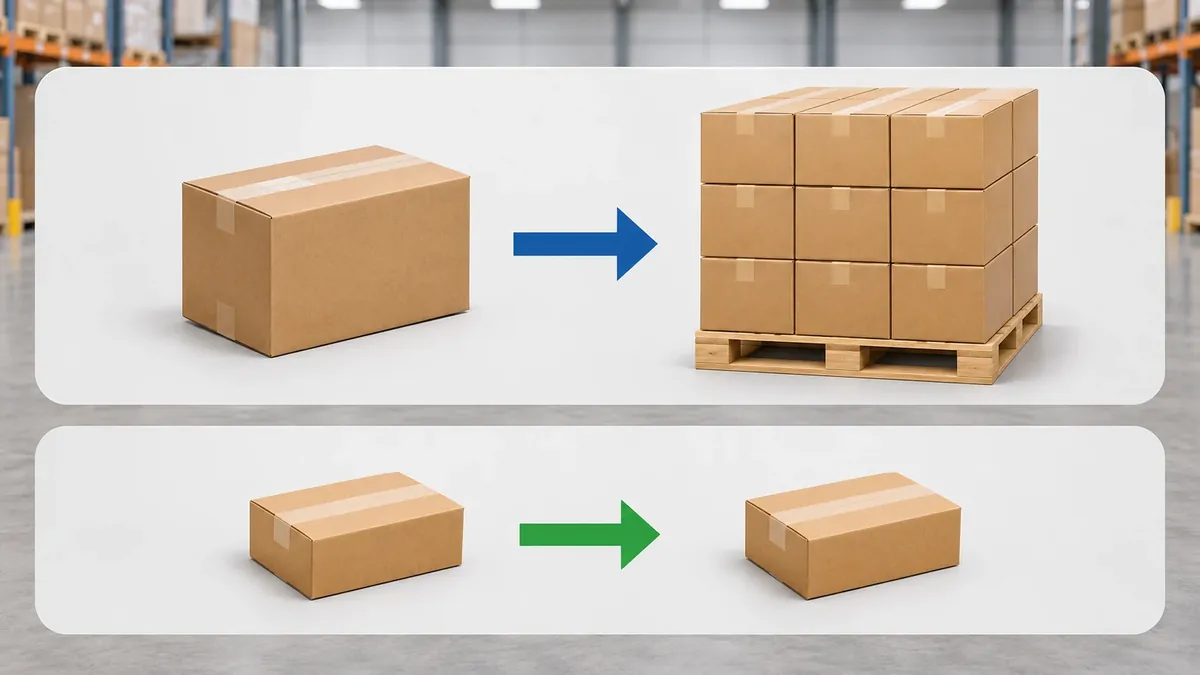
This map helps buyers ask a packaging question that a facility label cannot answer: “What is the unit you will receive from us, and what unit will your system pick for the order?” If the answer includes several pack levels, document each level separately.
How Should Importers Translate Facility Roles into Packaging Instructions?
Packaging requirements belong to the actual buyer, receiver, and route. A distribution center’s case movement may make the master carton important for identification and handling. A fulfillment center’s each-pick activity may make the individual sellable unit important for scanning, damage prevention, and presentation. The same product can need both: protective individual packaging inside a master carton that is also suitable for inbound receiving.
Before quotation or sample approval, confirm:
- The sellable unit: one finished accessory, one pair, one kit, or another defined pack.
- The inner pack quantity, if the buyer uses one.
- The master-carton quantity and mixed-SKU rules.
- Whether the buyer or receiving operator requires a label on each unit, each carton, or both.
- Required SKU, purchase-order, barcode, carton count, or destination fields.
- Whether cartons are delivered individually, palletized, or in a consolidatable load.
- Any parcel-specific protection or e-commerce presentation requirement.
- Whether the receiver requires an appointment, advance shipment information, or particular booking references.
A facility name does not tell a supplier the barcode format, label placement, carton dimensions, pallet pattern, booking method, or acceptable packaging material. Those requirements need to be supplied by the customer or the fulfillment provider. Do not infer them from the building role or a general logistics article.
For carton dimensions and material efficiency, see Koitor’s existing guide to bathroom hardware carton size optimization. That page addresses carton design and protection; the current article addresses what order unit the facility handles. For mixed products sharing a master carton, the guide to mixed-SKU master-carton identification covers the distinct SKU-identification task.
Which Assumptions Should Buyers Avoid?
The words “distribution center” and “fulfillment center” are not reliable shortcuts for every operating detail. Buyers should not assume that a fulfillment center is always smaller, holds less stock, has more robots, stores goods for less time, costs more per order, or ships faster. They should also avoid assuming that a distribution center is always large, pallet-only, or unable to pick individual units. Those conclusions require facility- or contract-specific evidence.
Other errors often happen when teams discuss packaging:
- Treating inbound case quantity as outbound order quantity. A site may receive cases and later pick single units.
- Assuming the facility chooses the product’s retail pack. The brand owner or importer may control the sellable unit and artwork.
- Confusing facility operations with channel accounting. A building’s warehouse role does not determine when a sale is recognized.
- Skipping item-level protection because the master carton is strong. The shipment route and receiver process determine the required protection.
- Assuming every receiver uses the same labels. Fields, placement, and scan rules must be confirmed for the specific customer.
- Changing carton quantity based on a generic definition. The buyer’s SKU plan and the operator’s handling rules govern the pack.
- Using “each pick” to mean one carton. Define whether “each” means one sellable product, a set, or a unit of measure in the order system.
The appropriate correction is a written pack-level specification. Identify the unit of sale, inner pack, master carton, and transport unit as separate levels. State who owns each label and which party approves it.
What Questions Should Buyers Send to the Receiver?
A short receiver questionnaire can resolve the practical uncertainty:
- Is this site receiving inventory for store replenishment, individual customer orders, or both?
- What inbound unit should we deliver: pallet, master carton, inner pack, or sellable unit?
- Will your operation pick master cases, individual eaches, or mixed order quantities?
- What SKU and order identifiers are required on the product, inner package, carton, or pallet?
- Are mixed-SKU cartons accepted, and how must they be separated and identified?
- Are there carton-size, weight, pallet, or stacking requirements in the current routing guide?
- Is each-unit parcel protection required for this product, or is that handled later?
- Which label artwork, data fields, and barcode specifications are current?
- Who approves a packaging sample and the final packaging change?
- How should changes to pack quantity, label, or carton dimensions be submitted?
Ask the fulfillment or distribution provider for its current operating guide instead of relying on a general article to define receiving rules. A guide can change when the customer, carrier, site, or order system changes. Keep the approved version with the SKU and packaging revision.
How Does This Connect to Importer Reporting and Reorders?
Facility flow and sales reporting are related to operations but answer different questions. A distribution operation may ship product to a store, while the store later sells the item to a consumer. A fulfillment operation may ship an order directly to a consumer. Those physical movements do not alone define a company’s sales-recognition method or channel reporting. Koitor’s separate explanation of sell-in and sell-out addresses transaction and channel boundaries.
For a reorder, keep the physical unit aligned with the commercial unit. If the buyer orders by case but the facility picks by each, the product master data needs to connect the case quantity to the each-level SKU. If the buyer changes a case pack, carton, or barcode, confirm whether purchase-order quantities, warehouse records, and retailer data need updating. Avoid changing the supplier pack until the buyer and receiving operator agree on the downstream effect.
A careful change record includes the prior pack, revised pack, effective date, affected SKU, label or barcode revision, and approval party. If more than one facility handles the product, document site-specific requirements rather than assuming all sites share one process. This is practical coordination, not a guarantee that any warehouse will accept a particular pack.

How Can an OEM Supplier Support the Packaging Discussion?
A bathroom and home-storage hardware factory can help buyers translate a confirmed pack requirement into a product-specific packaging conversation. That may include reviewing the product dimensions, protective separation, finish contact points, carton layout, assembly state, label placement area, sample packaging, and order quantity. The supplier should not invent a warehouse requirement or claim that its package meets a receiver’s rules without checking the actual specification.
Koitor Hardware is a family-owned custom metal hardware factory focused on bathroom and home storage products. Its flexible OEM work can include drawing or sample review, finish discussion, packaging preparation, and small-batch development depending on the project. The factory’s role is to respond to documented buyer requirements for the metal product and its agreed packaging scope. The importer or its logistics provider remains responsible for providing current receiving guides, barcode data, booking instructions, and destination-specific rules.
When the facility’s instructions are incomplete, hold the relevant packaging decision open. Confirm the order unit and label requirements first, then approve a packaging sample and record its revision. This prevents a supplier from optimizing a carton around an assumed outbound process that does not match the buyer’s actual channel.
Buyer Checklist Before Requesting a Quotation
How Can a Buyer Test the Pack-Level Logic?
Run a small paper exercise with one SKU before agreeing to a new carton configuration. Write down the sellable unit, the quantity inside an inner pack, the quantity inside a master carton, and the quantity on a pallet or other transport unit if one is specified. Then trace one store replenishment order and one direct customer order through the same inventory record. The exercise is not a warehouse simulation; it exposes missing definitions in the purchase data.
For example, if a buyer orders 24 retail units in one master carton but a store requests 6, the receiving and outbound systems need a clear way to record a partial case or a unit pick. If an online customer orders one unit, the operation may need to retrieve one sellable pack and add parcel protection. The hypothetical quantities illustrate the logic only; actual case quantities must come from the buyer’s assortment and the supplier’s confirmed packaging sample. If a receiving system cannot identify the each-level SKU or unit conversion, the team should resolve that data before changing the printed carton count.
This review is especially useful when the same item has a retail box, a protective inner, and a master shipper. Keep the label owner, data source, and approval revision attached to each layer. A buyer may approve the retail artwork while a distributor controls the carton label, and an ecommerce operator may require a separate parcel workflow. Naming those owners prevents the supplier from receiving inconsistent instructions from different channel teams.
The result should be a concise pack specification that lists units, quantities, identifiers, label positions, and approval responsibility. If the facility has not supplied its requirements yet, mark the affected fields as pending rather than converting an assumption into a production instruction.
- Product type, model, dimensions, and drawing or sample.
- Exact sellable unit and kit contents.
- Inner-pack and master-carton quantities, if already defined.
- Whether the product will go to a distribution operation, fulfillment operation, or both.
- The receiving unit expected at each site.
- Confirmed label, barcode, SKU, and purchase-order data.
- Mixed-SKU carton and pallet rules.
- Individual-unit protection and parcel presentation requirements.
- Target market, finish, and any handling constraints.
- Sample packaging approval process and revision owner.
- Target order quantity and reorder plan.
- Contact or routing guide for the actual receiving operation.
الأسئلة الشائعة
Is a distribution center the same as a warehouse?
Not necessarily. “Warehouse” is a broad term for a facility that stores goods. A distribution center commonly performs redistribution and outbound order preparation as part of its role. A specific warehouse may have one or several functions, so buyers should verify the site’s actual work.
Does a fulfillment center always ship only single products?
No. Individual customer orders are a common fulfillment emphasis, but a facility can handle other order types or share functions with distribution operations. Confirm whether the site receives and picks cases, eaches, or both.
Should a supplier use different packaging for a distribution center and a fulfillment center?
Only when the buyer or receiving specification calls for a different pack. Facility labels alone do not define carton quantity, barcode, parcel protection, or pallet rules. The importer should provide the current requirements and identify who approves the packaging.
Can a distribution center also fulfill direct-to-consumer orders?
A company may combine functions or use a site for different order profiles. The labels are not mutually exclusive building types. The buyer should ask which processes and order units apply to the specific SKU and destination.
Map the Handling Unit Before Comparing Sites
The warehouse label alone does not tell a supplier how an order will move. A distributor may receive full cartons, break them into store replenishment quantities, and later ship mixed cases. An e-commerce operation may receive master cartons but pick individual units only after orders arrive. A fulfillment center may also handle pallet replenishment, while a distribution center may support direct-to-customer dispatch. The operation should therefore be described as a flow of handling units, not a rigid label. Record what arrives, where it is stored, what quantity is picked, which label is scanned, and what leaves the facility.
This distinction changes packaging instructions. If a carton is opened for each order, inner packs need to stay identifiable after the outer case is removed. If workers pick whole cases, the case quantity and external SKU label become more important. If mixed-SKU cartons are accepted, the packing list and carton markings need to show the contents clearly. If the receiver uses pallet IDs or advance shipment notices, those requirements should be agreed with the logistics team before artwork and carton layout are frozen. Avoid promising that a particular carton will work in every warehouse: conveyor dimensions, pallet rules, barcode systems, and receiving procedures vary by operator.
Use a Small Flow Trial
Before a large packaging change, trace one representative SKU through the intended route. Write down the supplier pack, inbound unit, storage unit, pick unit, outbound unit, and any repack step. Then ask the receiving or fulfillment operator to confirm the proposed labels, scan points, and quantities. A simple mock carton or printed label can reveal whether a warehouse needs a different data field or clearer unit count. This kind of review is not a substitute for a formal logistics specification; it is a way to surface assumptions early, while changes are still inexpensive.
For repeat orders, save the approved pack configuration with the SKU and revision. If an assortment, inner-pack count, or destination changes, review the flow again rather than copying an old instruction blindly. The supplier can then quote against a defined packaging scope, and the buyer can distinguish product cost from labeling, carton, or packing-work changes. That clarity helps prevent a receiving exception from being misdiagnosed as a product defect.
A useful distribution center vs fulfillment center review records the exact part, responsible supplier, source document, drawing revision, review owner, and unresolved limitation. Keep unknowns visible instead of substituting a generic assumption. When the requirement affects safety, fit, or regulated performance, obtain approval from the qualified design or technical owner. For repeat orders, connect the accepted sample and inspection evidence to the purchase specification so changes can be reviewed before production.
For this decision, keep the phrase distribution center vs fulfillment center tied to the exact model, documented condition, and intended application. For this decision, keep the phrase distribution center vs fulfillment center tied to the exact model, documented condition, and intended application.
اعمل مع شركة «كويتور» للأدوات
Planning Case Packs for a Hardware SKU?
Share the product drawing or sample, confirmed order unit, carton and label requirements, finish, and target quantity. Koitor can review the metal product and agreed packaging scope while your receiving operator confirms its site-specific rules.
OEM / العلامة التجارية الخاصة
حوّل دليل التوريد هذا إلى موجز منتج
يرجى إطلاعنا على المنتج المستهدف، والحجم، والتشطيب، وكمية الطلب، ومتطلبات التغليف. وسيتلقى فريقك تقييمًا عمليًّا لإمكانية التصنيع قبل تقديم عرض الأسعار.


 English
 Español
 Português
 Français
 Deutsch
 العربية