
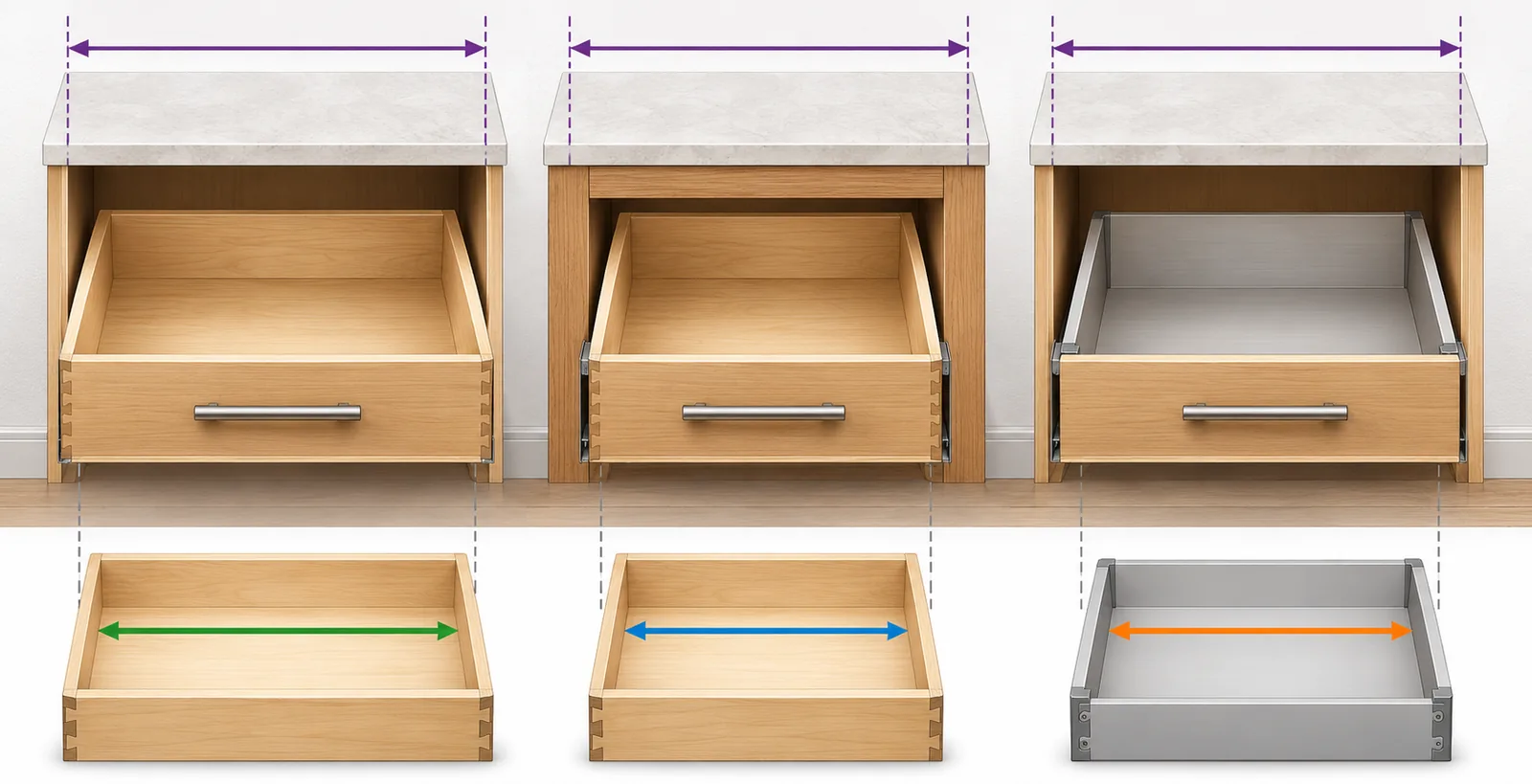
Standard drawer sizes can refer to a cabinet’s nominal width, the opening, the drawer-box exterior, the front, or the usable interior. Those are different measurements. One universal subtraction does not turn every cabinet width into the correct insert width. In Cabinets.com’s 2026 dimension reference, three construction families at an 18-inch cabinet width have different listed interior widths: 13-1/2 inches for the framed family, 15-1/8 inches for the frameless family, and 14-7/8 inches for the European frameless family. They are values for that supplier’s named families, not universal construction standards.
For a buyer, the key is to identify the exact measurement an organizer needs and verify it against the actual finished drawer or the correct product drawing. A cabinet-width label is useful for locating a product family, but it does not disclose the usable interior by itself. Keep the maker, construction family, dimension definition, and units attached to every value.

Define the Drawer Dimension Before Comparing Numbers
Begin by naming the field shown in a catalog or drawing. Nominal cabinet width identifies a cabinet size according to the supplier’s convention. The opening is a gap or access space within the surrounding cabinet structure. The drawer front is the visible panel. The drawer box is the assembled container behind that front, and its interior is the usable space inside the box. An insert usually depends on the interior or another clearly defined interface, not simply the outside width written in a cabinet schedule.
Some product tables group several kinds of dimensions under one heading such as “drawer sizes.” That can be convenient for a homeowner comparing a cabinet range, but a sourcing team should retain the exact subheading and endpoints. If a value is an inside width, call it inside width. If it is the drawer-box outside width, do not shorten it to “drawer width” in an RFQ. Ambiguity here can create a sample that appears close but cannot be compared consistently with the buyer’s drawing.
The same distinction applies to depth and height. A drawer front may be taller than its box. A listed box depth may not equal the clear depth available after a rear obstruction or slide component is considered. The source table should state which construction family and dimension each value belongs to. A diagram can help, but a photo without labeled endpoints does not define a measurement convention.
When the needed field is not named, ask the cabinet supplier to clarify the measurement origin and end point. Keep the answer with the model code and drawing revision. Do not derive an interior value from a photograph or from a familiar rule of thumb. The documentation for the exact model should control the purchasing decision.
Compare Three 18-Inch Families in One Source
Cabinets.com’s public 2026 dimension sheet allows a direct comparison at the same nominal cabinet width. It lists different drawer interior widths for its framed, frameless, and European frameless families. The example is useful because it demonstrates that the cabinet width alone does not determine a single interior dimension.
| Named Cabinets.com family | Cabinet width in cited row | Listed drawer interior width | How to use the value |
|---|---|---|---|
| Framed | 18 in | 13-1/2 in | Reference for that supplier’s framed family only |
| Frameless | 18 in | 15-1/8 in | Reference for that supplier’s frameless family only |
| European frameless | 18 in | 14-7/8 in | Reference for that supplier’s European frameless family only |
The measurements are deliberately limited to three named entries from one source. They do not establish that every framed drawer is 13-1/2 inches wide or that every frameless drawer will match either of the other two. Another manufacturer’s construction, box, or slide arrangement may use different dimensions. The correct interpretation is “this source lists these values for these families,” not “all cabinets follow this conversion.”
The source also lists depth values tied to its families. If depth matters to a buyer, use the appropriate family row and preserve the association between width and depth. Do not combine a width from one family with a depth from another to assemble a fictional model. The chart is not a license to transfer dimensions between product systems.
This comparison helps explain why two cabinets described as 18-inch units can present different usable spaces for an insert. It does not rank one construction as better, stronger, or more suitable. The table answers a dimensional question for the named catalog entries. It does not determine slide performance, installation quality, or the compatibility of an accessory whose own interface has not been checked.
For standard drawer sizes, the model family is as important as the nominal cabinet width because the same width label in this source maps to different interiors.
Keep the Supplier and Product Family Attached
A dimension copied into an assortment spreadsheet can lose context as it is handed from merchandising to engineering, purchasing, or a distributor. Preserve the manufacturer and family in the same row as the number. Include the model or width represented, the measurement label from the source, and the document date or revision if available. This makes it possible to distinguish a genuine change in dimensions from a change in the source table or the selected product family.
If one catalog uses “framed” and another uses similar wording, do not assume the products share identical construction or interior dimensions. Treat the terms as each maker’s product-family labels. A buyer may create a side-by-side comparison, but should identify the source behind each value and avoid presenting the resulting table as an industry standard.
When retailer and maker pages disagree, first confirm that the model numbers are exactly the same. Retail listings can summarize a product family or omit details that appear in a dimension sheet. If the discrepancy remains, ask the manufacturer which current drawing applies. Do not average the numbers, select the larger one to make an insert fit on paper, or silently replace a supplier value with an estimate.
The reviewed evidence supports the three Cabinets.com examples and the distinction among cabinet opening, drawer box, front, and interior. It does not support a general construction formula, a slide-clearance deduction, or a woodworking cut list. Keep the article’s numbers as evidence from one catalog rather than turning them into instructions for building a drawer.
Measure the Finished Interior at the Accessory Location
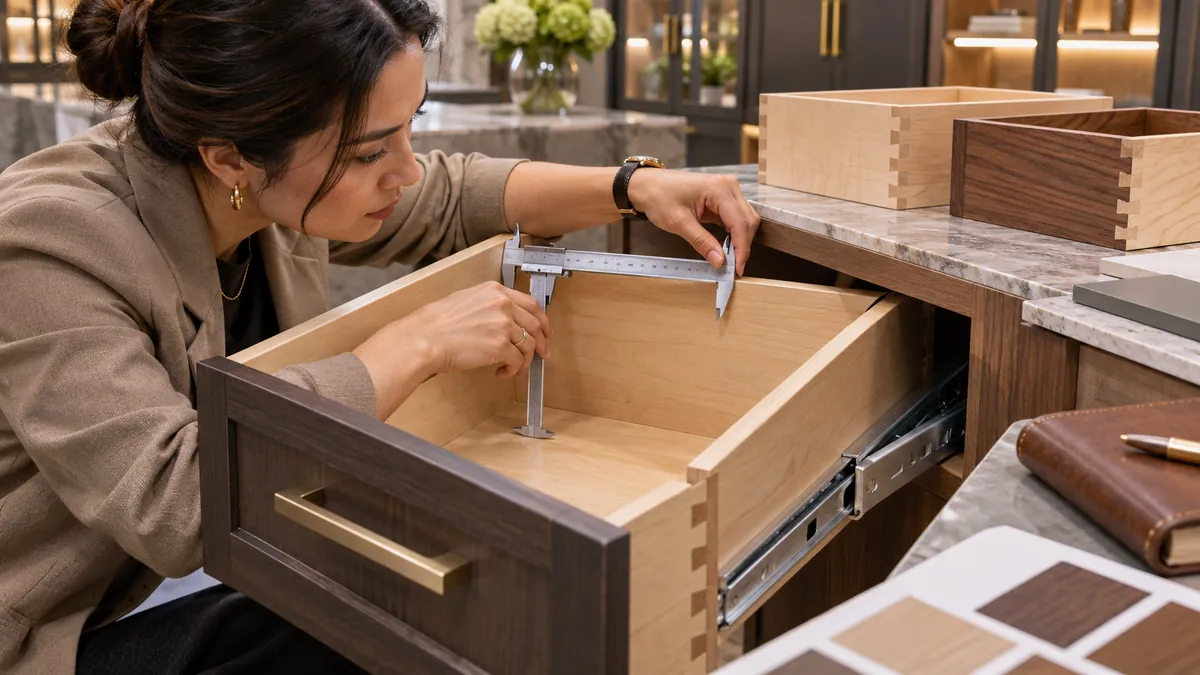
If the cabinet or drawer sample is available, measure the space the accessory will actually occupy. Record the inside width between the relevant surfaces, usable depth, and any localized obstruction that changes the fit. Note where the measurement was taken: near the front, middle, or rear; above or below a rail; or at another position specified by the accessory drawing. These notes help compare the sample with the final selection without implying a tolerance that the source does not state.
A single measurement may not describe a space that changes along its length. If the interior visibly narrows, has an angled side, or contains a local feature, record those observations and ask the responsible supplier how the dimension should be evaluated. Do not invent a measurement standard or choose the most favorable point. A fit review should use the location and conditions relevant to the actual accessory.
If the product is not yet built, request its model-specific technical drawing or a confirmed dimension from the cabinet maker. Ask whether the stated width is the opening, the outside of the box, or the clear interior. For a proposed substitute, obtain that substitute’s own documentation. A similar nominal cabinet width does not prove that a previous model’s insert will fit.
Record the measurement endpoints
An interior width is useful only when the measurement endpoints are understood. A drawing may show the side surfaces that define the clear span; a sample check may use a tape or another tool, but the note should still identify the surfaces being compared. If the drawer has a liner, divider, hinge projection, or rail feature, state whether that item is included in the usable space. Do not treat a general exterior dimension as if it were taken between those internal points.
For a repeatable sourcing conversation, include the cabinet family, model, drawer position, measurement location, units, and source of the value. If a buyer provides a measurement from a sample, label it as an observed sample value rather than an official production tolerance. If the cabinet maker supplies a dimension, identify it as a maker-provided value and retain the drawing or message that defines it. These records make later differences easier to investigate.
When values are close, avoid rounding away the difference. Preserve the original decimal or fraction and record any unit conversion separately. A convenient spreadsheet number should not imply that a supplier guarantees that level of precision. The actual acceptable range must come from a project specification that the responsible parties have reviewed. This article does not set a tolerance or inspection limit.
Check the travel path, not just a static opening
An insert that fits while a drawer is open may still encounter a lip, a front panel, a hinge, or another obstruction as it moves. For a moving accessory, identify its path and the surrounding surfaces that can interfere. This is distinct from the drawer’s nominal interior width. If the accessory is stationary, its support surface and access needs may be different again.
The measurement exercise should therefore follow the product’s intended use. A removable tray may only need to sit inside the box. A fixed organizer may need to align with mounting points. A pull-out assembly may need clear movement through the opening and the space behind the front. These examples do not establish a fit rule; they show why the buyer has to connect the measured field to the specific product and operation.
If movement is part of the requirement, ask the cabinet and accessory suppliers to review the same drawing or representative sample. Record what was checked and what remains unverified. A single width value cannot establish that the moving assembly clears every obstruction.
If a sample check is part of approval, identify the cabinet model, accessory model, drawing revisions, and observation. A sample can show the fit condition of the sample presented. It does not prove every future unit is identical, establish a load rating, or certify slide performance. Any production acceptance criteria should be separately agreed and supported by the appropriate project documentation.
The phrase “standard” should therefore be read as the name of a comparison task, not proof that every maker follows one interior dimension. A buyer can still compare published examples, but the comparison needs a named source, construction family, and measurement label. If a team uses a standard-size matrix for assortment planning, add those qualifiers to every row and keep the original drawing available. That lets the team discuss a potential common organizer range while recognizing that individual cabinet models still need fit confirmation. A range-planning decision and a model-level compatibility decision are related, but they are not the same approval.
Separate Drawer Dimensions from Slide and Load Questions
Interior width answers a space question. It does not establish the load rating, operating life, mounting requirements, or performance of a drawer slide. Those questions require the exact slide model and the slide maker’s documentation. A drawer that moves in one sample does not prove it will operate the same way under every load or installation condition.
Likewise, dimensions alone do not establish that the cabinet remains square or that slides are parallel. If the issue is slide alignment or racking in a wide basket system, use the existing page devoted to that question. Do not repeat its answer here or treat the three interior-width examples as evidence about rail tolerance.
For an insert buyer, distinguish the dimensional fit review from any performance review. A tray may need to pass over a lip or around a hinge; a pull-out rack may depend on a rail interface; a divider may fit inside an existing box. These are different accessory cases. Identify the product and evidence owner for the exact interface, then use the relevant drawing or guide.
This separation also helps product teams manage the work in stages. A category manager may use nominal width families to decide what to stock. A designer may need a real interior measurement to develop an insert. A quality reviewer may need a sample acceptance criterion. The same number should not be assumed to answer all three tasks.
Make a Comparable Specification Record
A practical dimension record can include the cabinet maker, product family, nominal width, construction type, box or interior width, usable depth, dimension source, revision, and measurement notes. Keep unknown fields visible. If the product sheet gives only an inside width, do not infer the opening or front dimensions. If it gives a nominal width, do not silently substitute it as the fit width.
For standard drawer sizes research across several suppliers, use one row per documented construction family rather than one row per nominal width alone. Keep the published field name, source model, and evidence type together. A “13-1/2 inches, interior width, framed, Cabinets.com sheet” record is interpretable; a bare “18-inch drawer = 13-1/2” claim is not. The latter loses the family boundary and can be misapplied to a different cabinet. Add a separate field for the fit dimension the accessory actually needs, and show whether that field is documented or still awaiting a sample. This structure makes catalog comparisons auditable without suggesting that the source table covers every drawer sold.
For a quotation, share the exact cabinet or drawer model where possible and identify the accessory’s installation position. State whether the dimensions are taken from a drawing or a physical sample. If the buyer is working with an assortment rather than one cabinet, list each family separately. This can reveal where a new sample or a supplier response is required before the team chooses a common insert.
When comparing multiple sources, preserve the native units and the original wording. A conversion between inches and millimeters can be useful, but retain the source value and mark any rounded conversion as calculated. Do not let rounding imply a precision or clearance that the source never claimed. The acceptance tolerance should come from the relevant product specification, not from an arithmetic conversion made for convenience.
The objective is not to build an exhaustive cabinet database from a single chart. It is to prevent a nominal cabinet label from being mistaken for the exact drawer interior. A short, traceable record attached to a real model is more useful than a broad table whose dimensions cannot be tied to a source.
Handle substitutions and engineering changes explicitly
If a selected cabinet becomes unavailable and another model is proposed, treat the replacement as a new dimensional reference. Similar outside dimensions do not prove that the drawer interior or mounting details match. Confirm the replacement maker, model code, construction family, and current drawing, then compare only equivalent fields. A previous sample can provide context, but it does not establish that the substitute will fit the same insert.
The same rule applies if the cabinet or drawer changes during product development. A revised front, box, slide arrangement, or interior accessory can change the relevant space. Note which revision was checked and whether the change owner has confirmed its effect on the fit. If no one can establish that effect from the available drawing, leave the fit decision open rather than relying on a familiar nominal size.
For a buyer managing many SKUs, it can help to maintain a source field and a verification status beside each measurement. For example, “maker drawing,” “sample measured,” or “pending confirmation” tells later users how much evidence supports the number. This is not a certification scheme; it is a practical way to avoid mixing a catalog value with a buyer estimate.
Buyer Checklist Before Ordering an Insert
- Record the cabinet maker, exact model, and construction family.
- Confirm whether the quoted dimension is nominal width, opening, box exterior, or usable interior.
- Keep each figure connected to the manufacturer source and document revision.
- Measure the finished interior at the location the insert will use, or request that precise dimension.
- Record depth and any local obstruction separately from width.
- If the product uses rails or slides, consult its own interface and performance documentation.
- Verify a proposed substitute cabinet independently; do not inherit the original model’s dimensions.
- Keep sample observations distinct from claims about all units or future production.
- Do not infer load, life, or slide performance from an interior measurement.
This checklist is a sourcing aid, not a universal drawer standard or a woodworking instruction. It helps the buyer identify the correct field and source before making a fit decision.
الأسئلة الشائعة
What does “standard drawer size” mean?
It may mean a cabinet width, opening, drawer-box exterior, front, or interior. Check the source’s table label and construction family before applying a number to an organizer.
Are all 18-inch drawers the same width inside?
No. The cited Cabinets.com table lists 13-1/2 inches for its framed family, 15-1/8 inches for its frameless family, and 14-7/8 inches for its European frameless family at an 18-inch cabinet width. These are supplier-specific examples.
Can I subtract one inch from a cabinet width to get the drawer interior?
The reviewed sources do not support a universal subtraction. Construction and product family matter. Use the correct manufacturer’s drawing or measure the actual finished interior.
Does drawer interior width tell me which slide to select?
No. Interior width answers a fit question. Slide selection, installation, and ratings require the documentation for the specific slide and cabinet configuration.
What should I send when requesting an organizer quotation?
Provide the cabinet model and construction family, the measured dimension at the accessory location, the accessory drawing or sample, quantity, finish, and packaging requirements. Keep outside size separate from usable interior measurements.
Source note: The comparison is limited to the named entries in Cabinets.com’s public drawer-box dimension sheet: https://www.cabinets.com/media/download/interior-drawer-box-dimensions.pdf. It should not be generalized to other manufacturers.
For a related but product-specific set of drawer organizer fit checks, see the existing importer guide. The maker-specific dimensions above should still be verified for the selected cabinet.
اعمل مع شركة «كويتور» للأدوات
Planning a Custom Metal Storage Hardware Order?
Share the cabinet drawing or sample, finished interior dimensions, target accessory, finish, and packaging scope. Koitor can discuss the documented metal hardware project and the information needed for a practical quotation.
OEM / العلامة التجارية الخاصة
حوّل دليل التوريد هذا إلى موجز منتج
يرجى إطلاعنا على المنتج المستهدف، والحجم، والتشطيب، وكمية الطلب، ومتطلبات التغليف. وسيتلقى فريقك تقييمًا عمليًّا لإمكانية التصنيع قبل تقديم عرض الأسعار.


 English
 Español
 Português
 Français
 Deutsch
 العربية