

Freight forwarder vs customs broker is a comparison between cargo-transport coordination and customs-entry representation. A freight forwarder may arrange and track inland or international freight, book cargo space, consolidate shipments and prepare shipping or export documents. A customs broker supports an importer with customs requirements and entry matters under the applicable country’s rules. One shipment may need both roles, and one organization may offer more than one service, but the job title alone does not establish authority or responsibility.
For an importer sourcing bathroom or home-storage hardware, the practical task is to name who arranges the route, who prepares or files customs information, who supplies product data, who pays duties, and who responds if the shipment is held. A freight quote is not a customs-entry plan. A customs broker appointment is not a freight booking. Write down the handoff between these workstreams before cargo leaves the supplier.
Freight forwarder vs customs broker: the core distinction
A freight forwarder organizes movement of cargo. Depending on the route and service agreement, that may include pickup, inland transport, international booking, consolidation, warehousing, export-document preparation and tracking. The U.S. International Trade Administration lists these as examples of services international freight forwarders may provide. The list is illustrative: each provider’s actual offer must be confirmed, and the company may act in different contractual capacities for different services. For the freight forwarder vs customs broker choice, compare these distinct work scopes before appointing either provider.
A customs broker assists an importer with customs formalities. For U.S. imports, Trade.gov describes customs brokers as private entities licensed, regulated and empowered by U.S. Customs and Border Protection to oversee customs-entry and admissibility matters, including classification, valuation, duty payment and other charges. Other countries have their own authorization systems and rules. Confirm that the named broker is authorized for the jurisdiction and activity at issue.
| Work item | Freight forwarder | Customs broker |
|---|---|---|
| Main purpose | Coordinate or arrange cargo movement | Support customs entry and related import requirements |
| Route and carrier | May arrange pickup, carriers, cargo booking and delivery legs | Not necessarily responsible for transport booking |
| Documents | May prepare or transmit shipping and export documents | May prepare or file customs-entry information under authorization |
| Classification and customs data | May collect or pass information; do not assume it validates the importer’s declaration | May advise or prepare entry data within the authorized scope; importer must provide accurate product facts |
| Duties and taxes | May pass through charges or arrange payment when agreed | May calculate, communicate or facilitate payment of import charges as authorized |
| Provider authority | Depends on jurisdiction, mode and transaction | Verify the applicable customs-broker license or authorization |
The table describes broad roles, not a legal determination for a particular transaction. An ocean freight forwarder may also serve in another capacity, such as an NVOCC, and a customs broker may coordinate freight through an affiliate or subcontractor. Identify the legal entity, contract, agency relationship and documents relevant to the shipment.
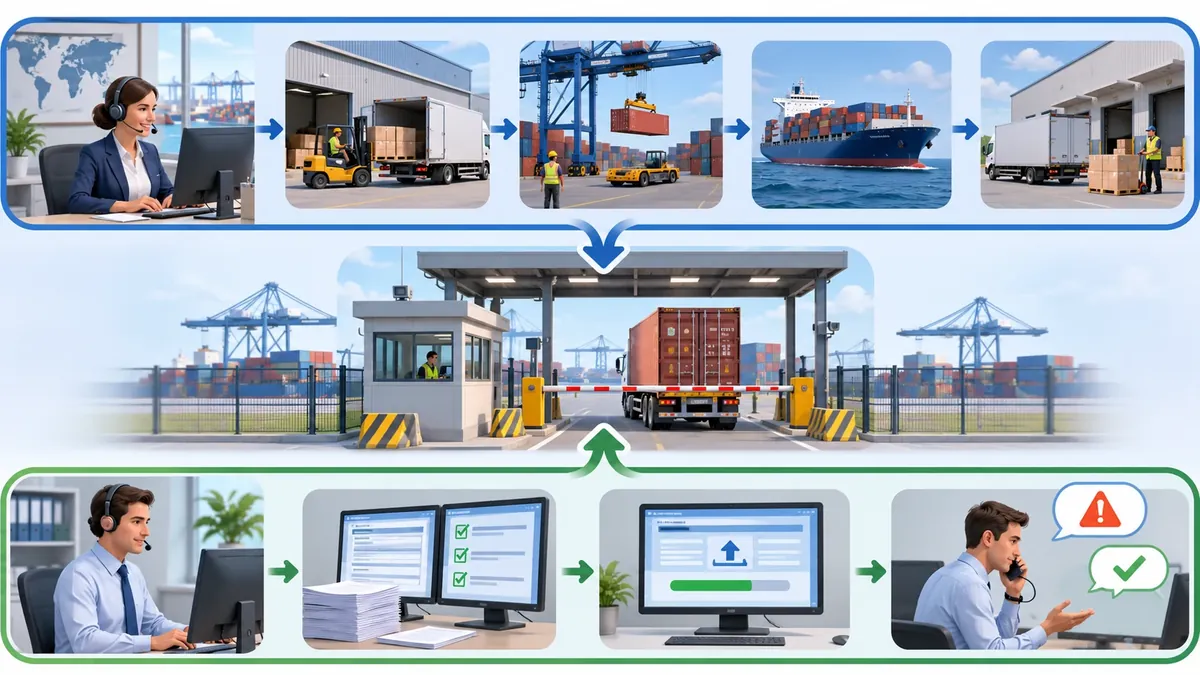
One shipment, two connected workstreams
Consider a shipment of metal bathroom accessories moving from a factory to a U.S. distribution center. The forwarder may coordinate factory pickup, export terminal handling, ocean transport, destination handling and final delivery. The customs broker may prepare the entry based on the importer’s purchase documents, product descriptions, origin details, values and other required information. The importer supplies or approves the underlying data, authorizes the broker, pays the applicable charges and makes sure the goods are legally admissible.
The two workstreams meet at several points. The forwarder needs accurate cargo description, count, weight and shipping instructions. The customs broker needs accurate product, seller, value, origin and classification information. If one provider receives a carton count or product description that conflicts with the invoice, the discrepancy should be resolved before filing or release. Do not assume a provider can correct product facts that only the buyer or supplier knows.
Make a simple flow diagram with four columns: cargo movement, customs filing, commercial documents and importer decisions. Put a named person or company in each cell. For example, the seller prepares a commercial invoice and packing list; the forwarder books and tracks cargo; the customs broker prepares an entry within the authorization; the buyer confirms item descriptions, origin and value. The exact allocation varies, but no key task should be left as “handled by logistics” without an owner.
What a freight forwarder’s quote should clarify
Read beyond the words “door-to-door.” Ask for the origin, destination, mode, named handoff points, routing assumptions, pickup and delivery scope, consolidation plan, cargo cut-off, transit estimate and responsible carrier or subcontractor. A forwarder may arrange an entire route but exclude customs entry, duties, taxes, insurance, examination charges, port storage or final-mile appointments. Require an inclusion and exclusion list.
For mixed-SKU hardware, confirm who counts and records cartons, whether the forwarder consolidates multiple supplier shipments, and how each shipment will be linked to a purchase order and packing list. A consolidation service does not automatically mean the provider checks product contents or verifies the buyer’s specifications. Confirm whether weighing, measuring, repacking, palletizing, labeling, photography or exception reporting is included and what evidence will be supplied.
Clarify insurance and liability separately. Ask whether the forwarder is arranging cargo insurance, issuing a certificate, offering an optional policy or only arranging carriage. Identify the insured party, coverage, value basis, exclusions, deductible and claims contact. A carrier liability limit and cargo insurance are not interchangeable. Use an insurance professional to assess the route and exposure if the shipment value or consequence makes the distinction material.
The booking confirmation should match the selected route, cargo information and agreed service. If a carrier, vessel, warehouse or destination changes, ask who must notify the importer and obtain approval. Preserve the final booking, tracking reference, handoff records and charge statement in the same shipment file.
What a customs broker appointment should clarify
Start with jurisdiction. A broker authorized for one country is not automatically authorized for another. If importing into the United States, verify the broker’s status and understand the written power of attorney and service agreement. CBP’s broker guidance explains that brokers have obligations and that importers retain important responsibilities. Appointing a broker does not remove the importer’s duty to provide accurate information or supervise its own compliance program.
Define exactly what the broker will do. Does it prepare the entry, file it, communicate with customs, pay charges from an advance, monitor holds, respond to document requests, arrange an examination or only provide a subset of those services? Who reviews product classification and customs value? What source documents must the buyer supply and by what deadline? Which charges are broker fees, government charges, advances or third-party expenses?
The broker needs product facts, not just a generic description such as “bathroom hardware.” Provide sufficiently detailed product descriptions, composition or material information where relevant, intended function, country-of-origin facts, commercial invoice, purchase order, assists or tooling information where applicable, freight details, packing list and any required permits or product documents. Classification and valuation can be fact-sensitive. If uncertain, route the question to a qualified trade-compliance professional instead of guessing from a broad product category.
Agree how corrections are handled. If a supplier changes the invoice, quantity, declared value, origin statement or product description, who reviews whether the entry data needs amendment? What is the process for post-entry questions, record retention, duty adjustments or a customs notice? Do not assume that a broker will discover every source-document error or automatically monitor all regulatory changes for the importer.
The handoff map: prevent gaps between providers
Prepare a responsibility table before the first shipment. It should name the owner, input, output, deadline and confirmation evidence for each step.
| الخطوة | Typical owner to confirm | Evidence to retain |
|---|---|---|
| Final product and order data | Buyer and seller | Approved purchase order, current invoice and product description |
| Cargo dimensions, carton count and readiness | Seller, with buyer review | Packing list and cargo-ready notice |
| Carrier booking and pickup | Buyer or forwarder, depending on contract | Booking confirmation and pickup record |
| Export documents | Seller, forwarder or export agent as agreed | Export filing or document receipt |
| Importer authorization and entry data | Importer and customs broker | Signed authority, source records and entry summary |
| Customs questions or holds | Broker coordinates; importer supplies facts and decisions | Notice, response, supporting documents and release record |
| Duties and other charges | Buyer or authorized payer | Government receipt, broker statement and invoice |
| Final delivery and receiving | Forwarder/carrier and buyer’s receiving team | Delivery receipt, shortage/damage record and carton reconciliation |
This is a planning aid, not a universal legal allocation. The contract, customs law, Incoterm, service order and provider authority determine what applies. If a service spans several companies, identify the party that owns escalation even when another company performs the physical task.
How to compare total cost and service levels
Ask the forwarder and broker to quote separately or clearly identify their charges. A logistics package may combine freight, terminal handling, brokerage, duty advancement, exam coordination, warehouse and delivery. Separate service fees from government charges and carrier pass-through amounts. Request the quote validity, currency, assumptions, payment timing and potential adjustment triggers.
Build a landed-cost view that includes product price, packaging, origin transport, export services, main carriage, insurance, destination terminal and handling, customs broker fees, duties and taxes, inspection or exam charges, storage, and final delivery. Not every line applies to every shipment. If an item is unknown, record it as an open assumption with an owner and due date rather than treating it as zero.
Service-level comparison should also be specific. Ask how quickly cargo receipt is acknowledged, how milestones are reported, what response time applies to a hold, how a document mismatch is escalated, whether after-hours contacts exist, and what information the provider needs to investigate a shortage. Avoid promises like “fast clearance” unless the provider defines what it means and the buyer understands the factors outside its control.
For a recurring program, review invoice variance and exceptions after each shipment. Compare quoted and actual charges, transit milestones, missing documents, receiving discrepancies and damage records. Use that evidence to update future shipment instructions. This improves purchasing control without assuming that a past shipment guarantees the same future route or cost.
Importer responsibilities do not disappear
Hiring a customs broker can provide expertise and operational support, but the importer must understand its own obligations. In the United States, official CBP guidance emphasizes that importers remain responsible for reasonable care and accurate information even when using a broker. The importer should maintain access to entry data and supporting records, review broker outputs, communicate material changes, and address questions or corrections promptly.
The buyer should establish who may approve customs data and duty payments. A logistics coordinator may manage bookings but may not have authority to approve classification, customs value or origin statements. A purchasing manager may approve price but not legal declarations. Keep decisions with qualified, authorized staff and document the basis for them.
Do not treat the freight forwarder’s transport document as proof of customs admissibility, or a customs release as proof that cargo arrived in good condition. The former addresses transport documentation; the latter indicates customs processing status. Product identity, legal entry, physical delivery, quantity reconciliation and quality acceptance are separate checks.
The importer should also decide how entry information is reviewed and approved internally. Create a data owner for each product or SKU who can confirm the commercial name, function, material description, supplier, origin facts, quantities and value records. Keep a versioned product file so a broker does not rely on a description from a previous model or a similar-looking item. A new finish, material, set configuration or bundled accessory can change the factual details that need review; do not assume a prior entry automatically covers a revised product.
Before filing, agree whether the broker will send draft entry data for importer review, which fields require review, and how quickly the buyer must respond. Some entries may operate under established procedures that do not use a routine buyer approval of every field. The importer should understand the agreed control, not assume it exists. Maintain a documented escalation path for missing values, unknown origin, inconsistent invoices, possible restricted goods or questions requiring a binding or specialist determination.
After release, reconcile entry summaries and payment statements with the shipment records. Retain the source documents and the broker’s filing output according to the importer’s record-retention requirements. If a discrepancy is discovered, notify the broker and qualified compliance adviser promptly; do not make an informal correction in a spreadsheet and assume the official entry has been amended. The appropriate remedy depends on the jurisdiction, entry status and facts.
Separate records that show customs status from records that show physical receipt. A customs release message does not confirm carton count, SKU identity, finish condition or delivery to the buyer’s warehouse. The receiving team should reconcile the packing list and purchase order, note visible damage or shortage on the delivery record, take photographs where appropriate, and notify the responsible carrier or forwarder within the applicable notice period. The importer should preserve those records with the entry file because a later claim may require both the customs timeline and the delivery evidence.
Assign a backup contact for urgent questions during customs review.
Common mistakes when choosing between the two
Assuming one provider does everything
A forwarder may coordinate freight and an affiliated broker may file customs entry, but the services, legal entities and contracts can differ. Request the names, authority, responsibilities and charges for each role.
Confusing a customs broker with a freight broker
The word broker is used in different industries. A freight broker arranges transportation; a customs broker supports customs-entry work under the applicable authorization. Verify service and legal role instead of relying on the shared word.
Treating shipping documents as customs approval
A bill of lading or booking confirmation describes transport. It does not by itself establish product classification, admissibility, origin or duty treatment. The customs entry requires separate information and review.
Providing vague product descriptions
Descriptions such as “metal parts” may not communicate function, composition or product identity well enough for accurate entry review. Give the broker and supplier consistent, detailed information and ask for advice where classification is uncertain.
Comparing only the freight rate
A lower transport charge can be offset by destination fees, brokerage, storage, insurance or service gaps. Compare the full route and clearly identify all excluded costs.
A buyer’s appointment checklist

Before cargo is released, the importer can confirm:
- The country and transport mode the provider is authorized to serve.
- The legal entity and capacity for each service.
- Whether the provider is a carrier, forwarder, freight broker, NVOCC, customs broker or a combination.
- The transport route, handoff points, booking cut-off and included charges.
- The customs broker appointment and written authorization where required.
- The product, material, origin, value and order facts supplied to the broker.
- Who reviews the draft entry or other customs information and who approves duty payment.
- Which party responds to customs questions and provides supporting evidence.
- What insurance is in place and how a claim is reported.
- How shipment milestones, holds, discrepancies and changes are escalated.
- Which documents and records will be retained by buyer, seller, forwarder and broker.
If a provider says that a task is “included,” request the exact action, output, deadline and associated fee. If an answer depends on local regulation, get confirmation from the relevant authority or a qualified adviser. A checklist is useful precisely because it exposes where assumptions remain unresolved.
الأسئلة الشائعة
Can a freight forwarder clear customs?
Some providers offer customs services through an authorized business or partner, but freight-forwarding status alone does not establish customs-broker authority. Confirm the responsible legal entity and authorization for the import jurisdiction.
Does a customs broker arrange international shipping?
A customs broker may offer additional services or coordinate with a forwarder, but customs-entry work does not automatically include transport booking. Confirm each service in the appointment and quote.
Does the importer remain responsible when it hires a broker?
In the United States, CBP guidance states importers retain responsibilities even when using a broker. Responsibilities differ by jurisdiction, so the importer should review official rules and obtain qualified advice.
Can one company be both the forwarder and customs broker?
Possibly, depending on its legal entities, licenses, jurisdictions and services. Ask which entity performs each function and which agreement governs it.
What information should a buyer send a customs broker?
Provide accurate commercial and product records, including invoice, packing list, purchase order, item descriptions, material or composition information as relevant, origin facts, freight details and any requested supporting documents. Ask a qualified broker what applies to the actual products and country.
Sources and scope
- U.S. International Trade Administration: Customs Brokers and Freight Forwarders — official U.S. overview of customs-broker and international-forwarder roles and service examples.
- U.S. Customs and Border Protection: Customs Broker Guidance, Version 2.0 — official broker and importer guidance. Confirm current requirements for the applicable entry and jurisdiction.
This guide provides general procurement education and does not provide customs, legal, tariff, insurance or tax advice. U.S. examples are not universal definitions. The article does not claim Koitor provides freight forwarding, customs clearance or brokerage services.
اعمل مع شركة «كويتور» للأدوات
Keep the product and packing information consistent
Share the approved product list, invoice details, carton configuration, weights, dimensions, origin information and shipment timing with the relevant logistics and customs providers. Koitor Hardware is a family-owned custom metal hardware factory focused on bathroom and home-storage products. The manufacturing team can coordinate the confirmed product and packing information for an OEM order; the buyer’s authorized advisers determine transport, customs-entry and compliance requirements.
Align Product Records Before Import
Share the approved product schedule and packaging data so your appointed forwarder and customs broker receive consistent shipment information.
OEM / العلامة التجارية الخاصة
حوّل دليل التوريد هذا إلى موجز منتج
يرجى إطلاعنا على المنتج المستهدف، والحجم، والتشطيب، وكمية الطلب، ومتطلبات التغليف. وسيتلقى فريقك تقييمًا عمليًّا لإمكانية التصنيع قبل تقديم عرض الأسعار.


 English
 Español
 Português
 Français
 Deutsch
 العربية