
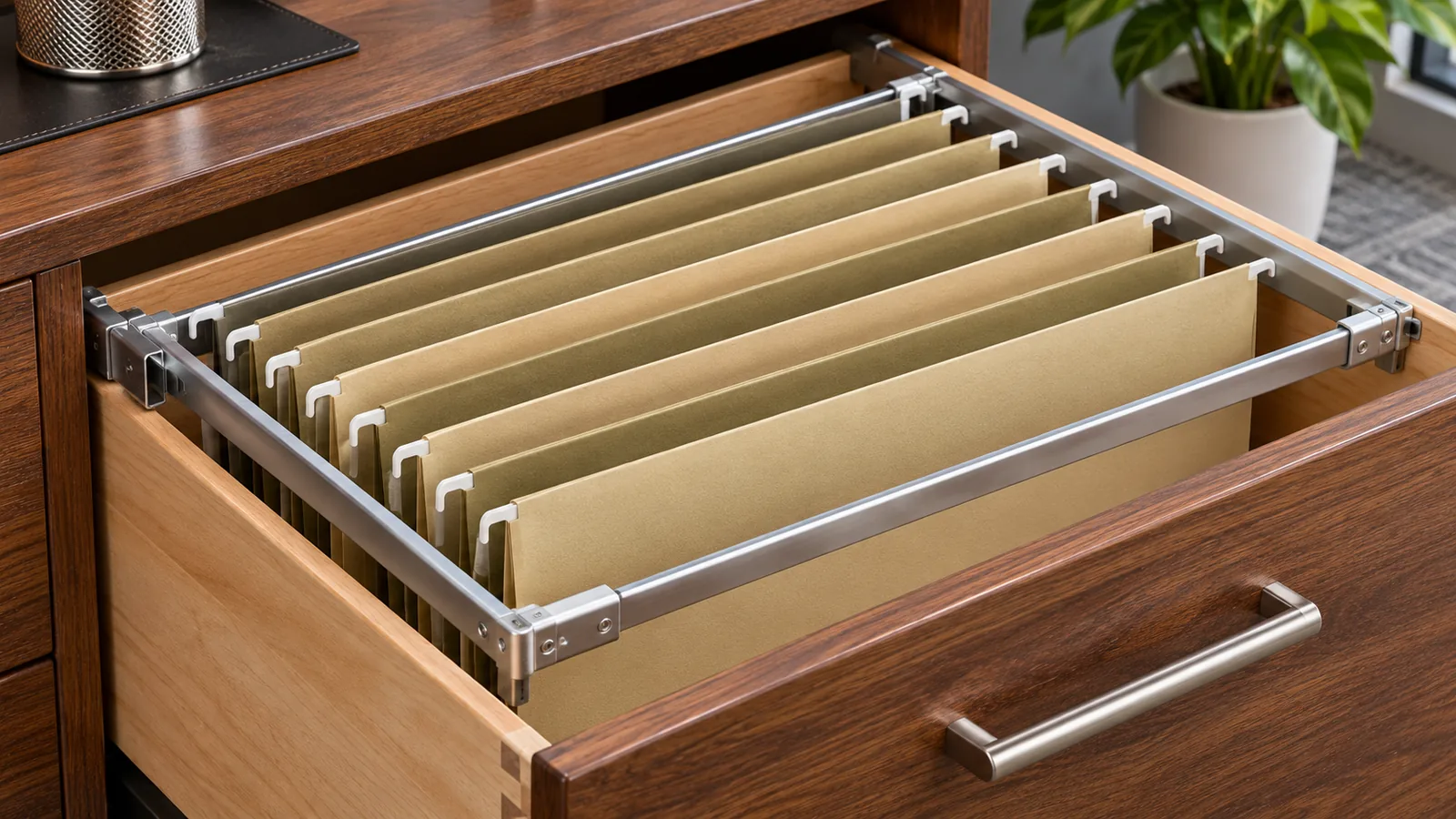
A buyer checking hanging file frame rail spacing should separate two dimensions that are easy to conflate: how the frame adjusts to the drawer’s front-to-back length, and how the frame supports the actual hanging folders across their rail or bar ends. A frame can adjust to a drawer and still be wrong for the folders or for the space available when the drawer closes. An “adjustable” label does not prove compatibility with every letter, legal, A4 or proprietary folder format.
This guide is for office and home-organization importers, stationery wholesalers, retrofit hardware distributors and private-label product managers. It is a sourcing and sample-approval framework, not a drawer modification guide. Do not cut a frame, hammer inserts, alter drawer rails or infer a load rating from an image. Use the current instructions from the exact frame supplier and ask it to confirm the intended folder and drawer configuration. For buyers assessing hanging file frame rail spacing, the controlling record is the approved configuration, supporting evidence, and named approval owner.
Distinguish Frame Length From Folder Support Spacing
A frame’s front-to-back adjustment can help it fit different drawer depths. Folder suspension depends on another relationship: the folder’s supporting ends must rest on the frame’s intended rails or bars. The usable support distance, rail profile, end retention and folder construction should be reviewed separately from the frame’s overall length.
Smead’s current product information for one named adjustable hanging file frame describes a letter-size configuration and separately sold named letter folders. A different manufacturer-authored instruction sheet for model 64855 describes side rails, U-frames, tie rods and inserts, and discusses another model’s positioning for folder formats. These documents illustrate distinct product configurations; they should not be merged into one universal frame. The 64855 instructions are not the current adjustable product’s manual, and their format references or assembly steps must not be transferred to it. See the current maker’s adjustable frame product page and obtain instructions for the exact model in the buyer’s quote.
A procurement record should distinguish:
- Drawer interior front-to-back length and width, sourced from the buyer or drawer maker.
- Drawer clear height and any obstructions, measured under the applicable project method.
- Frame’s external length range and adjustment method, as documented by its supplier.
- Distance between the folder-support surfaces, as defined by the frame supplier.
- Actual folder model and the shape or span of its suspension ends.
- Folder-tab or label envelope above the support plane.
- Included inserts, corners, clips or connectors.
- Whether folders are included or sold separately.
- Frame, folder and drawer revisions represented by the sample.
Do not derive support spacing from paper sheet dimensions. A paper format name describes a document size, not necessarily the mechanical interface of a hanging folder. Folder makers may use different end constructions, bars or side shapes. The buyer should identify the actual folders and ask the frame supplier to confirm the pairing.
For a retrofit, the drawer itself is also part of the reference system. A frame that fits an empty drawer may interfere with runners, a lock, a divider, a cabinet front or contents when the drawer is used. Record the drawer model and revision when available. If the buyer has only an approximate interior measurement or a photo, mark the review preliminary and request more precise information before releasing a final SKU claim.
Verify Drawer Dimensions and Adjustment Method Separately
Measure the drawer interior using the drawer maker’s guidance or a qualified project method. Capture front-to-back length, width and clear height, and identify any features that intrude into the space. The buyer should keep the measurement source and date. A nominal drawer size or furniture label may not describe the usable envelope inside the finished drawer.
Then ask the frame supplier which part adjusts and how the adjustment is represented on its current drawing. If the frame has sliding members, insert positions or other supplier-defined settings, record the exact model and allowed configuration. Do not modify a product based on instructions for another frame. The research pack expressly excludes reproducing hammering, pliers, snap-off, cutting or dimensional modification steps from a different model’s manual.
A fit review can capture:
- Drawer model and interior measurement source.
- Frame model, revision and external length setting.
- Any support point or contact location defined by the supplier.
- Obstructions that remain in the drawer during intended use.
- Whether the review sample represents the final drawer construction.
- Whether the frame is removable or fixed, if the supplier documents it.
- Any parts that are supplied separately or purchased by the buyer.
- Open questions for the frame maker or drawer maker.
This information does not define a universal length range or clearance allowance. The supplier’s own data applies to its named model. If a buyer wants to compare several drawer families, create a separate row for each rather than inferring that one adjustment mechanism covers them all.
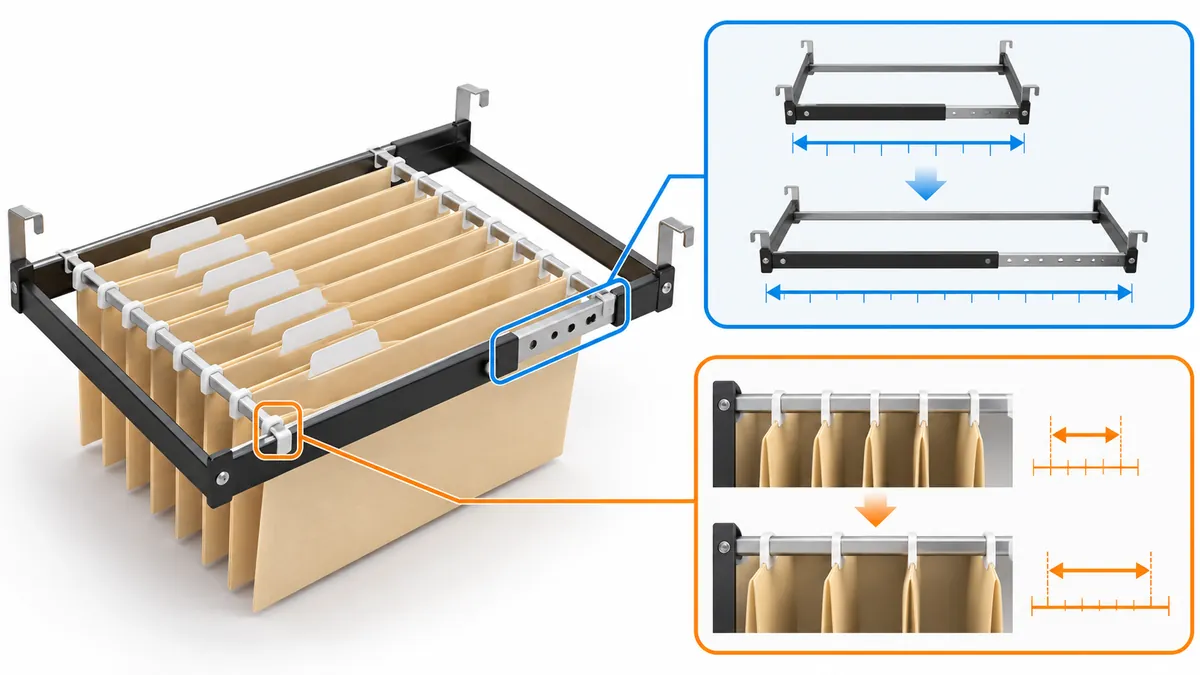
Match the Folder Ends to the Actual Rails
Choose the folder before approving the frame or obtain a folder sample from the buyer’s intended supplier. Record its model, format description, revision and suspension-end construction. Identify which surfaces are meant to sit on the frame’s rails, rods or inserts. The frame supplier should confirm that the selected folder model is intended for that support arrangement.
A product page that names “letter” folders may be clear about the specific product offered but should not be broadened to legal, A4 or other formats without confirmation. The separate 64855 document in the research pack refers to its own metal rails, U-frames, tie rods and plastic corners or inserts. That architecture is not proof that a different adjustable frame includes the same components. Nor should buyers blend one model’s instructions with another model’s product page.
A folder-to-frame matrix can include:
| Folder reference | Suspension end | Frame reference | Status |
|---|---|---|---|
| Exact maker SKU and revision | Bar, hook, formed end or other maker-defined feature | Exact frame and rail model | Confirmed only with supplier source |
| Second intended folder | Different or revised end construction | Candidate frame | Pending if not reviewed |
| Unidentified folder | Unknown | Any adjustable frame | Unresolved; no universal fit claim |
| Customer-supplied sample | Sample and source noted | Exact frame sample | Visual/fit observation with stated limits |
At sample review, verify that both folder ends sit on the intended support surfaces according to the frame maker’s instructions. Note any contact that looks incomplete, any end that does not seat, and whether the supplier has provided a correct reference. Do not invent a span tolerance, load limit, retention feature or universal paper-format dimension.
If the frame supplier says a specific folder family is supported, preserve the exact name and evidence. If the buyer substitutes a folder from a different maker, request confirmation. A visually similar bar or hook may not behave the same way or be intended for that frame. The buyer should not use the word “standard” unless a responsible source defines what standard means for that mechanical interface.
Review the Suspended Drop, Tabs, and Occupied Drawer Closure
A frame may fit the drawer and support the folder ends while the folder body, side gusset or top tab occupies space needed for closure. The occupied drawer should therefore be reviewed with actual folders in the proposed arrangement. Include the folder drop, any expansion or contents, tab or label height, and the drawer’s internal obstructions that remain during ordinary use.
The review should separate several states:
- Empty drawer and frame fit.
- Folder ends seated on the intended rails.
- Folders hanging empty.
- Folders in a representative expanded or filled state, if the buyer’s use case requires it and the responsible parties approve the condition.
- Drawer open and closed with the reference folders present.
- Folder retrieval and return as demonstrated under supplier guidance.
These are review states, not loading instructions. Do not set an arbitrary folder weight, expansion ratio or durability cycle. The supplier should define what the frame supports, and the buyer should identify whether the sample reflects the intended office or home use. If filled folders are relevant, the product team must provide realistic folder samples and the responsible supplier must state whether it has assessed that condition.
A drawer closure check can identify visible collisions or a tab projecting into an area where it cannot be accommodated. It does not establish long-term wear, load capacity, document preservation, security or ergonomics. Keep those claims with the supplier or project owner that has evidence. If no filled-folder sample is available, record that closure was reviewed only with empty folders.
A complete drawer sample is preferable when the frame’s supports interact with runners or internal walls. A mock-up may be useful for preliminary selection, but it should be labeled as such if it omits the actual drawer. Avoid declaring a retrofit approved from a desktop image or a frame held beside an unrelated cabinet.
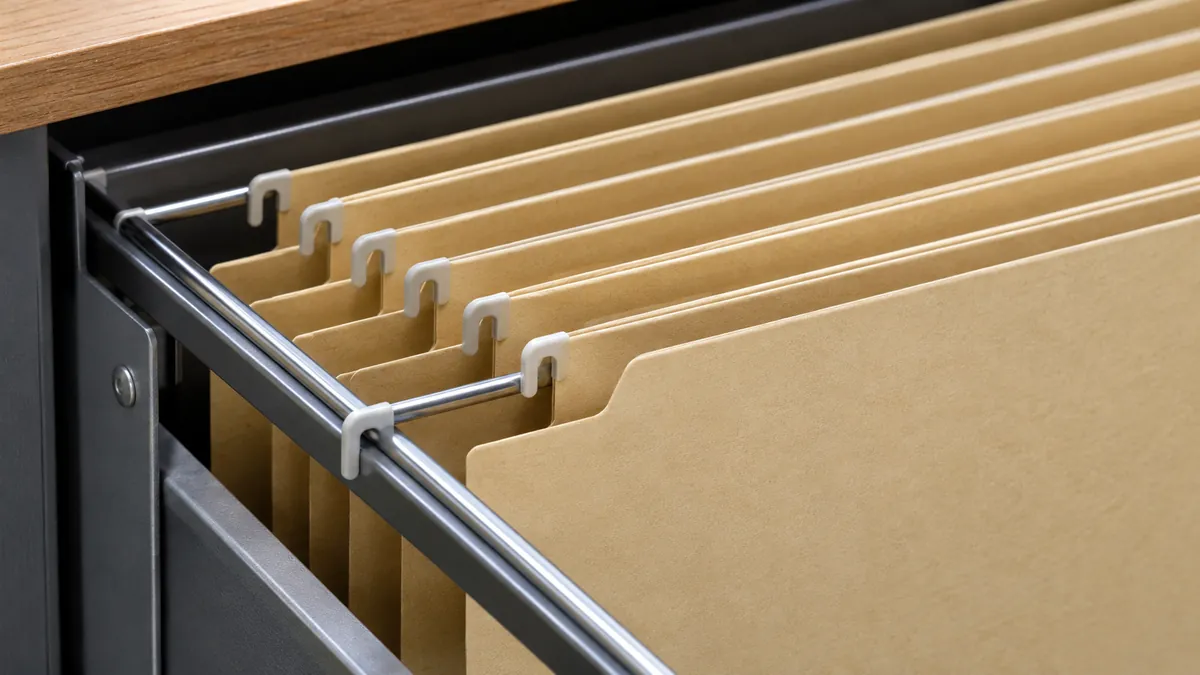
Identify Included Connectors and Replacement Parts
Frames may contain metal rails and supports alongside plastic corners, inserts or other purchased parts. The buyer should identify each component and the supplier responsible for it. If parts are not included, list them as exclusions. Do not assume an all-metal product from the presence of metal side rails, and do not imply that Koitor molds a connector based on another manufacturer’s product.
A quotation should clarify:
- Which metal members and crosspieces are included.
- Whether corners, inserts or end retainers are supplied.
- Whether the folder set is part of the sale.
- Which parts are adjustable, fixed or replaceable under the supplier’s instructions.
- How replacement components are ordered for the exact frame model.
- Which supplier controls changes to purchased connectors.
- Which assembly or setup information accompanies the unit.
When a component is sourced separately, ask for a part reference and compatibility statement. A general description such as “plastic corner” is not enough to identify a replacement. If a supplier proposes a substitute, request confirmation that the current frame and folder pairing remain valid. Store the changed BOM and sample record together.
Koitor’s verified metal-storage capability can support a bounded drawing discussion about frame members, rails, finish and assembly. The research pack does not establish a current hanging file frame product, plastic molding, specialized connector design, archival expertise or document-security testing. The article should not imply Koitor currently supplies a complete office file system. If the buyer has an adjacent metal-part request, qualify the scope and purchased components before making any supplier claim.
Use a Sample Review and Change-Control Record
A useful sample review identifies the exact frame, drawer and folder references. Record who supplied each item, which instructions were followed and what was observed. Keep photos of the frame length setting, folder support points and drawer closure with the model and revision. If any one of those references changes, ask whether the original review remains applicable.
A buyer checklist can ask:
- Does the sample match the frame model and revision in the quote?
- Is the drawer the intended model, or clearly marked as a mock-up?
- Was the frame length configured under the maker’s instructions?
- Do the actual folder ends rest on the named support surfaces?
- Are any inserts, corners or connectors missing or substituted?
- Does the folder drop or tab occupy space relevant to drawer closure?
- Were representative folders empty or filled, and which state was reviewed?
- What has not been evaluated, such as load, endurance or document security?
- Who must resolve each open question?
- Which changes trigger a fresh supplier confirmation?
The checklist does not provide a universal pass/fail measurement. It prompts the parties to decide whether more information or a different sample is necessary. If the supplier’s instructions are unclear, stop and request the exact current manual rather than following a third-party video or a different model’s procedure.
Before a retrofit SKU is released, decide how unresolved drawers will be handled. The sales team can request a drawer model, a measurement record or a customer-provided sample, but should not claim a match based on an approximate furniture label alone. If the distributor offers a range of frames, give customer support a routing note that explains which data is needed to select the right model and where to escalate a non-listed drawer. This converts a vague “will it fit?” question into a clear evidence request without promising a universal result.
The package and instructions should also reflect the approved state. If the buyer must purchase folders separately, state that clearly. If a frame ships with inserts or connectors, list them and show which references they are intended for. If no folder sample was included in a review, make that limitation visible in the approval record. A warehouse should not assemble different inserts or frame versions simply because the components share a color or general shape.
For a product range, keep one compatibility row per intended frame-folder-drawer combination. If a specific letter-size folder is approved with a named frame, do not generalize that approval to legal, A4 or another product family. A change in folder supplier, end profile, frame connector, drawer model or internal obstruction can change the context. The supplier should confirm whether the combination remains within scope.
Compare frame and folder evidence by model
A buyer can map each source to the component it actually describes. The current product page can establish the named frame model and the folder product it sells separately. A different model’s manual can illustrate that a frame assembly may include metal rails, U-shaped supports, tie rods and plastic corners or inserts. Neither source proves that the two models share dimensions, format claims or adjustment steps. The matrix should therefore include separate columns for source, model, date or revision, and the exact claim extracted from it.
This is especially useful when a product catalog uses broad descriptions such as “adjustable,” “letter,” or “multi-format.” Preserve the precise wording and ask the manufacturer what it means for the SKU being purchased. If the answer depends on another part number, capture that part number. If a retailer listing and maker document differ, do not choose the more convenient statement; ask the maker to resolve the discrepancy.
A sample set can contain a frame from one supplier and folders from another. Identify both suppliers in the review notes. A successful sample fit is an observation of those parts; it does not create an authorized cross-reference for every folder the buyer may source later. If the suppliers do not confirm the combination, keep the commercial record provisional and avoid representing it as a validated assortment.
When creating product pages, align the title and size claims with that matrix. “Fits an adjustable drawer” should not conceal that only particular folder references were confirmed. “Universal hanging file frame” requires broad supporting evidence; do not use it based on a single sample. Make exclusions visible to customer support and purchasing as well as merchandising.
Keep drawer measurements tied to their reference surfaces
When requesting a drawer measurement, tell the buyer or furniture supplier which internal surfaces are being measured and whether runners, dividers or existing hardware remain installed. A nominal cabinet width, external drawer width and clear interior width describe different things. The frame maker should state which reference it uses in its drawing. If the buyer’s measurement method differs, ask the supplier to reconcile it before a quote is treated as final.
Record both the measured value and its source. A number transcribed from a furniture catalog is not the same evidence as a measurement taken from the actual drawer. If a cabinet family includes several generations, note the drawer model or revision. A retrofit solution should not quietly assume that every drawer with the same outside label has identical internal space or obstructions.
This measurement record should remain separate from the folder-support measurement. The buyer may know that a frame spans the drawer front to back but still not know whether the folder’s ends seat correctly. Conversely, folders may sit on a rail in a sample while the overall frame cannot be placed in the customer’s drawer. Keeping these as independent checks makes the gap visible and directs the next question to the right supplier.
If a dimension is unknown, mark it unknown rather than estimating it from a photograph. If the customer cannot safely or accurately measure the drawer, route the inquiry to the furniture maker or a qualified service party. The article does not prescribe a measuring tool, tolerance or modification procedure. The responsible supplier must identify its own interface and acceptance criteria.
Buyer Questions Before Ordering
Does an adjustable frame automatically accept letter, legal and A4 folders? No. The buyer needs the actual folder end and supplier-confirmed rail pairing.
Does the frame’s drawer-length range define its folder rail spacing? No. These are separate dimensions and should be recorded independently.
Can instructions for one Smead model be used for another? Not unless the maker confirms that the steps and dimensions apply. The research pack specifically distinguishes the current adjustable product from model 64855 instructions.
Does an empty frame fitting inside a drawer prove the drawer will close with folders? No. Review occupied drop, tabs and any obstructions with the intended drawer and folders.
Are all frame components metal? Do not assume so. A documented model may combine metal rails with purchased inserts or corners. Confirm the BOM for the quoted SKU.
Can a buyer alter a frame to make a folder fit? This guide provides no modification procedure. Use only current instructions for the exact model and the responsible supplier’s guidance.
A Two-Axis Approval Record
Before ordering, name the drawer and frame references, record the drawer-length setting, then separately identify the folder model, end profile and support spacing. Review actual folder drop and tabs in the occupied drawer, confirm included connectors and preserve supplier instructions. List exclusions and changes that trigger another review. Do not infer compatibility from paper size labels, empty-frame fit or one manufacturer’s other model.
A hanging file frame rail spacing record helps distributors qualify a retrofit without turning “adjustable” into a universal compatibility claim. It distinguishes drawer fit, folder suspension and closure space, while keeping connector and folder claims tied to the responsible suppliers. Koitor’s related metal mesh desk organizer guide addresses a different compartment and drawer-travel configuration. For a metal-storage scope discussion, review Koitor’s OEM home-storage hardware information and share a controlled drawer, folder and frame drawing through the contact page.
اعمل مع شركة «كويتور» للأدوات
Discuss an Adjacent Metal Hardware Scope
Koitor’s confirmed focus is bathroom and home-storage metal hardware. For an adjacent product, share a controlled drawing, representative sample and any bought-in component scope so the team can assess whether the request fits its confirmed capabilities. This review does not imply that the complete product is currently manufactured.
OEM / العلامة التجارية الخاصة
حوّل دليل التوريد هذا إلى موجز منتج
يرجى إطلاعنا على المنتج المستهدف، والحجم، والتشطيب، وكمية الطلب، ومتطلبات التغليف. وسيتلقى فريقك تقييمًا عمليًّا لإمكانية التصنيع قبل تقديم عرض الأسعار.
 English
 Español
 Português
 Français
 Deutsch
 العربية