

The heat affected zone is the region of base metal beside a weld whose structure or properties were changed by the welding heat, even though it never melted. It sits between the fusion zone, where weld metal solidified, and the unaffected base metal further away.
Before a QC sheet treats the heat affected zone as a defect, a colour band or a corrosion finding, it should name the region correctly and separate it from weld metal and from surface heat tint.
Every fusion weld has a heat affected zone. Its existence is not a defect. What matters is how much the region changed, in what way, and whether that change matters for the part’s function, finish or corrosion behaviour. Those questions depend on the alloy, the process, the heat input and the specification.
This guide is for importers, quality managers and product teams who review welded stainless and steel bathroom and storage hardware. Koitor Hardware is a family-owned China OEM manufacturer that uses TIG, laser and resistance welding on towel racks, shower caddies, hooks and wire products. We explain what the region is; specific conclusions need specific evidence.
Two live guides cover neighbouring questions. Surface colour beside welds is covered in stainless weld heat tint buyer criteria. Sensitization risk on thin stainless is covered in stainless steel weld sensitization and heat input on thin parts.
What is the heat affected zone in welding?
The heat affected zone, often shortened to HAZ, is base metal that was heated enough during welding to change its microstructure or properties, but not enough to melt. Close to the weld it reached high temperatures; further out the peak temperature falls until the metal is effectively unchanged.
A cross-section through a weld usually shows three regions after etching. The fusion zone in the centre is weld metal that melted and solidified, often with a columnar or dendritic grain pattern. Next to it lies the heat affected zone, where grain size or structure differs from the original. Beyond that is unaffected base metal.
الـ TWI explanation of the heat affected zone describes it as the non-melted area of metal that has undergone changes in material properties from exposure to high temperatures. It also notes that the extent and magnitude of change depend on the base material, the filler and the heat input.
The HAZ is not one uniform band. Close to the fusion line, metal reaches temperatures near melting and may show grain growth. Further out, it sees lower peaks and different changes. Metallurgists subdivide the region, but buyers rarely need those subdivisions on a QC sheet; they need to know that the region exists and what evidence describes it.
Width varies widely. Concentrated heat sources such as laser welding tend to produce narrow heat affected zones. TIG welding on thin material, with slower travel and broader heat, tends to produce wider ones. Thickness, joint design, travel speed and cooling all influence the result. This page does not give widths, because they are process- and alloy-specific.
Heat input is the general term for how much energy the weld puts into the joint per unit length. Higher heat input, through higher current, slower travel or more passes, generally means a larger and more changed heat affected zone. Lower heat input generally means a smaller one, but too little can cause other problems such as lack of fusion. This is why procedures balance settings rather than chase a minimum.
Is the heat affected zone part of the weld?
It is part of the welded joint but not part of the weld metal. The weld metal is the fusion zone that melted. The heat affected zone is base metal changed by heat. Keeping those terms separate matters, because requirements for weld metal and for the HAZ can differ, and confusion leads to wrong tests.
How is the heat affected zone different from heat tint and weld metal?
Heat tint is a thin oxide film on the surface, visible as straw, blue or brown colours beside the weld. The heat affected zone is a subsurface region whose structure changed. Weld metal is the melted and solidified zone. A colour band on the surface is not a measurement of the HAZ, and removing tint does not remove the HAZ.
Heat tint is the most common confusion. On stainless, the coloured bands form because the hot surface oxidised in air. They often sit roughly over the heat affected zone, which is why people use the terms interchangeably. But tint is a surface condition that can be removed by appropriate cleaning or pickling, while the HAZ remains in the metal underneath.
The live heat tint guide explains why tint matters for appearance and corrosion resistance on stainless hardware. Its concerns are about the surface oxide layer and the chromium-depleted layer just below it. Those are real, but they are different from the bulk metallurgical change in the heat affected zone.
Weld metal is the other neighbour. It has its own composition, influenced by the filler and the base metals that melted, and its own solidification structure. A requirement on weld metal, such as a filler specification, does not describe the HAZ. A defect in weld metal, such as porosity or lack of fusion, is not a HAZ defect.
Arc strikes sit apart again. They are small melt scars outside the intended weld, with their own tiny fusion and heat affected zones. The live arc strike guide explains why they matter on stainless and how to describe them.
| Term | Where it is | How it is seen | What it is not |
|---|---|---|---|
| — | — | — | — |
| Fusion zone (weld metal) | Centre of the joint, melted and solidified | Section and etch; visible bead shape | The heat affected zone |
| Heat affected zone | Base metal beside the fusion zone, not melted | Section and etch; hardness traverse | A surface colour band |
| Heat tint | Surface oxide film beside the weld | Visible colours on the surface | A measurement of the HAZ |
| Unaffected base metal | Beyond the heat affected zone | Section and etch shows original structure | Guaranteed identical properties right up to the HAZ boundary |
| Arc strike | Outside the intended weld | Small melt scar on the surface | Part of the planned weld |

What changes in the heat affected zone of common hardware metals?
The change depends on the alloy and its starting condition. Cold-worked stainless can soften. Some carbon steels can harden or coarsen. Heat-treated aluminium alloys can lose strength. Zinc-coated steel loses its coating near the weld. Austenitic stainless can, under some conditions, become susceptible to intergranular corrosion. Each is a different question with different evidence.
Cold-worked austenitic stainless is common in hardware. Tube and sheet that were drawn, rolled or formed gain strength and hardness from cold work. Welding heat can relax that cold work in the heat affected zone, leaving a locally softer band. A hardness traverse can show this, as explained in the batch guide on Vickers hardness.
Carbon and low-alloy steels behave differently. Depending on composition and cooling rate, the HAZ may harden or show grain growth. For thin hardware steel this is often modest, but heavier sections and higher-carbon steels need more attention. The welding procedure is where that is managed.
Heat-treated aluminium alloys can soften in the heat affected zone because welding heat reverses part of the strengthening treatment. Where aluminium components are welded, the design and procedure should account for the softer region.
Zinc-plated or galvanised steel loses its zinc coating in and around the weld because zinc vaporises at welding temperatures. The heat affected zone may therefore lack the corrosion protection the rest of the part has, unless the area is treated afterwards or the part is coated after welding.
Austenitic stainless can experience carbide precipitation at grain boundaries when held in a certain temperature range, depleting nearby chromium. This is called sensitization, and it can make the region susceptible to intergranular corrosion in some environments. Whether it happens depends on grade, carbon content, thermal cycle and exposure. The live sensitization guide covers the evidence.
Duplex and ferritic stainless grades, used less often in bathroom hardware, have their own HAZ behaviour, including phase balance and grain growth concerns. If a buyer specifies one of those grades, the welding procedure and any testing should be chosen for that grade rather than borrowed from austenitic practice.
Multiple passes and repairs add complexity. Each pass reheats the heat affected zone of earlier passes. A repair weld creates a new HAZ overlapping the old one. Where repairs are allowed, it is sensible to agree how they will be recorded, so the history of a joint is known if a question arises later.
Does the heat affected zone always weaken the part?
No. In some materials and conditions it is softer, in others harder, and often the change is small relative to the part’s needs. Whether the HAZ matters depends on the alloy, the starting condition, the process and the load on the joint. That is a design and procedure question, not something a photo can answer.
How is the heat affected zone examined in a laboratory?
A laboratory usually examines the heat affected zone by cutting a cross-section through the weld, grinding and polishing it, and etching it so the zones become visible. A hardness traverse across weld metal, HAZ and base metal can then show how properties change. Corrosion susceptibility tests are separate and only run when specified.
Section location comes first. The laboratory needs to know which joint, which position along it and which direction to cut. On a towel bar, a cut across the post-to-flange weld at the most visible point gives a different picture from a cut at the end of the weld, where heat may have built up. The request should name the location rather than leave it open.
Preparation affects what can be seen. Grinding and polishing must avoid overheating the sample, and the etchant must suit the alloy. Austenitic stainless, carbon steel and aluminium each need different etchants. A good report states the preparation and etchant so another laboratory could reproduce the image.
Macro examination at low magnification shows the overall shape: weld profile, penetration, fusion boundary and the approximate extent of the HAZ. Micro examination at higher magnification shows grain size and structure. Most hardware questions are answered at macro level; micro work is for specific metallurgical concerns.
A hardness traverse adds numbers. Indents are placed in a line from base metal through the HAZ into weld metal, at a defined spacing and test force. The result shows whether the HAZ is softer or harder than its neighbours. The method, force and spacing should be stated, because results depend on them. The batch guide on Brinell hardness explains why some methods suit thin welds poorly.
Corrosion susceptibility is a different test family. Practices for detecting susceptibility to intergranular attack in austenitic stainless include etch screening and exposure tests, chosen by grade and purpose. They should be specified in advance by someone qualified to choose the practice, not added after a sample looks discoloured.
What should a lab report on the heat affected zone include?
- Sample identity, lot and joint location.
- Alloy, condition and thickness as declared.
- Preparation and etchant used.
- Macro image with zones labelled.
- Hardness method, force, spacing and values, if a traverse was run.
- Any corrosion practice used, with its reference and result.
- What the report does not assess, such as appearance or field performance.
What does a heat affected zone not prove on its own?
The presence of a heat affected zone does not prove a defect, a weakness, sensitization, cracking or a corrosion problem. Seeing a band in a section or a colour on the surface is an observation, not a conclusion. Each conclusion requires evidence tied to the alloy, the specification and, for corrosion, the service environment.
Defect is the first over-reach. A HAZ is an inevitable part of fusion welding. Calling it a defect without a specified requirement it fails is a category error. Defects in the HAZ, such as cracks, are separate observations that should be named as such.
Weakness is the second. A softer HAZ in cold-worked stainless may still exceed the strength the design needs. A harder HAZ in steel may or may not reduce toughness meaningfully. Those are engineering judgements that need the design load and the material data.
Sensitization is the third and most important for stainless bathroom hardware. Seeing heat tint or a HAZ band does not mean the stainless is sensitized. Testing for susceptibility to intergranular attack follows defined practices, such as those in ASTM A262 for austenitic stainless steels, and should be specified when the risk warrants it.
Corrosion performance is the fourth. Corrosion depends on grade, surface condition, cleaning after welding, design details that trap water, and the environment. A HAZ is one factor among several. The live thin-stainless sensitization guide explains which evidence answers that question.
- Do not record “HAZ” as a defect without a specified requirement it fails.
- Do not treat a heat tint colour as a measurement of the HAZ.
- Do not conclude sensitization without the grade, carbon condition, thermal history and a specified test.
- Do not infer strength loss without design loads and material data.
- Do not set a maximum heat input or HAZ width as a universal rule.
How should a QC sheet or RFQ describe the heat affected zone?
Describe it only when a requirement relates to it. Name the joint, the alloy and condition, the process, the evidence type such as a section, etch or hardness traverse, and the specification that sets the requirement. Separate surface appearance requirements, which belong to heat tint and finish criteria, from metallurgical requirements, which belong to the HAZ.
A useful habit is to write the concern in plain language first, then translate it into a requirement. “The weld area must not show colour after finishing” is an appearance requirement. “The joint must hold the rated load” is a strength requirement. “The towel bar must resist corrosion in a humid bathroom” is a corrosion requirement. Only the translation step tells you whether the HAZ is relevant.
Many hardware RFQs need no HAZ requirement at all. If the concern is appearance, the requirement should be about heat tint removal, finish and visual criteria. If the concern is corrosion in a bathroom, it should address grade, post-weld cleaning and passivation as agreed. If the concern is strength, it should address the joint design and procedure.
Where a metallurgical requirement exists, make it testable. Name the method: macro-etch to show zone extent, hardness traverse with method and force, or a corrosion susceptibility practice. Name the specimen and location. Name the acceptance criteria and their source. Without those, a laboratory cannot test it consistently.
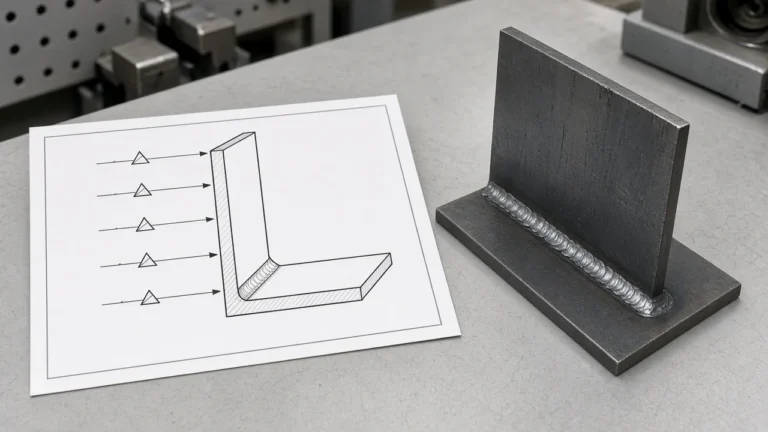
Joint identification should use the drawing. The live guide on how to read welding symbols explains how drawings identify welds. Using the same identifiers keeps HAZ requirements tied to the right joints, especially on parts with several welds of different types.
Process choice can be part of the conversation. Laser welding generally puts less heat into thin parts than TIG welding, which can mean a narrower HAZ and less heat tint. That does not make one process always better. Joint design, fit-up, appearance and cost all matter. Buyers can ask how the chosen process affects the HAZ for their part.
From Koitor’s manufacturing view, the most common practical HAZ issues on stainless hardware are heat tint on visible surfaces, distortion of thin parts from heat, and local softening of cold-worked tube. Those are addressed through process choice, fixtures, sequence, and post-weld grinding, polishing or cleaning, rather than by treating the HAZ itself as a defect.

Buyer checklist before writing about the heat affected zone
- The concern is clearly appearance, corrosion, strength or a specified metallurgical property.
- Heat tint and the heat affected zone are named separately.
- Weld metal requirements are kept separate from HAZ requirements.
- Alloy, condition, thickness and process are stated.
- Evidence type is named: section and etch, hardness traverse, or a specified corrosion practice.
- Joints are identified using drawing references.
- Acceptance criteria and their source are named.
- No sensitization or corrosion conclusion is drawn from colour or a section band alone.
FAQ
What is the heat affected zone?
It is the region of base metal beside a weld whose microstructure or properties changed because of welding heat, without melting. It sits between the weld metal and the unaffected base metal. Every fusion weld has one; its existence alone is not a defect.
Is heat tint the same as the heat affected zone?
No. Heat tint is a thin surface oxide film that shows as colours beside a weld. The heat affected zone is a subsurface region whose structure changed. Tint can be removed by suitable cleaning; the HAZ remains in the metal.
Can you see the heat affected zone without cutting the part?
Not reliably. Surface colours give a rough hint of where heat went, but the HAZ itself is usually revealed by sectioning, polishing and etching, or characterised by a hardness traverse. A visual report can describe tint, not the HAZ.
Does a heat affected zone mean stainless steel will rust?
No. Corrosion depends on grade, carbon content, thermal history, surface condition, cleaning and environment. Sensitization is possible under some conditions and is assessed with defined practices when specified. Seeing a HAZ or heat tint is not proof of a corrosion problem.
Does laser welding eliminate the heat affected zone?
No. Every fusion weld creates a heat affected zone. Concentrated heat sources such as laser welding often produce a narrower one than TIG welding on thin parts, but the size depends on process settings, thickness, joint design and alloy.
Should a hardware drawing specify a maximum HAZ width?
Usually not, unless a specific engineering reason exists and a test method is named. Most hardware requirements are better expressed through appearance, finish, corrosion and strength criteria. A HAZ width limit without a method and reason is hard to test and easy to dispute.
اعمل مع شركة «كويتور» للأدوات
Review weld and finish requirements on a stainless drawing
Send the drawing, the material grade, the weld callouts and any finish or corrosion requirements your customer applies. We can review whether the wording separates weld appearance, heat tint and metallurgical requirements clearly enough for welded hardware parts. We do not issue corrosion predictions or act as a welding inspector.
OEM / العلامة التجارية الخاصة
حوّل دليل التوريد هذا إلى موجز منتج
يرجى إطلاعنا على المنتج المستهدف، والحجم، والتشطيب، وكمية الطلب، ومتطلبات التغليف. وسيتلقى فريقك تقييمًا عمليًّا لإمكانية التصنيع قبل تقديم عرض الأسعار.
 English
 Español
 Português
 Français
 Deutsch
 العربية