
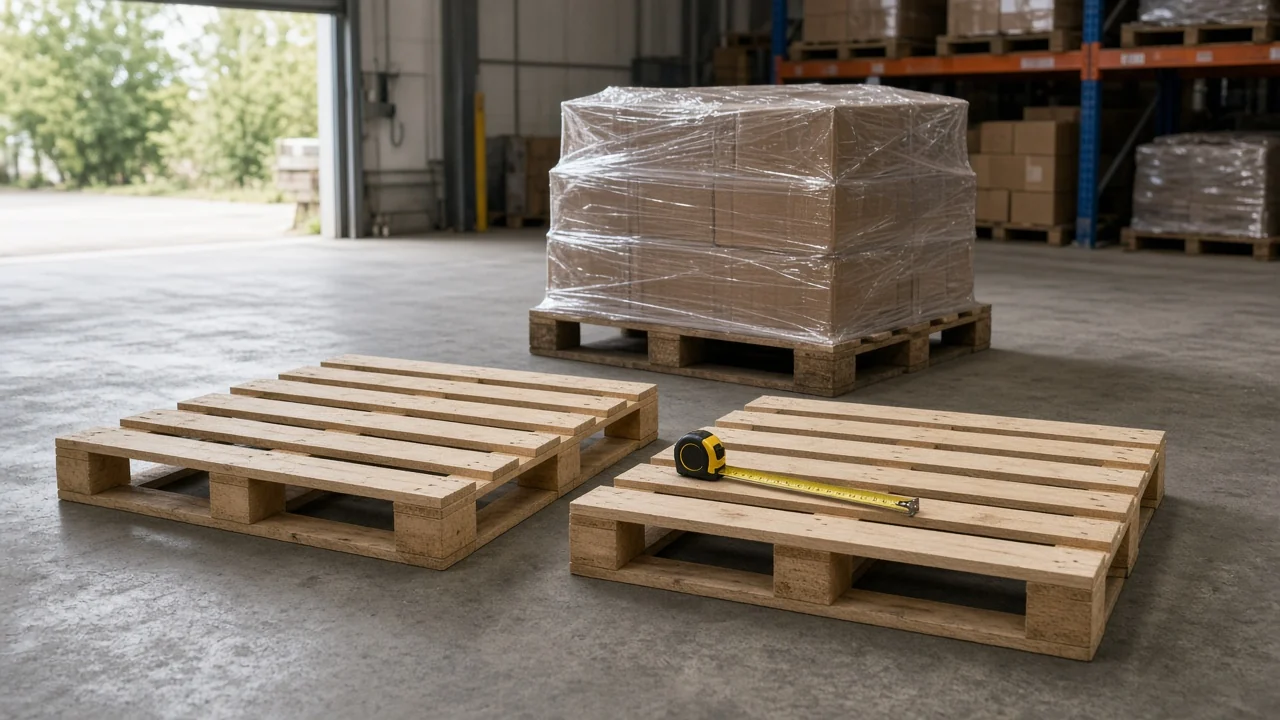
There is no single standard pallet size used everywhere. The most common footprints include 1200 × 800 mm, often called the EUR or euro pallet, 1200 × 1000 mm, and 48 × 40 inches, about 1219 × 1016 mm, widely used in North America. The right standard pallet size for a shipment is the one your destination warehouse, retailer or forwarder actually expects.
That answer frustrates people looking for one number, but it saves real money. A carton designed for a 48 × 40 inch pallet can overhang or waste space on a 1200 × 800 mm pallet. Retail distribution centres may reject loads on the wrong footprint. Getting the footprint right early avoids repacking at origin or at destination.
This guide is for importers, sourcing managers and product teams planning cartons and pallet loads for bathroom and storage hardware. Koitor Hardware is a family-owned China OEM manufacturer; packaging preparation is one of our processes. Pallet types, pool programmes and handling rules belong to your logistics partners, so treat this as a planning guide, not a pallet specification.
Several live guides cover neighbouring topics. Pallet construction and materials are covered in types of pallets. The difference between pallets and skids is covered in pallet vs skid. Load building is covered in how to stack boxes on a pallet.
Is there a standard pallet size?
There is no single global standard pallet size. ISO 6780 recognises several footprints used in different regions, and regional practice adds more. Within a region, one footprint often dominates, such as 1200 × 800 mm in much of Europe or 48 × 40 inches in North America, but those are regional conventions rather than world rules.
The international standard on flat pallets, ISO 6780, lists principal dimensions for pallets used in international materials handling. It includes 1200 × 800 mm, 1200 × 1000 mm, 1219 × 1016 mm (48 × 40 in), and several square sizes such as 1067 × 1067 mm and 1100 × 1100 mm. The standard acknowledges that different regions use different footprints.
In Europe, the 1200 × 800 mm footprint is strongly associated with the EUR pallet. The EPAL description of the euro pallet shows how a pool system defines a pallet by footprint, construction and marking. A pallet that only matches the footprint is not automatically an EPAL pallet.
In North America, 48 × 40 inches is the most common footprint for grocery and general retail, but other sizes are used in specific industries. Asian markets often use 1100 × 1100 mm or 1200 × 1000 mm, depending on the country and the supply chain.
The practical lesson is that “standard” always needs a qualifier: standard for which country, which retailer, which warehouse or which pool. A purchase order that says “standard pallet” without naming the footprint leaves room for an expensive mismatch.
Metric and imperial footprints are close but not interchangeable. A 48 × 40 inch pallet measures about 1219 × 1016 mm, which is close to 1200 × 1000 mm but not the same. Carton patterns designed tightly for one may overhang the other by a few centimetres. When the destination uses one, design for that one rather than for a near equivalent.
Why do people call 48 × 40 the standard pallet size?
Because it dominates many North American supply chains, and much online content is written from that perspective. For a shipment into the United States, 48 × 40 inches is often the right default to ask about. For Europe, Asia or Australia it may be wrong. It is a regional standard, not a world standard.
What are the common pallet footprints by region?
The common footprints in international trade are 1200 × 800 mm, 1200 × 1000 mm, 48 × 40 inches, and square sizes such as 1100 × 1100 mm and 1067 × 1067 mm. Each is associated with particular regions or industries. Your destination’s dominant footprint, and your customer’s specific requirement, matter more than any general list.
| Footprint | Approximate imperial | Commonly associated with | Planning note |
|---|---|---|---|
| — | — | — | — |
| 1200 × 800 mm | 47.2 × 31.5 in | Europe, EUR/EPAL pool | Pool pallets have defined construction and marking |
| 1200 × 1000 mm | 47.2 × 39.4 in | Europe and parts of Asia | Sometimes called industrial pallet |
| 1219 × 1016 mm | 48 × 40 in | North America | Most common US retail footprint |
| 1100 × 1100 mm | 43.3 × 43.3 in | Parts of Asia | Square footprint; check orientation rules |
| 1067 × 1067 mm | 42 × 42 in | Several regions, some industries | Used in specific supply chains |
The table lists footprints, not load capacities. Load rating depends on pallet construction, material, condition and how the pallet is supported, whether on the floor, on forks or in racking. The live guide on pallet static, dynamic and racking load ratings explains why one footprint can carry very different loads.
Pallet height is a separate question. The deck-to-floor height of the pallet itself varies with construction. The overall load height limit comes from the warehouse, the trailer or container, the racking and the retailer’s rules. Ask for the load height limit explicitly.
Fork entry matters too. Some pallets allow fork entry from two sides, others from four. Retailers and warehouses may require four-way entry. The live guide on pallet fork entry clearance and load handling dimensions covers that topic.
How do you measure a pallet footprint correctly?
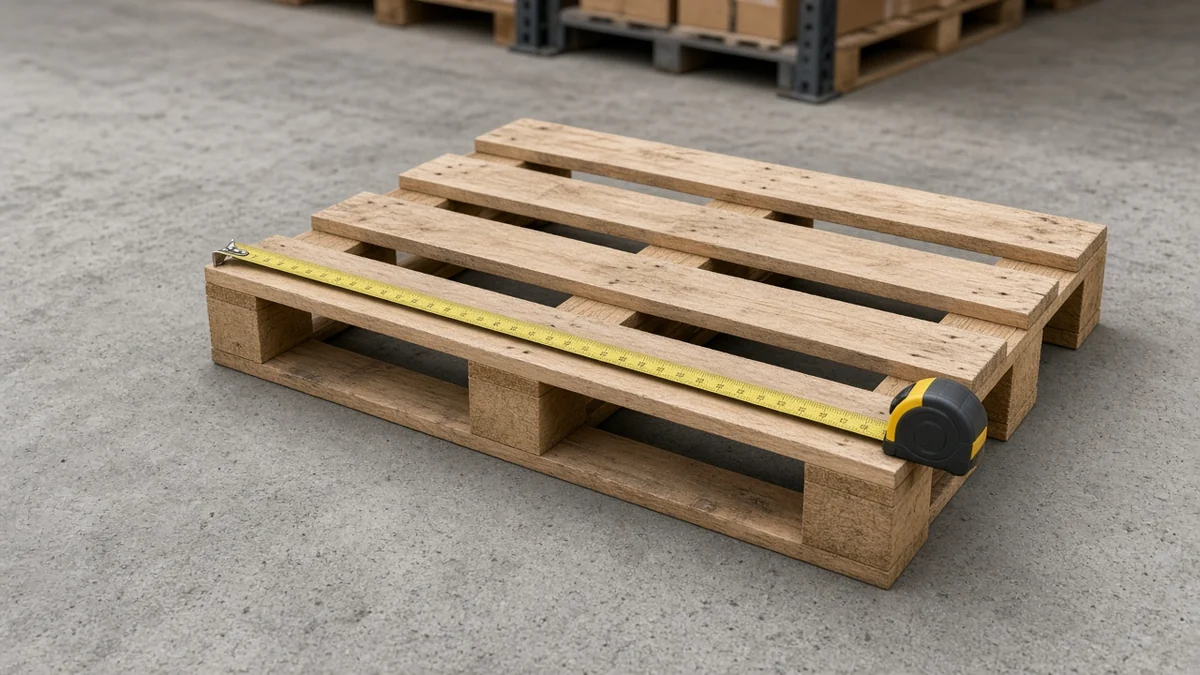
Measure the deck length and width at the top boards, edge to edge, and note which side is the length by convention. In many conventions the first figure is the stringer or longer side, but practices vary, so state which dimension runs along the fork entry. Measuring a sample pallet, rather than trusting a label, catches worn or non-standard pallets before loading.
Pallets also vary within tolerance. A pallet nominally 1200 × 800 mm may measure a few millimetres different, and used pallets may be damaged or repaired. Carton plans that leave no allowance at all for these variations can produce slight overhang on some pallets. A small margin in the plan avoids that.
Does the pallet footprint change shipping cost?
It can. Freight is often priced by weight, volume or pallet positions, and the footprint affects how many pallets fit in a truck or container and how well cartons fill each pallet. Dimensional and freight class calculations are covered in the batch guide on how to calculate dimensional weight and the live guide on how to calculate freight class.
How do you choose the right pallet size for an export shipment?
Ask the destination first. The receiving warehouse, retailer or 3PL usually has a footprint, height limit, pallet type and labelling rule. Then confirm with the forwarder whether that footprint works for the transport mode. Only after that should carton sizes and layouts be finalised around the agreed footprint.
Start with the consignee. A retail distribution centre may publish a vendor guide with pallet footprint, maximum load height, maximum gross weight, pallet grade and label position. A 3PL may have its own rules. Getting those in writing removes guesswork.
Check transport fit next. Sea containers, trucks and air freight each have internal dimensions and door openings. A footprint that suits the destination warehouse may fit a container less efficiently. The live guide on container floor point load and heavy cargo pallet footprint explains why heavy metal loads also need attention to how the footprint spreads weight.
Consider whether palletising is needed at all. Some shipments are floor-loaded as loose cartons in containers and palletised at destination, while others must arrive palletised. That decision affects cost, handling time and damage risk. The forwarder and consignee usually settle it.
Wood pallets crossing borders often need to meet phytosanitary rules for wood packaging, commonly ISPM 15 treatment and marking. Plastic or engineered wood pallets may avoid that requirement. Confirm the rule for the destination with the forwarder rather than assuming.
Destination handling equipment also matters. Some warehouses use automated conveyors, shuttles or stacker cranes that only accept particular footprints and bottom-board designs. A pallet that a forklift handles easily may jam an automated system. Vendor guides usually state these limits, and they override general preferences.
Pool and exchange programmes add rules. If a retailer requires pallets from a specific pool, the pallet must come from that pool and meet its specifications. Those specifications belong to the pool operator, not to the supplier, and can change over time.
Air freight brings its own constraints. Aircraft unit load devices and cargo doors limit pallet height and contour, and dense metal loads may be limited by floor loading. Hardware rarely ships by air in volume, but samples and urgent replenishment sometimes do. For those, ask the forwarder for the airline’s pallet limits before building the load.
Domestic delivery after import can impose a different requirement. Goods may arrive in a container on one footprint and then be repalletised for store delivery on another. Knowing the full route lets the buyer decide whether to ship on the final footprint from origin or accept repalletising cost at the destination warehouse.
Who should decide the pallet size, buyer or supplier?
The buyer or its logistics partner should decide, because the requirement comes from the destination. The supplier can advise on carton fit and loading but should not guess the footprint. A clear instruction in the purchase order, confirmed before packaging design, avoids disputes.
How do you plan hardware cartons for a pallet footprint?
Design carton dimensions so that whole numbers of cartons fill the footprint in a stable pattern without overhang. Check the weight per layer, the total height against the limit, and how the pattern interlocks. Metal hardware cartons are dense, so the weight limit is often reached before the height limit.
Overhang is the first thing to avoid. Cartons that hang over the pallet edge lose support, get crushed by forks and straps, and can fail compression. A carton footprint that divides neatly into the pallet footprint, in at least one orientation, prevents that.
Underhang wastes space and can make loads unstable if the gap is large. A small, even underhang is often acceptable, but a load that covers only part of the deck tends to shift. The live stacking guide covers column and interlocking patterns in more detail.
Weight is the second constraint. Towel racks, wire baskets and steel shelving are heavy for their volume. A pallet loaded to the height limit with steel parts may exceed the weight limit set by the warehouse, the racking or the pallet itself. Calculate weight per layer before choosing the number of layers.
Height is the third. Many warehouses and retailers set a maximum load height including the pallet. Stack height also affects carton compression; lower cartons carry the weight of everything above them. Carton board grade and internal packaging must suit the stack.
Carton strength must match the stack. Lower cartons in a pallet stack carry the weight of everything above, often for weeks in a container and warehouse. Humidity at sea weakens corrugated board. A carton that survives a short drop test may still crush under long-term stacking, so stack height, board grade and inner supports should be considered together.
Product orientation inside cartons interacts with pallet layout. Long towel bars or shelf uprights may suit long, narrow cartons that only fit the footprint in one orientation, which can limit interlocking. Discussing these constraints during packaging preparation helps choose carton dimensions that serve both product protection and pallet efficiency.
Mixed SKUs need a plan. When several products ship on one pallet, cartons of different sizes must still form a stable load. Grouping similar sizes by layer, putting heavy cartons at the bottom and labelling each carton clearly reduce problems at receiving.
From Koitor’s packaging preparation work, a frequent issue is carton sizes chosen for retail display or product fit before anyone confirms the pallet footprint. Small changes to inner packaging or carton depth, made early, can turn an awkward pallet pattern into a clean one without changing the product.
- Confirm footprint, height limit and maximum gross weight before carton design.
- Check carton dimensions against the footprint in both orientations.
- Calculate layer weight for dense metal products.
- Avoid overhang; keep any underhang small and even.
- Plan mixed-SKU layers with heavy cartons at the bottom.
What mistakes cause pallet size problems at destination?
Most pallet problems come from assumptions: assuming “standard” means the same thing everywhere, assuming the footprint alone defines an acceptable pallet, assuming height and weight limits, or assuming the supplier knows the consignee’s rules. Each assumption is cheap to check before shipment and expensive to fix after arrival.
The first mistake is using a home-market default. A sourcing team based in the United States may write “standard pallet” and mean 48 × 40 inches, while the goods are going to a European warehouse that expects 1200 × 800 mm. The supplier ships what was understood, and the warehouse refuses or repacks the load at the importer’s cost.
The second mistake is treating footprint as the whole requirement. A retailer may require a specific grade, four-way entry, a pool pallet, a maximum deck height or a particular bottom-board pattern for its conveyors. A pallet with the right footprint but the wrong construction can still be rejected.
The third mistake is ignoring load height. Some warehouses have low racking positions, some retailers cap load height for store delivery, and some trailers have limited internal height. A load built to the maximum that fits in a container may still exceed the consignee’s limit.
The fourth mistake is ignoring weight. Dense metal products reach weight limits quickly. A tall pallet of steel shelving or wire baskets can exceed the pallet’s rating, the forklift’s capacity at height or the racking beam’s limit. Weight limits should be checked as carefully as dimensions.
The fifth mistake is changing cartons late. When product packaging changes after the pallet plan is agreed, the pattern can break. Late changes to inserts, manuals or carton board thickness often add a few millimetres that create overhang or reduce the number of cartons per layer.
The sixth mistake is inconsistent documents. If the packing list shows one pallet count and dimensions while the physical load differs, receiving teams and customs may hold the shipment. Measuring and weighing finished pallets before dispatch keeps documents honest.
A seventh mistake is forgetting returns and reuse. If the consignee participates in a pallet exchange or return programme, pallets of the wrong type may not be accepted for exchange, creating extra charges. Where pallets are one-way, the buyer may prefer a cheaper non-pool pallet, but that choice should be explicit.
How can buyers prevent pallet mismatches?
Request the consignee’s written pallet specification, pass it to the supplier with the purchase order, ask for a pallet plan showing cartons per layer and layers per pallet, and approve that plan before packaging is printed. For a first shipment, photos of a finished pallet with measured height and weight provide a final check.
What should a PO or packaging spec say about pallets?
It should name the footprint in millimetres or inches, the pallet type or material, any pool or grade requirement, entry type, maximum load height including the pallet, maximum gross weight, wrapping and strapping, label positions, and any wood treatment rule. Each item should come from the consignee or forwarder, not from a guess.
Footprint should be stated as numbers. “Euro pallet” or “US pallet” is helpful context, but numbers remove ambiguity. If a pool pallet is required, name the pool explicitly.
Load limits should be stated as maximums with units. Height including the pallet and gross weight per pallet are the two most common. If the warehouse uses racking, its limits may be stricter than floor storage.
Securing and labelling complete the load. Stretch wrap, corner boards, straps and top sheets affect stability and protection. Label position, content and format may be set by the retailer. The live guide on stacking covers securing methods in more detail.
Photographs help resolve disputes. Asking for photos of each finished pallet from two sides, with the label visible, gives both parties a record of how the load left the factory. If damage or a size complaint arises at destination, the photos show whether the problem began before or after dispatch.
Orientation markings and handling labels also belong in the spec when needed. Arrows, fragile marks or stacking limits on cartons and pallet labels should follow the consignee’s rules, and the spec should say where they go so they stay visible after wrapping.
Documents should match the load. Pallet counts, gross weights and dimensions on the packing list should match what is physically shipped. Inconsistencies cause delays at receiving and customs.
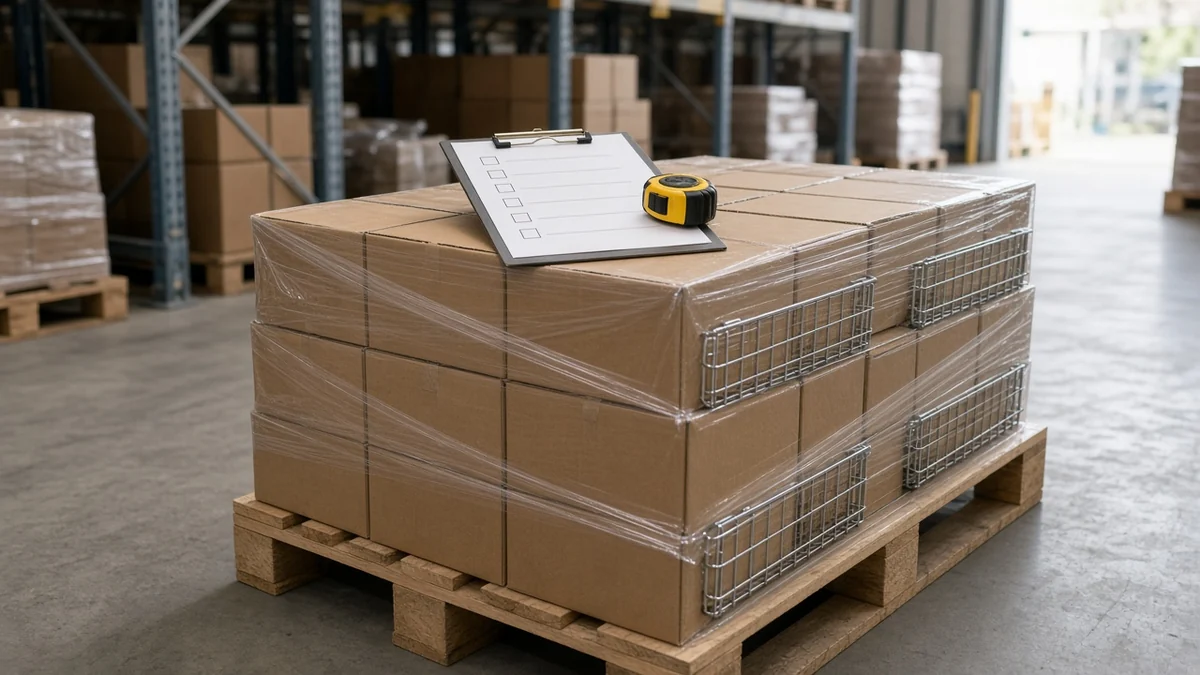
Pallet requirement checklist for a hardware order
- Footprint stated in millimetres or inches, not only a common name.
- Pallet material and any pool or grade requirement named.
- Two-way or four-way entry requirement stated.
- Maximum load height including the pallet stated.
- Maximum gross weight per pallet stated.
- Wood packaging treatment rule confirmed for the destination.
- Wrapping, strapping and label positions agreed.
- Carton dimensions checked against the footprint before production.
FAQ
What is the standard pallet size?
There is no single world standard. Common footprints include 1200 × 800 mm (EUR), 1200 × 1000 mm, and 48 × 40 inches in North America. The right size is the one your destination warehouse, retailer or forwarder specifies.
What size is a euro pallet?
The EUR or euro pallet footprint is 1200 × 800 mm. A pallet in a pool system such as EPAL also has defined construction and marking; matching the footprint alone does not make a pallet part of that pool.
Is 48 × 40 a world standard pallet?
No. 48 × 40 inches is the dominant footprint in much of North America and is one of the sizes listed in ISO 6780, but Europe, Asia and other regions commonly use different footprints.
How much weight can a standard pallet hold?
It depends on construction, material, condition and support, not on footprint alone. Static, dynamic and racking ratings differ. Ask the pallet supplier or pool for ratings, and check the warehouse’s own limits.
Do I need heat-treated pallets for export?
Wood pallets crossing borders often need treatment and marking under phytosanitary rules for wood packaging, commonly ISPM 15. Requirements vary by country. Confirm with your forwarder, or consider pallet materials that are exempt.
Should cartons be designed before choosing the pallet?
Ideally no. Confirm the pallet footprint, height and weight limits first, then design or adjust carton sizes to fit. Designing cartons first often leads to overhang, wasted space or repacking.
اعمل مع شركة «كويتور» للأدوات
Review carton and pallet requirements for a hardware order
Send your destination, the pallet footprint and height limit your warehouse or forwarder expects, and the product list. We can review how cartons could be sized and laid out for that footprint during packaging preparation. Pallet type, pool programmes and handling rules stay with your logistics partners.
OEM / العلامة التجارية الخاصة
حوّل دليل التوريد هذا إلى موجز منتج
يرجى إطلاعنا على المنتج المستهدف، والحجم، والتشطيب، وكمية الطلب، ومتطلبات التغليف. وسيتلقى فريقك تقييمًا عمليًّا لإمكانية التصنيع قبل تقديم عرض الأسعار.

 English
 Español
 Português
 Français
 Deutsch
 العربية