
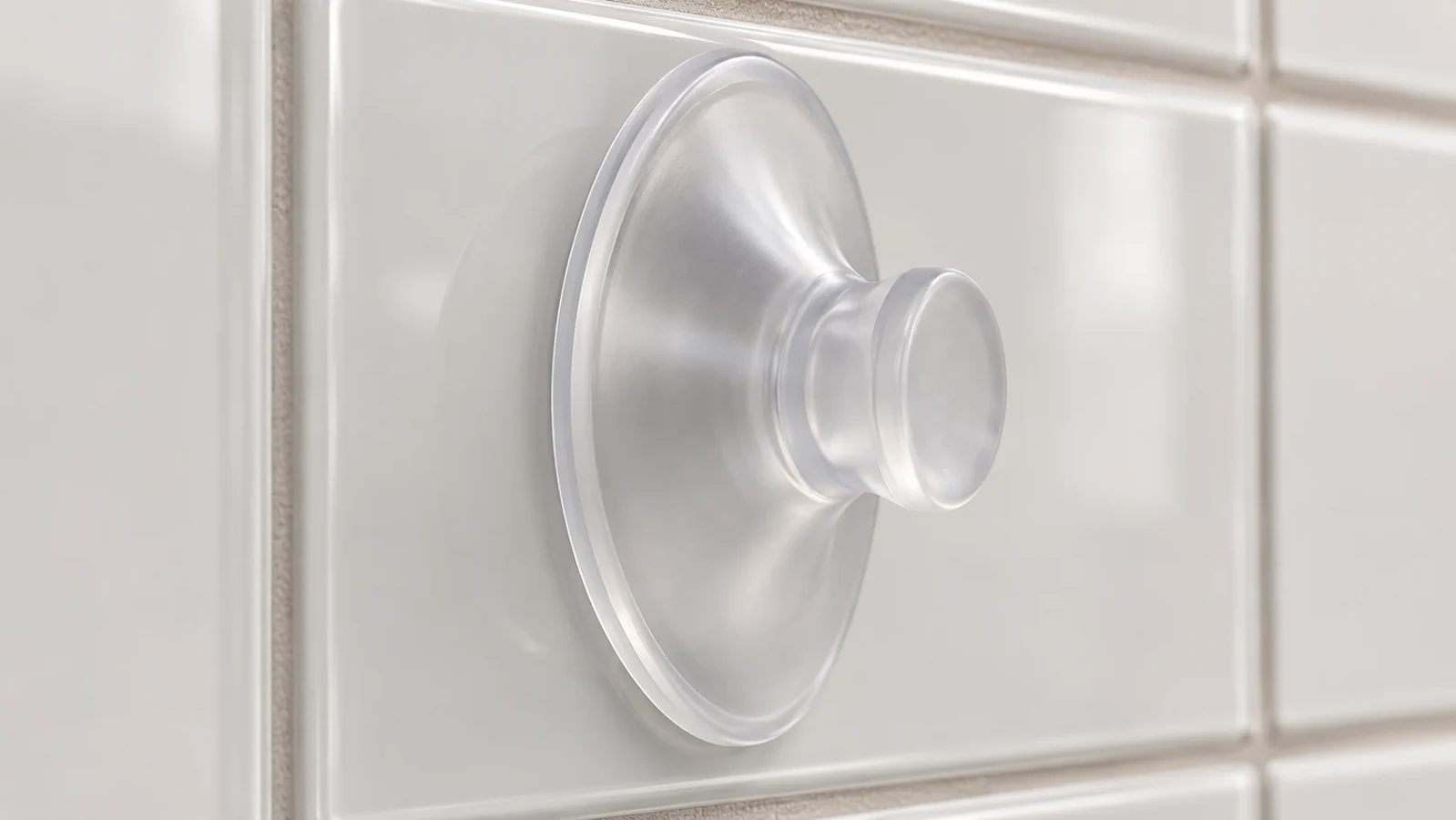
How do suction cups work? The short answer is that a pressure difference presses a sealed cup toward a surface. For a product buyer, how do suction cups work is a question about the seal and both pressure regions, not a capacity promise. Air pressure outside the cup is greater than the pressure in the space beneath it, so the surrounding atmosphere pushes the cup toward the wall. The cup’s flexible shape and rim help create and maintain that lower-pressure space. It is not a special adhesive pulling the cup onto the wall, and the space beneath it does not have to be a perfect vacuum.
For a bathroom storage buyer, that mechanism explains why the cup and contact surface must be considered together. It does not establish that a particular accessory suits every tile, glass panel, finish, load, or use condition. The maker’s actual instructions and evidence govern that separate product decision.
What pressure difference holds a cup toward a surface?
Pressure describes force distributed over an area. When a cup seals against a suitable surface, the pressure beneath it can be lower than the pressure in the surrounding air. The greater outside pressure then pushes the cup toward the surface. The cup is not being pulled by a glue-like vacuum material; the net effect comes from the difference between the two pressure regions.
The phrase “suction” can make the mechanism sound like the cup actively sucks itself onto the wall. A clearer explanation looks at both sides of the cup. The outside air remains at its surrounding pressure. The sealed space under the cup is at lower pressure. The pressure difference creates a force toward the contacted surface while the seal remains effective.
A cup may operate with a partial vacuum. Partial vacuum means pressure lower than the surroundings; it does not mean that all air has been removed or that pressure is zero. Describing a cup as “vacuum mounted” does not establish a fixed pressure. Actual pressure depends on the specific design, use conditions, measurement method, and the maker’s product information. A visible cover, a lever position, or a user’s sense of resistance is not itself a pressure measurement.
This mechanism is familiar in press-on cups, but not every product uses the same way to establish or maintain the pressure difference. A simple flexible cup can deform when pressed so that air escapes from the space beneath it. A lever or pump design may use a different movement to create a sealed lower-pressure region. Industrial suction systems may connect cups to a powered vacuum generator. The common physical principle does not imply identical construction or performance.
For a consumer bathroom accessory, do not assume a hidden valve, spring, pump, or lever simply because a separate industrial vacuum source uses those parts. A drawing or product specification should establish what the actual mounting component contains. The article’s principle explains pressure; it does not reverse-engineer an unseen Koitor or supplier product.
How do suction cups work in a sealed-versus-leaking comparison?
A conceptual comparison begins with two states of the same cup. In the first state, the rim is in contact around the relevant boundary and the space beneath it is at lower pressure than the air around the cup. The surrounding pressure acts across the cup and presses it toward the surface. The pressure difference may be partial; the mechanism does not require a perfect vacuum. The drawing should show the outside and the sealed region separately, because the difference between them is the explanation.
In the second state, a gap allows surrounding air to enter. As the pressure beneath the cup moves closer to the outside pressure, the difference is reduced. The cup may then experience less force toward the surface. This comparison explains why the seal and contacted surface belong to the mechanism. It does not say that every leak looks the same, that a user can diagnose the condition by eye, or that the cup will detach at one universal point.
The simple explanation also clarifies a common language trap. People may say a cup “creates a vacuum,” but that phrase is shorthand for a lower-pressure region in ordinary usage. It should not be read as proof that the space contains no air. The technical sources describe a pressure relation, not a magic pulling force. A buyer can use this distinction to ask more precise questions about the cup’s construction and product instructions without claiming a measurement that has not been made.
A conceptual diagram should avoid numbers unless the exact product and conditions are supported. It can mark “higher surrounding pressure,” “lower pressure beneath the sealed cup,” and “air entering through a leak path.” Relative arrows communicate direction. They do not indicate a particular force magnitude, test duration, wall material approval, or safe load. That is why a mechanism image should be visually distinct from a product installation sheet or a laboratory result.
For household products, pressing a flexible cup against a suitable surface can displace air and leave a lower-pressure space when the rim seals. The exact deformation, contact boundary, and pressure achieved are design-specific. Some products instead use a lever or pump. Do not combine those arrangements into a fictional universal mechanism; ask for the actual product drawing or maker documentation when construction matters to the sourcing decision.
How does the rim maintain the lower-pressure space?
The cup’s rim or lip forms a boundary between the space beneath the cup and the surrounding air. When that boundary seals, air does not freely enter the lower-pressure region. If a leak path opens, the pressure beneath the cup moves toward the surrounding pressure. As the difference decreases, the force pressing the cup toward the surface also decreases.
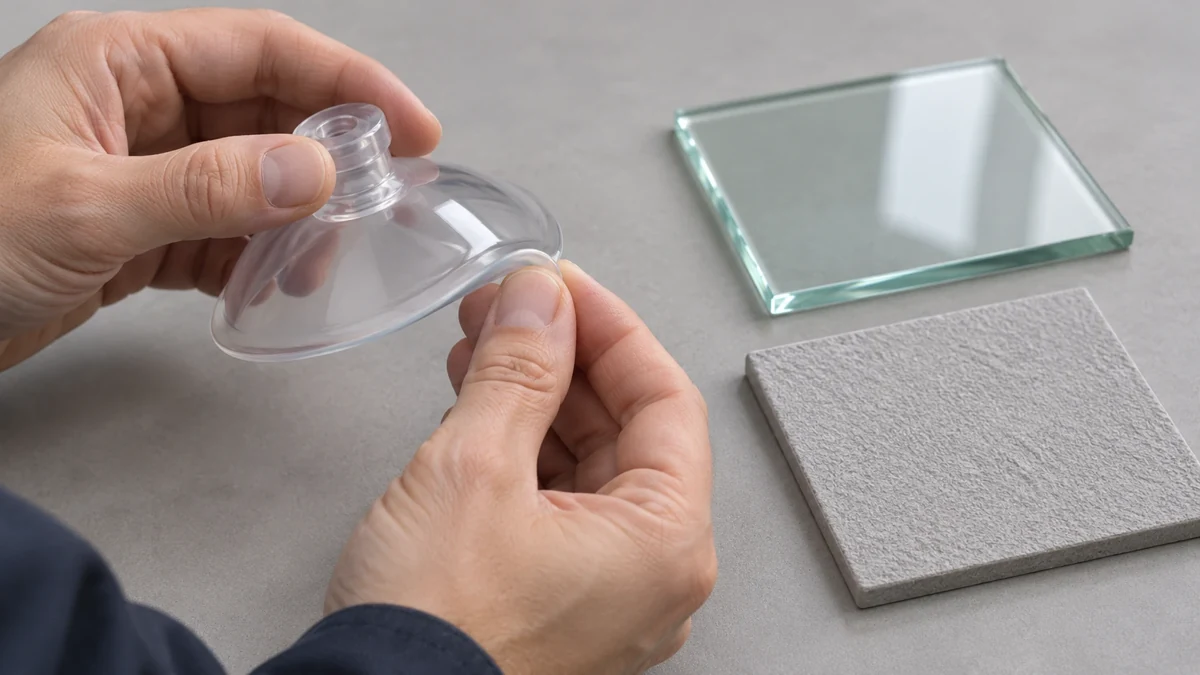
This is why the surface and the seal matter to the mechanism. A rim that cannot maintain contact across the intended area may allow air to enter. Surface texture, curvature, contamination, material, and cup design can all be relevant to a particular product’s fit, but the mechanism alone does not say which surfaces a particular accessory is approved for. The product’s own instructions and compatibility evidence must answer that question.
A shiny or smooth appearance is not a universal compatibility test. Different materials can appear similar while presenting different surface conditions. A generic diagram cannot substitute for the accessory maker’s instructions. A buyer sourcing a suction-mounted bathroom basket should ask which surfaces the actual product is intended for and what conditions the maker has considered. Do not make a claim about textured tile, porous stone, grout, paint, or coatings from the word “suction cup” alone.
The seal is not equivalent to adhesive. An adhesive layer bonds through its own material and surface interaction. A suction cup instead relies on maintaining a pressure difference across a boundary. Some mounting products may combine a suction mechanism with other features, but the exact product construction must be verified. Do not assume that every cup uses an adhesive pad, and do not infer an approved hybrid design without product evidence.
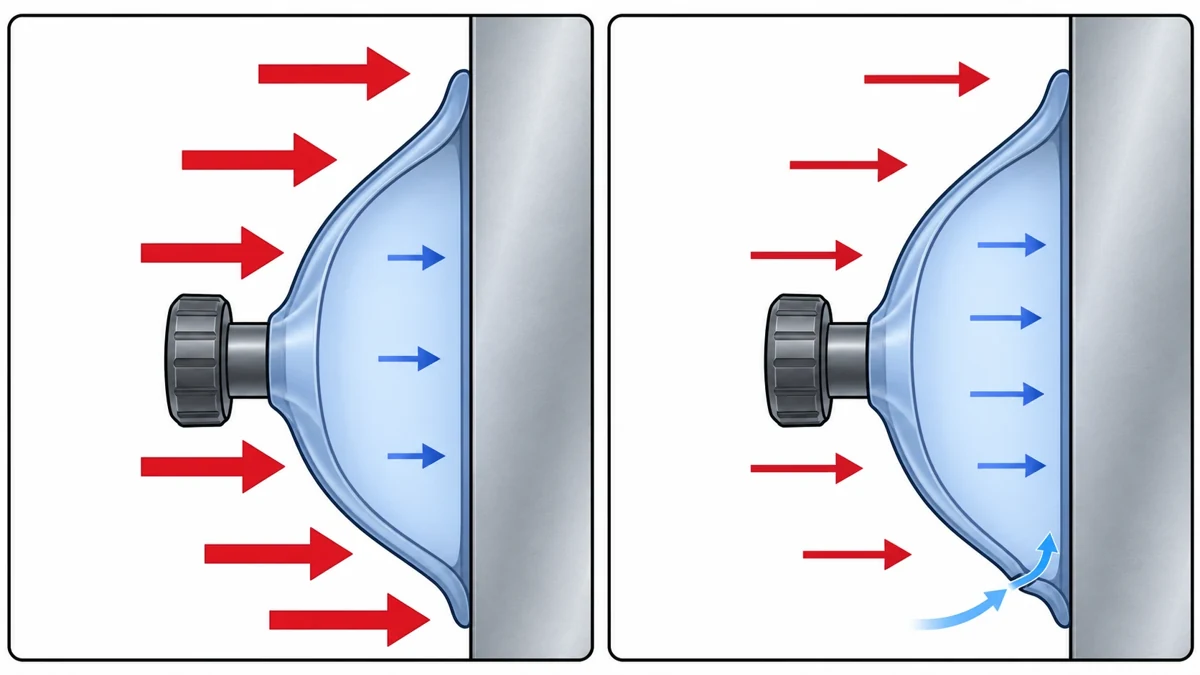
An authored two-state model helps explain the boundary. In State A, the rim seals and the lower-pressure space remains separated from the surrounding atmosphere. In State B, air enters through a leak path and the pressure difference becomes smaller. The arrows in such a model should indicate relative direction only. No pressure number, holding weight, or failure time can be concluded from the sketch.
What does a pressure difference tell a buyer?
A pressure difference can help explain why a cup experiences force toward the mounting surface. In an idealized model, the theoretical force depends on both the pressure difference and the effective area over which it acts. The effective area is not automatically the cup’s outside diameter converted into a usable load rating. The pressure actually achieved is another variable, and real mounting assemblies have additional conditions.
This is a mechanism-level relationship, not a product capacity calculation. It does not provide a kilograms-per-cup value, a guaranteed safe working load, or the capacity of a complete basket. A bathroom accessory includes more than the cup: the interface, connection, arm or body, load position, surface, number and arrangement of mounts, and use conditions may all matter. The evidence for the whole assembly must come from the responsible product maker under conditions relevant to that product.
Theoretical force toward a surface also is not the same as the force resisting an object sliding down the surface. A vertical wall illustrates the difference. A cup can experience a force normal to the wall, directed toward it, while the hanging accessory and its contents create a downward load parallel to the wall. Those are different directions. The complete assembly and the interaction with the surface determine whether the product remains positioned.
A catalog diameter alone therefore cannot establish performance. Two cups with the same outer diameter may differ in construction, effective sealed area, material, interface geometry, or intended conditions. Even if a supplier provides a theoretical calculation, it should not be treated as a product test or safety factor unless the source and method support that interpretation. This article intentionally gives no numerical example because the accepted sources do not supply a universal bathroom-accessory test condition.
For product development, the question is not simply “How large is the cup?” The buyer should connect the cup to the actual accessory and application. Which mount is specified? Which surface is in scope? What direction does the expected load act? What evidence describes the complete assembly, and under which stated conditions? A supplier should answer for the actual product rather than borrow a force figure from an industrial cup with another configuration.
The distinction also helps avoid an overconfident conclusion from a successful one-time placement. A cup that appears to hold immediately has not thereby demonstrated a quantified duration, repeated-use life, resistance to every disturbance, or suitability for every wall. Those would require specific evidence. Do not turn the basic pressure principle into an unsupported performance promise.
Why are normal force and shear different?
A force normal to the wall points toward or away from the surface. A shear force acts along the surface. On a vertical wall, the weight of a hanging basket acts mainly downward, parallel to the wall, while the pressure difference produces force toward the wall. Friction and the complete connection are involved in the assembly’s behavior, but this short explanation is not an engineering load-path calculation.
Industrial vacuum-cup references often distinguish theoretical suction force perpendicular to the contact surface from tangential shear. The distinction is useful for understanding direction. Their numerical force values and vacuum conditions, however, belong to the specified industrial cup and source conditions. They cannot be carried over to a passive bathroom accessory without evidence that the systems and test assumptions match.
The same caution applies to terms such as “holding force,” “pull-off force,” or “load.” Ask what direction, fixture, surface, duration, measurement method, and product configuration a stated value covers. A force measured perpendicular to a flat test plate does not automatically describe downward movement on a vertical wall. Nor does a component-level result necessarily establish a complete multi-cup accessory rating.
An image can show two arrows to make this distinction visible: one toward the wall and one downward along it. Such an illustration is explanatory, not a test fixture, a validated structural model, or proof that a particular basket can support a specified load.
How does a household cup differ from an industrial vacuum system?
A passive press-on cup and a powered industrial vacuum system may share the pressure principle while differing in how they produce and maintain the pressure difference. An industrial system may use a pump or generator, monitoring, valves, or a designed circuit. That equipment context does not describe an ordinary bathroom accessory unless its actual design includes those components.
Industrial technical data can clarify ideas such as theoretical force and force direction. But the data usually depend on stated cup dimensions, materials, pressure conditions, surface assumptions, and safety treatment. Those values should stay attached to the equipment and operating conditions in the source. An industrial lifting value is not a household accessory rating.
It would also be too broad to conclude that every vacuum system behaves identically on every porous surface or that no system can work in any challenging surface condition. Specialized equipment may use different mechanisms and process controls. That does not establish that an unknown passive cup works on a porous or textured wall. The correct scope is specific: identify the mounting product and follow its documented surface limits.
For an importer evaluating a bathroom-storage product, separate the system category from the product claim. Ask whether the actual design is a passive press-on cup, a lever-assisted arrangement, or another configuration. Then ask which product data and mounting instructions support the intended use. Do not infer a pump, valve, or industrial monitoring feature from an image or a broad product label.
What should a buyer verify for a suction-mounted accessory?
A useful review separates the physical principle from product fit and the intended use. The buyer can identify the actual mounting part and its construction, the surfaces named by the manufacturer, any stated use limitations, and the complete accessory configuration. If the product will carry bathroom items, ask for evidence related to the complete assembly and the conditions described by the maker. A mechanism explanation alone cannot supply that evidence.
Clarify the load direction and where the product is intended to be installed. A holder mounted on a vertical surface can experience a downward force as well as force normal to the wall. The actual design and evidence should address the relevant arrangement. Do not substitute an ideal suction-force equation or an unrelated industrial test for product-specific support.
Keep this assessment separate from neighboring questions. The surface-compatibility guide covers how buyers assess a specified surface for a particular accessory. A separate removal and repositioning guide addresses handling after use. The replacement-parts article covers what to confirm if a component needs replacement. Linking those owners is more useful than repeating their full checklists here.
If a supplier proposes a different suction cup, request the exact part identification and supporting information. A replacement with a similar outside dimension is not automatically equivalent. Keep any product revision or mounting-interface change documented and obtain the responsible buyer’s acceptance. This is a procurement control, not a claim that every component change creates a defect.
When reviewing a test statement, match the record to the exact component and assembly being considered. Note whether the source describes an isolated cup or a complete accessory, whether the force is perpendicular or parallel to the mounting surface, and what surface and conditions were used. If any of those details are absent, ask the supplier what the statement covers before using it in a product decision. A technical value without its conditions is not a transferable approval.
The same principle applies to indicators. A colored mark, lock position, or visible deformation may communicate something about a product only if the maker has defined it. Do not assume an indicator measures pressure, predicts remaining holding time, or confirms a safe load. Keep the explanation tied to documentation for the actual product; the generic pressure model cannot assign meanings to an unknown visual feature.
What evidence answers which buyer question?
| سؤال من المشتري | Evidence to request | What that evidence does not establish by itself |
|---|---|---|
| What type of mount is supplied? | Product drawing, part reference, or maker description | Compatibility with every surface |
| Which surfaces are in scope? | The actual product instructions and documented surface limits | A guarantee for an unlisted finish or installation condition |
| What does a stated force value mean? | Test method, direction, setup, and product configuration | A rating for a different accessory or load direction |
| What does an indicator show? | Product documentation explaining its meaning | A pressure measurement unless the maker says so |
This map keeps the question how do suction cups work separate from questions about installation, fit, or load acceptance. The mechanism explains why pressure difference matters. The maker’s evidence describes which product and conditions have been evaluated. Neither should be stretched beyond its stated scope.
الأسئلة الشائعة
Do suction cups use glue?
A basic suction cup holds through a pressure difference maintained by a seal, not because the empty space acts like glue. A specific product may combine mechanisms, so confirm its actual design.
Is there a perfect vacuum inside a working cup?
Not necessarily. The cup can function with pressure below the surrounding atmosphere; this is a partial vacuum. A generic description does not establish zero pressure or a fixed value.
Does a larger cup always hold more weight?
No universal capacity follows from outside diameter. Effective sealed area, achieved pressure, product configuration, force direction, surface, and the maker’s test conditions all matter. Use product-specific evidence.
Why can a cup shift downward on a wall?
The load direction parallel to the wall is different from the cup’s force toward the wall. Friction and the rest of the assembly matter. This principle does not diagnose a specific product or surface.
Does a shiny tile guarantee a seal?
No. Appearance alone is not proof of compatibility. Follow the actual product’s surface instructions and evidence.
Can industrial vacuum data rate a bathroom basket?
Not by itself. Industrial data apply to their stated equipment and test conditions. Do not transfer a capacity to a different passive accessory without supporting product evidence.
Does a locked lever measure pressure?
No. A lever or visual indicator is not a pressure measurement unless the product documentation specifically explains what it indicates and how it is validated.
Do all suction cups use a pump or valve?
No. Designs vary. A simple press-on cup can use deformation and a rim seal; other designs may use levers, pumps, or powered systems. Verify the construction of the actual product.
Sources and scope
Original technical material from vacuum-component makers and a consumer suction-cup source supports the pressure-difference mechanism, the role of a seal, and the distinction between perpendicular force and shear. Industrial data and product claims are not transferred to a bathroom accessory. No load rating, installation recipe, holding duration, or Koitor-specific test is asserted.
- Schmalz: Vacuum suction cups
- Schmalz: Technical data of suction cups
- Adams Manufacturing: Suction cups 101
- WPG: Vacuum overview
- WPG: How suction cup lifters work
- Koitor: Suction-cup accessory surface compatibility
- Koitor: Suction-cup removal and repositioning
- Koitor: Suction-cup replacement parts
Discuss a related hardware project with Koitor
Share the relevant drawing or sample, product revision, finish, order quantity, and mounting-interface scope to clarify the manufacturing discussion. Product compatibility, loading and test results must be confirmed for the actual accessory.
OEM / العلامة التجارية الخاصة
حوّل دليل التوريد هذا إلى موجز منتج
يرجى إطلاعنا على المنتج المستهدف، والحجم، والتشطيب، وكمية الطلب، ومتطلبات التغليف. وسيتلقى فريقك تقييمًا عمليًّا لإمكانية التصنيع قبل تقديم عرض الأسعار.
 English
 Español
 Português
 Français
 Deutsch
 العربية