

An install sheet can tell a buyer how to install rivets only after the packed joining family, the grip or stack and hole, and the approved setting tool or method are named from the supplier’s setting data. The family is a blind or pop rivet, or a solid or semi-tubular rivet, written in the supplier’s terms. The tool is a purpose-made setter for that family, or an explicit exclusion that points back to the cited data.
Identification of rivet types belongs on the types-of-rivets file. Grip-range procurement belongs on the live blind-rivet grip-range RFQ. Service-access comparisons of rivets versus screws, and pivot questions about solid versus semi-tubular bodies, belong on those neighboring files. None of those decisions is a first-set leaflet, and none should be rewritten as one.
This guide is for importers, distributors, and private-label teams approving a setting leaflet for joining rivets already used on brackets, plates, or storage assemblies in the live OEM library. Koitor Hardware is a family-owned China OEM manufacturer of custom metal bathroom and home storage hardware. Adjacent typological, grip-range, and versus-screw pages already sit in that published library.
That published-library fact is not a claim that Koitor currently manufactures a named joining-rivet SKU, a rivet tool, or garment rivets. Send the rivet drawing or setting data, the stack and hole, and the intended tool family. We can review the wording and the named family. We will not issue a universal stroke chart, a without-gun method, an aircraft approval, or a garment, leather, or fabric sequence.
What does a how to install rivets file actually freeze?
It freezes the packed joining family, the documented grip or stack and hole, and the approved setting tool or method, or an explicit exclusion for any of those fields. It does not freeze a types table, a grip-range RFQ, a rivet-nut first set, or a later removal map.
Searchers often ask how to install a pop rivet, how to install a blind rivet, or how to install rivets in metal because a carton arrived without a named tool, or because a forum thread treated every rivet as the same job. That demand is real. For an importer, the usable decision is whether a listing may say the rivet is easy to install, and which family, stack, and tool that sentence is allowed to assume.
A blind or pop rivet and a solid or semi-tubular rivet do not share a setting leaflet, even when the finish or the head style looks familiar. If the sheet does not say which of those families shipped, an easy-to-install line will be applied to the wrong tool and the wrong stack. This file is not a consumer shop tutorial, and it is not a product listing.
A rivet nut is not a joining rivet. The already-written rivet-nut first-set article in this batch freezes a threaded insert, a grip and hole, and a purpose-made rivet-nut setter. This joining-rivet file may name that neighbor so the two families are not interchanged. It should not become a second rivet-nut leaflet.
Removal of a set pop or blind rivet is a different service mode. The companion removal article in this batch, when published, will freeze the packed pop or blind family and the documented removal method. This first-set file should not print a drill-out map, a remaining-hole note, or a salvage sequence.
و OEM home storage hardware manufacturer can review whether a first-set sentence and a packed joining family stay together. Matching a head style or a finish to a collection is not the same as inventing a default family, a default stroke, or a without-gun path. If you are screening this adjacent line, bring the intended family, the stack and hole, and the tool family with the drawing.
A published easy-to-install claim is only as complete as the named family, the named grip or stack and hole, and the named tool. If the photograph shows a blind rivet and the bag holds a solid shank, the sheet has already failed, even if both parts are called rivets in casual speech. The same is true of a missing nosepiece, a borrowed garment method, or a gun that belongs to a different family.
This file can precede a setting-data RFQ. It should not be turned into a catalog page, a types essay, a grip-range chart, or a tool shop. Those jobs already have, or should keep, their own files.
Which joining family, grip or stack and hole, and approved tool must be named first?
Name the packed joining family first, in the supplier’s terms: a blind or pop rivet, or a solid or semi-tubular rivet, or another documented joining family the carton actually ships. Do not start with a generic how-to-install-rivets sequence, and do not start with a without-gun question that has not been excluded.
A blind or pop rivet is set from one side with a mandrel and a purpose-made riveter. The sheet should say so, and it should say which body style is packed if that style is part of the supplier’s setting data. Calling the part a rivet is not a complete family line if the setting path is left unnamed.
A solid or semi-tubular rivet is a different first set, even when the head and the finish match a blind rivet in a photograph. The setting path, the access required on the far side, and the approved tool family are not interchangeable with a nosepiece riveter. If that family is not the packed family, a pop-rivet sentence will be applied to the wrong carton.
Name the grip or stack and hole from cited setting data, or keep the field named and honestly blank. Do not invent a factory-universal grip table, a hole chart, or a borrowed blog list of diameters. If the supplier’s current data leaves a value to the buyer, the sheet should say that the value comes from that data, not from this page.
Name the approved setting tool or method for the packed family, or mark the tool excluded and point to the supplier’s current setting data. A purpose-made hand riveter with a nosepiece may be the packed or required tool for a blind or pop rivet. That is not permission to treat pliers, a bolt and nut, or a rivet-nut setter as a stand-in.
Informal names such as pop rivet or blind rivet are coverage of the same joining-family decision when the packed part is that family. They are not a license to open a second first-set page for each synonym, and they are not a license to print a garment, leather, or fabric method under a metal heading.
If the program packs more than one joining family in the same assortment, the sheet must say which family each bag or compartment belongs to. A mixed photograph that shows a blind rivet and a solid shank in the same first-set panel is how the wrong tool is promised for the wrong SKU.
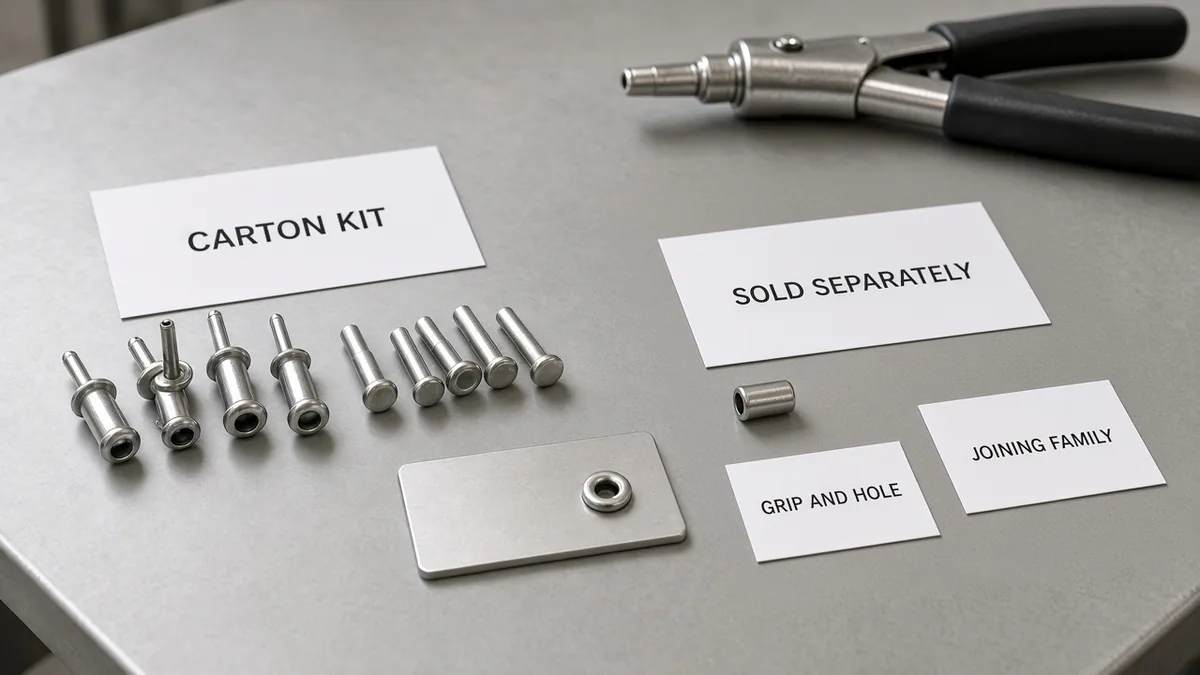
What belongs in the setting-sheet kit list, and what must stay out?
The kit list should name what the carton actually ships for this first set, and what the cited setting data requires the buyer to supply. It is not a shopping list, and it is not a place to merchandise a gun as the thesis of the page.
If a purpose-made riveter, a nosepiece, or a setting card ships in the carton, say so in those terms. If that tool is sold separately, the sheet should say so on its own line, not in a merged phrase that reads as if the carton already includes it. A hardware kit packing inspection checklist is useful only for that packing-honesty check, not as a substitute for the named family.
Garment, leather, jeans, and fabric rivet sequences stay off this kit list. Those volumes were not validated as this page’s target, and they must not be borrowed to fill a metal first-set leaflet. A canvas or leather punch is not an approved joining-rivet tool on this file.
Without-gun or without-tool paths stay off the list, including improvised pliers, hammer, and bolt-and-nut workarounds. Demand for those paths is evidence that the approved tool must be named or excluded. It is not a license to print a bypass.
| Field or claim | What must be named | What belongs in the kit or data | What this row is not |
|---|---|---|---|
| Packed joining family | The rivet family the carton actually ships, in the supplier’s terms | The packed rivets and the matching setting instructions | A rivet-nut first set, a garment rivet, or an invented Koitor SKU |
| Grip or stack and hole | The grip or stack and hole taken from cited setting data, or a named field left blank | Only the values the cited data actually supplies | A factory-universal grip or hole chart, or a borrowed blog table |
| Approved setting tool | A purpose-made setter family for that joining rivet, or an explicit exclusion plus a pointer to the supplier’s data | The named tool family, if the program packs or requires one, not a shopping list | A without-gun method, pliers used as a stand-in, or a threaded rivet-nut tool treated as the same gun |
| Easy to install | The family, grip or stack and hole, and approved tool the sentence is allowed to assume | Nothing beyond that named list and cited data | A stroke chart presented as a Koitor standard, or tool merchandising as the thesis |
| Later removal | That removal is a different service mode, not this first set | A pointer to the companion removal file when that file is published | A drill-out map, a remaining-hole promise, or a no-damage guarantee |
The table is a decision map for the first-set leaflet. It is not a setting-stroke standard, an aircraft approval, or a claim that Koitor manufactures rivet tools. If a row cannot be filled from the supplier’s current data, leave the field named and blank rather than inventing a number.
A custom metal storage rack manufacturer review can confirm whether a joining-rivet sentence belongs on a bracket or plate program already in the live library. That review does not turn this page into a rack catalog, and it does not authorize a structural or aircraft claim.
Why are without-gun threads not a license to print a bypass?
Forum threads and marketplace questions often ask how to install rivets without a rivet gun, or without a tool. That wording is a real demand signal. It is not a method this sheet may teach, and it is not a secondary keyword this page should official or target.
A first-set leaflet that prints an unofficial path will be copied onto cartons that never intended it. The buyer then treats the unofficial path as if it were the approved tool family. When the joint fails, or when the remaining hole is wrong, the listing still said the rivet was easy to install.
The honest response is to name the approved tool family, or to exclude unofficial methods and point to the supplier’s current setting data. If the program does not pack a tool, say that the tool is sold separately or buyer-supplied, in those words. Do not fill the gap with pliers, a hammer sequence, or a bolt-and-nut workaround.
Brand videos and specialist blogs may show a particular gun, a particular stroke, or a particular shop setup. Those sources can explain why a buyer arrived with a how-to question. They are not a factory standard for this leaflet, and they are not a license to invent a Koitor stroke, a hex size, or a timed setting claim.
Aircraft, structural, or certified-joint claims stay off this page. A bathroom or home-storage bracket program is not an airframe leaflet, and this file must not borrow that authority. If the buyer’s question is actually a structural approval, the question does not belong on this first-set sheet.
The same discipline applies to garment and leather content that outranks metal first-set pages in some search results. Those pages were not validated as this target. Do not import a jeans or canvas sequence to pad a metal leaflet, and do not treat a fabric eyelet tool as an approved joining-rivet setter.
Which neighboring rivet files should stay out of this sentence?
The types-of-rivets identification file should stay a types file. It can help a buyer name the family they are looking at. It should not be reprinted here as a first-set sequence, and it is named in prose only because the official lock-copy of the internal-link list omits that href.
The live blind-rivet grip-range RFQ should stay a procurement file. Grip or stack values on this sheet come from cited setting data, or they stay named and blank. This page must not become a second grip-range chart.
Rivets-versus-screws service-access questions, and solid-versus-semi-tubular pivot questions, belong on those neighboring files. This first-set leaflet may point to them by name. It should not settle a service-access or body-style selection argument in a setting sentence.
The rivet-nut first-set article already written in this batch stays a different family. A rivet nut is a threaded insert set with a purpose-made rivet-nut tool. Do not interchange that family with a joining rivet, and do not invent an href for that companion if the official lock-copy list does not yet carry it. Name it in prose.
The companion article on how to remove a pop rivet, when published, stays a removal map. First set and removal are different service modes. Do not merge them into one leaflet, and do not print an undocumented without-drill trick on either page.
If a later file owns mandrel retention, open-versus-closed-end body style, pull-through, or self-piercing comparisons, keep those questions there. A first-set sentence that tries to settle every neighboring RFQ will be wrong for the carton that actually shipped.
What should be checked before a listing says the rivets are easy to install?
Use the list as a setting-sheet review, not as a shop sequence and not as a pass-fail audit grade. If a line cannot be answered from the drawing, the carton, or the cited setting data, keep the field named and unresolved rather than inventing a value.
- Name the packed joining family in the supplier’s terms before any setting sentence is printed, and treat pop-rivet or blind-rivet phrasing as coverage of the same decision when that family is what shipped.
- Name grip or stack and hole from cited setting data, or keep the field named and blank; do not invent a factory-universal chart.
- Name the approved purpose-made setting tool family, or mark it excluded and point to the supplier’s current setting data.
- State clearly whether the tool, nosepiece, or setting card is in the carton or sold separately; do not merge those states on one label.
- Exclude without-gun, without-tool, and improvised pliers or bolt-and-nut methods; do not print those paths.
- Keep garment, leather, jeans, and fabric sequences off this leaflet; those volumes were not validated as this target.
- Keep rivet-nut first set and pop-rivet removal on their companion files; do not interchange those families or modes with this first set.
- Keep types, grip-range, rivets-versus-screws, and solid-versus-semi-tubular questions on their neighboring files, named in prose when the lock copy omits those hrefs.
- Do not merchandize a tool or gun as the thesis, and do not claim that Koitor manufactures rivet tools or garment rivets.
- Do not print an aircraft, structural, or certified-joint approval, a stroke or torque chart, or a timed setting standard.

If the listing still wants an easy-to-install line after this review, the line may only assume the family, the stack and hole, and the tool that were just named. A sentence that cannot point to those three fields is not ready to print.
A missing approved tool is a packing or wording defect, not a reason to publish a workaround. The same is true of a photograph that shows the wrong family, or of a bag that mixes joining rivets with rivet-nut inserts.
If a buyer arrives with a mixed bag, stop the easy-to-install sentence until each compartment is named. A shared finish or a shared head drawing does not make two joining families share a tool, and it does not make a rivet nut into a joining rivet. The carton should be re-sorted against the setting data before any first-set claim is printed.
When the official lock-copy of the internal-link list omits a neighboring rivet href, name that neighbor in prose and stop there. Do not invent a URL, and do not paste a types table or a grip-range chart into this leaflet to make up for the missing link. The first-set decision can still be frozen without reprinting those files.
If the intended application is a garment, a leather good, or a fabric panel, this sheet is the wrong file and should say so. Point the buyer off this leaflet rather than improvising a punch sequence. The same is true of an aircraft or structural joint that the buyer hoped to cover with a bathroom-hardware setting card.
الأسئلة الشائعة
Can the listing say the rivets are easy to install?
Only after the packed joining family, the grip or stack and hole, and the approved tool are named or honestly pointed to cited setting data, and only if unofficial methods are excluded. An easy-install line is not a substitute for a missing family or a missing tool.
Are pop rivet and blind rivet different first-set files?
No. Those names are coverage of the same joining-rivet first-set decision when the packed part is that family. Name the packed family in the supplier’s terms. Do not open a second page for each informal name, and do not invent a Koitor SKU from the synonym.
What should the sheet say if the buyer asks how to install rivets without a gun?
Exclude that path and point the buyer to the approved tool family or to the supplier’s current setting data. Do not print a workaround on this page. Without-gun demand is evidence that the approved tool must be named, not evidence that a bypass belongs in the leaflet.
Is this the same file as how to install a rivet nut?
No. The rivet-nut first-set article already written in this batch freezes a threaded insert and a purpose-made rivet-nut setter. A joining rivet is a different family. Do not interchange the two, and do not treat a rivet-nut tool as a stand-in on this leaflet.
Does this sheet also cover how to remove a pop rivet?
No. Removal is a different service mode and belongs on the companion removal article in this batch. This first-set file may name that neighbor. It should not print a drill-out map or a no-damage promise.
Can this leaflet include a jeans, leather, or fabric rivet sequence?
No. Those volumes were not validated as this page’s target and are a hard exclude. A metal first-set leaflet for brackets, plates, or storage assemblies must not borrow a garment method, and Koitor does not claim to manufacture garment rivets.
اعمل مع شركة «كويتور» للأدوات
Review a joining-rivet first-set sheet
Send the rivet drawing or setting data, the stack and hole, and the intended tool family. We can review the wording and the named joining family. We will not issue a universal stroke chart, a without-gun method, or a garment sequence.
OEM / العلامة التجارية الخاصة
حوّل دليل التوريد هذا إلى موجز منتج
يرجى إطلاعنا على المنتج المستهدف، والحجم، والتشطيب، وكمية الطلب، ومتطلبات التغليف. وسيتلقى فريقك تقييمًا عمليًّا لإمكانية التصنيع قبل تقديم عرض الأسعار.
 English
 Español
 Português
 Français
 Deutsch
 العربية