
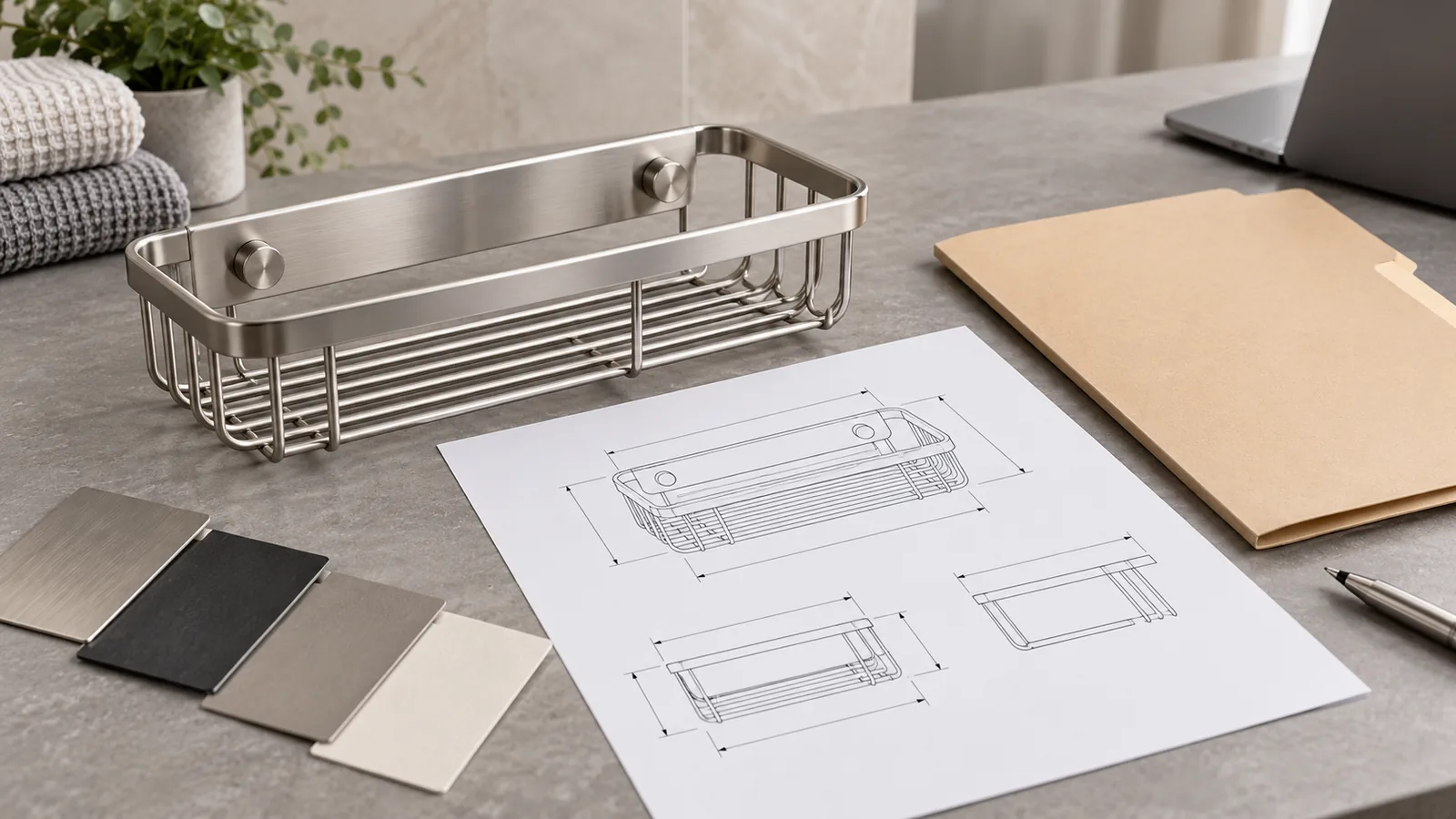
There is no single HS code bathroom accessories number that can safely be applied to every metal shelf, basket, hook or storage product. U.S. classification depends on the exact imported article and the applicable U.S. Harmonized Tariff Schedule (HTS). A manufacturer can provide the product facts it controls; the importer and its customs broker should evaluate the classification and current treatment, and the importer may consider asking U.S. Customs and Border Protection (CBP) for a binding ruling when appropriate.
This guide is a factory-to-broker information checklist. It does not assign a tariff number, determine origin, calculate duty or replace broker or CBP advice.
Is there one HTS number for bathroom accessories?
No. “Bathroom accessory” is a broad commercial description, not a complete classification analysis. A wire shower basket, a wall-mounted towel bar, a plastic soap dish and a metal storage shelf can differ in material, function, structure and imported configuration. Even products that share a retail category may need to be reviewed individually.
The international Harmonized System (HS) provides a common basis for the first six digits, while countries can add their own further digits and duty provisions. The U.S. HTS contains U.S. tariff categories and statistical reporting numbers. The USITC explains that a supplier’s tariff code may come from the exporting country and may not match the appropriate U.S. number. That is why the phrase “we already have the HS code” does not close the U.S. importer’s review.
If a team searches for “HS code bathroom accessories,” treat that phrase as the start of a product-specific inquiry. It does not identify one tariff line that applies to every item sold in a bathroom category.
The current USITC tariff-information page states that 2026 HTS Revision 21 was published October 9, 2026. The HTS can change, so buyers should check the current schedule and relevant notes when a classification decision is made and again when shipment planning requires it. The USITC’s classification FAQ explains that classification categories are defined by legal rules and notes; searching a familiar product name may not reveal how the tariff schedule describes the item.
A code lookup page or past entry can be a research lead, but it is not proof that another product has the same classification. A prior CBP CROSS ruling applies to the facts and product described in that ruling. A steel organizer rack or other storage item in CROSS should not be treated as the answer for a bathroom shelf merely because both products store household goods.
For the “HS code bathroom accessories” question, the next useful step is to replace the category label with a factual description of the exact SKU and shipment configuration.
Which product facts should the factory provide?
Ask the factory for a complete, SKU-specific description and documents that let the broker understand what will actually be imported. CBP’s importer guidance calls for a full product description and identifies details such as manufacturer, origin, composition and intended use. CBP also describes a precise commodity description as plain-language detail sufficient to identify the product’s size, shape and characteristics.
Use a product data sheet that distinguishes confirmed product facts from information the importer or broker must determine:
| Product field | What the manufacturer can document | Buyer or broker review |
|---|---|---|
| Exact product identity | SKU, model, drawing number, revision and sample reference | Confirm the documents match the invoice line and imported SKU |
| Function and intended use | What the product is designed to hold or support; how it is installed | Assess how function and use matter under applicable classification rules |
| Construction | Parts, joins, mounting method, assembly state and whether items ship together | Review the imported condition and whether components are treated as a set or separate goods |
| Materials | Material by component where known, such as wire, sheet, tube, plastic parts, pads or fasteners | Evaluate material information against applicable schedule language and rules |
| Dimensions and form | Overall dimensions, component sizes, drawing and photographs | Determine which characteristics are relevant and whether more evidence is needed |
| Finish and treatment | Buyer-approved finish description and any supported process detail | Avoid treating finish language as a classification conclusion |
| Included accessories | Screws, anchors, hooks, cups, pads, brackets or instruction parts actually packed | Match accessory description to the shipment configuration |
| Product variants | Differences among sizes, materials, finishes, mounting systems or pack configurations | Decide whether variants can share a review or require separate analysis |
| Manufacturer details | Legal manufacturer name and production location as recorded for the SKU | Confirm origin and other entry data separately; do not infer from a product drawing |
| Commercial image set | Front, side, back, installed, component and packaging photos | Check that the photos depict the exact version being imported |
Do not send only a marketing title such as “stainless bathroom shelf.” That description may omit whether the product is a wire basket or formed tray, whether it is wall-mounted or freestanding, what components are included, and how it is presented for import. The purpose of the data sheet is to make the physical article understandable, not to steer the broker toward a preferred answer.
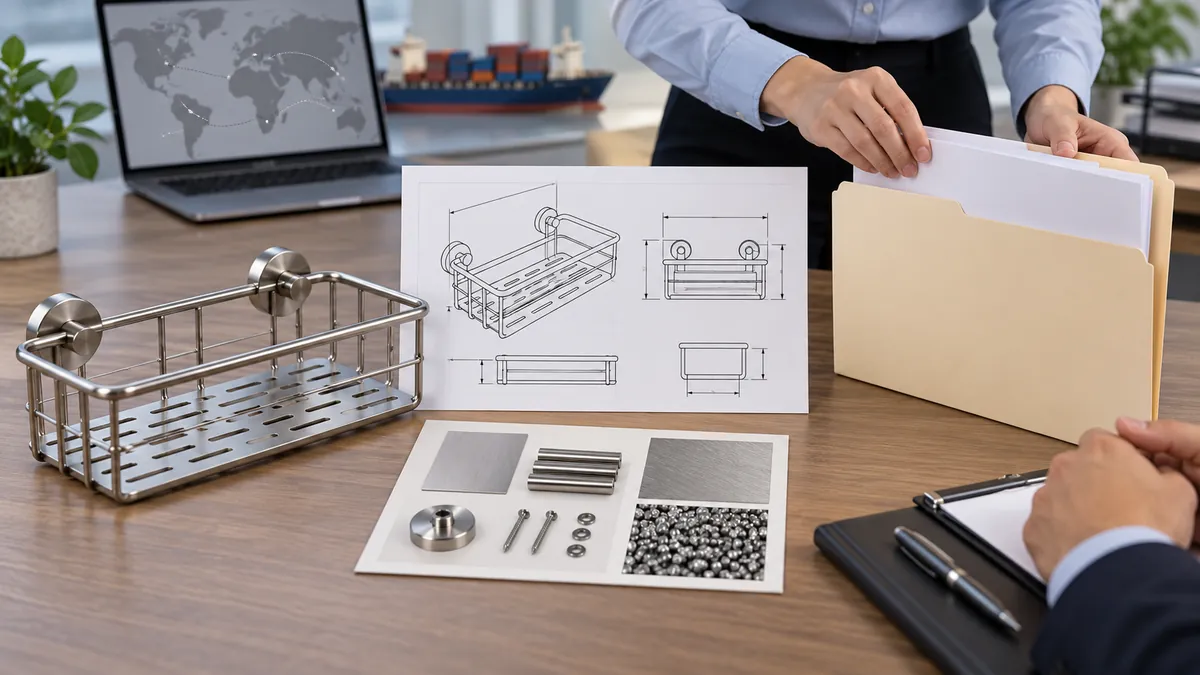
A manufacturer should not guess at missing data. If a material grade is not confirmed in the product record, label it as unconfirmed and request the relevant documentation rather than filling the gap from appearance. If a product is shipped in multiple configurations, attach a parts list or configuration table for each SKU. A drawing should identify the revision and match the production sample or commercial item that is actually being imported.
How should the importer package the broker handoff?
Use one folder or controlled record for each product family, with clear separation between SKUs and revisions. The importer should be able to trace every description, photograph and component list to the invoice line and order configuration under review.
A practical handoff can include:
- A plain-language product description that names the object, function and installation type.
- Product photographs from multiple angles, including the mounting side and parts supplied.
- A dimensioned drawing with the product identity and revision.
- A component list with material descriptions by part when those details are confirmed.
- A note stating whether the item is imported assembled, unassembled, with accessories, or in a combined retail package.
- Intended use and any important design function known to the manufacturer.
- Finish/process descriptions supported by the current product record.
- Manufacturer and production-location facts supplied for that SKU.
- Samples or additional technical documents if the broker or CBP requests them.
- A change log that identifies design, material, assembly or pack changes since the prior review.
Name files consistently, for example: SKU, document type, revision and date. Do not rely on a folder name alone; put the exact SKU and revision on the drawing or data sheet where feasible. If the invoice uses a commercial name while the factory drawing uses an internal model number, provide a mapping so the broker can see that both refer to the same good.
Separate a classification question from other import questions. Country-of-origin marking, customs value, additional duties, product compliance, packaging obligations and shipping descriptions may require their own facts and review. A tariff classification does not by itself resolve every import requirement.
A useful product-description pattern
Use a factual sentence structure and fill it only with confirmed details:
“[Product] is a [construction/material description] designed to [function], installed by [mounting method], and imported as [assembled or component configuration] with [included accessories]. The product is identified as [SKU/drawing revision].”
This is a completeness prompt, not a legal formula. Do not copy the sample sentence into an entry document with blanks, guesses or unverified material claims. The commercial invoice and customs filing must use the descriptions and data required for the actual transaction.
How can a buyer use the HTS and CROSS resources responsibly?
The USITC maintains the U.S. HTS and provides an official HTS search و guidance for finding an HTS number. Use product terms as one way to explore the schedule, then read the relevant heading text, subheading text, notes and applicable legal rules. A search result alone does not establish the correct classification.
CBP’s CROSS database can help identify prior rulings and the facts CBP discussed in comparable cases. Compare product construction and use carefully. A ruling concerning a floor-standing rack, wall fixture or organizer may differ materially from a bathroom accessory. Do not take a code from a look-alike result and paste it into a supplier file without review.
The buyer can give a broker a concise question: “Given these product facts and this shipment configuration, what U.S. HTS classification should we use, and what additional details do you need?” That keeps the manufacturer’s role clear: supply accurate product information and clarify gaps, while the importer and broker assess the classification and entry obligations.
The USITC maintains the schedule but states that it is not authorized to provide legally binding interpretations of how goods should be classified. Its public FAQ explains that CBP rulings and legal notes help define treatment. Therefore, the manufacturer-to-broker checklist should make evidence easier to review; it should not present a factory-assigned result as official.
When should an importer ask about a binding ruling?
Consider a CBP binding-ruling request when the classification question is material to a prospective import and the product facts are complete enough for review. CBP’s Binding Ruling Program describes pre-entry decisions and requests that include a detailed product description and, where required, a sample. The current eRulings portal provides the electronic submission route and related instructions.
Whether a ruling is suitable is a decision for the importer and its customs professional. A ruling request should describe the actual transaction and the exact good, supported by relevant photographs, drawings or a sample as applicable. A vague product name or a description that omits components may lead to follow-up questions. If the importer changes material, function, configuration or assembly after a ruling, it should ask the broker whether that change affects the ruling’s applicability.
Do not assume a ruling can be transferred to an unrelated product or treated as a guaranteed answer for goods that differ in a material respect. The importer should keep the ruling, product record and shipment SKU linked and follow the current CBP requirements for the request.
What can Koitor confirm, and what remains for the importer?
A factory can confirm product facts in its own records: the drawing revision, components, materials when verified, dimensions, construction, finish direction, accessories packed and production configuration. It can answer follow-up questions about what changed between samples or order revisions. The importer can then share those facts with its customs broker and ask what else is needed.
Koitor’s OEM home-storage page describes its custom metal hardware product-development context. This article does not represent Koitor as a customs broker or classification specialist, and it does not claim that Koitor has assigned a U.S. HTS code or obtained a CBP ruling for any product. Buyers should request product-specific facts and confirm any unverified item directly.

Before you send the file
- Confirm SKU, model, drawing revision and order configuration.
- Describe function, mounting and imported assembly state in plain language.
- List components and material descriptions only where confirmed.
- Include dimensions, product views, mounting details and relevant sample photos.
- Identify included accessories and packaging configuration.
- Flag unknowns and changes instead of filling them by assumption.
- Ask the broker to determine whether more evidence or a binding ruling request is appropriate.
- Check the current U.S. HTS and current CBP guidance for the transaction date.
Frequently asked importer questions
Can I use the HS code from my Chinese supplier?
Treat it as a starting reference only. It may reflect the export country’s tariff schedule and may not match the applicable U.S. HTS number. Give the code and the complete product file to your U.S. broker for review.
Does every metal bathroom accessory use the same HTS category?
No. “Bathroom accessory” and “metal rack” are broad commercial labels. The exact product, construction, function, materials and imported configuration need to be reviewed under the current schedule and applicable rules.
Should the supplier decide the U.S. classification?
The supplier should provide accurate product details it controls. The importer and its customs broker should assess the U.S. classification, with CBP ruling procedures available for appropriate prospective questions.
Is a past CBP ruling enough to classify a new product?
Not automatically. A prior ruling concerns the described facts and product. Compare construction, use, materials and configuration, and ask the broker whether the ruling is relevant to the current SKU.
Does the HTS code settle the total duty due?
No. Classification is only one part of import entry review. Origin, applicable trade measures, customs value and other transaction facts can also matter. Check current official guidance and consult the broker for the shipment.
اعمل مع شركة «كويتور» للأدوات
Need a Clear Product File for Broker Review?
For a Koitor hardware SKU, share the product reference and the product facts your broker requested. The factory can confirm the details recorded for its product; your importer and customs broker should assess U.S. tariff classification and entry treatment.
OEM / العلامة التجارية الخاصة
حوّل دليل التوريد هذا إلى موجز منتج
يرجى إطلاعنا على المنتج المستهدف، والحجم، والتشطيب، وكمية الطلب، ومتطلبات التغليف. وسيتلقى فريقك تقييمًا عمليًّا لإمكانية التصنيع قبل تقديم عرض الأسعار.
 English
 Español
 Português
 Français
 Deutsch
 العربية