
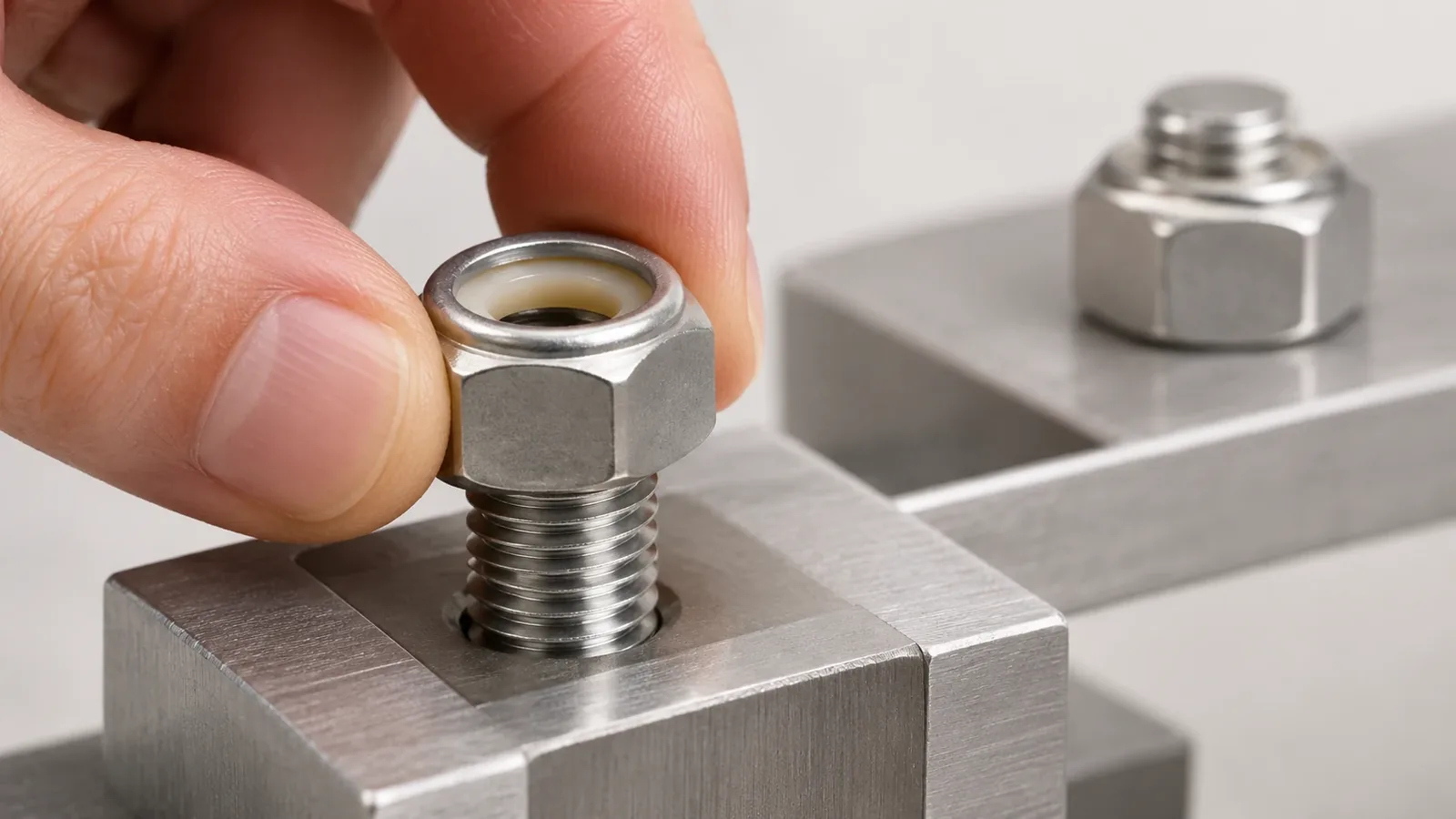
A prevailing torque nut is identified by resistance during threaded engagement before the nut is fully seated against the joint. That locking behavior can come from different constructions, including a deformed metal-thread region or a polymer insert. “Prevailing torque” describes the resistance behavior; “all-metal” describes construction. The categories therefore overlap but are not synonyms: a nylon-insert nut can also be a prevailing-torque design.
What Does Prevailing Torque Describe?
Prevailing torque refers to resistance encountered as a nut is turned on a mating thread before it reaches the final seated position. In a conventional free-running threaded engagement, the nut can turn along the thread without an intentional locking feature creating that same type of resistance. A prevailing-torque design introduces a feature or material interaction that creates friction or interference during engagement.
The term is about a behavior at the threaded interface, not one material or one external shape. A design might deform metal threads in a defined region, or use a polymer insert that interacts with the mating thread. The exact mechanism, dimensions, material, and installation method depend on the selected fastener and its maker’s documentation.
Earnest Machine’s explanation distinguishes the resistance during thread engagement from the final clamped joint and distinguishes prevailing-torque function from all-metal construction. Lok-Mor describes metal-thread deformation and polymer-insert mechanisms as different ways to create that behavior. The article uses those sources to explain the terminology; it does not establish universal resistance values, guaranteed vibration performance, temperature limits, reuse counts, or installation torque.
A useful mental model is to separate the nut’s movement into stages. First, the threads approach and begin to engage. Next, the locking feature begins to interact while the bearing face is still not seated. Finally, the nut’s bearing face meets the joint and the assembly proceeds under its approved tightening procedure. The second stage is the key to understanding prevailing resistance. It is not itself proof that the joint has reached an acceptable clamp load.
What Happens Before the Nut Is Fully Seated?
During early engagement, the nut turns onto the mating thread. When the threads reach the feature that creates the prevailing resistance, turning requires overcoming friction or interference before the nut’s bearing face contacts the joint. The nut then continues toward seating under the exact maker’s and assembly instructions.

The middle stage explains why a buyer or assembler should not treat turning resistance as equivalent to final tightening. Resistance may occur while a gap remains under the nut. The bearing face has not necessarily reached the intended joint surface, and the fastener has not thereby been shown to meet a specified assembly condition.
This sequence is a conceptual explanation, not a torque calculation or inspection test. It does not tell an assembler how much force to apply, how many turns are acceptable, or whether a particular fastener is reusable. Those are model-specific requirements, if the maker provides them. Use the exact installation instructions and engineering specification for the selected item.
A drawing or product description that says “prevailing torque” should therefore be paired with a complete part identity. The generic family name does not tell a buyer the thread, size, material, insert type, coating, mating screw, or assembly requirements. Two nuts can both create engagement resistance while differing in construction and approved applications.
Is a Prevailing Torque Nut Always All-Metal?
No. Prevailing torque is a functional description of resistance during thread engagement. All-metal is a construction description that says the nut does not use a nonmetallic insert in the locking feature. The two terms answer different questions.
An all-metal prevailing-torque nut may use a deformed thread region to create interference. A nylon-insert nut may use polymer contacting the mating thread and can also create prevailing torque. Thus “all-metal” does not mean “the only kind of prevailing torque,” and “prevailing torque” does not mean “all metal.” A buyer should state both dimensions when both matter: the intended locking behavior and the required construction.
| Description | What it identifies | What it does not establish by itself |
|---|---|---|
| Prevailing torque | Resistance during threaded engagement before final seating | Material, exact mechanism, torque value, or reuse count |
| All-metal | Construction without a polymer insert in the locking feature | That it is the only prevailing-torque type or universally suitable |
| Nylon insert | A polymer feature interacting with the thread | Exact performance, temperature range, or service-life guarantee |
| Locking nut | A broad functional family that requires a specific subtype | The selected mechanism or approved installation method |
A product catalog may use overlapping terms. Read the maker’s exact description and part number. If a buyer requires an all-metal construction, specify that explicitly instead of assuming a “prevailing torque nut” will satisfy it. If a polymer insert is allowed or required, state that separately and verify the target application’s conditions with the maker.
How Should Buyers Specify the Fastener?
Start with the joint and the exact fastener identity. The specification may need the thread, nominal size, pitch, nut form, material, finish, construction, mating component, and source-approved installation instruction. Not every project requires every field in the same format, but the buyer should avoid relying on a family name that leaves the actual part ambiguous.
If the assembly needs a particular prevailing-torque mechanism, describe it as a construction requirement and verify the supplier’s offered part. If the requirement concerns metal construction, name “all-metal” explicitly. If the buyer needs a polymer insert, name or approve that construction. The buyer’s design authority should determine which properties are critical; this guide does not recommend one type for every product.
A quote request should also identify whether the fastener is supplied loose, preassembled, packaged in a kit, or installed by the component supplier. The buyer should confirm part identification and traceability through the relevant records. A substitute may change more than the appearance: construction, matching thread, finish, installation instructions, and service-part identity all may need review.
For bathroom or home-storage hardware, a nut might be one part of a bracket, mounting kit, furniture connection, or other assembly. The example context does not imply that Koitor manufactures every type of lock nut or that any one nut construction is used in a particular current product. Confirm the actual bill of materials and project scope. If a separate supplier owns the fastener, use its technical data and instructions.
What Does Prevailing Resistance Not Prove?
Resistance felt while turning a nut does not by itself prove that the final joint is seated, tightened to the required condition, or resistant to a specified vibration environment. It does not establish a clamp force, a torque value, a material grade, a temperature range, or a reusable number of cycles. Those conclusions need evidence for the exact fastener and assembly.
Likewise, the presence of a polymer insert does not automatically make a nut unsuitable or suitable for a given application. The material’s limits depend on its exact formulation and product. An all-metal construction may be relevant for a project requirement, but the label alone does not prove superiority or guarantee performance.
The research sources differ in some broad statements about use or reuse. The permitted article therefore avoids a universal reuse rule. Follow the maker’s instructions and the applicable assembly specification. If the exact product documentation does not cover a question, ask the fastener supplier rather than inferring an answer from a generic category.
Buyers should also separate the locking feature from other joint elements. A washer, threadlocker, joint material, mating surface, and tightening process can affect the assembly. The general term “lock nut” does not make those other components unnecessary, nor does this article state that one locking method can replace another. The existing lock washer versus lock nut guide covers that comparison as a separate topic.
How Can a Buyer Read a Sample or Assembly Sequence?
If a sample review is authorized, identify the exact nut and mating thread first. A representative hand check can help confirm that the sample corresponds to the intended assembly instruction, but it is not a standardized performance test unless a defined method and acceptance criteria exist. Do not use an unmeasured hand-feel judgment to invent an acceptable torque range.
A conceptual observation sequence might record:
- Fastener and mating-thread identity before assembly.
- Point at which the locking feature begins to engage.
- Whether the nut’s bearing face is still visibly separated from the joint at that point.
- The maker-directed transition toward final seating.
- The final assembly method and any required record specified by the project.
This is a way to understand the stages, not a process instruction to use instead of the manufacturer’s procedure. If the nut binds before the expected point, the thread identity, condition, alignment, or part may need investigation. Stop and consult the responsible supplier rather than forcing the fastener or adding an unapproved lubricant.
A buyer can request the supplier’s technical drawing, exact part number, construction description, and installation guidance. Keep those records attached to the product revision and bill of materials. If a future replacement is sourced from another supplier, compare the actual construction and instructions instead of matching only the external shape.
The existing nut types guide covers broader nut classifications. If the question is whether an installed locking nut can be reused in knock-down furniture, refer to the separate lock-nut reuse guide. This article does not replace either topic or settle a project-specific reuse decision.
How Does the Term Relate to a Lock Nut?
A prevailing-torque nut can be part of a broad locking-nut category, but the words should not be used as if they specify the same details. “Lock nut” is often used broadly for a nut intended to resist loosening by a feature or method. “Prevailing torque” more specifically describes resistance during threaded engagement before the joint is fully seated.
The exact product’s description determines which construction is present. Some catalog pages may use the terms together; others may describe a specific subtype. Check whether the supplier’s phrase is an umbrella label or a defined product name. If the purchase order requires a certain mechanism, a broad “lock nut” description may be insufficient.
The term also should not be confused with the final torque applied to tighten the joint. A nut name containing “torque” does not supply the assembly torque value. The installation value, if any, must come from the applicable joint design, fastener maker, and controlled work instruction. Do not copy a torque value from another fastener or infer one from the name.
What Common Purchasing Errors Should Buyers Avoid?
Treating prevailing torque and all-metal as synonyms. One describes behavior; the other describes construction.
Assuming every prevailing-torque nut uses deformed metal threads. A polymer insert can also create the relevant engagement resistance.
Equating hand-turn resistance with final clamp condition. The locking feature can engage before the bearing face seats.
Inferring a torque setting from the product name. The term does not provide a universal installation value.
Assuming all-metal is always better. Suitability depends on the exact requirement and maker’s data; no universal ranking is supported here.
Assuming a nylon insert has one universal temperature limit. The insert material and fastener product determine the applicable information.
Claiming vibration performance from the category alone. The cited definitions do not guarantee performance in every assembly.
Applying a reuse rule to all products. Follow the exact fastener maker and project instructions.
Substituting a catalog item based only on its external shape. Verify thread, size, construction, finish, mating part, and instructions.
Forcing a nut that binds unexpectedly. Stop, inspect the part identity, and seek supplier guidance rather than changing the process.
How Should Buyers Compare Two Nut Descriptions?
When two supplier descriptions use different wording, compare the actual product records instead of ranking the labels. One offer may say “all-metal lock nut,” while another says “prevailing-torque nut.” The first phrase identifies a construction family but may not fully describe its mechanism; the second identifies a behavior but may not tell the buyer whether a polymer insert is present. Ask each supplier to state the construction and how its product generates the specified engagement behavior.
A useful comparison has separate fields for thread and size, body form, locking feature, material, coating, mating fastener, and maker’s installation instructions. If the requirement prohibits a polymer insert, state that restriction. If the requirement calls for a specific insert type, name it and ask for the source documentation. If no construction preference exists, the design owner should determine which characteristics matter before the buyer selects a quote.
Do not compare friction values unless each supplier provides comparable data for the exact product, test method, thread condition, and measurement stage. The sources reviewed for this article establish the terminology and mechanisms but do not provide a universal numeric acceptance table. A catalog adjective is not a data point, and two products with the same family name are not thereby proven equivalent. Keep any supplier-specific measurements tied to their stated method and application.
A substitution review should also preserve the joint context. Confirm that the mating thread, bearing face, materials, finish, assembly procedure, and service documentation remain suitable. If the nut is part of a kit, update the kit identification and replacement instructions. The buyer should retain the approved sample or traceable part reference where the project process calls for it.
How Should the Approved Part Be Kept Traceable?
Keep the chosen nut identity attached to the controlled bill of materials, drawing revision, incoming description, and assembly instruction. If a product uses multiple nut sizes or styles, identify each by its actual location and part reference rather than a shared shorthand. This reduces the chance that a visually similar replacement enters the wrong kit. For changes, record who approved the substitution, which lot or revision it affects, and whether the mating screw or installation document also changed. Traceability clarifies which instructions apply; it does not prove performance beyond the supporting product data.
When a supplier changes a part number, verify whether the locking feature or material changed, even if the new item retains the same broad catalog family. Record the answer with the revised quote and approval.
How Should the Assembly Record Identify the Locking Feature?
The assembly record should name the exact fastener and the instruction that governs installation. If the design requires an all-metal feature, say so; if it allows a polymer insert, make that allowance explicit and tie it to the maker’s part data. Keep the thread, mating screw, nut part number, material, and finish in their respective fields so that a future replacement is not selected only by a broad “lock nut” label.
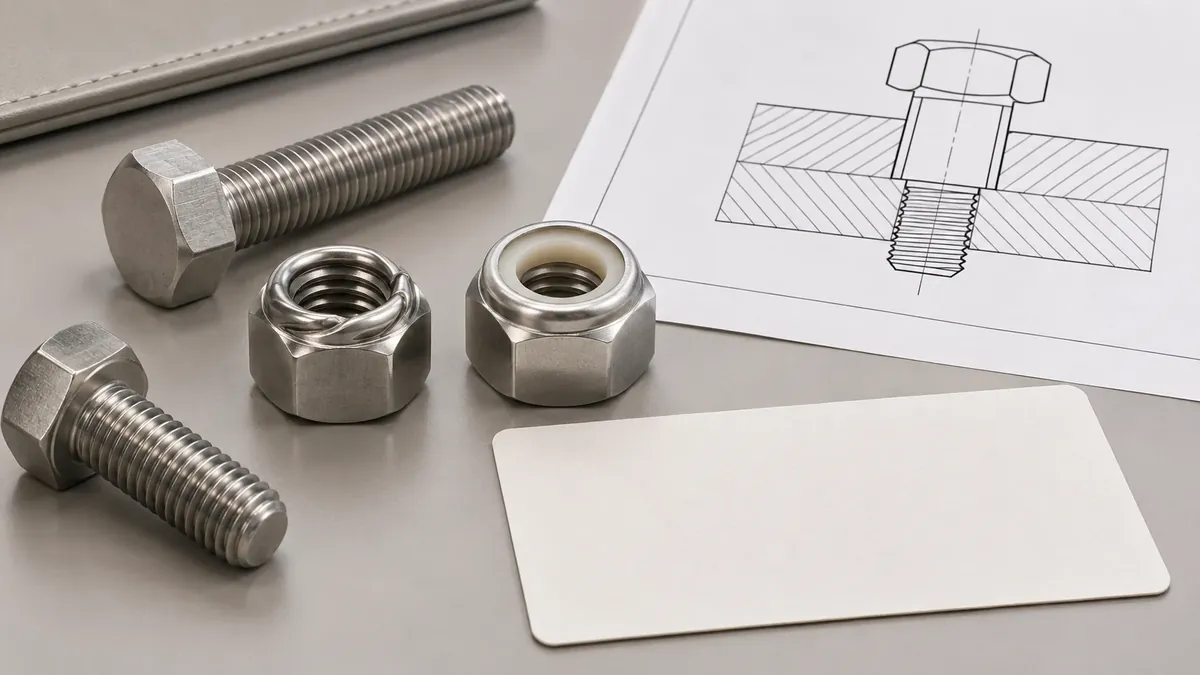
For a multi-component kit, note which nut is used at each joint and whether a special assembly sequence is supplied. A generic image of a nut or the visible outer profile may not reveal whether the locking feature is a deformed region or an insert. If the buyer’s requirement depends on that construction, request a drawing, product description, or sample confirmation from the fastener supplier.
When troubleshooting, separate a nut that creates resistance during engagement from a joint that has reached its specified final condition. If a fastener stops unexpectedly or does not seat as intended, preserve the part identity and consult the approved instruction. Do not increase tightening force, add an unapproved compound, or substitute another nut based on hand feel. The exact joint design and supplier instructions decide the permitted next step.
What Should a Buyer Ask When Catalog Terms Conflict?
If one supplier calls a part a prevailing-torque nut and another calls a similar item an all-metal lock nut, ask each supplier to identify the locking feature and material construction separately. Request the part number, drawing or technical description, mating thread, and installation instruction. If the buyer’s requirement is silent on polymer inserts or another construction detail, send the question to the design owner before selecting the lower-priced line. The catalog wording may describe an umbrella function, a specific subtype, or a brand’s own naming convention.
Keep supplier statements source-specific. A claim that one construction is suitable for a given temperature, vibration environment, or reuse condition should be tied to that exact product and application evidence. The terminology article alone cannot resolve those limits. Where the data are missing, record them as unconfirmed rather than generalizing from a broad nut family.
Buyer Checklist Before Approving a Nut Specification
- Is the exact part number and thread identity known?
- Does the requirement state prevailing-torque behavior, all-metal construction, polymer insert, or another specific feature?
- Is “lock nut” being used as a broad family term or a specific maker product name?
- Is the mating fastener identified and compatible according to the responsible supplier?
- Are material and finish requirements stated separately?
- Does the assembly instruction cover the exact nut and joint?
- Are torque, clamp, temperature, vibration, and reuse claims backed by model-specific evidence?
- Is any sample observation kept separate from a formal test result?
- Is the bill of materials linked to the approved drawing revision?
- Are proposed substitutions reviewed rather than accepted by appearance alone?
If any property is not specified or documented, keep it open and ask the fastener maker or design owner. Do not substitute a generic family label for an exact requirement or turn a conceptual mechanism explanation into an installation procedure.
الأسئلة الشائعة
What is a prevailing-torque nut?
It is a nut that creates resistance during threaded engagement before it is fully seated. The mechanism and exact specifications vary by product.
Is every prevailing-torque nut all-metal?
No. A polymer insert can also create prevailing resistance. All-metal identifies construction, while prevailing torque describes a behavior.
Does thread resistance prove the joint is tight?
No. The resistance can occur before the nut’s bearing face reaches the joint. Follow the exact maker’s installation instruction.
Does prevailing torque tell me the installation torque?
No. It is not a universal tightening value. Use the applicable fastener and assembly documentation.
Can a prevailing-torque nut be reused?
This article does not give a universal reuse rule. Check the exact product documentation and project instruction.
المصادر
- Earnest Machine: Prevailing Torque vs All-Metal Lock Nuts
- Lok-Mor: What Are Prevailing Torque Locknuts and How Are They Used?
- Koitor: Nut Types for Hardware
اعمل مع شركة «كويتور» للأدوات
Discuss a Custom Metal Hardware Assembly
Share the drawing, fastener interface, approved component identity, finish, packaging scope and target quantity. Koitor Hardware can review the defined metal hardware request; fastener construction and installation requirements should be confirmed with the responsible component maker.
OEM / العلامة التجارية الخاصة
حوّل دليل التوريد هذا إلى موجز منتج
يرجى إطلاعنا على المنتج المستهدف، والحجم، والتشطيب، وكمية الطلب، ومتطلبات التغليف. وسيتلقى فريقك تقييمًا عمليًّا لإمكانية التصنيع قبل تقديم عرض الأسعار.


 English
 Español
 Português
 Français
 Deutsch
 العربية