
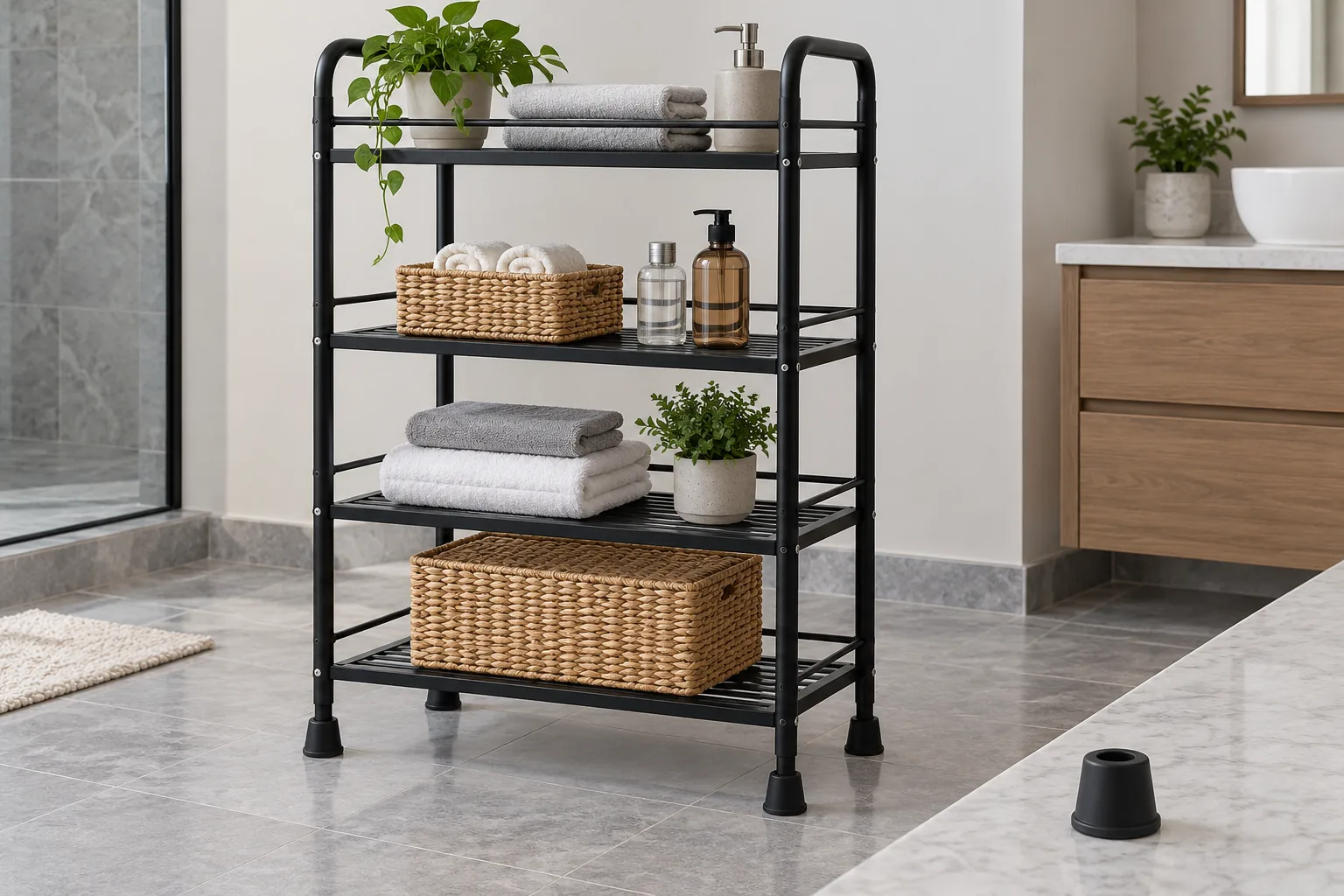
When a storage rack or bathroom accessory uses bought-in rubber feet, a buyer may need to compare supplier evidence for repeated rubbing against a floor, shelf, or other contact surface. The rubber abrasion resistance wear protective feet question is not answered by a hardness number or one laboratory result alone. Buyers should identify the wear mode, material and specimen, test conditions, and actual product interface, then decide whether a standardized rubber test is suitable for screening or whether a product-representative evaluation is also needed.
This is a sourcing guide for purchased protective feet and pads used with metal hardware. It does not imply that Koitor formulates rubber, molds elastomers, owns an abrasion tester, or guarantees any service life. The buyer’s goal is to make supplier evidence comparable and relevant to the intended product—not to turn a material test into an unsupported promise about years of use.
What is abrasion resistance, and how is it different from other rubber properties?
Abrasion is material loss or surface damage caused by rubbing contact. A rubber foot may encounter abrasion as a rack is moved, dragged, repositioned, cleaned, or exposed to grit. The real wear depends on more than the compound: the counterface, contact pressure, motion, contamination, temperature, geometry, and use frequency can all matter. A small foot sliding over a rough tile under one loading condition is not the same as a rubber specimen run against a standardized abrasive surface.
Abrasion is different from tear strength, tensile strength, hardness, compression set, and friction. Tear evidence concerns crack propagation from a cut or edge. Tensile data describe material response under a pulling test. Shore hardness is a local indentation measure under a specified procedure. Compression set concerns deformation remaining after a compressive exposure and recovery. Friction relates to resistance to relative motion at a particular interface and condition. These properties may all influence a foot’s performance, but they do not substitute for one another.
Koitor already has related buyer guides on rubber pad hardness و compression set for mounting pads. Those topics answer different questions from repeated material wear. A buyer who sees a foot thinning or polishing should not assume hardness or compression set alone explains the condition; likewise, a good abrasion value does not prove that a pad will grip a wet surface or remain securely attached.
What do common rubber abrasion tests tell a buyer?
The test method matters because laboratory abrasion procedures use specified specimens and abrasive conditions. ISO 4649:2024 describes rotating-drum methods for determining abrasion resistance of vulcanized or thermoplastic rubber and reports outcomes such as relative volume loss or an abrasion-resistance index. ASTM D5963 describes a rotating-drum abrader method for rubber exposed to abrasive or frictional wear. The specific edition and procedure should be confirmed in the buyer’s contract; search snippets and method summaries are not the complete standards.
These methods can help compare materials under an agreed laboratory condition. They do not automatically recreate the geometry and contact of a finished rubber foot. ISO’s guidance in ISO 23794:2023 addresses choosing methods and conditions for products subject to abrasion and discusses the relationship between lab and product performance. A test report should therefore be treated as material evidence for a defined condition, not as a direct service-life forecast.
| Evidence type | Useful buyer question | Boundary to keep clear |
|---|---|---|
| Rotating-drum material test | How did identified rubber specimens perform under this specified abrasive method? | Does not by itself reproduce the finished foot, surface, or movement pattern. |
| Material supplier data sheet | Is this a candidate material for initial screening? | May be typical or reference data rather than lot-specific evidence. |
| Production-foot sample | Does the supplied geometry fit the rack and contact surface as intended? | A small sample test may not represent all floors, contaminants, or years of service. |
| Product-representative wear trial | How does the actual assembly respond under agreed contact and movement conditions? | The result applies only to the documented test conditions and acceptance rule. |
| Visual incoming inspection | Are feet present, correctly formed, and free from obvious damage? | Does not measure wear resistance or prove compound identity. |
The useful conclusion is conditional: if the supplier proposes a standard abrasion test, the buyer can use it to compare specimens prepared and tested the same way. A separate functional evaluation may be needed if the concern is a specific finished-product behavior such as visible wear, loss of floor protection, debris, a sharp exposed metal edge, or a pad that no longer stays in place.
How should buyers compare supplier reports?
Begin with identification. Record the part number and revision, supplier, declared rubber or thermoplastic material, compound designation if supplied, color, lot or production date, and the source of the specimen. Establish whether the report used a production foot, a separately molded test piece, or another standardized specimen. If the report cannot be tied to the bought-in component or its stated material, mark the relationship as unconfirmed.
For a rubber abrasion resistance wear protective feet decision, source identity is as important as the test number: a technically sound report for a different compound or specimen may not represent the item being quoted.
Then align the test. Ask the supplier to provide the method and edition, specimen condition, abrasive specification, test setup, conditioning, result units and calculation basis, number of replicates, individual results or spread, and the sample or lot identifier. Some details depend on the standard and agreement. The buyer should not reconstruct missing test conditions from a headline value or assume that two values from different laboratories are interchangeable.
For a second source, request testing under the same agreed method and conditions where practical. If one supplier provides ISO 4649 and another provides ASTM D5963, do not assume a direct numerical conversion just because both concern rubber abrasion and rotating drums. Ask a qualified laboratory or materials engineer whether the procedures and reporting basis are comparable for the actual decision. If the goal is only preliminary screening, keep that limitation in the comparison record.
| Report field | What to align | Why the buyer needs it |
|---|---|---|
| Part and material identity | Foot drawing, revision, material/compound declaration, lot | Connects the test to the offered component and source. |
| Method and edition | Exact standard designation and edition | Prevents unlike procedures from appearing directly comparable. |
| Specimen source | Production foot, molded plaque, or standard specimen | Processing and geometry can differ from the finished component. |
| Abrasive and setup | Method-required abrasive and test arrangement | Abrasive condition influences the result. |
| Conditioning | Environmental and pre-test conditioning details required by the method | Helps interpret differences between reports. |
| Result basis | Units, normalization, calculation, individual values and average | Avoids mixing volume loss, index, and other reporting bases. |
| Traceability | Lab/report, supplier, sample ID and production lot | Supports a purchase decision and future change review. |
| Disposition | Screening, qualification, or agreed acceptance purpose | Clarifies what the evidence is authorized to prove. |
If a report omits a key field, ask for the missing information before accepting a comparison. Where the supplier cannot provide it, record the gap and decide whether a new test or a product-level sample review is proportionate. A missing report detail is not proof that the material failed; it means the buyer cannot yet interpret the data confidently.
When should a buyer add a product-representative trial?
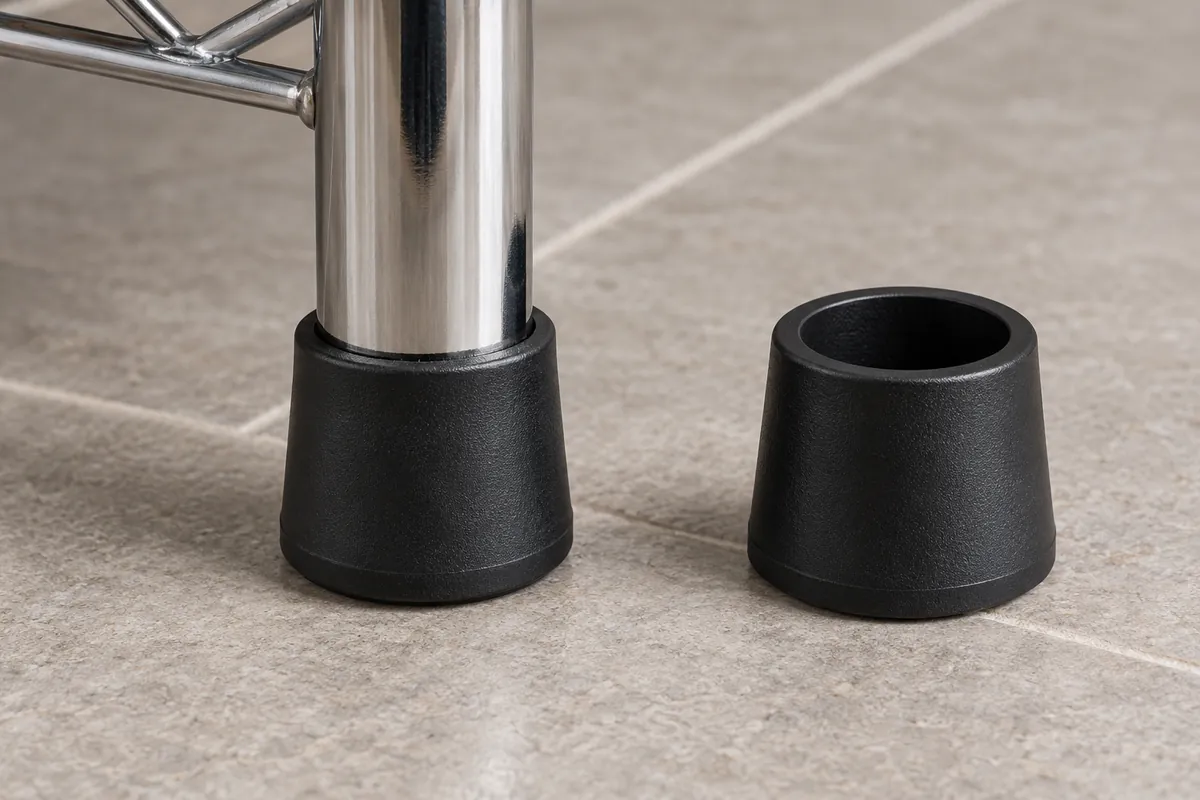
Use the actual hardware and foot geometry when the buyer’s risk depends on an interface that a standard material test does not reproduce. Examples include a foot that slides while carrying a rack, a contact point that wears against a specific surface texture, a protective pad that may rotate or detach, or a rack whose feet see water, detergent residue, grit, or repeated cleaning. These are test-design prompts, not claims that any particular Koitor product has experienced those failures.
Before a trial, define the contact surface, load range if relevant, movement type, distance or cycle plan, wet/dry condition if applicable, inspection intervals, and the criteria for visible damage or functional change. Use the same setup for the approved reference and alternate candidate. If the buyer cannot define a reliable numerical limit, begin with documented comparison and a review decision rather than inventing a universal abrasion target.
The sample should represent the offered component. Check fit on the actual metal leg or support, installation method, surface contact area, and any adhesive or retention feature. Record the rack and foot revisions together. A test using a different foot size, hardness, compound, or counterface should not be merged into the same comparison without explaining the change.
If the risk is mainly a cosmetic scuff during shipment, packaging and handling trials may be more relevant than an abrasion method. If the concern is floor marking or slip, use a separate assessment appropriate to that interface. If the pad compresses and fails to recover, consider whether compression-set evidence is more relevant. A practical quality plan may contain several checks, but each should have a named question and evidence source.
What should go into the RFQ or quality agreement?
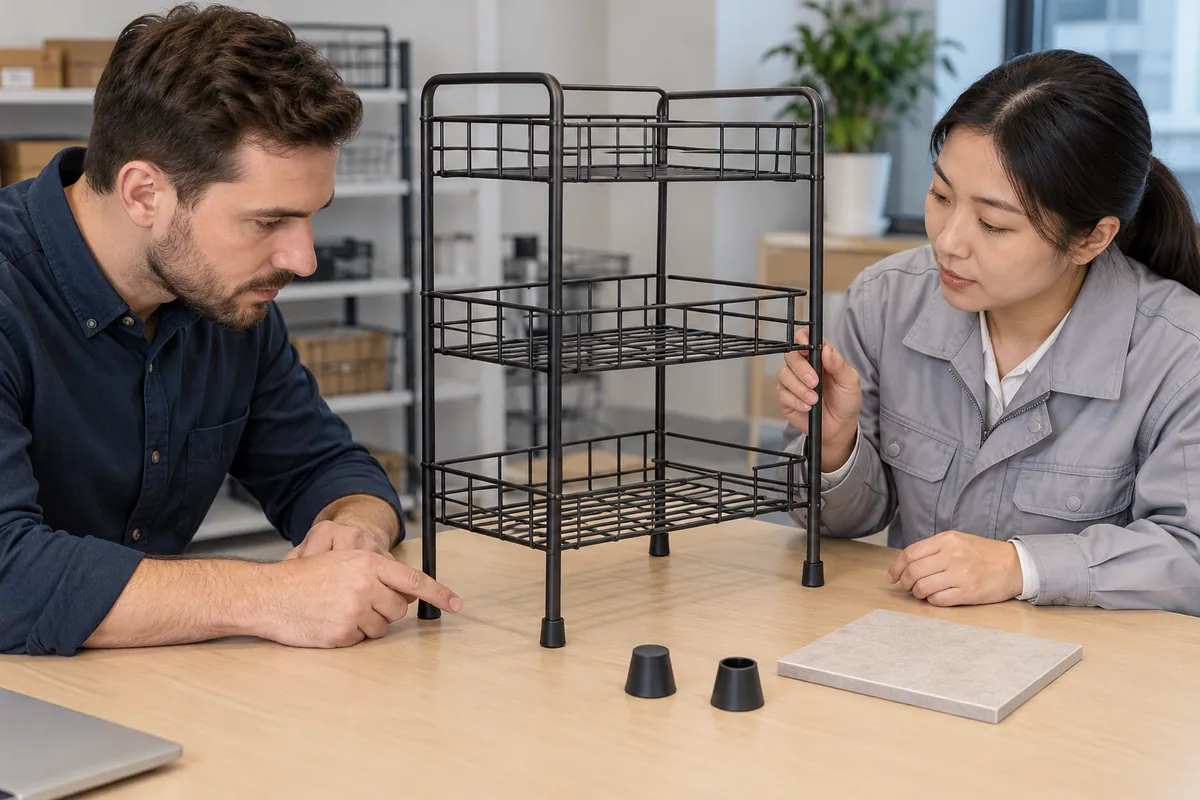
The buyer can state the component’s function, target metal-part interface, expected contact surfaces, whether the part is a protective foot or load-bearing interface, and the evidence needed for qualification. Specify the material requirement only as far as the project supports it; do not assume a particular rubber family or hardness is universally best. Ask the supplier to declare the compound or material grade and identify which source report represents the offered part.
If a standardized abrasion report is required, name the method and edition or ask the supplier to propose one for approval before testing. Define whether the report is for screening or acceptance, how samples will be selected, how many parts or specimens are needed, and what happens if results vary. For product-representative testing, identify the sample assembly and surface, loading and movement conditions, inspection points, and disposition rules. Have the relevant engineering or quality owner approve criteria before suppliers quote against them.
Change control is important. A rubber-foot change can involve geometry, compound, color, mold, supplier, cure, or attachment method. Not every change means the full test plan must be repeated, but the buyer should require notification and an impact assessment against the approved part. When a change could affect wear or retention, ask for a side-by-side sample or targeted evidence before production release.
| RFQ item | Recommended instruction |
|---|---|
| Intended function | Describe what the foot protects, supports, or contacts. |
| Product interface | Attach the mating metal-part drawing and approved sample reference. |
| Declared material | Require the supplier to identify the offered compound or material without implying an unverified grade. |
| Test evidence | Name the method or require a proposal with justification and buyer approval. |
| Sample condition | State whether evidence comes from standard specimens or production-intent feet. |
| Acceptance basis | Define the decision rule before testing; do not retrofit a threshold after seeing results. |
| Traceability | Record lot, revision, supplier, report ID, and sample identity. |
| Change notification | Identify changes that require buyer review or updated evidence. |
For a metal hardware factory that assembles purchased elastomer parts, responsibilities should be explicit. The component supplier can provide material declarations and relevant test reports; the metal OEM can review assembly fit and sample integration within its confirmed scope; the buyer owns the product requirement and acceptance decision unless the contract assigns it differently. Koitor can discuss drawing, sample, and assembly interfaces for bathroom and home-storage hardware without claiming rubber compounding or laboratory testing. Contact the OEM hardware team or send a project inquiry.
What can make abrasion results misleading?
Treating volume loss as service life. A laboratory abrasion result does not tell a buyer how many months or years a foot will last. Service depends on real contact, use, environment, and geometry.
Comparing different procedures as if they share one scale. Confirm standard, edition, specimen, abrasive, conditioning, and reporting basis before comparing.
Ignoring the specimen source. A standard specimen or plaque may not reproduce the foot’s molding history, thin sections, edges, or surface finish.
Assuming hardness predicts wear. Hardness may be a useful incoming specification, but it is not a direct replacement for abrasion evidence or product-level assessment.
Testing the wrong failure mode. A foot that tears at an edge, detaches, compresses permanently, or slips may require a different investigation. Abrasion results do not diagnose those issues by themselves.
Setting a limit after seeing the data. Select the method and acceptance rule before testing. Otherwise, a buyer risks choosing a threshold that only rationalizes one supplier’s result rather than defining performance need.
A practical decision path for buyers
- Identify the protective foot, material source, function, and expected contact.
- Decide whether the concern is wear, tear, hardness, compression, friction, fit, or attachment.
- Review the exact abrasion method, specimen source, conditioning, and reporting basis.
- Compare suppliers only when the test conditions are compatible; otherwise mark data non-comparable.
- Add a product-representative trial if geometry or use conditions drive the risk.
- Agree on acceptance, traceability, sample retention, and change-control before release.
A buyer can share the hardware drawing, foot sample, known material declaration, and observed concern to shape a proportionate qualification plan with the responsible suppliers. The rubber abrasion resistance wear protective feet evaluation should leave a clear record of what was tested, what remains uncertain, and who owns the next approval decision. Koitor is a family-owned custom metal hardware factory focused on metal storage products; any bought-in elastomer material or testing capability must be confirmed with the relevant component supplier for each project.
Buyer checklist for protective-foot wear evidence
- Is the concern actually abrasion rather than tear, compression set, hardness, friction, or detachment?
- Is the report for the offered compound and a traceable component or specimen?
- Are the standard, edition, specimen, abrasive, conditioning, and reporting units stated?
- Are supplier results based on the same test conditions before ranking sources?
- Is a lab material test enough, or does the product interface need its own comparison?
- Are load, counterface, movement, and wet/dry conditions relevant to the buyer’s risk documented?
- Has the acceptance rule been agreed before testing?
- Are the approved part, lot, and change-control conditions recorded?
Does a lower abrasion volume loss guarantee a longer-lasting rubber foot?
No. It describes a result under a specified laboratory method. It does not guarantee a particular service life or reproduce every finished-product contact condition.
Can Shore hardness be used instead of an abrasion test?
Not as a direct substitute. Hardness and abrasion are different properties. A buyer should specify each only when it answers a defined product or sourcing requirement.
Should buyers use ISO 4649 or ASTM D5963?
Choose a method with the supplier or qualified test provider based on the material, intended comparison, and contract requirement. Do not assume that reports from different procedures can be directly converted.
Does a material report prove the installed foot will stay attached?
No. Retention and fit depend on geometry, attachment, assembly, and use. Review the production-intent interface separately when it is a buyer requirement.
Review Your Hardware Drawing and Protective-Foot Sample
Share the rack drawing, foot sample, known material declaration, and observed wear concern. Our family-owned factory can discuss metal-part interfaces and OEM assembly options within a confirmed project scope.
OEM / العلامة التجارية الخاصة
حوّل دليل التوريد هذا إلى موجز منتج
يرجى إطلاعنا على المنتج المستهدف، والحجم، والتشطيب، وكمية الطلب، ومتطلبات التغليف. وسيتلقى فريقك تقييمًا عمليًّا لإمكانية التصنيع قبل تقديم عرض الأسعار.
 English
  Español
  Português
  Français
  Deutsch
  العربية