

Shared mounting plate bathroom accessories can make a coordinated collection easier to manage when buyers need compatible replacement parts, a consistent installation interface, or a defined way to change accessory styles. They are not automatically the best choice for every SKU. A common plate should be approved only after each accessory fits it, covers the intended wall area, retains its intended assembly and finish, and passes the buyer’s product-specific verification. The decision is about a controlled interface within a named product family, not a universal bathroom hardware standard.
Should bathroom accessory collections share a mounting plate?
The short answer is: consider a shared plate when cross-SKU interchangeability or a common service part is a real buyer requirement, and retain product-specific interfaces when shared geometry would compromise fit, function, appearance, or revision control. The word “shared” needs a precise definition before a supplier develops samples. It may refer to the concealed plate alone, the wall-hole pattern, the cover footprint, the screw or locking detail, the complete mounting kit, or all of these items together.
Those are different levels of compatibility. Two models might use the same backplate but have different covers. They might share a screw pattern but require model-specific plates. Or an entire collection might use one interface that allows one accessory body to be replaced with another. Buyers should state which level they intend to standardize and what may remain unique.
Manufacturers show that a common interface is one possible collection architecture. Croydex describes an “x” plate as universal across its Flexi-Fix collection and says the system is intended to support swapping accessories within that collection. The statement applies to Croydex’s own named system; it does not establish compatibility with another brand or product family. A 2019–2020 Weslock bath-accessory catalog also describes a shared plate for interchangeability in its 9000 series. These are examples of manufacturer-specific decisions, not evidence that every accessory can use one plate.
When buyers compare shared mounting plate bathroom accessories, the first question is which components the supplier actually treats as common—not whether the products share a collection name or finish.
What exactly should a buyer mean by a shared interface?
Define compatibility as a set of controlled features rather than a broad promise. For each SKU, identify which interface features are common and which are model-specific. A supplier drawing should use the same names and revision references that appear in the sample and parts list.
| Interface level | What may be common | What the buyer should still check |
|---|---|---|
| Wall-hole pattern | Locations or usable adjustment range shown on the approved drawing | Whether the complete fixing arrangement and cover fit the intended SKU and project condition |
| Backplate | Plate outline, thickness, openings, or locating features | Whether each accessory body mates correctly and the approved assembly is retained |
| Cover footprint | Visible footprint or coverage around the installed plate | Whether the cover conceals the planned interface without colliding with the accessory body or adjacent surfaces |
| Locking or retention detail | The named joining feature between accessory body and plate | Whether each model and revision uses the same confirmed parts and assembly method |
| Complete kit | Plate, screws, spacers, cover, and other included parts | Whether the kit list, labels, instructions, and replacement mapping match each SKU |
Do not infer interchangeability from a matching product family name, finish name, or similar appearance. Confirm it in controlled drawings and representative samples. If the claim is “the accessory body can be exchanged while the wall plate remains installed,” test and document that exact operation for the applicable models and revisions. If the intended claim is only that several products use a similar plate design, do not market it as a direct swap system.
Which buyer benefits are real, and which are assumptions?
A shared mounting plate may reduce the number of unique interface parts a buyer has to identify, quote, approve, stock, or map to replacement models. It can also make a collection’s interface documentation more consistent. Whether those outcomes matter depends on the assortment, replacement plan, order pattern, and service model. A common plate alone does not guarantee lower cost, shorter lead time, simpler installation, fewer defects, or compatibility with products outside the collection.
The buyer should compare the full system, not just count plates. A common component may require a larger or more complex plate, additional adapters, model-specific covers, extra assembly checks, or a wider package. Those possible effects need to be assessed against the actual drawings and supplier quotation. The supplier should distinguish confirmed shared parts from parts that remain unique; the buyer should not translate a design concept into a cost-saving claim without a comparable commercial scope.
| Buyer objective | Shared interface may help when… | A unique or family-specific interface may be better when… |
|---|---|---|
| Replacement planning | The buyer has defined which products should accept the same replacement component | A model, revision, or product body has a distinct fit that cannot be covered by the shared part |
| SKU management | The common part has clear identifiers and the spare-part map remains unambiguous | Common labeling would create confusion about which bodies and revisions are compatible |
| Collection appearance | The plate and cover remain concealed or visually consistent across intended SKUs | Different product shapes need different coverage, proportions, or visible geometry |
| Product development | A common interface reduces avoidable variation without limiting approved designs | The shared part forces compromises to the body, joint, finish, or installation envelope |
| Commercial comparison | Quotations clearly list common and unique parts on the same scope | A “shared plate” headline hides added adapters, assembly, packaging, or exceptions |
There is also a middle option: define a small number of interface families instead of one plate for every model or one unique plate for every SKU. For example, the buyer may group accessories that share a similar body-to-wall connection, while allowing products with different geometry or service needs to use a separate family. That is a proposed assortment method, not a proven cost formula. It should be selected from the buyer’s product schedule and evidence from samples.
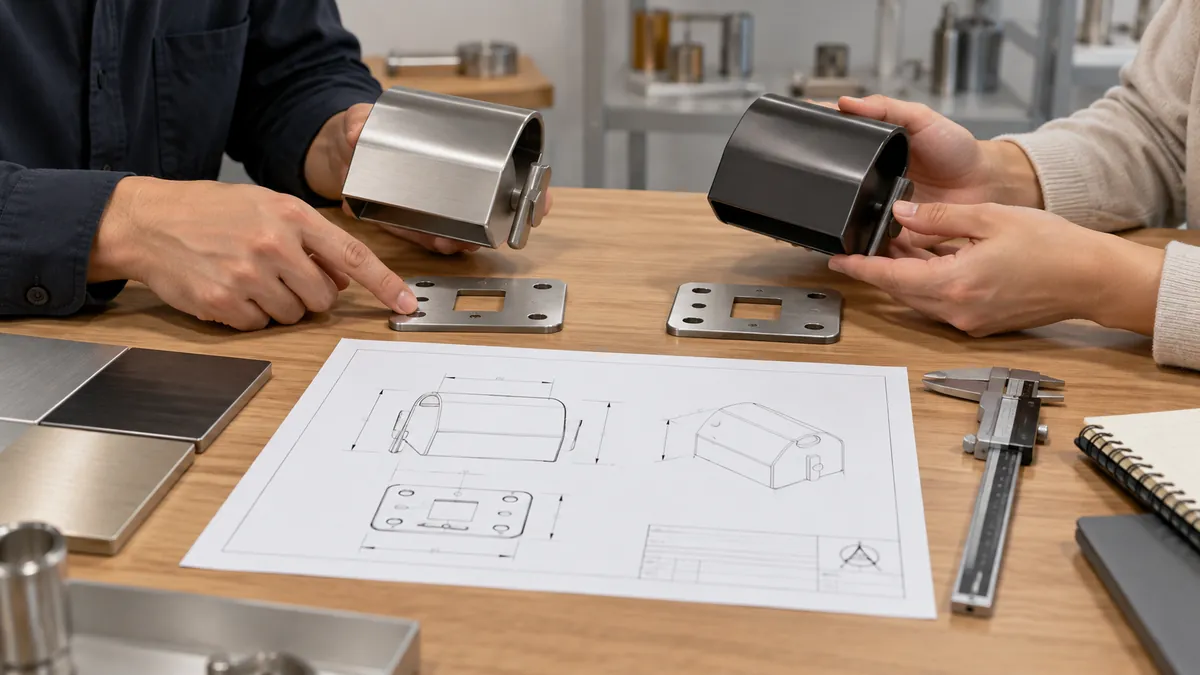
What must product engineering verify before a plate is reused?
Every intended SKU must be checked as its own assembly. A match at one point does not prove that the complete accessory fits, covers the wall interface, or assembles correctly. Buyers should ask the supplier to map each approved model and revision to the interface drawing, bill of materials, and sample used for sign-off.
Start with the interface envelope: plate outline, thickness or formed profile, openings, locating surfaces, and the space required for the accessory body. Then check whether the visible cover has enough planned coverage for the approved wall pattern and intended product position. The drawing should also show which parts are common, which are model-specific, and how the accessory is retained. These are design-review questions; they do not replace project-specific engineering or installation instructions.
The connection between the plate and accessory body also deserves review. Different accessory forms can create different geometry and usage conditions. A towel bar with two mounting points, a single hook, a toilet-paper holder, and a glass or cup holder should not be assumed to load or assemble in the same way merely because their covers look alike. The responsible product engineer must establish requirements and validation for each product. This article does not provide a load rating, wall-anchor recommendation, or safety approval.
Before sample approval, check the following evidence for each SKU:
- A controlled drawing identifies the common interface features and permitted model-specific features.
- The drawing revision and sample revision match the buyer’s review record.
- The plate, cover, locking detail, and accessory body are listed separately where the parts are not identical.
- A representative sample is assembled and inspected for fit, alignment, visible coverage, and the specified retention method.
- Any product-specific structural or functional requirements are defined by the responsible buyer and qualified product team, then validated on the correct model.
- Finish and surface expectations are checked on the actual approved parts, including the visual areas visible after assembly.
- The kit contents, model labels, packaging identifiers, and installation documents use the same approved compatibility map.
- Exceptions are written down rather than left to verbal assumptions.
An approval record should say what was inspected, which revision it covered, who approved it, and what remains open. A sample that fits one accessory does not automatically approve every member of the collection. For related commercial project documentation, buyers can also use the commercial washroom accessory submittal checklist to align product models, room schedules, finishes, samples, and revisions.
When should a collection keep product-specific plates?
Keep an interface unique when the common plate cannot satisfy the documented fit or product requirements without creating a compromise the buyer does not accept. This may apply when product bodies differ substantially, a plate cannot be concealed consistently, an accessory needs a different connection geometry, or replacement compatibility would become ambiguous. A unique plate can also be preferable when one SKU has a different finish, body revision, or service requirement that must be controlled separately.
The choice does not need to be permanent across every future product. A buyer may launch with separate interfaces, then standardize a subset after the product family and replacement needs are clearer. Conversely, a plate that began as common may need a documented exception after a model change. In either direction, change control matters: record the affected SKUs, old and new interface revisions, parts that remain compatible, and the point at which the change applies to orders.
Avoid vague supplier statements such as “all models are universal” unless the scope and evidence are explicit. Ask: universal across which named models, which finishes, which revisions, and which part numbers? Does “universal” mean the wall plate is shared, or that the complete accessory can be exchanged without changing the installed plate? What components must be removed or replaced? Which exceptions are excluded? An answer that names the models and revisions is more useful than an unbounded adjective.
Parts lookup is another reason not to rely on appearance alone. Hansgrohe’s spare-parts search organizes lookup around product and article numbers and connects parts with product information. That is an example of a model-specific identification path; it does not make a claim about shared plates. A buyer planning a collection should define whether service depends on a common component number, a model-specific number, or both. Keep compatibility explicit in the parts map so distributors and service teams do not infer it from visual similarity.
How should buyers compare and document shared, grouped, and unique interfaces?
Use a collection interface matrix before asking for a final quote or sample approval. One row per SKU prevents the most important questions from disappearing into a collection-level headline. The matrix can be a spreadsheet or controlled appendix to the product schedule.
| SKU / product | Interface family | Plate and cover revision | Wall pattern reference | Shared parts | Unique parts / exceptions | Sample checked | Replacement mapping |
|---|---|---|---|---|---|---|---|
| Model A | Family 1 or unique | Drawing and sample revision | Approved drawing reference | List named components | Record any adapter or cover difference | Date / reviewer / result | Part number and compatible models |
| Model B | Family 1, family 2, or unique | Drawing and sample revision | Approved drawing reference | List named components | Record any adapter or cover difference | Date / reviewer / result | Part number and compatible models |
| Model C | Family 1, family 2, or unique | Drawing and sample revision | Approved drawing reference | List named components | Record any adapter or cover difference | Date / reviewer / result | Part number and compatible models |
The matrix is a buyer control tool, not a test report or engineering approval. The buyer should ask the supplier to complete it from the controlled product documents, then verify it against samples. If the supplier proposes one common plate after quotation, request a clear change summary: which SKUs are affected, what geometry or hardware changes, whether samples require renewed approval, and how old inventory or parts will be identified. Keep any commercial cost comparison tied to the same list of parts and order assumptions.

For private-label bathroom accessories, align the matrix with the private-label product development brief and the buyer’s final model schedule. A شركة متخصصة في تصنيع تجهيزات الحمامات حسب الطلب can review drawings and samples as part of an OEM discussion, but no supplier should be assumed to offer a shared platform unless that capability is confirmed for the project.
The final approval record should be concise enough for purchasing and service teams to use, but precise enough to prevent accidental substitution. Record the collection name, model or buyer SKU, approved product revision, interface family, plate identifier, cover identifier, fastener-kit reference, drawing number, sample date, finish, and approved compatibility statement. If two products share only the wall pattern while the plate or body differs, state that distinction plainly.
If a listing or supplier proposal uses the phrase “shared mounting plate bathroom accessories,” make the model and revision scope visible beside the claim so future buyers do not mistake a collection-specific interface for universal compatibility.
The replacement record should answer a practical question: which part may replace which approved part, for which model and revision, and under what documented conditions? If the answer is unknown, mark the relationship as unverified rather than implying compatibility. Product changes should trigger a review of the matrix, sample status, packaging labels, spare-part records, and any published product information that refers to interchangeability.
Use this final checklist before describing a collection as having a shared mounting plate:
- Name the models and revisions included in the shared-interface claim.
- Define exactly which components and dimensions are common.
- Identify parts that remain model-specific and record approved exceptions.
- Confirm the interface and product bodies against controlled drawings and representative samples.
- Record the buyer’s relevant fit, appearance, assembly, and product-specific validation requirements.
- Map the approved parts to SKU labels, packaging, instructions, and replacement references.
- State the compatibility limit so buyers do not assume cross-brand or future-revision fit.
The goal is a product family that is easier to specify and support without forcing unlike products into one interface. A common plate is successful only when its scope is clear and each intended SKU remains acceptable on its own merits.
الأسئلة الشائعة
Are bathroom accessory mounting plates universal?
No industry-wide universal plate is established by the examples in this guide. A manufacturer may define an interface as common across its own named collection. Buyers should verify the precise models, components, and revisions covered and should not infer cross-brand compatibility.
Does a shared mounting plate always reduce product cost?
No. It may reduce some part variants, but the full design may also need adapters, different covers, extra assembly or packaging controls. Compare like-for-like quotations and named components before making a cost claim.
Can buyers approve a common plate by checking one sample?
Only if the supplier and buyer have defined that sample as representative of the relevant interface and every intended product variation has been covered by an approved validation plan. One assembled model does not prove that every SKU fits or meets its requirements.
Should every product in a collection use the same wall-hole pattern?
Not automatically. A shared pattern may help a defined replacement or installation objective, but it must fit each product and approved project context. A grouped or product-specific interface may be a better design decision.
What should be written on a replacement-part list?
Include the exact part identifier, applicable model and revision, documented compatibility, and any exclusions. If compatibility has not been verified, label it as unverified instead of implying that a visually similar part will fit.
اعمل مع شركة «كويتور» للأدوات
Planning a Bathroom Accessory Collection?
Share the product-family list, drawings or samples, finish targets, and the mounting-interface requirements you want to evaluate. Koitor can discuss drawing- and sample-based OEM development for bathroom and home-storage hardware. Any shared-interface design, fit, compatibility, testing, or performance claim must be confirmed for the specific project and models.
OEM / العلامة التجارية الخاصة
حوّل دليل التوريد هذا إلى موجز منتج
يرجى إطلاعنا على المنتج المستهدف، والحجم، والتشطيب، وكمية الطلب، ومتطلبات التغليف. وسيتلقى فريقك تقييمًا عمليًّا لإمكانية التصنيع قبل تقديم عرض الأسعار.


 English
 Español
 Português
 Français
 Deutsch
 العربية