
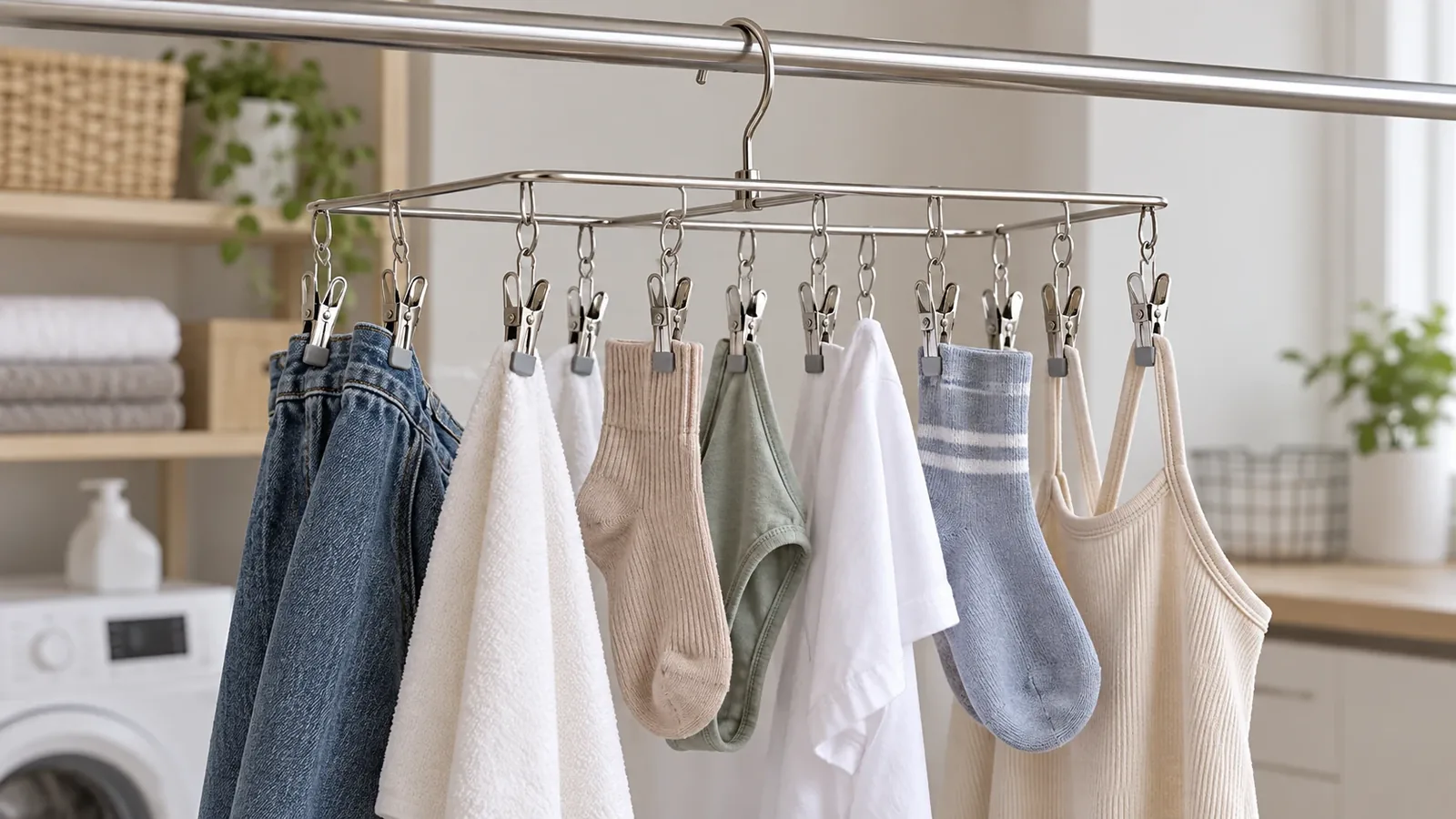
A sock drying hanger with clips should be evaluated as an assembly of a frame, clips, springs, and connectors rather than as a peg count alone. A hanger may have many positions yet become inconvenient if a clip detaches, a connector loosens, a spring fails, or a broken part cannot be replaced. For an importer, the key sample questions are how each clip attaches, how it behaves through ordinary loading and removal, which materials are used, and what the supplier can replace or support. A few user reports can reveal questions worth testing, but they do not establish a universal failure rate.

Map the product’s components
Before comparing samples, list the parts that make the hanger function. A typical multi-clip design may include a main frame, hanging hook or swivel, individual pegs, springs, rings, links, joints, and possibly non-metal clips or caps. Different products use different combinations of metal and polymer components. The material for one component should not be generalized to the entire hanger.
Ask the supplier for a component map or bill of materials. Record the material, source responsibility, attachment method, and finish for each part. If clips or springs are bought in, identify the supplier and whether replacements can be sourced later. If the frame is metal and the clips are polymer, determine how the clip connects to the frame and whether the joint can be separated without damage.
A component table is useful:
| Component | Information to specify | التحقق من المشتري |
|---|---|---|
| Frame | Material, finish, wire or section dimensions | Does it stay aligned with the intended load? |
| Clip body | Material, jaw shape, opening and contact surface | Does it hold the garment without obvious damage? |
| Spring | Material and assembly form | Does it open and close consistently in sample use? |
| Connector | Ring, slot, pin, loop, or molded interface | Does the clip remain attached through use and handling? |
| Hanger hook | Material, swivel or fixed arrangement | Does the loaded unit hang in the intended location? |
| Spare part | Replaceable part number and supply route | Can the buyer obtain a replacement if needed? |
Do not assume that all components are made by the same factory. A supplier may manufacture the metal frame and assemble purchased clips or springs. That arrangement can be entirely workable, but the quotation and quality plan should state who controls each component and what happens if a part is unavailable.
Define the use case and load pattern
A multi-clip hanger can serve socks, small garments, cloths, or other laundry items. The buyer should identify which item types the product is intended to hold and how many pieces are loaded. A lightweight sock and a damp, heavier item create different loads at the clip and connector. Do not infer a maximum load from the number of clips or from a product photograph.
Collect representative garments from the target range. Include the thinnest fabric, a thicker cuff or waistband, and any item whose shape may be difficult for the clip jaw to grip. Record the intended drying location—indoor rail, outdoor line, balcony, or another setting—without assuming that one material or finish suits every environment. If the product is not rated for certain exposure, that limit should be clear.
Define the normal loading pattern. Are all clips expected to be occupied? Will users load one side more heavily? Do garments hang symmetrically, or could a single heavy item tilt the frame? A sample that remains stable when evenly loaded may rotate or twist under an uneven pattern. The buyer should decide which condition represents normal use and test it.
Inspect the clip-to-frame connection
The peg-to-frame interface is the central design point for this topic. Clips may connect through rings, loops, slots, molded tabs, hooks, or other forms. Each connection has different movement and retention characteristics. The buyer should inspect whether a clip swings freely where intended, whether it can rotate into the frame, and whether it can be detached accidentally during loading.
Open and close each representative clip several times by hand, then load and remove garments. Observe whether the clip shifts along the frame, twists, catches on an adjacent clip, or separates at the connection. Check central and end positions because an end connector may experience a different movement or contact condition than a clip near the middle. Do not infer a cycle rating from a brief manual review.
If a numerical cycle test is needed, define the test fixture, opening range, speed, garment or simulated load, number of cycles, and acceptance criteria. A generic instruction such as “durable clips” does not provide a measurable requirement. The supplier may propose a test method, but the buyer should review whether it reflects the actual product use and the failure mode of concern.
Record the connection geometry and relevant clearances. For a metal frame, check whether cut ends, bends, welds, or finish transitions interfere with a moving clip. For a molded connector, identify the material and the retention feature. If a ring or link is used, check its opening and orientation. A clip that works when unloaded may open, rotate, or slide differently under a damp garment.
Review clip holding and garment contact separately
A clip that stays attached to the frame still needs to hold the garment. Test the intended fabric types and thicknesses. Observe whether a garment slips under its own weight, whether the jaw closes consistently, and whether visible impressions or damage occur after the agreed sample use. A clip designed to grip a thin sock may behave differently on a thicker cuff.
The buyer should avoid setting a universal clamp-force claim without a method. If holding force matters, define the garment material, thickness, jaw location, pull direction, rate, and acceptance range. A simple functional check may be sufficient for an early sample, while a formal numeric requirement may be needed for a specific retail promise. State which is being used.
Inspect the jaw edges and contact pads. A sharp edge, burr, or exposed spring end could catch a knit or delicate fabric. If polymer tips or pads are used, identify whether they are supplied, attached, and included in the replacement plan. Do not claim that a clip will never leave marks or damage garments unless a representative test supports that claim.
If the clip material and frame finish differ, check for contact or wear where they meet. A metal spring, polymer body, and coated frame can form a mixed-material assembly; the buyer should confirm the actual materials rather than assume them based on appearance. A market example listing several materials demonstrates why component-level declarations matter, but it does not prove that another product uses the same combination.
Check replacement and service strategy
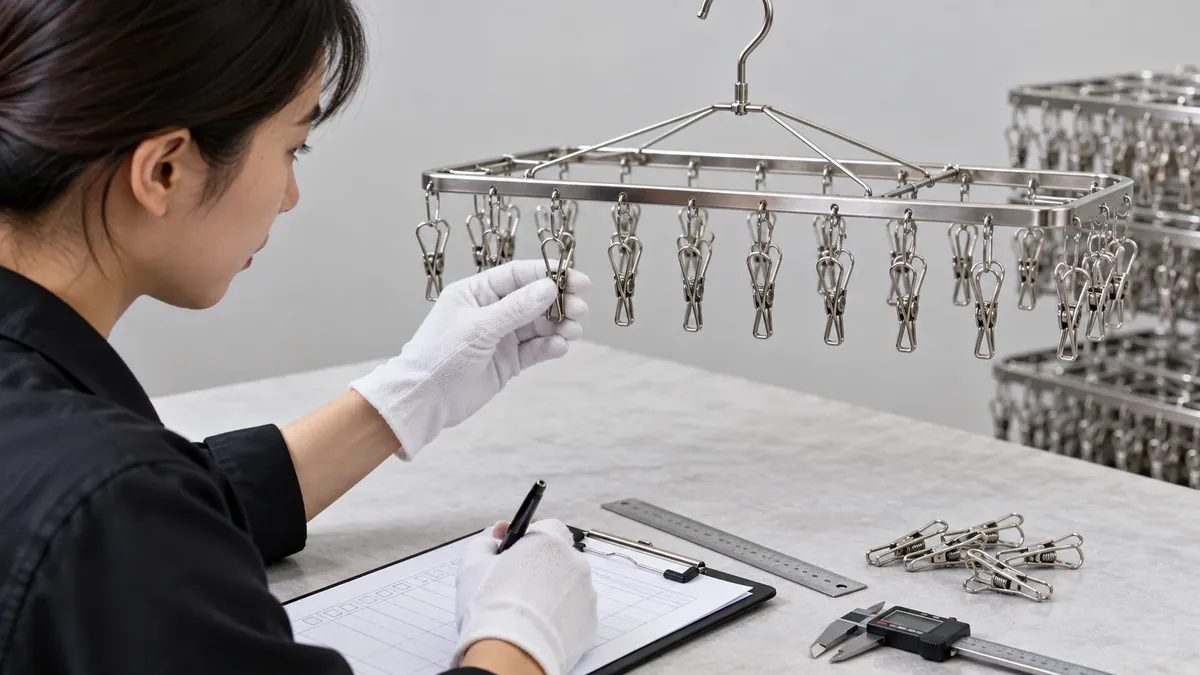
A broken clip can reduce the usefulness of a multi-clip hanger even if the rest of the frame remains intact. Buyers should decide whether clips are intended to be replaceable, whether replacements will be stocked, and whether replacing one requires tools. Permanently assembled clips may simplify use but make repair difficult. Removable components can improve serviceability but may be easier to lose or reinstall incorrectly.
Ask the supplier whether clips, springs, or connectors have separate part numbers. Confirm whether replacement parts can be ordered independently, how they are packed, and whether they are interchangeable across variants. If there is no replacement program, record that fact and consider how it affects warranty, customer support, and spare inventory decisions.
Test replacement on a sample if it is part of the product promise. Follow the intended instructions and check whether the new part remains secure during normal use. If replacement requires bending a metal loop or prying a connector, the buyer should evaluate whether that action is appropriate for an end user or should be reserved for service. Never imply repairability simply because a component can be physically removed during sample inspection.
Evaluate corrosion and outdoor-use claims carefully
Laundry products may be used indoors or outdoors, but the intended exposure should be defined. Humidity, rain, cleaning agents, and storage conditions can differ significantly. A metal frame, spring, fastener, and clip may use different materials and finishes, so one corrosion statement may not describe every component.
If corrosion resistance is a buying requirement, specify the environment and the evidence expected. A salt-spray result, for example, only has meaning in relation to the test method, specimen preparation, duration, and acceptance criteria; it does not directly establish service life in every home or climate. Do not invent a rating or equate one test result with a universal lifetime.
Inspect samples after any agreed exposure check, including joints and contact areas where coating may be damaged during assembly. If the product has mixed materials, check the interface and explain any care limitations. The buyer should avoid claiming “rustproof” or “weatherproof” unless the exact construction and evidence support the statement.
Test the fully loaded hanger and packaging
Load the product using the agreed garment set and pattern. Hang it from the intended support, open and close clips, remove items, and observe whether the frame twists or the hook rotates. If the hanger is meant to fold or collapse, operate that mechanism separately and verify that clips do not become trapped or detached. Record the orientation and load pattern for repeatability.
Transport can also stress connectors. A packed hanger may place clips against the frame or one another; a bag of loose spare clips can be lost or scratched. Ask for a pack-out sample and inspect whether moving parts are restrained. If the product ships assembled, check whether the clips remain attached after normal carton handling checks selected by the project. Do not translate a single pack-out review into a broad transit-damage guarantee.
A practical sample sequence:
- Inspect each clip, spring, and connector on the unloaded product.
- Attach representative garments across the frame.
- Include a defined uneven-load condition if it reflects actual use.
- Open and close selected clips during loading and removal.
- Check that no connector shifts or separates under the agreed handling.
- Evaluate any folding or swivel action.
- Review the packed unit for contact, restraint, and spare-part identification.
Use the same garment samples and conditions when comparing suppliers. This avoids treating a different fabric or load pattern as a product performance difference.
Specify how the sock drying hanger with clips sample will be measured, installed, and approved before production release.
Record how the sock drying hanger with clips will be checked against the approved drawing, reference item, and sample acceptance criteria.
RFQ inputs for a multi-clip hanger
A useful supplier brief includes:
- Target garment types and representative fabric samples.
- Number of clips and intended occupied positions.
- Frame dimensions, material, finish, and color.
- Clip body, spring, connector, and pad material requirements.
- Attachment method and whether clips should be replaceable.
- Intended use environment and any defined corrosion evidence.
- Required holding or cycle test, with method and acceptance criteria.
- Hanger hook, swivel, folding, or storage requirements.
- Packaging method and whether spare clips are included.
- Instructions, labeling, barcode, and sample quantity.
Ask for assumptions in the quotation: which parts are factory-made versus purchased; what materials are included; whether a sample uses production-representative components; what replacement parts can be supplied; and what tests are included. Compare suppliers only when the component and service scope match. A lower quote that substitutes a different clip or excludes spare parts may change the product the buyer is evaluating.
Koitor’s current multi-clip hanger product and any particular polymer, spring, or replacement component are unconfirmed. Its documented metal forming and assembly knowledge can inform discussion of the frame and manufacturing questions, but the exact product capability should be confirmed using the buyer’s drawing, samples, and requested component list.
Approve with component-level criteria
A sample approval should identify the clip and frame configuration, the garments used, the load pattern, and the review method. Confirm that clips remain attached under the agreed use, garments stay held under the defined check, and contact surfaces do not show unacceptable snagging or damage. If replaceable parts are promised, record the replacement procedure and verify that the installed spare is retained.
Describe failures in observable terms. “Clip 7 rotated and contacted the neighboring clip when a damp thick cuff was removed” is more useful than “clips are weak.” “The connector ring opened during repeated loading on the end position” identifies where to investigate. Do not report an assumed root cause unless a supplier investigation confirms it.
Tie the approved sample to its drawing, component list, finish, and packaging configuration. If the clip, spring, frame coating, or connector changes, repeat the relevant checks. Preserve a reference sample when the project process permits. Component substitutions can alter fit or retention even when the overall hanger dimensions remain the same.
Sourcing takeaway
A dependable multi-clip hanger brief names the parts and interfaces that matter: frame, clip, spring, connector, contact surface, and replacement route. Importers should test real garments, inspect the clip-to-frame connection at several positions, define any cycle or corrosion method, and review packaging and spare-part expectations. This makes a peg count meaningful only in the context of a tested assembly and use case.
For related metal storage projects, see Koitor’s OEM home-storage hardware manufacturing information and confirm the exact frame, purchased components, assembly, finish, and supply scope directly with the factory.
Discuss Your Multi-Clip Laundry Hangers Specification
OEM / العلامة التجارية الخاصة
حوّل دليل التوريد هذا إلى موجز منتج
يرجى إطلاعنا على المنتج المستهدف، والحجم، والتشطيب، وكمية الطلب، ومتطلبات التغليف. وسيتلقى فريقك تقييمًا عمليًّا لإمكانية التصنيع قبل تقديم عرض الأسعار.
 English
 Español
 Português
 Français
 Deutsch
 العربية