
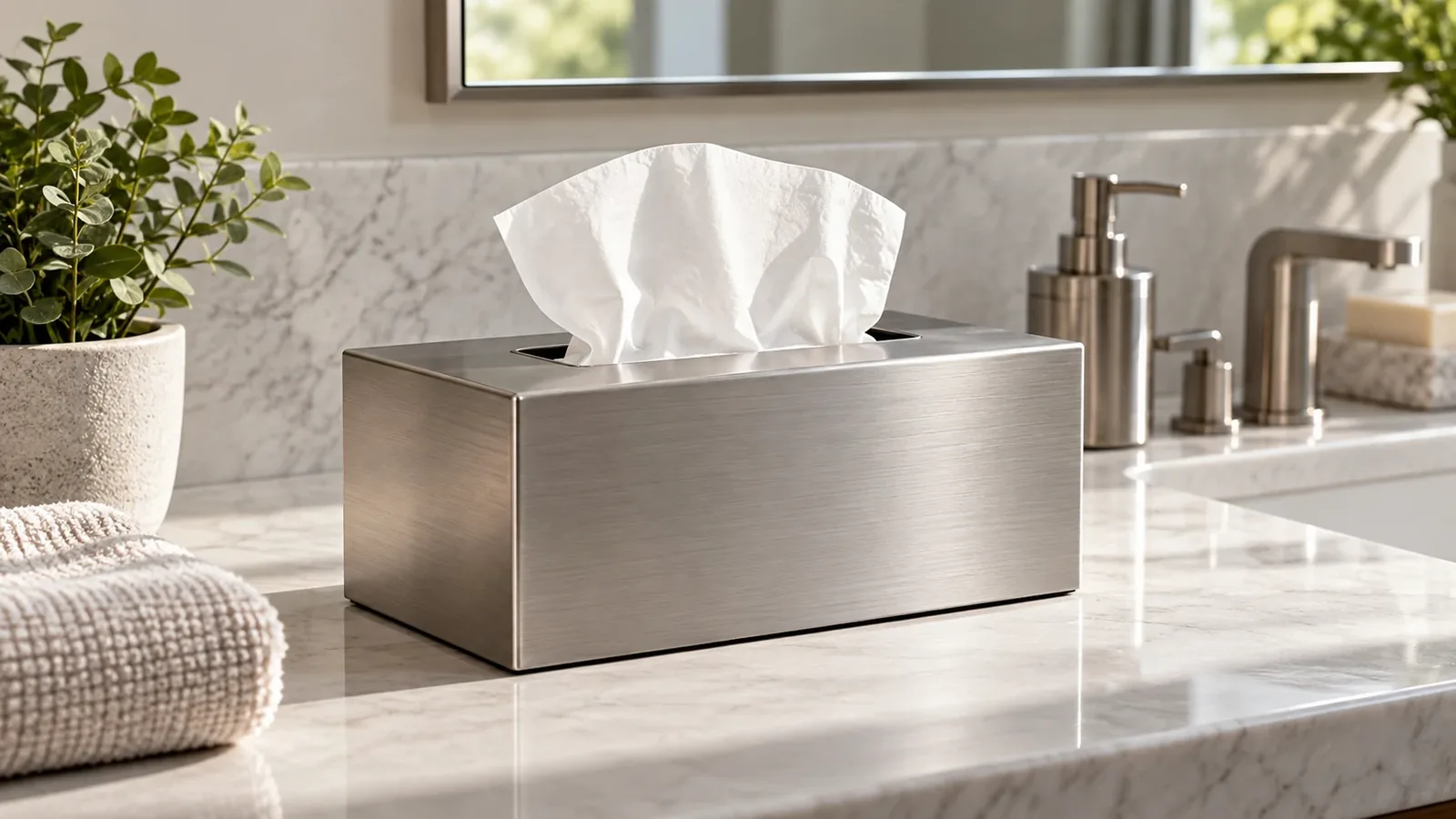
A tissue box holder should be approved with the facial-tissue cartons or refill packs the buyer plans to sell, not with an assumed universal box size. Carton height, width, depth, dispensing opening, and packaging revision can vary. A case can fit the carton but still press on its top, cover the opening, or make the first sheet difficult to pull. For an importer, the practical sample question is whether the specified pack loads, remains positioned, and dispenses tissues through the intended opening at full and partly used states.
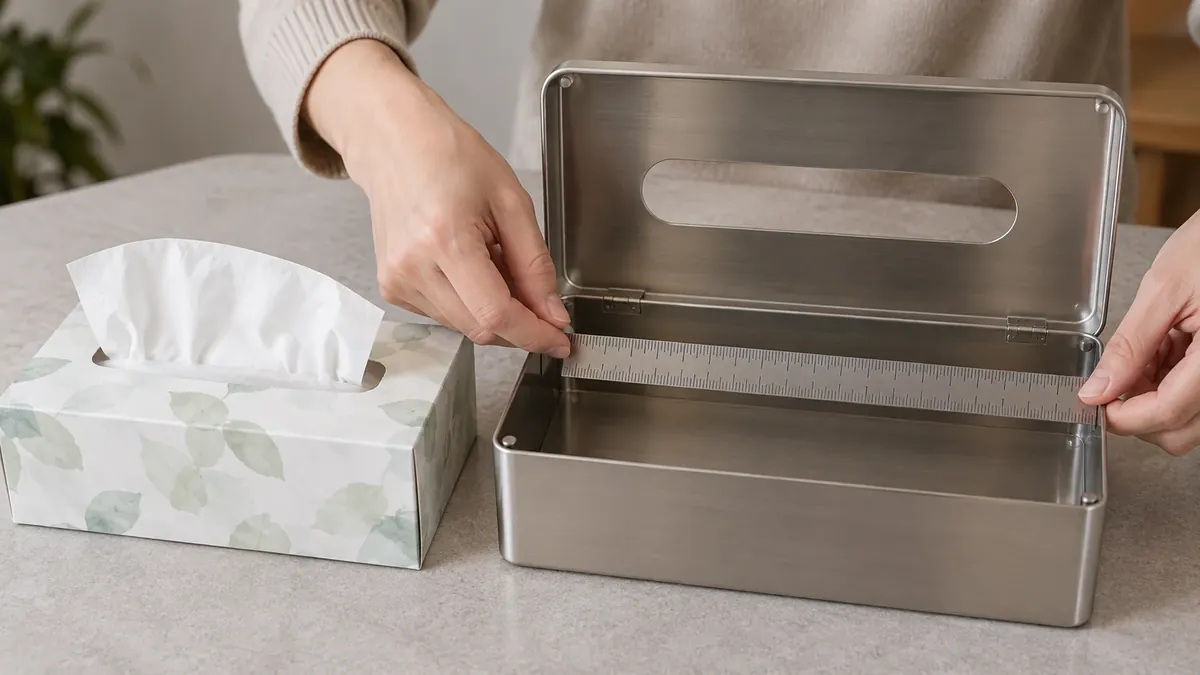
Identify the packaging formats
Facial tissues are sold in different formats: rectangular cartons with a top opening, soft packs, loose refill packs, and cylindrical or other specialty refills. A metal case designed for one format may not accept another. A tissue holder designed around a box is not automatically suitable for a cylinder, and a product intended for a soft pack may need a different support arrangement from a rigid carton case.
List the target SKUs and collect current packaging from the markets where the product will be sold. Measure external width, depth, height, and any bulging or tapered surfaces. Record the carton opening position, the shape of its opening, and how far the first sheet projects. If multiple suppliers or private-label variations are included, test more than one. Package sizes can also change when a brand revises its box graphics or board thickness.
A reference matrix can keep assumptions visible:
| Package type | Measurements to record | Sample review question |
|---|---|---|
| Rectangular carton | Width, depth, height, corner shape | Does it load without crushing or excessive movement? |
| Carton opening | Position, length, width, flap style | Is the tissue opening aligned with the case? |
| Soft pack | Full and partly used dimensions | Does the case support it without collapsing the opening? |
| Refill pack | Folded dimensions and loading direction | Can it be inserted and retained as intended? |
| Cylinder refill | Internal and external dimensions | Is this a separate case architecture? |
Use actual physical packages where possible. A manufacturer’s nominal carton dimensions may not reflect finished packaging, seams, bulges, or production variation. Measure several units if the buyer’s compatibility statement covers a range. Save a record of the package SKU and revision so future changes can be checked against the approved case.
Set the usable interior envelope
The case’s outside dimensions do not describe its usable interior. Measure the inside width, depth, and height after accounting for bends, corner joints, coating, internal supports, and any liner. If a lid or top plate rests on the carton, measure its clearance and contact area. A nominal maximum carton height in one product listing is specific to that model; it is not a universal height for all tissue boxes.
Specify a fit range rather than “standard size” when the case should serve multiple cartons. Identify the largest intended package, the smallest package that should remain stable, and any dimensions that are critical. A large internal cavity might accept many cartons but allow smaller boxes to move, misalign, or sit too low for convenient extraction. The buyer should decide whether a spacer, adjustable support, or separate size is useful and then verify it with real packages.
If the case uses a removable lid, determine how the carton is loaded and where the lid rests. Does the lid sit on the case frame, contact the carton, or press on a separate insert? If it touches the carton, consider whether that pressure can close or distort the carton opening as the box becomes empty. If the design has no lid, check whether the carton is visible and whether the opening remains aligned.
A fit check should include the finished case. Coating thickness, edge returns, welds, and liners can affect interior clearance. A bare prototype can help review the architecture but may not represent the final fit. Identify critical internal dimensions on the drawing and inspect them on a production-representative sample.
Test tissue extraction at different fill levels
A carton that fits can still dispense poorly. The case opening must align with the carton opening, and the case should not obstruct the path of the tissue as it is pulled. Test the first sheet, several consecutive sheets, and the final tissues. A carton’s shape and stiffness change as it empties, and the opening may collapse or move.
A practical test sequence:
- Load a new carton using the intended refill method.
- Pull the first sheet using the ordinary hand position.
- Pull several sheets in succession and observe whether more than one emerges unintentionally.
- Repeat when the carton is partly depleted.
- Continue to a near-empty state and check whether the box shifts, collapses, or becomes hard to reach.
- Reload the case and repeat with each carton type listed in the compatibility range.
Record the carton brand or SKU, package dimensions, case position, and what happened during extraction. If a tissue tears, folds, or catches, note whether the issue appears to come from the carton’s perforation, the case opening, lid pressure, or hand clearance. Do not assume a case caused the outcome without checking the carton itself.
If a performance claim such as “one-handed dispensing” is desired, define how it is tested. Identify the user action, case position, carton type, and acceptance condition. An attractive product photo or one successful pull does not establish reliable one-handed use across different tissue packs. Avoid claims such as dust-proof, moisture-proof, or universally compatible unless the case is designed and tested for those outcomes.
Review the first-sheet problem and opening geometry
Some cartons require the user to find and lift an initial tissue through an inner film or perforated opening. A decorative case can make that task easier by holding the carton still, or harder if the opening is too small, offset, or partially covered. Review the exact opening geometry with the carton installed, including the movement needed to grasp the first sheet.
Measure the usable opening after accounting for the surrounding frame and any lid. The visible opening can look large from above while its inner edge still catches a tissue pulled at an angle. Check whether the user can reach the tissue without scraping fingers along an edge. If the top plate is removable, assess how it is handled during loading and whether it stays aligned during repeated extraction.
Do not create a case opening based only on a generic tissue-box image. Carton openings can be centered, offset, oval, rectangular, or covered by film. The product brief should include a representative package or scaled top-view drawing. If the buyer wants the case to work with more than one opening position, test the range and state its limits.

Consider package changes and variant management
A private-label carton can change after the case design has been approved. A new board thickness, revised dimensions, different tissue count, or altered opening can create a fit issue. The buyer should decide whether the case is designed for one named carton, a defined size range, or a family of cartons. Compatibility statements should match that decision.
Keep a simple revision record with the tissue SKU, carton dimensions, opening layout, and date. If packaging changes, compare the new dimensions to the approved fit envelope and repeat extraction checks if relevant. If the new carton falls outside the range, options include revising the package, changing the case, adding a tested insert, or narrowing the product statement. Do not assume a few millimeters are irrelevant; even a small height change can affect a close-fitting lid.
The buyer may choose a fixed interior or adjustable design. Adjustability can broaden compatibility but add parts and setup steps. A removable shim may solve one box-height issue while creating another loose component to manage. Test it with all intended packages and clarify whether it ships installed or loose. Separate case variants may be simpler but create additional inventory, packaging, and labeling tasks.
Distinguish box cases from refill dispensers
A case that encloses a standard rectangular box differs from a container intended for loose tissues or a cylindrical refill. Their internal geometry, loading sequence, and extraction behavior are different. A product listing for a round tissue holder may specify an internal diameter and height, while a rectangular case may specify a maximum box height. Those are model-specific examples of different architectures, not interchangeable standards.
If the buyer’s product is intended for loose tissues, define how the stack is inserted, held, and accessed. Does a spring platform or flexible insert maintain contact? Are there pressure points? How does the stack behave as tissues are removed? If those mechanisms are not part of the product, do not imply compatibility with loose tissue refills.
For a conventional carton cover, specify whether the carton remains inside and is replaced as a unit. If the case includes a base, lid, frame, or liner, identify how each part is removed and cleaned. Product pages and packaging should make the refill format clear so buyers do not assume the case accepts a different system.
Check finish, edges, and cleaning access
Inspect the finished product around the opening, corners, lid, and loading edge. Look for burrs, sharp transitions, coating buildup, and exposed seams. Check whether the carton rubs against the interior or catches when it is inserted. If a wood or polymer component is included, verify the material and attachment in the bill of materials; do not assume it is part of the product from a photograph.
Ask how the user accesses the case for refilling and routine cleaning. A close-fitting lid may be attractive but difficult to remove. A liner may help hold the carton but could conceal residue or complicate replacement. The design should be reviewed for the actual care instructions the buyer intends to provide.
Do not claim that a metal case protects tissues from dust or moisture without a defined design and test. An open tissue slot can leave tissues exposed by design. A cover may reduce direct contact, but that does not establish a sealed barrier. Keep product claims proportionate to the construction and evidence.
Specify how the tissue box holder sample will be measured, installed, and approved before production release.
Build the RFQ around actual tissue packs
A supplier brief should include:
- Target carton or refill SKUs and physical reference samples.
- Full external dimensions and carton opening geometry.
- Required interior fit range and critical clearances.
- Whether the case should fit one package or several variants.
- Lid, liner, spacer, or insert details.
- Loading and refill sequence.
- Expected tissue extraction behavior and test method, if needed.
- Material, finish, color, and cosmetic surfaces.
- Packaging, assembly, instructions, and barcode requirements.
- Sample quantity and acceptance checklist.
Ask suppliers to state assumptions. Is the quote based on one supplied carton or estimated dimensions? Does it include the lid, liner, or insert? Which surfaces are finished? Is the sample representative of the final coating? What happens if the carton changes after approval? If the supplier proposes a larger cavity or adjustable insert, ask how it affects stability, extraction, and pack-out.
Compare quotations using equivalent product scope. A case with an included lid or insert is not equivalent to a bare sleeve. Confirm whether packaging materials and protective wraps are included. Record tooling, sample, and order assumptions before reviewing price differences.
Koitor’s current tissue-case product, wood lid, silicone gasket, polymer insert, and tissue performance tests are unconfirmed. The buyer should supply the actual carton and confirm the factory’s product-specific capability and component responsibilities before proceeding as though a standard SKU exists.
Approve with a carton-by-carton checklist
For each approved package, record whether it loads, aligns with the opening, stays positioned, and dispenses acceptably at full, partly used, and near-empty states. Photograph the top opening and the loaded case. Note any pressure from the lid, movement of a small carton, or difficulty reaching the first sheet. Identify any exceptions in the compatibility list.
Use specific observations. “The revised carton is 5 mm taller and contacts the lid before the case closes” is more useful than “the box is too big.” “The first sheet catches on the rear edge of the metal opening when pulled toward the user” points to an interface that can be evaluated. The supplier can reproduce the condition if the exact package and action are recorded.
If the internal dimensions, lid position, finish, or insert changes, repeat the relevant checks. Keep the approved drawing and package revision together. When tissue packaging changes in the future, compare it with the approved range rather than relying on memory or a generic size name.
Sourcing takeaway
A tissue box holder is specified by the package it surrounds and the opening through which the user pulls tissues. Importers should measure actual cartons, define the interior envelope, test lid pressure and first-sheet access, and review full-to-empty extraction. Manage carton revisions explicitly and keep compatibility statements within the verified range.
For adjacent metal storage projects, see Koitor’s OEM home-storage hardware manufacturing information and confirm the exact case construction, finish, inserts, and production scope directly with the factory.
Discuss Your Metal Tissue Cases Specification
OEM / العلامة التجارية الخاصة
حوّل دليل التوريد هذا إلى موجز منتج
يرجى إطلاعنا على المنتج المستهدف، والحجم، والتشطيب، وكمية الطلب، ومتطلبات التغليف. وسيتلقى فريقك تقييمًا عمليًّا لإمكانية التصنيع قبل تقديم عرض الأسعار.

 English
 Español
 Português
 Français
 Deutsch
 العربية