

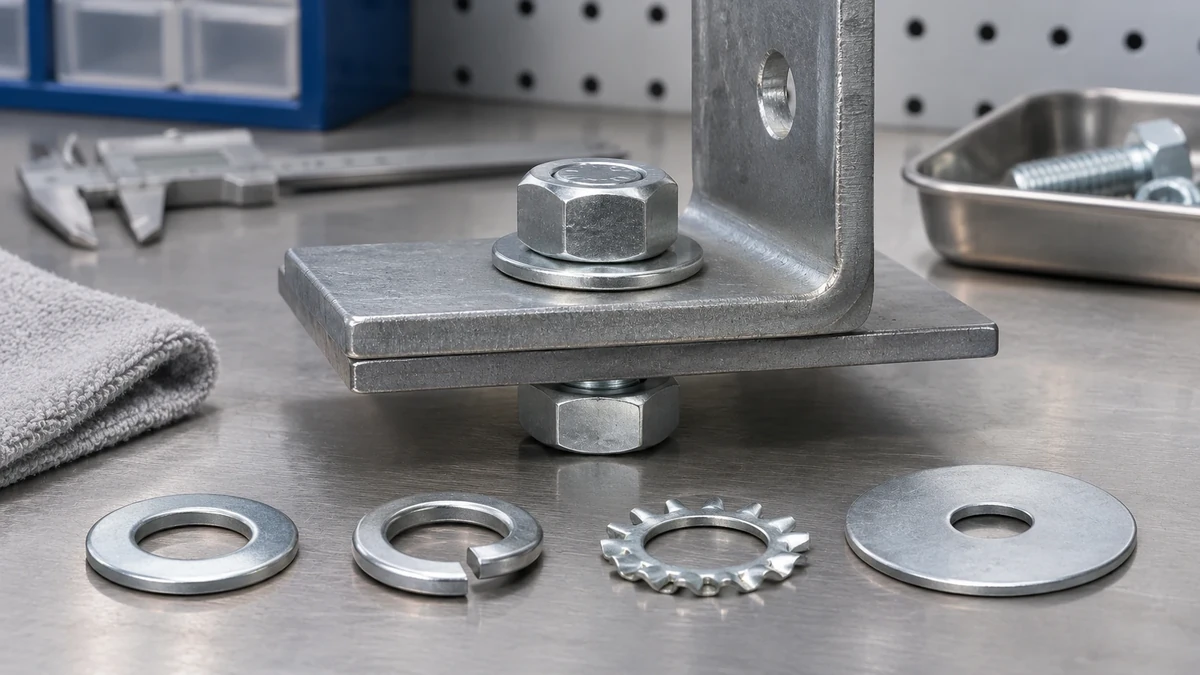
A washer types chart helps a buyer identify a candidate shape, but the washer must still be specified as part of the complete fastener stack. Flat, fender, finishing, spring, conical, toothed, insulating, sealing, and retaining forms can look similar or overlap in supplier catalogs. Before ordering, match the washer’s inside and outside dimensions, thickness, material, finish, contact surface, fastener, and function to the actual joint. A washer label alone does not prove locking, sealing, vibration resistance, or corrosion performance.
What problem does a washer chart help solve?
Buyers use washers to distribute contact, protect a surface, create spacing, support a fastener, or satisfy a specified retention or sealing function. A BOM that says only “washer” leaves the supplier to guess the profile and dimensions. The result can be a stack that assembles but does not bear where intended, covers the wrong area, interferes with a moving part, or has an unapproved finish.
A washer is not an isolated accessory. Its performance depends on the fastener, clamped parts, hole, surface, assembly method, load, environment, and any retention or sealing requirement. The same visible washer outline can serve different functions in different joints. Conversely, a design feature such as an integrated flange or tooth may overlap with another category.
Use a washer types chart as an identification aid, not as a universal joint design manual. It helps buyers decide what information belongs on the drawing and quote. It does not establish a torque, load capacity, anti-loosening result, seal rating, or corrosion guarantee for an unspecified product.
A useful worksheet separates four questions:
- What is the geometry? Record the inside diameter, outside diameter, thickness, profile, and any key feature.
- What is the function? State whether the washer is a flat bearing surface, a larger-area support, a finishing piece, a spacing element, a retention feature, or a seal.
- What is the material and finish? Identify the approved material and finish without assuming that appearance proves performance.
- What is the joint? Identify the bolt, screw, nut, hole, host material, surface, and assembly sequence.
The chart gives common families to recognize. The actual supplier drawing or part number controls the purchased item.
How should buyers organize washer types?
A chart becomes more useful when it groups washers by geometry and function instead of presenting one long list of names as mutually exclusive categories. The Grainger washer guide و Bolt Depot’s fastener type chart show common catalog forms, while Fastenright’s washer form guide demonstrates that dimensional series may also be identified by supplier or standard-specific form codes. Those catalogs are reference points, not substitutes for the chosen product drawing.
| Family | Recognizable feature | Typical buyer question | Important limit |
|---|---|---|---|
| Plain or flat washer | Flat ring with a central hole | What bearing surface and dimensions does the joint require? | Does not automatically lock or seal the joint |
| Fender or large-OD washer | Larger outside diameter relative to its hole | Does the joint need a wider contact area or cover? | Larger coverage is not a load rating |
| Finishing or cup washer | Formed rim or recessed profile around a fastener head | Does the appearance or head seating need a defined finish? | Name and form vary by catalog; check actual drawing |
| Spring or split washer | Split or formed profile intended for a defined joint arrangement | What system and instructions call for this specific washer? | Do not assume universal vibration locking |
| Conical or disc-spring washer | Curved or conical profile | Is a defined spring characteristic required? | Shape alone does not establish load-deflection performance |
| Tooth or star washer | Internal or external teeth on the ring | Is electrical or mechanical contact/retention part of the design? | Teeth do not prove a corrosion-resistant or locking result |
| Insulating washer | Nonconductive material or insulating design | Must the washer isolate surfaces electrically or protect them? | Confirm material, thickness, temperature, and application |
| Sealing washer | Washer designed with a sealing element or surface | What medium, contact face, and compression requirement apply? | A generic ring does not establish leak-tightness |
| Shoulder or stepped washer | Raised shoulder or stepped profile | Does a component need centering, spacing, or an isolated bearing? | Confirm shoulder dimensions and mating bore |
| Retaining washer | Feature retains a part on a shaft, pin, or opening | Which groove, shaft, or panel feature is being retained? | Not a substitute for a clamp-load washer |
| Countersunk or finishing ring | Profile matches a recessed fastener head or visible face | Does the head need to sit in a defined recess? | Match the fastener head and seat geometry |
The categories can overlap. A sealing washer may also have a metal backing; a toothed washer can have an internal or external tooth pattern; a conical washer may be grouped with spring washers. The buyer should specify the actual part and function rather than assume the chart’s category labels form one exclusive taxonomy.
Which common forms should a buyer recognize?
Flat washers provide a flat ring between components. Buyers may use them as a bearing surface, spacer, or protective layer when the design specifies that role. Confirm the hole, outer diameter, thickness, material, finish, and which surface contacts the washer. A flat washer does not automatically prevent loosening or make a joint stronger.
Fender washers have a comparatively large outer diameter. A buyer may consider them when a larger area needs coverage or when a hole must be covered by a ring-shaped component. Confirm that the washer actually covers the feature and fits within the available envelope. A larger ring may interfere with nearby parts, a curved surface, or a decorative cover. Do not infer a load capacity from its diameter alone.
Finishing washers are shaped to provide a defined visible interface around a screw head. The exact cup, seat, and compatible head form vary. Match the fastener head geometry and the visible finish to the actual supplier drawing. A photograph can help identify a candidate but does not define dimensions or surface quality.
Split or spring washers are recognizable by a split or formed profile. Catalogs may describe them as spring washers, lock washers, or by a more specific design. A buyer should not assume that any split washer prevents loosening under every vibration, torque, reuse, or substrate condition. If a design requires a retention method, identify the exact system and evidence, and confirm the assembly instructions.
Conical washers and disc springs have a curved profile that can provide spring action in a designed assembly. Their behavior depends on geometry, material, orientation, stack arrangement, and the manufacturer’s data. A generic conical ring should not be presumed to be a particular Belleville disc spring or to supply a known preload without the exact specification.
Toothed or star washers use internal or external teeth. The teeth may be relevant to a specified surface contact or retention design, but a visible tooth pattern does not establish the result in a particular assembly. Surface coating, material, contact pressure, corrosion environment, and electrical requirements can change what evidence is needed. Do not use a toothed washer to make an unsupported claim about a complete fastener joint.
Insulating washers may separate a fastener or component from a conductive surface or protect a finish. The material, thickness, temperature, compression, and contact conditions matter. If electrical isolation is required, specify the actual requirement and obtain evidence for the exact material and assembly; do not infer isolation solely from a product photo.
Sealing washers are selected for a defined sealing interface. A washer may use a compressible element or a formed profile, but the label “sealing” alone does not identify the medium, pressure, surface, compression, temperature, or service condition. Use the component maker’s instructions and a test or acceptance plan suitable for the application.
Shoulder washers include a raised portion that can locate or separate a component. Buyers should specify the shoulder height, diameter, bore, material, and mating feature. If the shoulder passes through a panel or bracket, confirm the panel thickness and clearance as well as the ring dimensions.
Retaining washers hold a part in relation to a shaft, pin, hole, or groove. Their function differs from a washer placed under a bolt head. Identify the retained element and the required retention geometry. Do not substitute a flat washer simply because the outer profile appears similar.
For bathroom and home-storage hardware, washers may be hidden under a screw head, used with a mounting plate, or packed as part of a kit. If the fastener stack affects a visible metal surface, call out which face is cosmetic and whether a mark, indentation, or gap is acceptable. A relevant mounting-plate and fastener interface guide covers the neighboring question of how the plate pattern and fasteners fit the host structure; it does not select a washer for every joint.
How do dimensions and contact surfaces affect the washer stack?
Nominal fastener size does not uniquely define a washer’s outside diameter, thickness, material, or series. Supplier charts may identify different form codes, regional conventions, or catalog dimensions. The Fastenright form chart illustrates that a washer’s form and dimension series are part of its product identity. Use the exact supplier drawing and designation, not a copied generic table.
A drawing or BOM should identify the dimensions that control the assembly. Depending on the joint, these may include:
- Inside diameter and any clearance to the screw or bolt.
- Outside diameter and available edge or cover area.
- Thickness, shoulder height, dish, or formed profile.
- Material, hardness or temper where specified, and finish.
- Flatness or surface condition if the contact area matters.
- Orientation of a conical, toothed, sealing, or stepped feature.
- The bolt head or nut geometry it must seat against.
- The host panel or bracket thickness and hole condition.
- Any coating, paint, plating, or soft layer between the washer and mating face.
The mating surface may be flat, curved, painted, coated, plated, soft, textured, or otherwise nonuniform. A washer that fits over a bolt may still contact the surface unevenly or cover a different area than intended. If the assembly depends on face pressure, electrical contact, paint protection, sealing, or a controlled spacing, state that purpose and have the responsible engineer or component supplier define the necessary dimensions and evidence.
For a visible bathroom accessory, a finishing washer may create a more intentional appearance than a plain ring, but it must match the screw head and cover. For a mounting plate, the washer may need to avoid blocking a slot or overlapping another fastener. For a thin panel, a wide washer may spread contact, but it does not automatically prove a certain pull-through performance. Do not convert a geometric change into a load claim without the appropriate test or calculation.
Consider the complete stack in the order it will be assembled. If a nut, washer, bracket, spacer, panel, and screw are supplied by different vendors, record which supplier owns each dimension and who checks the assembled result. A sample with a temporary washer may not represent the final specification. Control the actual stack before approving production.
Does a washer automatically lock or seal a joint?
No. A washer form is not by itself proof of a locking or sealing outcome. Locking performance depends on the specified washer design, fastener, assembly method, substrate, preload or other joint conditions, environment, and evidence. Sealing performance depends on the exact washer material and geometry, mating surfaces, compression, medium, temperature, pressure, and applicable method.
An attached washer or flange can change contact area and stack dimensions, but it does not automatically replace every separate washer or retention device. A split ring can be included in a catalog’s lock-washer group, but that label does not establish that the joint resists a specific vibration condition. A tooth pattern can affect contact, but it may damage coatings or behave differently on soft or hard surfaces. The buyer should specify the complete use requirement rather than rely on category shorthand.
If a joint uses a washer to maintain electrical continuity, a nonconductive insulating washer could contradict the purpose. If the washer is meant to isolate surfaces, a conductive metal ring may defeat that purpose. If a sealing washer must keep water out, a flat washer may not perform that role. These are function-level checks; the actual materials and validation need to come from the product’s responsible technical source.
A supplier’s catalog description can help identify the product family, but it may use broad marketing language. Ask for the part drawing, manufacturer instruction, technical data, and relevant test method for any performance claim. Keep the statement bounded to the tested configuration and avoid extrapolating one result to another material, finish, size, or assembly.
How should a buyer compare washer quotations?
Request the same specification from each supplier and require the quote to show the part identity. If one supplier quotes a plain washer and another quotes a toothed washer, they are not offering the same part. If both use the word “flat,” their actual dimensions and material may still differ.
A comparable quote should include:
- Supplier part number, drawing, or catalog designation.
- Washer family and intended function in the joint.
- Inside diameter, outside diameter, thickness, and any formed feature.
- Material and finish, including approved alternatives.
- Mating fastener and the surfaces that contact the washer.
- Installation orientation and assembly sequence if relevant.
- Any sealing, retention, isolation, or surface-protection requirement.
- Sample or first-article review expectation.
- Inspection dimensions and acceptance criteria.
- Packaging, identification, and part separation from similar washers.
- Deviations from the buyer’s drawing or sample.
Do not compare unit price until each quote refers to the same item and scope. A different material, coating, dimensional series, or quantity can change the offer. If the supplier suggests a substitute, review whether its size, form, contact surface, and function match the actual joint. A substitution may require an assembly test or engineering approval.
For production, maintain a controlled BOM and drawing revision. The part label should make it possible to distinguish similar washers in storage and packing. If multiple washers are included in a retail kit, identify their position and quantity in the assembly instruction. Mixing visually similar sizes can create avoidable assembly errors even when each individual washer is acceptable.
What mistakes should a buyer avoid?
Ordering only by nominal bolt size. It may not identify washer OD, thickness, series, or form. Specify the actual product designation and controlling dimensions.
Treating every washer as a flat washer. A formed, sealing, insulating, retaining, or toothed part may have a different role and assembly orientation.
Assuming a lock washer guarantees retention. Identify the exact design and supporting evidence for the joint condition. Do not interpret a category name as universal performance.
Assuming a washer seals because it sits under a fastener. A sealing function requires the right material, geometry, surface, compression, and application evidence.
Using an oversized washer without checking clearance. A larger OD can overlap slots, covers, moving parts, or neighboring fasteners. Confirm the available footprint.
Ignoring finish and material contact. A washer can scratch, mark, isolate, or react with the surface. Define the contact and environment when those outcomes matter.
Copying a supplier’s dimensional chart into a new drawing without context. Form codes and series may be specific to a supplier or standard. Verify the current exact part.
Changing the fastener but keeping the old washer by assumption. A new head, thread, coating, or stack height may alter fit and contact.
Using a generic test result as a product claim. Evidence for a washer alone does not automatically rate the complete assembly.
Leaving kit assembly ambiguous. State whether washers are installed, packed loose, counted individually, or supplied with the corresponding fastener.
What should go into a washer specification checklist?
Before approving a quote or sample, record:
- Washer’s role in the joint.
- Form and supplier designation.
- Inside diameter, outside diameter, thickness, and profile dimensions.
- Material and finish.
- Fastener or mating component.
- Contact surface and host material.
- Assembly order and orientation.
- Clearance to slots, edges, covers, and moving parts.
- Required surface protection, insulation, retention, spacing, or sealing function.
- Evidence, test method, or supplier instructions required for the stated function.
- Sample approval and part revision.
- Packaging and identification for kits or mixed sizes.
- Substitution and change-control rules.
Use a drawing note that states what controls. For example, a buyer may require a named supplier part number and list a critical inside diameter and outside envelope. If the buyer has not established a tolerance or performance threshold, it should remain an open engineering input rather than a guessed acceptance value.
A physical sample should be reviewed in the actual fastener stack. Check whether the washer sits flat where expected, clears the surrounding geometry, fits the screw or bolt, and presents the intended appearance. If sealing, isolation, retention, or load distribution is important, the sample fit check is only one step and should not be represented as proof of performance.

How can an OEM factory coordinate washer details?
Koitor Hardware is a family-owned custom metal hardware manufacturer focused on bathroom and home-storage products. A project conversation can cover the metal bracket, mounting plate, fastener kit, sample assembly, and packaging. The approved company profile does not mean Koitor manufactures every washer or fastener listed in this chart.
For a custom hardware RFQ, send the assembly drawing and identify who supplies the screw, nut, washer, and host panel. If the washer is purchased from a separate fastener supplier, retain its part number and drawing in the project record. Clarify whether the metal hardware manufacturer installs it, packs it, or leaves it for final assembly by another party.
If the project has a surface-finish or corrosion concern, keep it distinct from the washer’s shape. The fastener galling guide for metal storage racks covers a separate contact and material question. For the metal component and assembly scope, use the OEM home-storage hardware manufacturing page أو send the drawing and sample to Koitor.
الأسئلة الشائعة
What should a washer types chart tell a buyer?
It should help identify common forms and their typical roles, while showing that exact dimensions and performance depend on the supplier drawing and complete joint. Use a chart to shortlist, then specify the actual part number, material, finish, and mating stack.
Does a flat washer prevent a fastener from loosening?
Not by itself as a universal rule. A flat washer may serve as a bearing or spacing feature, but retention depends on the complete joint and any specifically designed locking system. Follow the supplier’s instructions and project evidence.
Are split washers always better for vibration?
No. The result depends on the joint and exact washer design. Do not assume a split washer prevents loosening in every vibration condition. Use an applicable design requirement and evidence.
Is a fender washer stronger than a standard flat washer?
A larger outside diameter describes its geometry, not a universal strength ranking. The joint, material, thickness, contact surface, and design requirements determine what can be concluded.
Is a toothed washer safe to use on powder-coated metal?
The teeth may affect or damage a coating, and contact behavior depends on the system. Confirm the design intent, surface requirements, and approved assembly with the responsible supplier or engineer.
Can a washer be used as a spacer?
A washer may be used as a spacer if the design and material support that purpose. Specify thickness, stack height, surface contact, and whether the spacing is critical rather than assuming any washer is an acceptable shim.
Does a sealing washer prove a waterproof joint?
No. The exact washer, mating surfaces, compression, medium, and test or acceptance criteria matter. A supplier category name is not a complete sealing qualification.
What should be checked when changing washer suppliers?
Compare the part number, drawing, dimensions, material, finish, function, and assembly fit. If a retention, sealing, electrical, or load requirement exists, confirm that the alternate has evidence for the same use.
اعمل مع شركة «كويتور» للأدوات
Need a fastener stack checked against a hardware drawing?
Share the mounting-plate drawing or sample, fastener specification, washer part number, contact surface, finish, and assembly sequence. Koitor can review the metal-part and OEM scope and coordinate which purchased hardware details need confirmation.
OEM / العلامة التجارية الخاصة
حوّل دليل التوريد هذا إلى موجز منتج
يرجى إطلاعنا على المنتج المستهدف، والحجم، والتشطيب، وكمية الطلب، ومتطلبات التغليف. وسيتلقى فريقك تقييمًا عمليًّا لإمكانية التصنيع قبل تقديم عرض الأسعار.


 English
 Español
 Português
 Français
 Deutsch
 العربية