

For a custom metal hardware SKU with one qualified source, dual sourcing vs safety stock is a choice between different forms of protection—not a universal contest with one winner. Inventory can bridge a temporary replenishment gap, while a qualified second factory may offer another production route but takes time and continuing control to establish. The right response depends on interruption impact, demand stability, recovery time, product transferability, qualification cost, and the cost of holding or obsoleting stock. Buyers should decide item by item, and sometimes combine a modest buffer with a qualified dormant source.
What decision does a buyer actually need to make?
The buyer is not choosing between “more suppliers” and “more inventory” in the abstract. The decision is how to reduce a specific SKU’s exposure to a supply interruption at an acceptable total cost and operational burden.
A safety-stock position is additional inventory held to cover uncertainty or replenishment time. A second source is another supplier that has been qualified to make the same product to an agreed specification. These are not interchangeable protections: stock is available only while quantities last, and a second source is useful only if it can reproduce the product, pass controls, and accept an order when needed.
A backup supplier can mean several different arrangements:
- Quoted alternative: a supplier has provided a price, but product, process, quality and capacity have not been qualified.
- Dormant qualified source: the second source has passed defined approval gates but receives little or no routine business.
- Warm backup: a qualified source periodically makes a small order or trial lot so that tooling, people and process knowledge remain current.
- Dual allocation: two qualified suppliers receive regular production share.
- Safety stock: the buyer owns or has reserved extra inventory against a defined demand and recovery scenario.
Calling an untested quote a “backup” creates false confidence. A second sample alone does not prove that the supplier can reproduce the approved configuration in a representative production lot.
Which SKUs deserve a continuity review first?
Start with the buyer’s own exposure data, not an arbitrary supplier-count target. Review products where a disruption would have meaningful commercial consequences and where recovery is difficult or slow. A recurring shower basket, towel rack, storage rack or other custom metal SKU may need a different response from a standard component with many interchangeable sources.
For each candidate SKU, estimate or document:
- Business impact if replenishment stops, using the buyer’s own sales, customer commitments and substitution options.
- Demand pattern and its variability, including seasonality and promotions.
- Current replenishment lead time and realistic recovery time after a missed production window.
- Available stock, open orders, transit inventory and the time before a shortage would matter.
- Whether another approved SKU or design can serve as a temporary substitute.
- Inventory carrying, storage, insurance, financing, damage and obsolescence exposure.
- Time and expense to qualify another source, including samples, tooling, inspection and trial production.
- The operational work needed to keep a backup specification and process current.
These inputs are not a formula that guarantees the correct quantity. They are a way to expose assumptions. A buyer should distinguish a documented supplier lead time from a planning assumption and should not treat a quoted production window as a guaranteed recovery date.
When should buyers choose inventory, a second source, or both?
Compare the two protections against the same SKU, interruption window and buyer-owned cost assumptions. Dual sourcing vs safety stock is not a universal either-or choice; a buyer may combine a limited buffer with a qualified dormant source when each covers a different part of the exposure.
When can safety stock be the simpler protection?
Inventory may be the more practical short-term option when demand is reasonably forecastable, the product is stable, carrying cost is acceptable, and an alternate source would take longer to qualify than the exposure window allows. It may also be suitable where a second source would need dedicated tooling or extensive process development for a low-volume item.
But safety stock has limits. It ties up working capital, consumes warehouse space, may age or become obsolete after a design or packaging change, and can still run out during a long interruption. A buffer also does not correct an unreliable replenishment plan. Buyers should connect any proposed stock level to a stated lead-time and demand scenario, then review it when those inputs change.
A useful question is: “How long would this stock cover under the demand case we are planning for, and what event would cause us to replenish or reduce it?” Avoid copying a stock quantity from another product or supplier without checking the SKU’s actual sales and lead time.
When is a second factory worth qualifying?
A second source becomes more valuable when the cost of a prolonged interruption is high, the product can be transferred with controlled requirements, and the buyer can fund the qualification work and maintain the relationship. A dormant source may reduce routine split-order complexity, but it still needs a current drawing, approved sample, material and finish definitions, critical dimensions, acceptance criteria and clear change control.
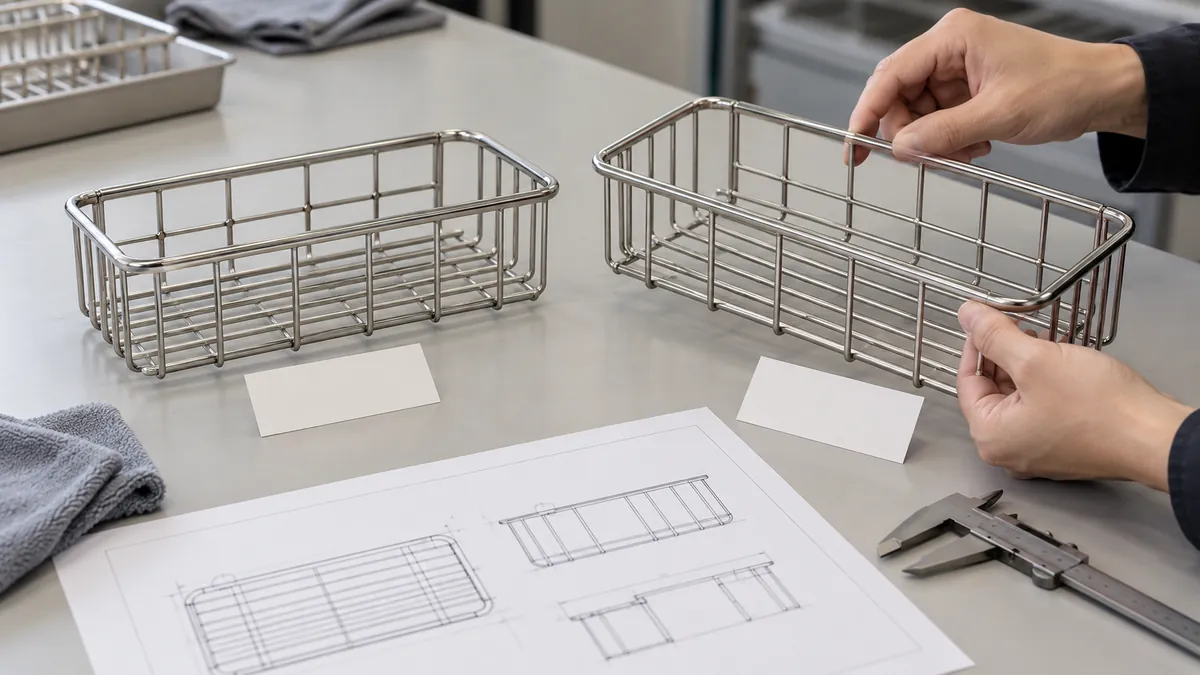
For custom metal hardware, transferability deserves particular attention. Two factories can interpret a drawing differently, use different forming or welding sequences, select different fixtures, or deliver different surface appearance while nominally meeting a short specification. Before calling products interchangeable, compare the approved construction and finish, hole and bend locations, wire or tube dimensions, weld positions, assembly fit, packaging and inspection method. The buyer should identify which features are critical and how they will be measured.
A practical sequence for qualifying a second source is:
- Provide the same controlled drawing, revision, product brief and acceptance criteria.
- Confirm material, finish, critical-to-quality characteristics, packaging and labeling.
- Review sample differences against the approved master sample and record accepted deviations.
- Confirm tooling and fixture ownership, availability, maintenance and transfer rights.
- Run a representative trial lot and inspect it using the agreed method.
- Compare packaging, carton identification and shipment documentation.
- Define who approves changes and what event requires requalification.
- Set a review cadence or a small exercise order so the backup does not exist only on paper.
The sequence will vary by product and buyer risk. It is not a claim that every SKU needs duplicate tooling or identical factory equipment. The buyer’s goal is evidence that the alternative can meet the product requirements, not superficial similarity.
How should buyers compare continuity options?
Build a comparison around one SKU and one interruption scenario. The following matrix identifies the questions to resolve; it does not assign a universal score or recommend a fixed supplier split.
| Response | What it can protect against | Main cost or limitation | Evidence to confirm |
|---|---|---|---|
| Additional safety stock | Short interruption within the covered time window | Cash, space, aging, obsolescence and eventual depletion | Demand assumptions, usable stock, lead time and replenishment trigger |
| Dormant qualified source | Production interruption at the primary source, if alternative capacity is available | Qualification expense and risk that an idle process or slot has changed | Current sample, trial-lot evidence, capacity confirmation and change controls |
| Warm backup | Loss of readiness caused by long inactivity | Periodic coordination and small-order cost | Recent production record, current tooling and latest approved revision |
| Routine dual allocation | Exposure to one source and potentially more order flexibility | More planning, supplier oversight and consistency comparison | Approved source-specific controls and common acceptance criteria |
| Alternate SKU or design | A source-specific disruption where customers can accept a substitute | Commercial approval, fit/function differences and new inventory | Buyer/customer acceptance and a controlled substitution specification |
A simple total-cost discussion should include more than unit price. For inventory, consider financing, storage, handling and write-off exposure. For a second source, include qualification samples, inspection, engineering clarification, tooling or fixture work where required, freight, order minimums and ongoing coordination. Avoid claiming that either option always reduces cost: the result depends on the buyer’s own volumes and conditions.

What common planning mistakes create false resilience?
The most common planning error is counting a supplier as qualified because it sent a quote or one attractive sample. Other mistakes include:
- Splitting orders before the two sources have aligned product specifications and acceptance criteria.
- Assuming that identical product names or photographs mean identical materials, dimensions, welds or finish.
- Holding stock without a stated coverage assumption, review date or obsolescence plan.
- Treating supplier capacity mentioned in a quote as reserved capacity.
- Forgetting to control the drawing revision, golden sample, packaging artwork and labels at both sources.
- Duplicating tooling without confirming who owns it, where it is stored, and whether it can be used or transferred.
- Ignoring the work of approving changes to coating, material, fixture, process sequence or subcontracted operations.
- Setting a permanent 50/50 or 80/20 split without evidence that it fits the buyer’s risk and operating costs.
Northern Ireland Business Info’s overview of single versus multiple supplier strategy frames the decision as a balance of disruption exposure and the additional costs of managing more sources. Research on dual sourcing and safety inventory under import uncertainty also treats the answer as conditional on model inputs rather than universal. These sources inform the decision framework; their findings should not be copied as a specific stocking rule for bathroom hardware.
A qualitative supply-chain discussion about a critical supplier with no qualified alternative illustrates the buyer question, but it is an individual cross-industry discussion—not proof of how often hardware importers face the problem.
How should buyers document and support a continuity plan?
A factory can help the buyer clarify product facts within its actual scope: drawings, sample revisions, dimensions, materials, finish descriptions, component details, packaging configuration and manufacturing questions that affect repeatability. It should not promise that another factory can reproduce the product or imply that it manages the buyer’s continuity plan.
For a custom metal hardware project, a useful discussion may cover which dimensions affect assembly, where weld appearance matters, what finish references are approved, how sample changes are recorded, and what needs to be checked in a trial order. A family-owned factory with small-batch OEM experience may be able to discuss drawings or physical samples directly, but the buyer remains responsible for defining the alternative-source requirements and accepting the evidence.
If the product is still being developed, ask each candidate source to quote against the same drawing revision and assumptions. Koitor Hardware’s custom bathroom hardware manufacturing page explains the factory’s relevant product-development context. Do not infer that one supplier page proves multi-site backup capacity.
A continuity record should make the decision reproducible when the team changes or the product is reordered. Keep a controlled record containing:
- SKU, market, buyer owner and date of review.
- Primary source and the verified product/drawing/sample revision.
- Interruption scenario, expected impact and recovery assumptions.
- Chosen response: inventory, qualified dormant source, warm backup, split allocation, substitute, or an explicitly accepted exposure.
- Inventory assumptions and review trigger, if applicable.
- Backup qualification stage, open gaps, tooling status and last trial date, if applicable.
- Material, finish, critical dimensions, weld/assembly details and packaging requirements.
- Acceptance criteria, inspection method and responsible approval owner.
- Change events that trigger review: repeated delay or defect, site/process/material/finish change, tooling move, new SKU variant or a new customer requirement.
- Reassessment date and action owner.
This record should distinguish confirmed evidence from assumptions. For example, “sample approved” is a fact about a sample; it does not prove current capacity, future availability or mass-production equivalence.
Use this buyer checklist before choosing stock or qualifying a second source:
- [ ] Identify the exact SKU and its approved configuration.
- [ ] Document the impact and recovery window for a disruption.
- [ ] Check demand variability, current stock, transit goods and replenishment lead time.
- [ ] Compare carrying and obsolescence exposure with second-source qualification and maintenance work.
- [ ] Confirm whether a substitute product is commercially acceptable.
- [ ] If qualifying another factory, use a controlled drawing and agreed inspection criteria.
- [ ] Confirm material, finish, tooling, fixtures, packaging, labeling and change-control expectations.
- [ ] Inspect a representative trial lot before treating the alternate as ready.
- [ ] Assign an owner and review date to the plan.
Frequently asked questions
Does a second supplier guarantee uninterrupted supply?
No. It creates another possible production route only if the supplier is qualified, available, and able to meet the controlled requirements when needed. Capacity, materials, tooling, logistics and the disruption itself can still constrain supply.
Should an importer always split orders between two factories?
No. Routine allocation can keep both sources active, but it increases coordination and may be uneconomic for some SKUs. Compare interruption exposure and total management cost before setting an allocation.
Is a golden sample enough to approve a backup source?
No. It records a visual or agreed product reference, but the buyer should also review critical specifications, materials, process-related requirements, packaging and a representative trial lot. A sample alone does not establish ongoing capability.
How should buyers evaluate dual sourcing vs safety stock?
Inventory may be simpler where the product and demand are stable, the disruption window is limited, and an alternate source would take longer or cost more to qualify. Confirm the buyer’s own assumptions and set a review trigger rather than treating stock as permanent protection.
Work With Koitor Hardware
Plan a Custom Metal Hardware Project
Share the drawing or sample, target market, order pattern and packaging requirements. Koitor Hardware can discuss manufacturing questions within its verified bathroom and home-storage hardware scope; continuity decisions remain specific to the buyer’s SKU and supply plan.
OEM / PRIVATE LABEL
Turn this sourcing guide into a product brief
Share your target product, size, finish, order quantity and packaging requirements. Your team receives a practical manufacturability review before quotation.
 English
 Español
 Português
 Français
 Deutsch
 العربية