
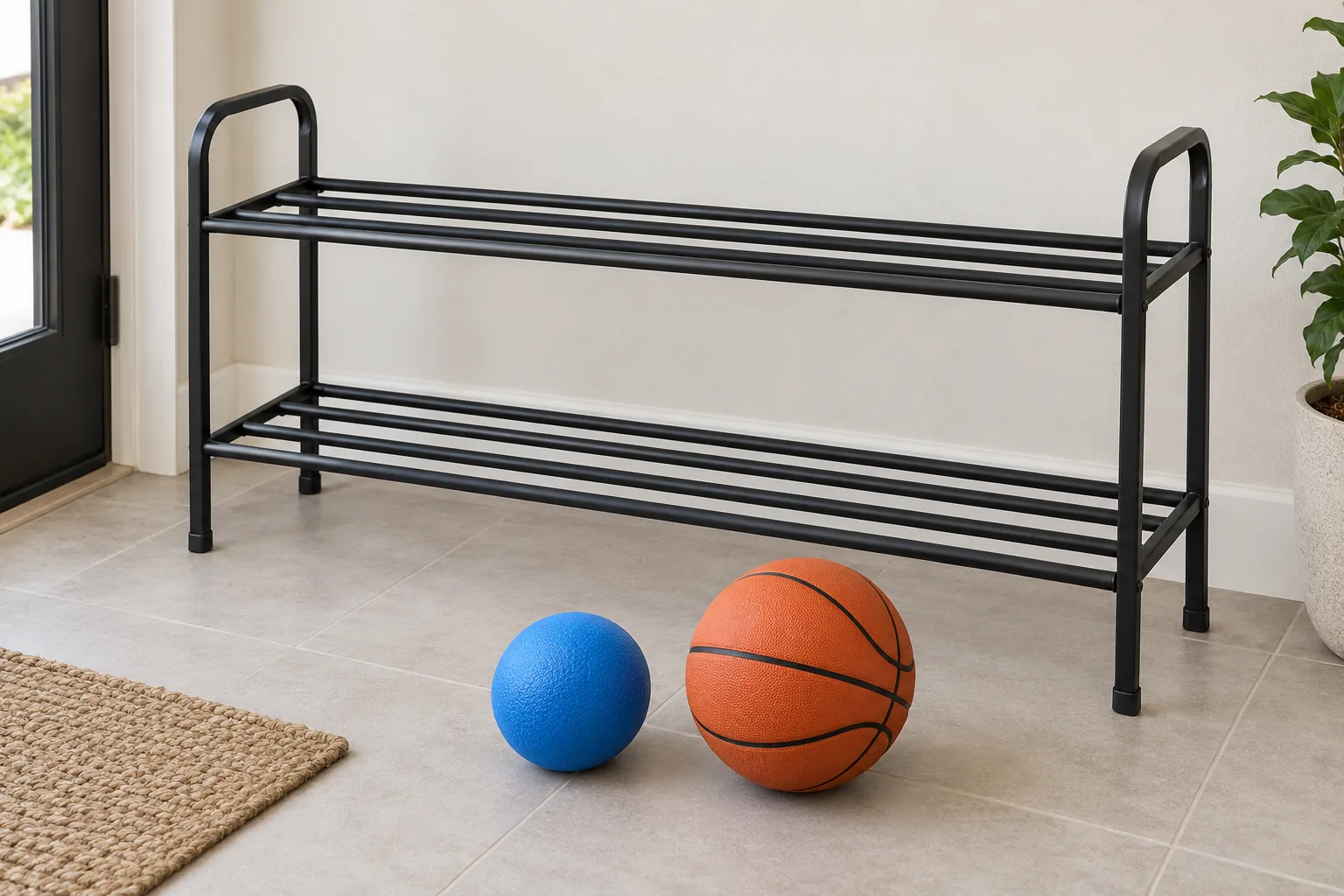
Ball storage rack ball size is a fit decision, not a capacity label. Buyers should match the actual ball diameters and shapes in the assortment to rail spacing, retaining stops, compartment clearance and the path users need to remove each ball. A rack that accepts one large sample may still lose a smaller ball between its rails, while a narrow opening that retains the smallest ball may make the largest difficult to retrieve. Approve representative small and large balls together in the finished assembly, and keep any compatibility statement limited to the models or dimensional range actually reviewed.
In a buyer’s search, “ball storage rack ball size” is shorthand for this interface question, not a universal geometry standard.
Why does ball diameter affect rack fit and retrieval?
A ball is supported by contact with a frame, shelf or pair of rails. Its diameter affects where that contact occurs, how far it can settle into an opening and how much room remains around adjacent items. When the diameter range is broad, one nominal “ball rack” configuration may behave differently at its smallest and largest intended sizes. A buyer therefore needs the assortment definition before approving the rack geometry.
A product page may give a nominal capacity such as a number of balls, but capacity does not answer whether each ball stays in its intended section or can be removed without moving the rest. A ball can bridge two rails, sit partly below their top plane, contact a retaining stop, or rest against a divider. Those relationships depend on the rail location and the ball’s actual surface and shape. Diameter is one key input, not a complete fit specification.
Household and entryway organizers should also be distinguished from sports-equipment racks. Medicine balls, slam balls and other weighted training products introduce load and use conditions that are outside a lightweight household storage guide. This article addresses household and entryway storage for the intended recreational ball assortment. Do not transfer a household organizer example to gym equipment or use it to imply a load rating.
A first-party product example helps show why buyers should ask for dimensions rather than a vague capacity claim. Yamazaki’s Tower Rolling Entryway Storage Shelf lists a 14–24 cm ball-diameter range and separately provides the pitch between pipes and the height of its upper and lower storage sections. Those values describe that specific product only; they are not universal spacing rules or suggested dimensions for another rack. The useful lesson is that the compatible ball range and the relevant rail geometry should be stated together.
Which rack features determine retention and access?
Start with the support direction. A ball resting across parallel rails may settle between them; a ball held within a ring or curved cradle has a different contact pattern. A front retaining lip can reduce forward movement but may obstruct removal. A side stop can limit lateral travel without addressing the opening beneath the ball. Buyers should identify which features carry, retain and divide the balls rather than treating every visible bar as equivalent.
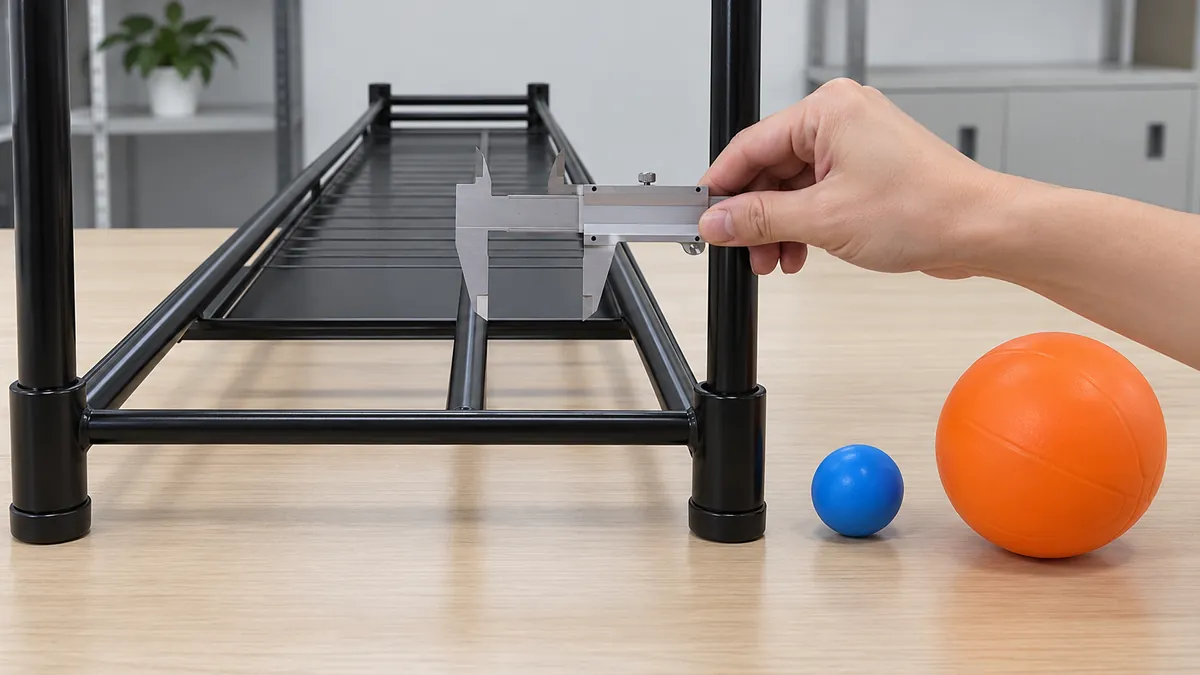
Clear spacing should be measured between the surfaces that actually form the opening, not inferred from the outside width of the frame. A support rail may be offset from a side frame, and a rounded tube or wire changes the clear gap compared with its centerline pitch. If the supplier drawing uses centerline spacing, request the rail diameter or section and calculate the resulting clear opening with the supplier. Record both the drawing datum and the usable opening so sample checks can be compared with the intended design.
The largest ball creates a different set of questions. Check the compartment’s clear width, depth and height at the point where the ball sits, including nearby uprights, dividers, handles, hooks or a top shelf. Confirm that the ball can be placed and removed along a plausible path. The outer rack width alone does not show whether a hand can reach the ball or whether a neighboring ball blocks it.
Surface finish and edge details also matter to the interface. A rough cut end, exposed joint, sharp corner or projecting fastener may catch a ball’s surface or make retrieval awkward. The visual finish should be examined where the ball contacts the rack, but a clean appearance alone does not establish retention or durability. If the product will be used with coated, inflatable or soft-surface balls, include representative examples in the review and define any cosmetic acceptance criteria separately.
What dimensions should the buyer record?
Create a fit record that links the ball assortment to the rack revision. For each reference ball, note its measured diameter at more than one orientation if the shape is not perfectly spherical, plus its surface type and any attached valve, seam or protrusion that may contact the rack. Record the measurement source and whether the item is new, inflated or otherwise prepared for normal storage. Do not substitute an internet size chart for the actual samples when the buyer already knows the intended models.
For each storage position, document the clear distance between supports, the rail or wire section, section depth and height, divider locations, stop height and any path needed to insert or retrieve the ball. The goal is not to impose a universal dimension. It is to make the supplier’s assumptions visible and checkable.
| Buyer check | What to record | What it helps confirm |
|---|---|---|
| Smallest intended ball | Model or measured diameter, shape and surface | Whether the ball is retained at the narrowest support opening |
| Largest intended ball | Model or measured diameter, orientation and protrusions | Whether the ball fits the compartment and can be retrieved |
| Rail geometry | Clear opening, centerline pitch and rail section | What opening the ball actually spans or settles into |
| Retaining features | Front lip, side stop, divider or cradle position | Which feature prevents unintended movement in the selected use |
| Neighbor clearance | Ball-to-ball and ball-to-frame space | Whether one ball blocks placement or retrieval of another |
| Rack revision | Drawing number, sample identity and component changes | Whether a future sample matches the approved interface |
| Scope of claim | Named models or agreed dimensional range reviewed | Which products the fit statement actually covers |
A fit matrix should preserve exceptions. If the smallest ball is secure but the largest needs to be rotated for removal, record that orientation. If a particular shape has a valve stem or projecting handle, state whether it was included in the approval. An article of product copy should not convert a single successful sample into an unrestricted “fits all balls” statement.
Record the search phrase “ball storage rack ball size” separately from the approved dimensional envelope and sample evidence.
How should buyers review a finished sample?
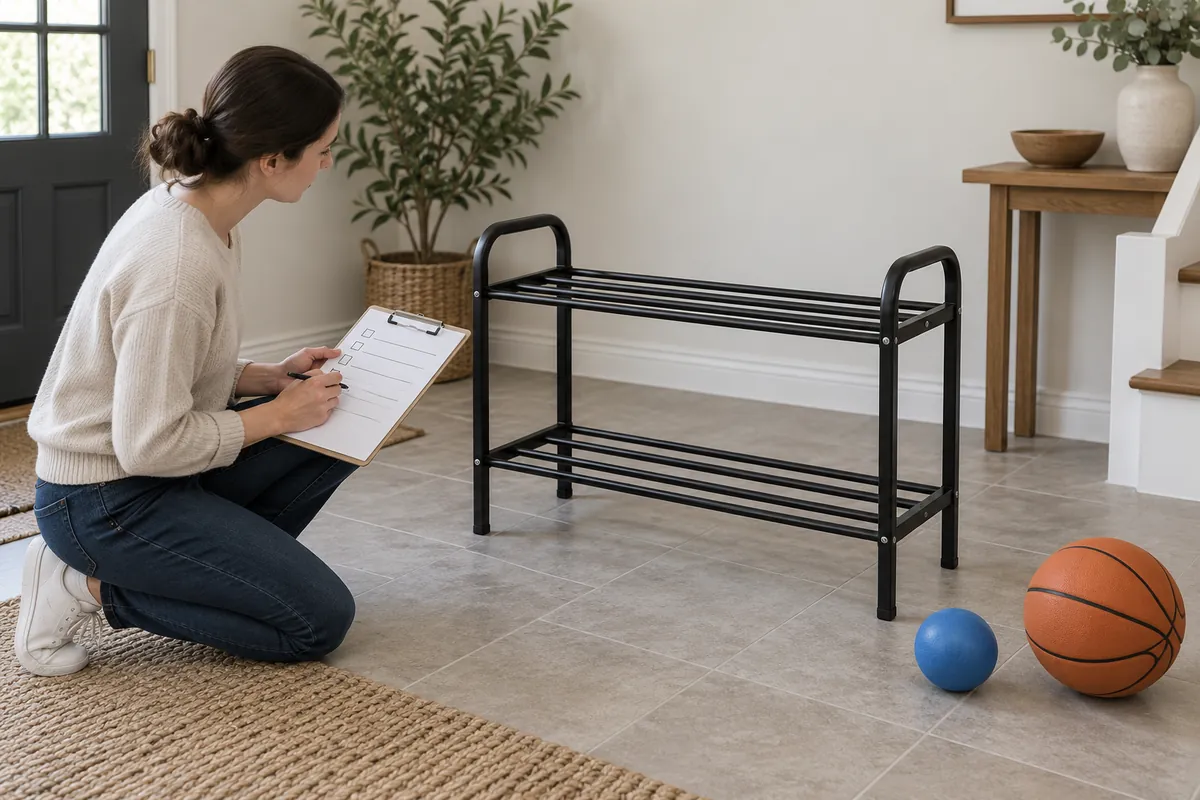
Test the smallest and largest intended examples first, then review the mixed assortment. Place each ball using the normal approach, release it without adding an unplanned hand hold, and observe where it settles. Check whether it can move through an opening, roll toward an edge, wedge against a divider or contact a neighboring item. The objective is to observe the actual interface under agreed conditions, not to claim a universal retention result.
Then remove each ball along the intended user path. Confirm that a hand can reach the item, that any retaining lip or stop does not require an awkward lift, and that one ball can be retrieved without shifting the whole row unless that movement is an accepted part of the design. A rack may retain every ball when static and still be difficult to use if the removal sequence is blocked by adjacent balls or uprights.
Load the full planned assortment in its intended arrangement. This checks whether the balls change position when neighboring spaces are occupied and whether the largest example crowds the opening needed by a smaller one. If the rack has multiple levels, verify each section independently and then review how the sections interact. A large ball on a lower level can project into the space needed to remove an upper-level ball.
Use a simple review record: ball identifier, measured or supplier-declared diameter, rack revision, storage position, placement result, removal result, interference observed, and disposition. Photograph the support contact from the front and side. If a test involves moving the rack, a particular floor surface, a defined tilt, repeated placement or another condition, agree that method and acceptance point in advance. A sample fit review without such a defined method must not be described as a stability, transport or durability test.
What should the supplier show on the drawing and sample record?
Ask for an assembly view that identifies the intended ball positions and support direction. Include section details for the rails, stops, dividers and contact surfaces, plus the clear access path for the largest ball. If the rack is adjustable, label the permitted adjustment positions and show how the selected arrangement is locked or retained. Do not assume an adjustable component remains in place under ordinary handling unless the supplier’s design and review support that conclusion.
A drawing should state whether dimensions refer to rail centerlines, outer surfaces or the clear gap between surfaces. It should identify the applicable tolerance source or project acceptance method rather than leaving the measurement datum ambiguous. Buyers should avoid copying the dimensions from a retail example without considering differences in rail diameter, material section, ball shape and intended use.
The finished sample should use the relevant production-intent frame, joints and surface finish where those features affect contact or removal. If a prototype omits a divider or uses a temporary support, record the difference and do not treat it as final fit approval. Ask the supplier to provide a revision-controlled drawing and identify the sample inspected so both parties can compare later changes.
A change to rail spacing, rail section, stop height, divider position, coating process or frame width can alter the contact interface. The supplier should flag changes that may affect the approved ball range and provide a short fit-impact assessment. The buyer can then decide whether to repeat only the affected size check or review the complete assortment. Keep product copy and packaging statements aligned with the verified range.
Koitor Hardware is a family-owned custom metal hardware factory focused on bathroom and home storage hardware. Its wire and tube rack forming, welding, finishing and assembly experience supports discussion of related metal storage geometry, but current production of this ball-rack SKU, fitness equipment engineering and advertised load ratings are unconfirmed. Buyers should share a drawing or physical sample so the exact project scope can be confirmed before quotation. Fit approval, load capacity and child-safety or other regulatory requirements are separate questions and should not be inferred from metal fabrication experience.
Buyer checklist before requesting a quotation
- Identify the product as a household or entryway organizer; exclude medicine-ball, slam-ball and gym-equipment uses unless separately engineered and supported.
- Provide representative smallest and largest balls, or a documented dimensional and shape envelope.
- State whether the balls are stored on parallel rails, a shelf, a cradle or another defined support.
- Request the clear opening and rail-section dimensions as well as centerline spacing.
- Show dividers, stops, shelf heights and the intended insertion and removal path.
- Review ball-to-frame and ball-to-neighbor clearance in the planned assortment.
- Record whether valve stems, seams, handles or soft surfaces were included in the sample review.
- Identify the approved drawing revision, sample and ball references.
- Define any movement or handling check before testing; do not treat a fit check as proof of stability or durability.
- Limit compatibility claims to the models or measured range actually reviewed.
- Request a fit-impact review if rail geometry, finish, divider layout or ball assortment changes.
- Keep product-capability and performance claims separate from adjacent manufacturing expertise.
Frequently asked questions
Does a ball rack’s stated capacity prove that every ball size fits?
No. Capacity usually describes a number of positions or the supplier’s stated assortment. It does not by itself prove that the smallest ball is retained, the largest fits, or the mixed group can be removed conveniently. Ask which ball sizes and arrangement the figure covers.
Is rail pitch the same as the clear opening?
Not always. Pitch commonly describes distance from one rail centerline to another, while clear opening is the free space between their surfaces. The rail section determines the difference. Ask the supplier which datum appears on the drawing and verify the usable opening on the sample.
Can one rack hold both small and large balls?
Potentially, if the support layout and access path accommodate the intended range. The buyer should review representative smallest and largest balls together, then check the mixed assortment. A product example or one successful sample does not establish universal fit.
Is the 14 cm pipe pitch a recommended size for all ball racks?
No. Yamazaki lists a 14 cm pitch for the ball sections of one specific entryway shelf and a model-specific compatible ball diameter range. Other rack geometries, rail sections and ball assortments can require different dimensions. Treat the published value as an example, not a design standard.
Does fitting the balls prove a rack can carry the stated load?
No. Fit checks assess the interface and access for the reviewed items. Load capacity requires its own defined configuration, loading method and evidence. Do not infer a rating from a ball’s diameter or from a fit result.
What should change control cover after sample approval?
Record any revision to the rails, dividers, stops, frame, coating or reference ball range that could affect support or retrieval. Ask whether the approved size matrix still applies and repeat the relevant checks where the interface changed.
Reference example: Yamazaki’s Tower Rolling Entryway Storage Shelf publishes a model-specific 14–24 cm ball range and the pitch and height of its ball-storage sections. Those figures are examples for that product, not universal criteria. For related OEM sourcing, see Koitor’s home-storage hardware manufacturing page.
Discuss a Custom Metal Storage Project
Share the ball-rack drawing, target ball assortment, support geometry, finish and packaging requirements. Koitor can review confirmed metal-hardware scope and manufacturability; production of this exact rack must be confirmed for each project.
OEM / PRIVATE LABEL
Turn this sourcing guide into a product brief
Share your target product, size, finish, order quantity and packaging requirements. Your team receives a practical manufacturability review before quotation.
 English
 Español
 Português
 Français
 Deutsch
 العربية