

Short answer: Compare named suppliers and actual production sites on the same specification, quantity, process scope, sample criteria, packaging and delivery basis. China and Southeast Asia are broad geographic labels. Neither one proves a particular factory’s capability, cost, quality or suitability for a bathroom or home-storage hardware SKU.
A useful China vs Vietnam sourcing comparison starts with a buyer’s product and destination, not a country ranking. A metal basket, towel bar, shower caddy or cabinet organizer may depend on several separate operations: cutting, forming, welding, grinding, polishing, coating or plating, assembly and protective packing. One supplier may control some steps and subcontract others. A listing that shows an office or warehouse does not by itself identify where the product is made or which process owner is accountable.
This guide gives importers, distributors and product teams a repeatable way to compare alternatives without relying on wage generalizations, supplier badges or a single attractive sample. It also explains what can and cannot be inferred from public comparisons of China and Vietnam. Koitor is a China-based family-owned metal hardware factory; this article does not claim Koitor has Southeast Asian production or a network there.
Table of contents
- Why a country label is not a supplier qualification
- Start with one defined SKU and a controlled RFQ
- Map the actual process and site ownership
- Compare samples using the same acceptance plan
- Normalize quotes before comparing landed cost
- Check origin and compliance with the right specialists
- Build a risk comparison that can be updated
- When an additional source is useful
- Practical sourcing worksheet
- FAQs
Why a country label is not a supplier qualification
Country-level sourcing articles can help a team formulate questions, but they cannot substitute for supplier-specific evidence. The Federal Reserve’s analysis of Vietnam’s export growth describes changes in supply-chain geography and the role of Chinese firms in Vietnamese exports. It is macroeconomic context, not evidence about a given bathroom-accessory manufacturer, an individual SKU’s origin, or a supplier’s metalworking process. It should not be used to infer that any particular Vietnamese factory depends on a particular Chinese input, or that one country’s suppliers perform better.
For a buyer, the operational questions are narrower: Which legal entity is quoting? What is the production-site address? Which operations happen at that site? What is purchased from subcontractors? Who controls drawings and revisions? Who approves a process change? What quantity and delivery plan does the offer cover? Those facts have to be verified for the named candidate.
A country comparison becomes misleading when it bundles distinct factors into a single conclusion. Labor rates, industrial clusters, port routes, supplier density, tooling access and language support may matter differently for a given design and order. A general article cannot calculate a buyer’s landed cost without the product, bill of materials, route, destination, order size, packaging dimensions, delivery term and current destination rules. Therefore, avoid conclusions such as “Vietnam is cheaper” or “China is always more flexible” unless a carefully defined, current comparison supports that exact case.
For bathroom and home-storage hardware, the product architecture can also change the relevant supplier pool. A wire basket may require different equipment and finishing access than a sheet-metal wall plate, a welded tube structure or an assembly containing purchased plastic or adhesive parts. A supplier’s country is a weak proxy for the process sequence. Request a process map and ask the supplier to distinguish in-house operations from subcontracted ones.
The comparison should be between Supplier A at Site A and Supplier B at Site B for one controlled scope. If the scope changes, record the change. A second-source decision can be useful even when the alternative does not reduce quoted unit price: it may improve resilience, serve a different region or give the buyer a different production route. Those benefits must be weighed against qualification, tooling, inventory and change-control costs rather than assumed from geography.
Start with one defined SKU and a controlled RFQ
Choose one representative SKU, preferably one that matters commercially and exposes the processes the team needs to evaluate. Do not compare a simple towel hook from one source with a multi-part shower organizer from another. The design, finish, packaging and quantity make the comparison uninformative.

Issue a controlled RFQ package with the same drawing revision, material and finish requirements, key dimensions, cosmetic-face notes, joint expectations, assembly requirements, labeling, packaging, quantity breaks and target delivery window. If the design is still changing, mark the open questions and avoid treating an early estimate as a firm, comparable quote. Record whether tooling is new, existing, modified or not applicable; ask the supplier to describe the assumption instead of leaving the line blank.
The RFQ should identify the order scenario as well as the nominal quantity. A quote for an initial trial order may be structured differently from a forecast with repeat releases. Provide a realistic annual range if available, but distinguish a forecast from a purchase commitment. Ask candidates to state minimum quantities, setup assumptions, quote validity and any price breaks in the same units. Do not pressure suppliers to quote a false precision for dimensions, materials or packaging that have not been approved.
For each supplier, record unanswered questions rather than awarding a score for a polished presentation. Examples include an unclear finish specification, a missing carton drawing, an unnamed coating subcontractor, no sample schedule, or a quote that omits a purchased component. Use the same clarification log for all candidates. If a supplier proposes a substitute material or process, compare it as a separate option and require written approval before it becomes the basis for the order.
Controlled-RFQ fields
| Field | What the buyer should freeze or ask |
|---|---|
| Product identity | SKU, drawing number, revision and intended application |
| Quantity | Trial quantity, forecast scenario and release pattern |
| Material and finish | Exact required grade or approved alternative, finish and visible surfaces |
| Critical interfaces | Hole positions, bends, mating parts, clearance and assembly |
| Process scope | In-house operations, subcontracted steps and accountable party |
| Tooling | Existing, new, modified or not applicable; ownership and assumptions |
| Quality plan | Sample approval, critical dimensions, functional checks and records |
| Packaging | Unit protection, carton quantity, labels, master-carton dimensions |
| Delivery basis | Named destination, shipping term and what costs are included |
| Open points | Owner, evidence needed, due date and decision status |
This is also where a buyer should separate product requirements from sourcing preferences. “Must use this finish” is a technical requirement; “prefer a supplier in a particular region” is a sourcing criterion. If the two conflict, make the trade-off explicit. A lower quote that relies on a different finish, fewer inspection records or a different carton specification is not a like-for-like offer.
Map the actual process and site ownership
Ask each candidate to describe the product’s route from incoming material to packed goods. A useful map names the site and the operation, such as wire forming, tube cutting, sheet-metal bending, welding, grinding, surface finishing, assembly, inspection and packing. It should identify external process providers where applicable and state how the supplier controls drawings, samples, deviations and incoming parts.
The aim is not to demand that every operation occur under one roof. Outsourcing a process is not automatically a defect. The buyer needs to know where risk and responsibility sit. For example, if finishing occurs at another site, ask who issues the finish specification, how parts are identified through transfer, how mixed lots are prevented and what record links the finished lot to the purchase order. If fasteners or pads are purchased, clarify who selects the component and how substitutions are controlled.
A supplier profile, directory listing, platform badge or trade-show booth is a lead, not a process audit. It may help confirm contact details or identify a potential business, but it does not prove that the displayed address is the manufacturing site, that the supplier owns the process, or that a specific line can meet the requested output. Ask for evidence proportionate to the order risk: a site discussion, process photographs, sample records, capability explanation, traceability example, or a third-party audit if the buyer requires and arranges one. Do not treat any single item as proof of long-term production consistency.
For a metal product, ask concrete questions tied to the drawing:
- Which features are formed, welded, machined or assembled?
- How are the critical hole-to-bend and mating-part dimensions checked?
- Which surfaces are cosmetic, and how are handling marks controlled before finishing?
- How are work-in-process lots identified when they move between operations?
- What records are retained for material, finish, inspection and shipment?
- Who is authorized to approve a change to the process, sub-supplier or material?
- What happens when actual production differs from the approved sample?
The answers should describe a real control, not just repeat “strict quality control.” If a supplier cannot answer immediately, that can be a follow-up item; it does not prove incapability. Record the evidence requested and the date due. Distinguish a verified answer from a verbal assurance, and distinguish a capability claim from a completed trial on the actual SKU.
A process map also helps clarify the meaning of “country of origin.” Supplier address, production site, process location and source of purchased inputs can be different facts. A shipment label or invoice address alone may not answer customs-origin questions. The buyer should maintain those facts accurately and consult a customs broker or qualified adviser for destination-specific origin determinations. Never use a supplier’s broad marketing phrase as a legal conclusion.
Compare samples using the same acceptance plan
A sample is useful only when the buyer knows what it represents. Mark whether it is a catalog sample, hand-built prototype, pre-production sample, or sample made using the intended material and process. Note whether it was made at the proposed site and whether any finish, fastener, insert or purchased component differs from the quote. A sample that is not representative can still answer selected design questions, but it cannot silently stand in for every production condition.
Set a simple comparison protocol before samples arrive. Use the same drawing revision, measurement method, reference points and packaging checks for each candidate. Record dimensions that matter to fit and assembly; do not measure every feature merely to generate paperwork. For a wire shelf, that might include overall envelope, mounting pattern, spacing at a mating interface and clearances identified on the drawing. For a wall-mounted rack, it may include projection, plate location and assembly alignment. Let the product’s design determine the critical checks.
Inspect both the product and the evidence that accompanies it. Photograph the sample beside its label or sample ID. Record the supplier, site, date, declared material and finish, drawing revision, any deviations and the person who approved them. When the sample is assembled, note whether the parts fit without forcing and whether the intended user can reach any service or adjustment point. If an issue is found, state the observed condition and measurement rather than using only a subjective grade such as “poor.”
Do not confuse a sample approval with bulk-production approval. A sample demonstrates one instance, under the conditions recorded. Repeatability depends on process controls, material variation, fixtures, handling, outsourced operations and inspection. For the first production order, define a pre-production or first-article review if needed, identify the lot and revision, and state how a discrepancy will be handled. A supplier’s strong sample is positive evidence, but it is not a guarantee of all future production.
When two candidates are close, compare the unresolved risk rather than forcing a winner. One may have a better-documented process but a longer lead-time assumption. Another may have a more familiar finish process but require an additional sub-supplier. Identify what evidence would change the decision: an updated quote, an approved sample, a documented process route, a packaging trial or a destination-specific logistics estimate. A decision log prevents the team from treating opinions as facts after the review meeting.
Keep a retained reference sample only if the parties agree what it represents and how it will be stored and retrieved. Mark the sample with the approved revision and date; do not rely on a box labeled simply “golden sample” if several finishes or design revisions exist. If the product changes, decide whether the old sample remains relevant for unchanged features or must be replaced. That small control makes future reorders easier to investigate.
Normalize quotes before comparing landed cost
Price comparisons are only useful when the quote scope matches. Ask each supplier to break out or clearly describe the assumptions for unit price, tooling, setup, packaging, inspection, sample charges, minimums and delivery. If a supplier cannot separate a cost, record that limitation rather than inventing an allocation.
Normalize the commercial scenario:
- Same product drawing and revision.
- Same material and finish, or a clearly separated alternative.
- Same quantity and shipment-release assumption.
- Same packaging configuration and labeling.
- Same included inspections and documents.
- Same delivery destination and named delivery basis.
- Same currency, quote date and validity period.
Then calculate destination-specific cost using buyer-verified inputs. Freight, insurance, duties, taxes, brokerage, inspection, local handling and inventory carrying effects may matter, but the values depend on the route, product classification, destination and current conditions. Use a customs broker or logistics provider for applicable charges and rules. Do not copy a broad web estimate into a quote comparison as if it were current for the actual SKU.
A lower unit price may be offset by minimum order quantities, tooling, extra packaging, longer replenishment cycles, higher inspection burden or a need to carry more safety stock. Conversely, a higher quote could include a process or service that the buyer would otherwise purchase separately. The right question is not “Which country is cheaper?” but “Which defined offer has the best total fit for this buyer’s cost, lead-time, quality and risk requirements?” The answer can differ by SKU and destination.
Use scenarios when the forecast is uncertain. Compare the initial order, a normal replenishment and a higher-volume case. Include the effect of MOQ and carton quantity, not just a per-piece estimate. If the supplier’s price break depends on a quantity the buyer cannot store or sell, show that inventory consequence. If a quote assumes a production run that is not yet authorized, keep it separate from the purchase commitment.
Lead time should also be normalized by milestone. Ask when the clock starts: deposit, approved drawing, sample sign-off, material availability or purchase-order confirmation. Separate production completion from inspection, booking, transit and receipt. Different suppliers may use “lead time” for different intervals. Record the supplier’s stated basis and the buyer’s own target rather than treating one number as a universal promise.
Before awarding, review whether the price and schedule are still valid and whether open technical questions have been closed. A quote received weeks earlier may need reconfirmation if material, freight, exchange rates or scope changed. Preserve the original version and the revised version so the buyer can see what changed. This is especially important if a sourcing comparison is being presented to finance or leadership.
Check origin and compliance with the right specialists
Supplier-origin research is not a substitute for customs advice. For imports, the buyer may need to establish the correct product classification, origin documentation, duty treatment, marking and other destination-market requirements. Those questions can depend on the product’s materials, manufacturing operations, input sourcing and applicable rules. The supplier can provide factual process and material records, but it should not be asked to make a definitive legal conclusion outside its expertise.
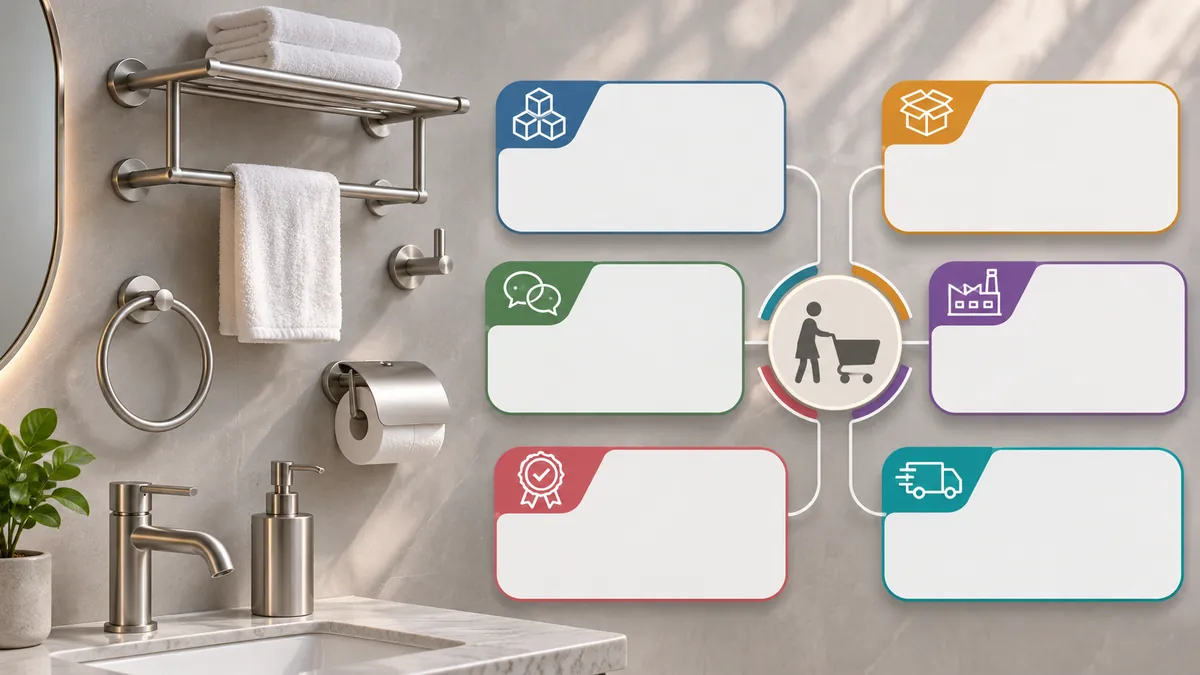
Keep a factual record with separate fields for the supplier’s registered address, the actual production location, process locations, subcontracted operations, material origin if documented, and the exporter or seller of record. Do not merge these into one “made in” assertion without qualified review. If country-of-origin claims affect a procurement decision, ask a broker or trade-compliance professional what evidence is needed and retain the resulting determination with the order file.
Similarly, standards and product requirements should be evaluated for the actual application and destination. This article does not assert that a particular bathroom accessory is subject to a specific certification, testing standard or legal requirement. The product owner should identify the relevant requirements, confirm current applicability through official sources or a qualified adviser, and give suppliers the applicable specification. Avoid asking suppliers to quote against the vague phrase “export standard.”
For supplier qualification, ask whether the offered manufacturing route can preserve the records your compliance process needs. If a coating or material certificate is requested, define the exact document, lot, issuer and product it must cover. A generic company certificate may not be evidence about the specific batch. If a restricted-substance declaration or other document is needed, define the applicable product and market and have the responsible compliance team review it. The goal is traceable evidence, not a collection of unrelated PDFs.
Build a risk comparison that can be updated
A sourcing decision should show what is known, what is assumed and what remains open. A useful scorecard can rate candidates on the buyer’s own criteria, but avoid a false sense of precision. For example, a team may classify each item as verified, partially verified, open or not applicable instead of assigning arbitrary decimal scores.
| Decision area | Evidence to retain | Open question example |
|---|---|---|
| Product fit | Controlled sample and dimension record | Has the proposed sample used the intended finish? |
| Process ownership | Process map and named site | Which party controls the outsourced finish step? |
| Revision control | Drawing register and change approval | How will a substitution be communicated? |
| Quality evidence | Inspection plan and actual sample record | Which dimensions are critical to fit? |
| Capacity and timing | Current schedule basis and order scenario | What milestone starts the lead-time estimate? |
| Packaging | Pack specification and carton details | Does the quote include the approved protection? |
| Commercial scope | Comparable dated quotes | Are tooling and setup treated consistently? |
| Destination cost | Broker and forwarder inputs | Which assumptions still need validation? |
| Continuity | Second-source qualification plan | What extra inventory or revalidation is required? |
Update the scorecard when evidence changes. A quote revision, sample correction, site change, material substitution or packaging update can alter the outcome. Keep an issue owner and due date so “open” does not become an invisible exception. If a supplier cannot provide evidence, describe the limitation factually and decide whether it matters to the order risk; do not fill the gap with a country stereotype.
Do not compare a well-documented candidate with an undocumented one using different levels of scrutiny. Give each supplier the same information and reasonable opportunity to answer. Clarify questions consistently and preserve responses. This helps prevent a fluent salesperson from receiving credit for evidence that another candidate was not asked to provide.
A decision can also be conditional. For example: approve a sample after one interface dimension is corrected; place a trial order after packaging is confirmed; or keep an alternative supplier qualified only for a subset of SKUs. State the condition, approving person and expiration or review trigger. Do not represent a conditional shortlist as a fully approved production source.
When an additional source is useful
A second source may reduce dependence on one process route or support demand in a different region, but it introduces work. The buyer may need separate tooling, product qualification, packaging, labels, inspection, supplier communication and inventory planning. If the second source uses a different process or material, the resulting product may not be interchangeable even if its outer dimensions match. Define whether the aim is exact interchangeability, contingency capacity, a regional assortment or a different price point.
For a second-source plan, start with the highest-risk item rather than duplicating every SKU automatically. A component with long replenishment, no substitute or high customer impact may justify qualification sooner than a low-value item with several compatible alternatives. Document the required records and the test or sample evidence before launching the qualification. Include the cost of maintaining approved drawings and samples for both sources.
If the buyer is evaluating a Chinese factory directly, existing guidance on China bathroom-hardware sourcing clusters can help organize regional supplier discovery, while the direct-factory versus sourcing-agent comparison explains responsibility questions. Those pages address different decisions; neither should be treated as a ranking of countries. For another qualified supplier, see the buyer checklist on qualifying a second source for a hardware component.
Koitor can discuss a scoped metal-hardware inquiry based on the actual product drawing or sample and the buyer’s requirements. It cannot validate an unrelated supplier, certify a Southeast Asian production site or determine customs origin. For a suitable metal part, share the drawing revision, quantity scenario, material/finish, critical interfaces and packaging scope through the Koitor contact page. A sourcing choice should remain evidence-led and specific to the buyer’s actual order.
China vs Vietnam sourcing: practical buyer worksheet
Before comparing supplier proposals, complete one page for the SKU:
- Product name, SKU, drawing number and revision.
- Destination market and named delivery location.
- Initial quantity, forecast range and release pattern.
- Required material, finish and visible surfaces.
- Critical dimensions and functional interfaces.
- Requested process route and acceptable alternatives.
- Supplier legal entity and production-site address.
- In-house operations and named subcontracted steps.
- Sample type, revision, measurements and approval owner.
- Inspection records and lot identification expected.
- Packaging, carton quantity, labels and documents.
- Tooling, setup, MOQ and quote-validity assumptions.
- Lead-time milestones and schedule-update method.
- Freight, insurance, duties and local charges from verified sources.
- Open questions, owner, evidence due and decision date.
The worksheet is more valuable when it records evidence links or attachments. Reference a specific drawing, quote version, sample photo, supplier response or broker estimate. If a field is not yet known, mark it as open. Avoid filling a blank with assumptions merely to make the table look complete.
At the review meeting, separate pass/fail requirements from preferences. A missing critical interface dimension may prevent approval; a preference for one region may be negotiable. Weight commercial factors only after the team agrees what evidence is reliable. If a major uncertainty remains, set a qualification step rather than pretending that a score resolves it.
A final comparison memo can state: “For this SKU, quantity and destination, Supplier A is the preferred candidate because of these verified conditions; these uncertainties remain; these are the next approval gates.” That language is more useful than “Country A wins.” It also stays valid only for the scenario and evidence date shown. When demand, route, design or supplier process changes, revisit the comparison.
FAQs
Is China vs Vietnam sourcing a simple price comparison?
No. Compare equivalent offers for a defined SKU, including process scope, quantity, packaging, delivery basis, tooling, schedule and destination costs. A country label does not establish total cost.
Does a factory address prove where the product is made?
No. Request the actual production location and process map, and distinguish in-house work from subcontracted steps. Keep the supplier address and each production location as separate facts.
Does one approved sample guarantee future production quality?
No. It documents one sample under stated conditions. The order should also define revision control, production inspection, lot identification and how deviations are approved.
Should a buyer prefer a country with more supplier listings?
Listing volume can support discovery, but it does not prove that a candidate can meet the drawing, finish, packaging or documentation requirements. Qualify the named supplier and site.
Can a supplier determine customs origin?
A supplier can provide factual process and input information. The buyer should obtain destination-specific origin advice from a qualified customs broker or trade professional.
Is a second source always worth adding?
No. The value depends on supply risk, demand, qualification costs, tooling, inventory and whether the products will be interchangeable. Start with the SKU whose continuity matters most.
What evidence matters before a trial order?
At minimum, align the controlled drawing and quote, review a representative sample, map process ownership, define inspection and packaging, and resolve critical open questions. Add evidence based on the product and order risk.
Does Koitor offer production in Southeast Asia?
This article makes no such claim. Koitor’s confirmed positioning is as a China-based family-owned metal hardware factory. Buyers should verify any candidate’s actual site and capability directly.
For a scoped metal-hardware inquiry, share the approved drawing or representative sample, annual and initial quantities, material/finish, packaging requirements and delivery destination through the Koitor contact page. For drawing preparation, see the drawing and sample guide.
Compare a Metal-Hardware RFQ
Send the controlled drawing, quantity scenario, finish, packaging and destination requirements. Koitor can review a scoped metal fabrication inquiry within its confirmed capabilities.
OEM / PRIVATE LABEL
Turn this sourcing guide into a product brief
Share your target product, size, finish, order quantity and packaging requirements. Your team receives a practical manufacturability review before quotation.

 English
 Español
 Português
 Français
 Deutsch
 العربية