
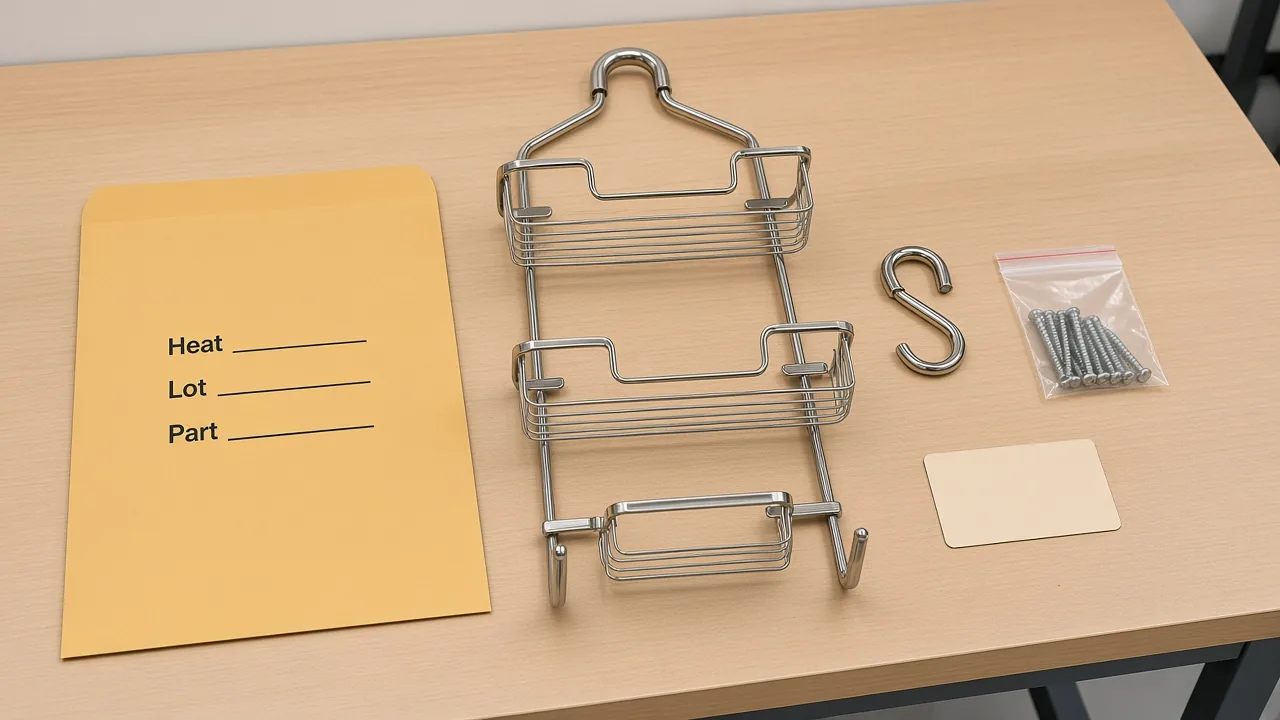
Wording comes after evidence. 201 vs 304 stainless bathroom hardware substitution should be blocked by an incoming and first-article file that covers the actual parts in the order, including hooks and fasteners, not only the showroom tube.
A magnet test is not enough, and a mill certificate that is not tied to the heat or lot is not enough. Freeze the grade scope, the cert and lot links, the limits of any agreed identification method, and the hold rule before a later heat can enter quietly.
This guide is for importers and private-label teams buying stainless bathroom hardware such as shower caddies, bars, hooks, and similar formed goods. It is not a general metallurgy essay, and it is not a rust-proof wording matrix. Koitor Hardware, a family-owned China OEM manufacturer of bathroom and home-storage metal hardware, can review an evidence brief with a drawing, a BOM, and a sample; this page does not claim a factory PMI program or a certified testing laboratory.
Why a wording matrix still needs a substitution-evidence file
A wording matrix decides what rust or grade language a construction may carry on a carton or a listing. An evidence file decides whether the parts in this lot are still the grade that wording assumed. You can write careful rust-resistant language and still be undone by a later hook, screw, or wire heat that is 201 when the BOM said 304.
Generic grade blogs explain families in the abstract. They do not tell you how to link a certificate to a formed caddy, a small hook, and a bag of fasteners. ASTM A240/A240M is a useful grade-family reference for flat product; it is not a substitute for certs on formed wire, hooks, or hardware in a finished SKU.
Custom bathroom hardware manufacturing und Fertigung von maßgefertigten Duschablagen can build stainless programs, but a quotation that only says “304” is not yet an incoming file. The inquiry should list which parts are in the grade scope.
Worked example: a first-article caddy is 304 on the frame. A later production lot uses a 201 hook because the hook vendor changed. The carton still says 304. Rust appears first at the hook, and the wording file is blamed, even though the wording was never the missing control.
Worked example: a mill cert is filed from a coil or a wire rod purchase, but it cannot be tied to the heat on the finished lot. Incoming accepts the paperwork and rejects the claim six months later, when a different heat is in stores. The cert existed. The link did not.
Do not rewrite a rust-wording page here. Do not publish a cookbook for faking grades. The job is to make silent substitution visible and holdable.
Which parts belong in the grade scope?
List every metal part that the shopper or the installer will treat as “the stainless product”: the main tube or wire frame, shelves or baskets, the hang hook or wall hook, weld filler if it is called out, screws, anchors when they are sold as stainless, and any small hanging loop or accessory hook that ships in the same SKU. If a part is allowed to be a different grade, say so in the BOM instead of leaving it silent.
Hooks and fasteners are where substitution often occurs, because they come from a different vendor or a different tote. A first-article photo of a mid-span tube will not catch them. Incoming photos should include the hook and the screw pack, not only the hero frame.
Weld filler, if specified, belongs in the same list. A 304 frame welded with an unspecified filler is a project discussion, not a reason to invent a Koitor welding procedure here. If filler grade is unknown, write it as unknown and decide whether that is acceptable for the claim, rather than implying it was checked.
Plastic caps, rubber pads, and similar non-metal parts stay out of the grade scope, but they should not be used to hide a metal hook or a screw in a photo set. If a cap covers a hook end, still identify the hook in the BOM.
Market kits can change fasteners. A European kit and a U.S. kit may use different screws. If both are called stainless, both belong in the scope. A kit change is a change to the evidence file, not only to a packing list.
{link(GALL, “Stainless fastener galling in metal storage racks”)} is a different decision: it covers thread seizure and lubricant or coating practice. Use it when galling is the problem. This page only asks whether the fastener is still the agreed grade.
What cert, heat, and lot links should incoming require?
Ask for certificates that can be tied to the heat or lot of the parts in the shipment, including the small parts. A cert for a warehouse coil from last year, with no heat link to this lot, is a document, not a chain. Write how the factory will mark or pack the link: a heat number on a tag, a lot code on the hook bag, a packing list that names both.
Say whether the cert is for the input wire or bar, or for a finished part. Formed hooks are often certified at the wire stage. That can be acceptable if the chain is written, and it is not acceptable if the hook vendor can swap wire without a new cert.
Incoming should tick the paperwork against the physical lot before the cartons are released. A certificate that arrives a week later, after goods are already in a 3PL, is a weak control. Hold the lot if the link is missing, rather than hoping the documents will catch up.
Do not invent a Koitor mill or a Koitor laboratory result. If a buyer requires a third-party chemistry or identification report, that is a project requirement, and any laboratory competence expectation such as ISO/IEC 17025 belongs to the chosen lab, not to a factory claim on this page.
Keep the document review method separate from any sampling plan for visual defects. A cert chain is not an AQL number. If you later sample parts for an agreed chemistry method, write that method in its own clause.
What can a magnet test not prove, and what agreed method may be added?
A magnet test is not a grade proof, especially across 200-series and 300-series stainless families used in formed goods. Some 201 and some 304 conditions can confuse a pocket magnet, and a magnet cannot tell you whether a hook in the bag matches the frame. If a magnet is used as a coarse screen, write it as a screen with limits, not as a pass for 304 language.
An agreed identification method, such as a chemistry check or a PMI-style reading, may be added when the buyer and the factory agree the instrument, the locations, and the accept rule.
This article does not invent results, does not assume Koitor owns a particular analyzer, and does not treat a photo of a gun as a certified test. If a project uses such a method, write it in the project file and keep the numbers off artwork until they are real project data.
Locations should include the hook, a fastener from the bag, and the frame, not only the easiest mid-span tube. Substitution that only happens on small parts will otherwise pass.
If no instrument is available, the file can still be strong: a named BOM, certs tied to heat or lot, a hold rule, and a ban on silent vendor changes. An instrument is an addition, not a license to skip the paperwork chain.
| Control | What to freeze | What incoming or first article should show | What to keep off the file or the artwork |
|---|---|---|---|
| Grade scope | Frame, hook, fastener, and any other metal part, including allowed exceptions | The sample and the lot photos include the small parts, not only the hero tube | A 304 line that silently excludes the hook or the screw |
| Cert and lot link | How the certificate ties to this heat or lot, including hook and fastener bags | A tag or packing list that an inspector can follow to the parts | A generic cert with no heat or lot link |
| Magnet screen | If used at all, its limits as a coarse screen only | A written note that a magnet pass is not a 304 proof | A listing that says a magnet proved the grade |
| Agreed chemistry or identification | Instrument, locations, and accept rule, only if the project agrees them | Readings or reports tied to the same lot, without inventing a factory lab | A Koitor certified-laboratory claim or a fake PMI result |
| Hold rule | What happens when a grade, a hook vendor, or a heat changes | The lot or the wording is held until the chain is restored | A quiet running change inside the same carton language |
| Neighbor files | Rust wording stays on its wording page; galling stays on its fastener page | This file only answers substitution evidence | A wording sentence used as if it were incoming proof |
What hold rule applies when a supplier changes grade or heat?
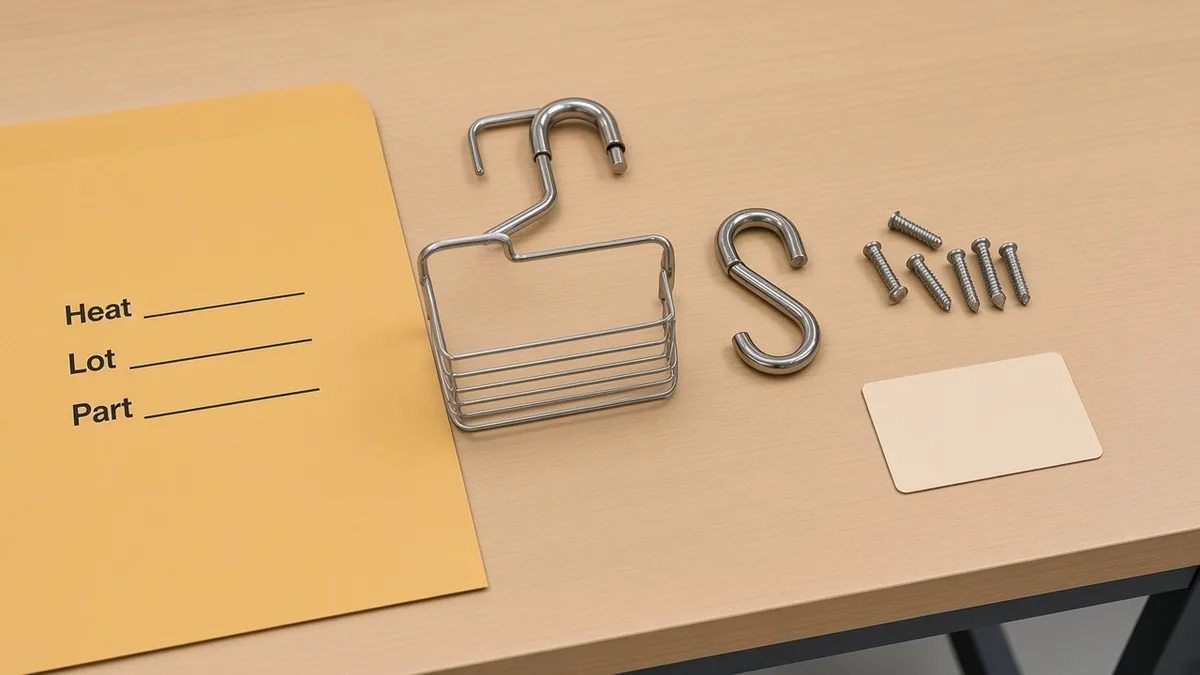
Write a hold rule before the first substitution happens. If a hook vendor, a fastener kit, a wire heat, or a stated grade changes, the lot is held, the wording or portal tag is held if you use one, and the evidence chain is rebuilt before shipping. A verbal “it is still stainless” is not a release.
Approved-vendor change control should name the small-part vendors, not only the frame vendor. A new hook shop is a new source, even when the frame plant is unchanged. First article the hook again, including paperwork.
If a customer or a market requires a third-party report on a change, that is a project decision. Do not imply that a report already exists, and do not invent a salt-spray hour or a chemistry percentage in this article.
Artwork should follow the hold. If the carton says 304, and the hook is under review, the carton does not ship. The U.S. FTC Policy Statement Regarding Advertising Substantiation is a useful reminder that a grade line is a claim. It needs a basis in the parts, not only in a first-article memory.
Buyer checklist against silent 201-for-304 substitution
Use this list before a stainless bathroom-hardware lot is accepted against a 304 or mixed-grade BOM.
- List every metal part in the grade scope, including hooks, accessory loops, weld filler if called out, and fasteners in each market kit.
- Write allowed exceptions in the BOM; do not leave a hook or screw silent.
- Require certificates that tie to the heat or lot of the parts in this shipment, including small-part bags.
- Photograph the hook and the fastener pack at first article and at incoming, not only the mid-span frame.
- If a magnet is used, record it as a coarse screen with limits, not as proof of 304.
- If a chemistry or identification method is added, agree the instrument, the locations, and the rule in the project file; do not invent a factory laboratory.
- Write a hold rule for a grade, heat, or small-part vendor change, and hold artwork that names 304 until the chain is restored.
- Keep rust-wording decisions on their wording file, and keep fastener galling on its own file.
- Do not treat a generic 201-versus-304 blog table as incoming evidence for formed bathroom hardware.
- Keep measurement or identification methods and any sampling plan in separate clauses.
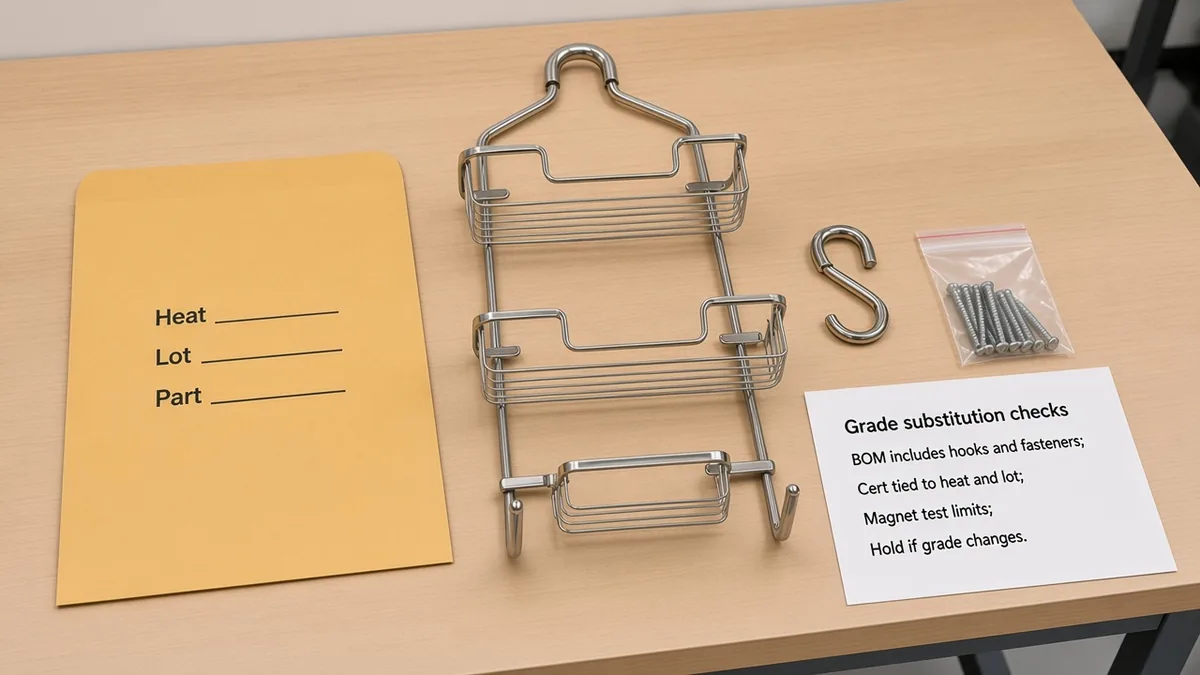
Koitor can review an evidence brief as part of Fertigung von maßgefertigten Badbeschlägen oder Fertigung von maßgefertigten Duschablagen. Send the BOM, the intended grade sentence, the hook and fastener list, and a sample if you have one.
Small-batch customization is possible depending on the product. MOQ can start from 100 pcs depending on the product, samples usually take 5–7 working days after details are confirmed, and bulk production usually takes 4–6 weeks depending on the project. A later third-party report, if a buyer requires one, is a project cost and timing discussion under careful approved wording, not a promised factory lab service.
A family-owned factory can help organize a BOM, a retained sample, and a paperwork chain, but it cannot honestly promise that every later vendor tote will match an unwritten hook grade. The buyer still owns the scope and the hold rule.
Incoming teams should open a hook bag and a screw bag on every new lot, not only when rust is already a complaint. 201 vs 304 stainless bathroom hardware substitution is cheaper to catch on a table than in a marketplace review.
If a distributor consolidates two hook vendors for cost, treat the consolidation as a change. The cheaper hook is a new part until the chain is rebuilt.
Retail sets that combine a caddy and a robe hook in one carton need both identities in the same evidence file, or two linked files. A 304 caddy packed with an unchecked hook is still a mixed-grade set.
Spare hooks sold later must follow the same grade scope. A spare that is “close enough” will become the unofficial hook in the field and will reopen the claim.
Warehouse mixing of leftover hooks from an older 201 program into a 304 line is a practical risk. Segregate leftover hardware, and audit the hook tote when a program changes grade.
When the scope, the cert-to-lot link, the method limits, and the hold rule are written, a 304 sentence can be considered against the actual parts. If the file only says “stainless,” 201 vs 304 stainless bathroom hardware substitution is still an open door.
A second plant should not inherit the grade claim by a first-article photo of a shiny frame. Rebuild the paperwork and the small-part photos on the actual lot.
Do not use rust on a hook as the first time the BOM is questioned. By then the wording is already in stores. The evidence file is meant to move that question to incoming.
If a listing translator drops “304” and writes only “stainless,” that is a wording change with evidence consequences. Either restore the grade word with the chain, or lower the wording on purpose. Do not let translation silently widen the claim.
Finish — chrome look, brushed, or powder over stainless — does not replace grade evidence. A bright hook can still be a different family from the frame. Identify the metal first, then talk about finish on its own file.
Screws that are only zinc-plated should be named as such if they are not in the stainless scope. Calling the whole kit 304 while the screws are a different system is a mixed claim, and it should be written or corrected, not left to a shopper with a magnet.
Keep a short map in the purchase file: parts in scope, cert link, last hold date, and small-part vendors. The map is easier to audit than a long email thread when a heat changes mid-season.
When a new colorway or a new hook shape is requested, attach that map, not only a rendering. Shape changes often change the hook vendor, and that is a substitution risk even when the grade name stays the same.
Installer kits that add decorative cap nuts or longer screws for thick walls should be written as kit variants under the same grade scope. A new screw is still a new line in the evidence file if it is sold as stainless.
If a marketplace title says “solid 304, including hardware,” that sentence must follow the hook and fastener chain, not precede it. If you cannot yet tie the bags to a heat or lot, do not write that sentence.
Returns that mention rust only at a weld or only at a screw should trigger a scope review, not only a finish argument. Ask which part rusted, then open the BOM and the lot paperwork for that part before a blanket coating change is launched.
A year-later revival of a retired finish should rebuild the chain. Hook vendors and heats move. A stored carton photo is not current evidence.
Keep the map and the last hold date in the same request so a new hook purchase starts complete, and so a heat change is not left to memory on either side of the order.
Häufig gestellte Fragen
Is a magnet test enough to accept 304 language?
No. A magnet is at most a coarse screen, and it is a weak screen across some 200-series and 300-series conditions. Use a cert-to-lot chain, and add an agreed method only if the project writes one.
Does a wording matrix replace this file?
No. A wording matrix decides what may be printed. This file decides whether the parts in the lot still match that wording, including hooks and fasteners.
Can a cert for wire rod cover a formed hook?
Only if the heat or lot link is written and the hook vendor cannot swap wire silently. A loose cert without a link is not enough.
Does Koitor operate a certified PMI laboratory?
This page does not claim a factory laboratory or a standing PMI program. If a project needs a third-party identification report, agree that requirement separately.
What should be held when a hook vendor changes?
Hold the lot and any 304 artwork or portal tag until the new hook is in the BOM, the paperwork is tied to the lot, and the agreed checks are repeated.
What should a first sample include?
The finished article, the hook, the fastener pack, the BOM grade list, and the paperwork chain you expect at incoming. A mid-span tube photo is not a substitution sample.
Arbeiten Sie mit Koitor Hardware zusammen
Need a stainless grade-evidence brief reviewed?
Send Koitor the BOM, the intended grade sentence, and the hook and fastener list. Our team can review the evidence scope and small-batch OEM options before quotation, without inventing laboratory claims.
OEM / EIGENE MARKE
Verwandeln Sie diesen Beschaffungsleitfaden in ein Produktdossier
Teilen Sie uns Ihr Zielprodukt, die Größe, die Oberflächenausführung, die Bestellmenge und Ihre Verpackungsanforderungen mit. Ihr Team erhält vor der Angebotserstellung eine praxisorientierte Prüfung der Herstellbarkeit.

 English
 Español
 Português
 Français
 Deutsch
 العربية