

316 vs 316L stainless steel comes down to carbon. Grade 316L is the low-carbon version of 316. Lower carbon reduces the risk of sensitization, a condition in which chromium carbides form at grain boundaries during welding heat and leave nearby areas more prone to intergranular corrosion. The molybdenum-bearing chemistry that gives both grades their chloride resistance is otherwise similar.
That makes 316L a common choice for welded parts that will see corrosive service. It does not make 316L universally required, and the two are not silently interchangeable. Thin parts welded with controlled heat input may perform well in 316, while some designs and specifications call for 316L by name. The drawing and the certificate decide.
This guide is for buyers and engineers specifying welded stainless hardware such as coastal towel bars, pool rails, marine brackets and outdoor storage. Koitor Hardware is a family-owned China OEM manufacturer that uses TIG and laser welding on stainless parts. We do not claim to stock either grade by default.
Whether 316 is needed at all, rather than 304, is covered in the live guide on 304 vs 316 stainless steel. This page assumes the molybdenum-bearing family has been chosen.
What is the difference between 316 vs 316L stainless steel?
The difference is the maximum carbon content allowed by the material standard. Grade 316L has a lower carbon limit than 316. Some standards also set slightly different strength minimums, because carbon contributes a little to strength. Corrosion resistance in the unwelded condition is broadly similar; the difference shows mainly after welding or other heating.
Carbon limits and mechanical requirements are set in material standards. ASTM A240 covers stainless plate, sheet and strip, including both grades, with their chemistry and mechanical requirements. Other standards cover tube, bar and wire. This page does not repeat the percentages; use the standard and the certificate.
The “L” suffix means low carbon. The same convention applies to 304 and 304L. The live guide on 304 vs 304L stainless steel for hardware buyers explains the parallel decision for the non-molybdenum family.
Strength differences are small for most hardware. Grade 316L may have slightly lower minimum yield and tensile strength in some standards. For towel bars and brackets, design loads rarely approach those limits, but load-bearing designs should check the stated minimums.
Forming, polishing and appearance are practically the same. Neither grade looks different, and both bend and finish in similar ways.
Availability varies by form and region. In some markets, much stainless sheet and tube is produced to meet both designations at once, which leads to dual certification.
Do both grades resist chlorides equally?
In the unwelded condition, their chloride resistance is broadly similar because both contain molybdenum and similar chromium and nickel. The carbon difference does not change pitting resistance much. The practical difference appears where heat has altered the microstructure, which is why the decision centres on welding.
Why does carbon matter at welds?
When austenitic stainless is held in a certain temperature range, carbon can combine with chromium to form carbides at grain boundaries. The areas next to those carbides lose some chromium and become less corrosion resistant. Lower carbon leaves less carbon available to form carbides, which reduces the effect.
Where do buyers meet the 316L designation most often?
In hardware sourcing, 316L appears most often on tube, wire and sheet for outdoor and coastal products, on architectural fittings, and in specifications written by engineers familiar with process-industry practice. Retail product specifications sometimes copy “316L” from other documents without a clear reason. When that happens, it is worth asking whether low carbon is really needed or whether 316 would satisfy the service.
Does filler metal follow the same logic?
Where filler is used in welding stainless, low-carbon filler designations exist for the same reason. Matching filler to the base material and service keeps the weld metal from becoming the weak point. Filler choice belongs to the welding procedure and should be consistent with the grade decision.
What is sensitization and why does it matter?
Sensitization is the loss of corrosion resistance along grain boundaries after stainless steel has been heated in a carbide-forming temperature range, as can happen in the heat-affected zone near a weld. In corrosive service, sensitized areas can suffer intergranular corrosion that weakens the joint and shows as cracking or a line of attack beside the weld.
The heat-affected zone is the area near a weld that did not melt but was heated. Its temperature history depends on heat input, part thickness, travel speed and cooling. Thicker parts and slower, hotter welding spend longer in the sensitizing range.
Thin parts cool quickly. Many hardware parts are thin-walled tube or sheet, and with controlled heat input they may pass through the sensitizing range quickly enough to limit carbide formation. That is one reason 316 can perform adequately on thin welded hardware.
Process control matters alongside grade. The live guide on stainless steel weld sensitization and heat input on thin parts covers heat input in more detail.
Environment determines consequences. In dry indoor service, a mildly sensitized zone may never corrode. In chloride, acidic or hot wet service, the same zone may be attacked. Grade choice should consider how aggressive the environment is.
Testing for susceptibility exists. ASTM A262 describes practices for detecting susceptibility to intergranular attack in austenitic stainless steels. Whether such testing is needed, and which practice, should be agreed for the specific product and service.
Why is intergranular corrosion hard to see?
Intergranular attack proceeds along grain boundaries beneath the surface. Early stages may show little on the outside, while the metal underneath loses strength. By the time a line of corrosion or a crack is visible, the attack may be well advanced. That is why designers prefer to prevent sensitization rather than rely on spotting its effects.
Can sensitization be reversed?
A solution anneal, heating to a high temperature followed by rapid cooling, can dissolve carbides and restore corrosion resistance. It is not practical for most finished hardware, which is why choosing grade and controlling welding heat are the usual approaches.
Heat tint deserves separate attention. The coloured oxide that forms beside a weld is not sensitization, but it also reduces local corrosion resistance. It should be removed by an agreed method such as pickling, electrochemical cleaning or mechanical finishing. Many corrosion complaints near welds trace back to heat tint rather than carbon content.
Signs of intergranular attack in service include a narrow line of corrosion running parallel to the weld, sometimes with fine cracking. If such a pattern appears on returned parts, a metallurgical examination can show whether sensitization is involved. That evidence helps decide whether grade, process or environment needs to change.
How do heat input and part thickness interact?
Heat input is the energy delivered per unit length of weld. Higher heat input and thicker sections both lengthen the time the heat-affected zone spends at sensitizing temperatures. Thin tube welded with low, focused heat may spend very little time there. A designer comparing 316 and 316L should think about the thickest welded section and the heaviest weld on the part.
When does 316L make sense for hardware?
Grade 316L makes sense for welded parts in corrosive service, especially where welds are heavy, parts are thicker, or heat input cannot be tightly controlled; where the customer’s specification names 316L; and where post-weld annealing is not possible. In those cases, the low-carbon grade reduces a known risk at little practical cost.
Coastal and marine fittings with structural welds are typical. Pool rails, boat hardware and seaside balustrade fittings often specify 316L.
Thicker sections retain heat longer. Brackets made from heavier plate or bar spend more time in the sensitizing range during welding.
Multi-pass welds reheat earlier passes and surrounding metal. Where a joint needs several passes, low carbon adds margin.
Customer specifications sometimes require 316L outright. Architectural, marine and some food-related specifications commonly do. In that case, 316 is not an acceptable substitute unless the certificate also names 316L.
Long service life expectations favour 316L in welded designs where failure would be costly or hard to repair.
What about tube made by welding?
Much stainless tube used in hardware is itself made by forming strip and welding the seam. The seam weld has its own heat-affected zone, created at the mill. Tube standards address this, and some tube is annealed after seam welding. When ordering tube for corrosive service, the tube standard and condition belong in the specification alongside the grade.
Is 316L always the safer choice?
It reduces sensitization risk, but it is not automatically required or better for every part. Unwelded parts gain little from lower carbon, and slightly lower strength minimums can matter in some load-bearing designs. The choice should follow welding, service and specification.
What about brazing, hot forming or heat treatment?
Any process that holds stainless in the sensitizing range can have a similar effect to welding heat. Brazing, hot bending and some stress-relief treatments are examples. If parts go through such steps, the low-carbon grade or a subsequent solution anneal may be more important than for parts that are only welded.
When can 316 be acceptable instead of 316L?
Grade 316 can be acceptable for unwelded parts, thin welded parts with controlled heat input in moderate service, and applications where the specification names 316 and the environment does not demand low carbon. It must still be the grade the drawing calls for. Substituting one for the other without approval is not acceptable, even if the parts look identical.
Unwelded parts such as bent bars, stamped plates and machined fittings do not go through a welding heat cycle. Low carbon offers little benefit there.
Thin welded parts can perform well in 316 when heat input is controlled, especially in moderate environments. The decision should be made by the designer with the service environment in mind.
Specification wording governs. If the drawing says 316, the supplier should supply 316 or an approved equivalent. If it says 316L, the certificate must show 316L.
Strength requirements sometimes favour 316. Where design calculations rely on the higher minimum strength of 316, substituting 316L without review may not be appropriate.
| Situation | 316 | 316L |
|---|---|---|
| — | — | — |
| Unwelded parts | Often suitable | Little added benefit |
| Thin welds, controlled heat, moderate service | Often suitable | Added margin |
| Heavy or multi-pass welds, corrosive service | Higher sensitization risk | Commonly specified |
| Specification names 316L | Not acceptable unless certificate names 316L | Required |
| Design relies on higher strength minimum | Matches 316 minimums | Review needed |

Fixturing and sequence influence heat too. Clamping that acts as a heat sink, short welds in a planned sequence and pauses between welds on the same area all reduce the time each zone stays hot. These are workshop practices rather than grade decisions, but they affect the same risk.
Inspection after welding usually focuses on visible quality: bead shape, heat tint, undercut and cleanliness. Sensitization itself is not visible, so process control and, where agreed, testing are the ways to manage it.
Does welding process choice matter?
Yes. TIG and laser welding can deliver focused, controllable heat on thin parts. Laser welding in particular has low heat input and a narrow heat-affected zone. Process choice affects sensitization risk alongside grade, and both should be considered together.
Communication between designer and supplier settles most cases. A short note explaining why a grade was chosen, such as “316L required due to heavy welds in coastal service”, helps the supplier make the right sourcing and process decisions and makes later substitution requests easier to assess.
When substitution is proposed, it should come as a written request with the reason, the proposed material and its certificate. The designer can then decide whether the alternative meets the need. Approval should be recorded with the drawing revision or purchase order.
What does dual-certified 316/316L mean?
Dual-certified material meets the requirements of both 316 and 316L at the same time, typically by having carbon low enough for 316L and strength high enough for 316. It counts as dual certified only when the mill certificate for the heat supplied names both designations. A supplier’s verbal claim or a certificate naming only one grade does not establish dual certification.
Mill certificates report the actual chemistry and properties of a heat. The live guide on mill test reports explains how to read them. For dual-certified material, the designation field should list both grades, and the reported values should satisfy both.
Dual certification is common in some product forms and markets. It simplifies stocking, because one material satisfies either specification.
Buyers should check the certificate, not assume it. A heat certified only as 316 does not meet a 316L requirement, even if its measured carbon happens to be low, unless the specification allows acceptance on chemistry alone.
Traceability links the certificate to the parts. The heat number on the certificate should be recorded through cutting and fabrication so the certificate applies to the delivered hardware.
- Certificate names both 316 and 316L for dual certification.
- Reported values satisfy both designations.
- Heat number traceable to the parts.
- Specification checked for any additional requirements.
What if a certificate shows low carbon but names only 316?
The designation on the certificate is what the mill certified. If a requirement calls for 316L and the certificate names only 316, the material has not been certified as 316L, even if the reported carbon looks low. Some specifications allow acceptance based on reported chemistry; others do not. The buyer’s specification decides, and the decision should be written down.
Is 316L the same as 316 with a different label?
No. It has a lower carbon limit and, in some standards, different strength minimums. Dual-certified material meets both, but standard 316 is not 316L simply by relabelling.
Should certificates be checked for every lot?
Yes, where grade matters. Each heat has its own certificate, and different lots may come from different heats. Checking that each delivery’s certificates name the right designation, and that heat numbers match production records, keeps the verification current rather than relying on a certificate from an earlier shipment.
How should buyers specify and verify 316 vs 316L?
State the exact designation and governing standard on the drawing, specify welding requirements and any post-weld cleaning, require mill certificates that name the designation, and confirm traceability from heat to finished part. If 316L is required, say so explicitly; if either is acceptable, say that too. Silence leaves room for substitution.
Designation should be explicit. “316 or 316L” and “316L” mean different things to a supplier. Choose the wording that reflects the design need.
Welding requirements matter as much as grade. Joint design, process and heat-input expectations, filler where used, and post-weld treatment to remove heat tint all influence corrosion performance.
Certificates should be required on the purchase order. Asking for them after delivery invites delays and gaps.
Identification checks can confirm molybdenum presence, but distinguishing 316 from 316L by carbon usually needs laboratory methods. Handheld instruments may not resolve low carbon levels reliably. Certificates and traceability are therefore the main verification tools.
Corrosion testing for intergranular susceptibility can be added for demanding applications. The practice and acceptance criteria should be agreed in advance.
For wider grade context, the live guide on stainless steel grades places these grades among other stainless families.
Retained material and records help in later disputes. Keeping labelled offcuts from each heat and the welding records for each lot allows a later investigation if corrosion appears in service. It is much harder to establish what happened years later without them.
For many bathroom and storage products, the honest answer to “316 or 316L?” is that welding quality, heat-tint removal and design for drainage matter more than the carbon difference. Where the environment is aggressive and welds are heavy, 316L adds useful margin. The drawing should reflect whichever conclusion the designer reaches.
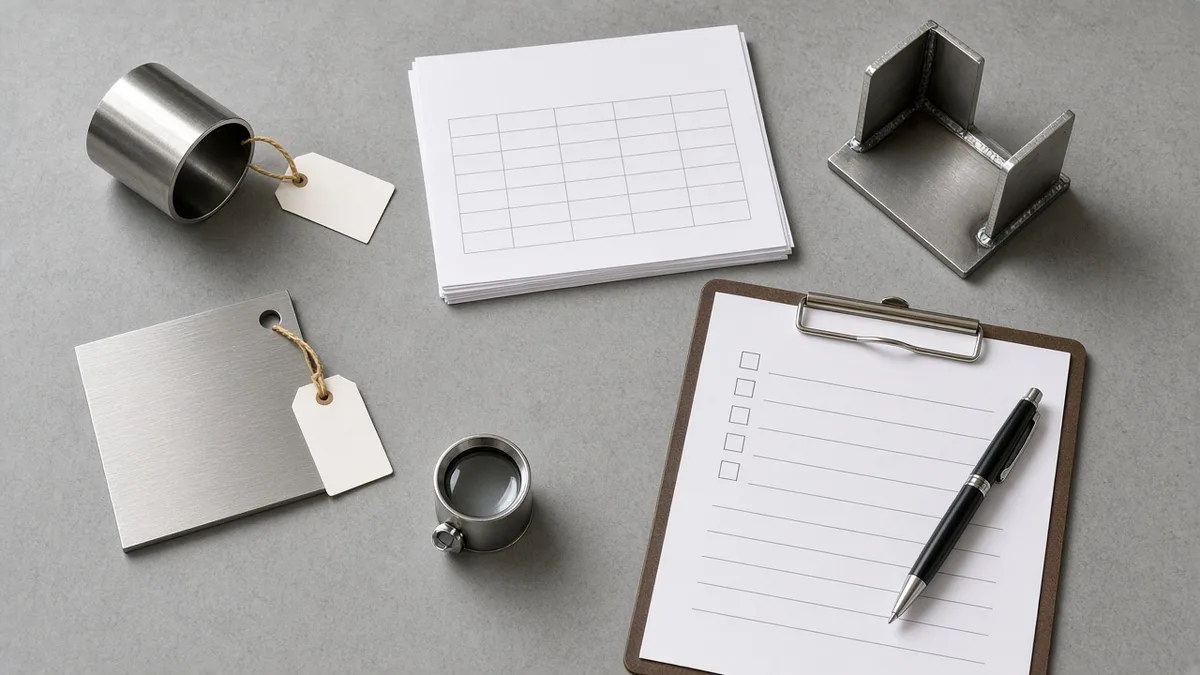
Cost and supply differences between the two grades vary by form and market, and in some forms dual-certified material makes the difference negligible. Rather than assume one grade is cheaper or easier to source, confirm availability for the specific tube, sheet or wire sizes needed at quoting stage, and record the result with the project.
Buyer checklist for 316 vs 316L
- Designation and standard stated explicitly on the drawing.
- Reason for low carbon recorded where 316L is required.
- Welding process and post-weld cleaning defined.
- Certificates required with the designation named.
- Dual certification accepted only when both designations appear.
- Heat traceability from certificate to parts.
- Intergranular testing agreed where service demands it.
Clear wording on the purchase order completes the specification. Restating the designation, the certificate requirement and any testing on the order, not only on the drawing, gives the supplier’s purchasing team the information they need when buying material.
FAQ
What is the difference between 316 and 316L?
Grade 316L has a lower maximum carbon content than 316. That reduces the risk of sensitization during welding. Other chemistry is broadly similar, and 316L may have slightly lower minimum strength in some standards.
Is 316L better than 316?
For welded parts in corrosive service, 316L reduces a known risk. For unwelded parts, the benefit is small. Neither is better for every application.
Can 316 be used where 316L is specified?
Not unless the material is certified as 316L as well, for example through dual certification shown on the certificate. Otherwise it is a substitution that needs approval.
What does dual certified 316/316L mean?
It means the material meets both designations, and the mill certificate names both. A certificate naming only one grade does not establish dual certification.
Can you tell 316 from 316L by testing a finished part?
Distinguishing them needs accurate carbon measurement, usually by laboratory methods. Many handheld analysers cannot reliably separate them. Certificates and traceability are the practical verification route.
Does 316L prevent all weld corrosion?
No. It reduces sensitization risk, but heat tint, crevices, contamination and poor finishing can still cause corrosion. Welding practice and post-weld cleaning remain important.
Arbeiten Sie mit Koitor Hardware zusammen
Review stainless designations on a welded hardware project
Send the drawing, the welding details and the certificate requirements. We can review whether the stated stainless designation, welding approach and documents fit your welded bathroom or storage hardware project. Material availability is confirmed per project.
OEM / EIGENE MARKE
Verwandeln Sie diesen Beschaffungsleitfaden in ein Produktdossier
Teilen Sie uns Ihr Zielprodukt, die Größe, die Oberflächenausführung, die Bestellmenge und Ihre Verpackungsanforderungen mit. Ihr Team erhält vor der Angebotserstellung eine praxisorientierte Prüfung der Herstellbarkeit.
 English
 Español
 Português
 Français
 Deutsch
 العربية