

For quick release shelf bracket latch access, approve the complete shelf assembly: bracket family, number and spacing of supports, release linkage, hand access and the operating sequence. On a wide folding shelf, a release handle may need to coordinate two or more brackets, so checking one loose bracket does not show whether the installed system engages and releases as intended. Confirm the supplier’s instructions and test a representative assembled sample before approving the bill of materials (BOM) or installation claims.
Why does a wide folding shelf need a system-level release review?
A folding shelf with multiple support brackets has several connected interfaces. Each bracket must attach to the wall and shelf, engage in its working position, and respond correctly when the user folds it. If the design uses a shared handle or linkage, its dimensions and attachment points must match the chosen bracket family and spacing. The buyer is approving that combination, not simply a bracket with a stated load rating.
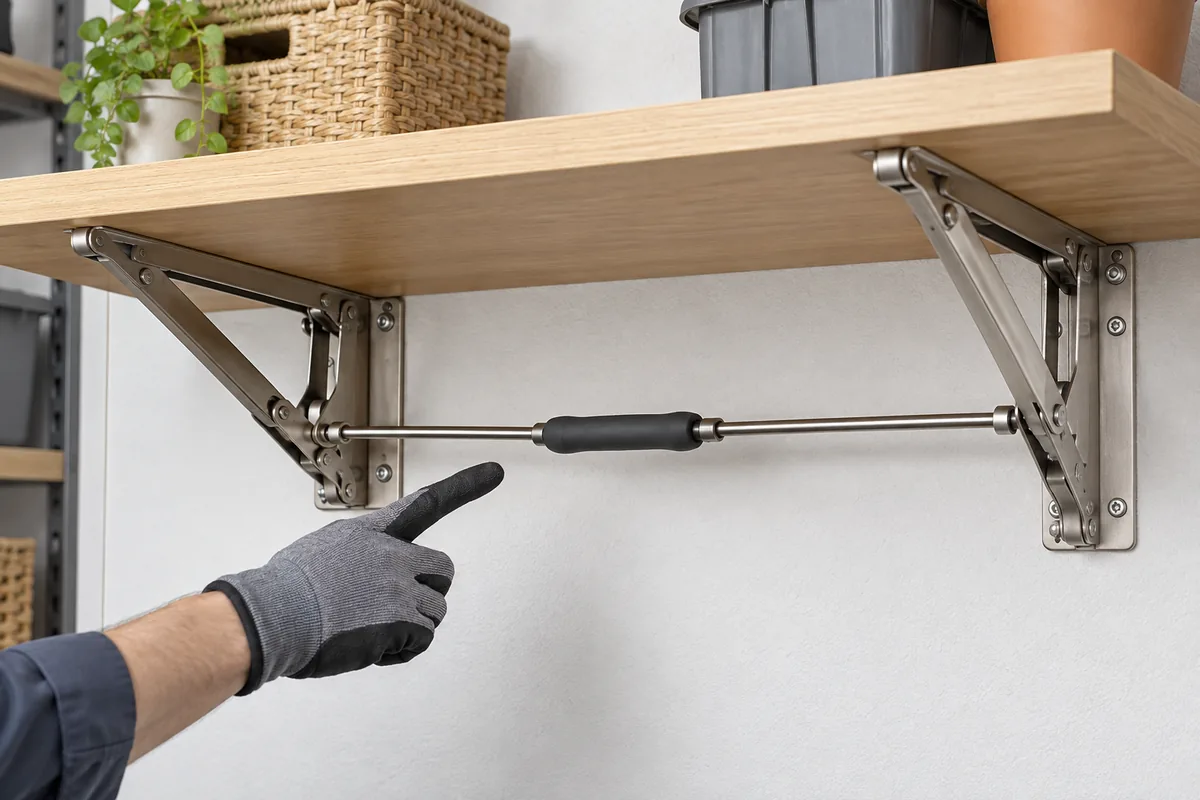
ROCA’s published account of its Robust Easy Release system describes a distributor request that led to an accessory handle for releasing two or three brackets on a wider shelf installation with one hand. The manufacturer presents that arrangement as a product-specific system. It is useful evidence that multi-bracket release access can matter to distributors, but it does not establish a universal design, a Koitor product or a performance claim for another supplier’s assembly. See ROCA’s Easy Release background and its product and instruction page.
For importers and private-label product teams, this becomes a specification question early: will one user be able to reach and operate the release after the shelf is installed in its intended setting? A handle can be present in the component list yet remain awkward to reach behind a shelf edge, cabinet side or adjacent fitting. Linkage length, bracket spacing, shelf depth and access direction all affect the answer.
Do not assume that visually similar folding brackets can share a release bar or handle. Bracket families can differ in pivot position, latch location, movement and mounting geometry. Require suppliers to identify compatible parts and show their arrangement in an assembly drawing. If the proposed shelf width changes later, the number or spacing of brackets may also change, which can affect the release system.
What inputs belong in the RFQ?
Provide the shelf’s intended use and geometry, then ask the supplier to define the compatible folding mechanism. Household or laundry shelving is the relevant scope here. Do not apply this guidance to seating, marine installations, escape equipment or other safety-critical uses without a separate engineering review and applicable evidence.
| RFQ input | What the supplier should identify | Why the buyer needs it |
|---|---|---|
| Shelf envelope | Width, depth, thickness, edge details and intended wall location | Establishes access and support spacing context |
| Bracket family | Part number, revision, quantity and mounting orientation | Prevents mixing incompatible components |
| Bracket layout | Center-to-center spacing and relationship to shelf ends | Defines linkage span and access position |
| Release components | Handle, rods/tubes, connectors, fasteners and any guards | Makes the complete BOM visible |
| Operating sequence | How the shelf is supported, unlocked and folded according to supplier instructions | Gives buyers a repeatable sample check |
| Installed context | Nearby walls, cabinet sides or objects that may block the handle | Checks real reach and clearance |
| Product options | Whether the system has optional locks or variants and how they are identified | Prevents accidental substitution |
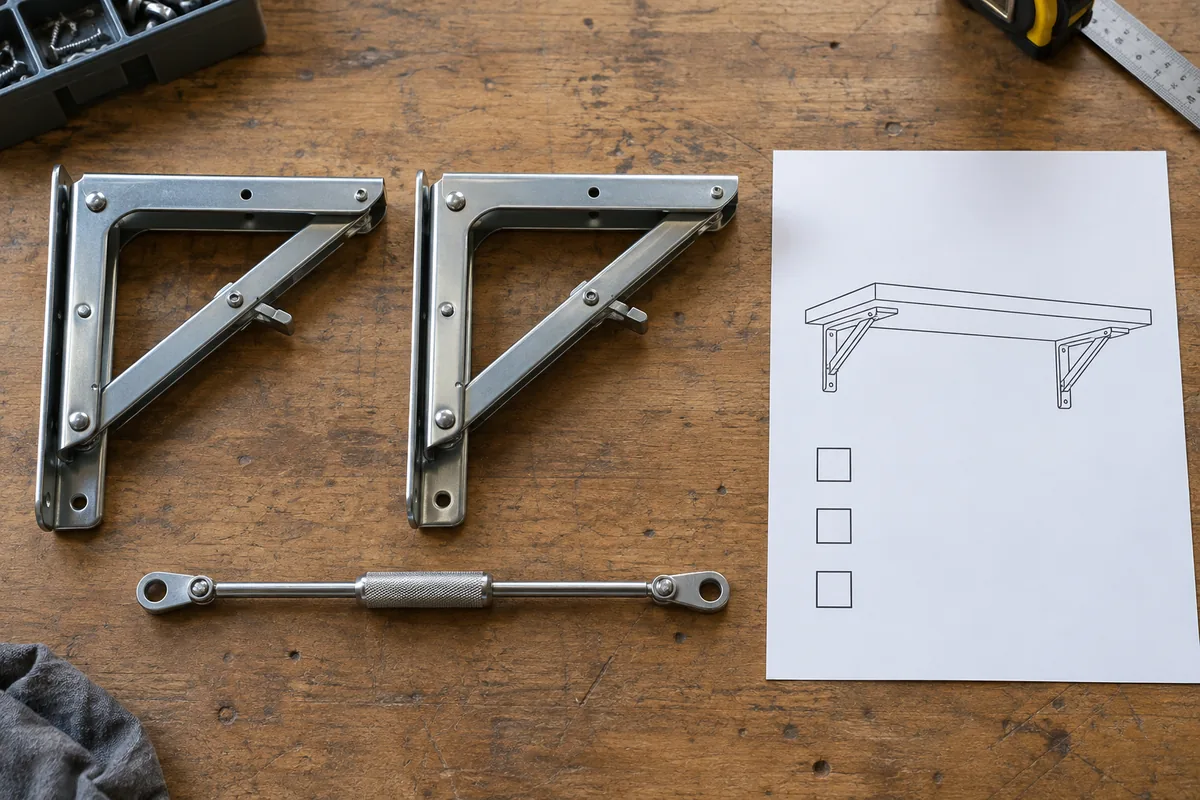
The supplier’s drawing should show the shelf in its deployed and folded conditions, the brackets at their intended spacing, the release linkage and the user-accessible handle. A parts list should distinguish standard bracket hardware from optional linkage components. If any accessory is supplied separately or needs to be ordered in a specific length, state that in the quotation and order record.
Ask for the manufacturer’s installation instructions for the exact proposed configuration. A product page or catalogue image may show the general idea, while the instructions identify assembly and adjustment steps. The product manager should not invent a new release sequence from a photograph or treat a generic video as approval of a particular bracket variant.
How should buyers check reach and synchronized operation?
Review access on a full-size assembled sample or representative mock-up. A short bench sample can help examine the parts, but it may not reproduce the reach around a wide shelf or the obstruction created by nearby cabinetry. The sample should use the proposed bracket family, spacing, linkage length, handle and fasteners.
Start by installing or positioning the shelf in the intended orientation. Identify where the user stands and which hand approaches the handle. Check whether the handle can be found and operated without reaching into a pinch area or contacting an adjacent surface. This is an observation for product review, not a substitute for a safety assessment. If the product includes a safety device, record the device variant and follow its manufacturer instructions; do not claim child-safe performance without relevant documentation.
Then observe bracket engagement at the specified positions. Check that each support reaches the intended working state according to the supplier’s instruction. Operate the release as directed and confirm that the connected brackets respond in the intended sequence. If one bracket lags, remains engaged or releases before the other, stop and ask the supplier to diagnose the assembly; do not force the mechanism or adjust a safety-critical component without approval.
Repeat the operation after folding and reopening the shelf as the instructions require. Record the sample identity, bracket spacing, linkage revision, visible interference and any adjustment made. The purpose is to see whether the assembled sample can be used consistently under the defined conditions, not to infer service life or load capacity from a brief demonstration.
Which configuration changes require renewed approval?
Treat the bracket, linkage and shelf as a connected assembly. A change to one may alter the others even when the shelf still looks similar. Before production release, agree which changes require a revised drawing, a new sample or an updated instruction.
| Proposed change | Possible interface affected | Buyer follow-up |
|---|---|---|
| Wider or narrower shelf | Bracket count, spacing and linkage span | Request revised layout and sample check |
| Different bracket family | Latch location, movement and attachment | Confirm compatible linkage and instructions |
| New handle or release rod | Reach, travel and attachment | Review operating access on the installed sample |
| Added cabinet side or nearby fixture | User approach and handle clearance | Test in a representative surrounding layout |
| Optional lock or guard variant | Operating sequence and component identity | Record the selected option in the BOM and order |
| Different shelf thickness or edge | Fastener fit and bracket position | Confirm the mounting details against the drawing |
The supplier should identify what belongs to the release kit and what must be purchased separately. Confirm package quantities, fasteners and revision identity before finalizing the BOM. If an alternate linkage is proposed, compare its fit and operation against the approved configuration rather than assuming it is interchangeable.
For quick release shelf bracket latch access, keep the approved handle, linkage and bracket spacing together in the same controlled assembly record. That gives the buyer a clear reference if the shelf width or supplied hardware changes before repeat production.
This also helps with repeat orders. If the buyer, supplier or sub-supplier changes one component, trace the change to the approved assembly and decide whether it affects fit, access, instructions or sample acceptance. Preserve the accepted drawing and sample record together so a later purchasing team does not approve a visually similar but mechanically different combination.
What evidence should a supplier provide?
The evidence package can be straightforward when it answers the buyer’s actual questions. Request the assembly drawing with bracket family and spacing, a parts list that includes the complete release system, and installation instructions for the proposed variant. Ask the supplier to identify any adjustment step and the conditions under which the sample was reviewed.
For sample approval, retain photographs showing the shelf open, folded and from the release-handle approach direction. Add a short observation record: whether each bracket engaged, what action released it, whether the handle was reachable in the intended location, and whether anything interfered. If an issue appears, describe what was observed without assigning a root cause before the supplier investigates.
Do not use a test result outside its scope. A load rating for one bracket configuration does not automatically verify the release linkage, and smooth release on an empty sample does not prove durability or safe operation over time. If the product requires load, cycle, stability or safety evaluation, ask the responsible supplier or qualified evaluator to define a product-specific method and acceptance criteria. Do not copy another manufacturer’s testing claims or thresholds.
The release system may include purchased components. A manufacturer that forms the shelf or support frame may not make the latch, handle or linkage. Make responsibility visible in the quote: who supplies each part, who confirms compatibility, who assembles it and who approves instructions. This prevents the buyer from attributing an accessory’s performance or design ownership to the metal-frame supplier without evidence.
What should buyers include in sample sign-off?
Use a short sign-off record that connects the product, configuration and observed behavior:
- Identify the shelf drawing, finish, bracket family and revision.
- Record the number and center spacing of brackets.
- List the handle, release linkage, fasteners, guards and optional components.
- Note the installation orientation and surrounding clearances represented by the mock-up.
- Follow the supplier’s approved operating sequence and record each bracket’s response.
- Record any interference, adjustment or open issue and assign it to the responsible supplier.
- Confirm that the product BOM, package contents and customer instructions match the approved sample.
- Define what configuration changes require another review before repeat production.
Avoid vague approval notes such as “release works” or “brackets are okay.” State which parts were tested together and how the handle was approached. If only a partial sample was available, list the unverified elements so that a buyer does not treat the result as final assembly approval.
Where does Koitor fit in the sourcing discussion?
Koitor Hardware is a family-owned custom metal hardware factory focused on bathroom and home-storage hardware, with drawing- and sample-based OEM communication. That experience can support a buyer’s conversation about metal shelf frames, support spacing, fabrication and assembly inputs. It does not confirm current production of a proprietary folding-bracket latch, release linkage, safety device or certified load system. Confirm the exact product scope and any bought-in components for each project.
For a wide folding shelf, share the shelf drawing, bracket data sheet, intended spacing, release kit and installation context before asking for a quotation. A home-storage OEM discussion can clarify which metal components may be within scope; buyers can also contact Koitor about a project. The proposed mechanism and its safety or performance evidence must remain tied to the chosen supplier’s documentation.
Häufig gestellte Fragen
Can one release handle operate more than one folding bracket?
Some product-specific systems are designed to release two or more compatible brackets through one handle. Confirm the exact bracket family, number, linkage and spacing in the selected manufacturer’s documents and sample; do not assume a shared handle fits unrelated brackets.
Should a buyer specify a universal linkage length?
No. Linkage length depends on the bracket family and installed spacing. Require a drawing for the actual shelf width and arrangement, and identify the part revision in the BOM.
Is handle reach part of the product specification?
Yes. A release component that cannot be reached in the intended installation may not serve its purpose. Review the user approach direction and nearby obstructions on a representative mock-up, following the supplier’s instructions.
Does a successful sample check prove the shelf is safe or load-rated?
No. It records only the configuration and observations made. Load, cycle life and safety claims require separate product-specific evidence and qualified review.
What should happen if one bracket releases before another?
Pause sample approval and report the observed sequence to the supplier with the drawing revision and configuration. The supplier should assess the cause and advise any adjustment; the buyer should not force or alter a mechanism outside its instructions.
What does a quick release shelf bracket latch access review record?
Record the bracket family, spacing, linkage and handle approach, plus the supplier instructions and sample configuration used. The note should describe observed operation rather than claim a universal safety or durability result.
Review a Folding Shelf Frame With Koitor
Share the shelf drawing, bracket data, intended spacing and release-kit documentation for a metal-frame sourcing discussion. Proprietary mechanisms and product-specific safety claims require confirmation from their supplier.
OEM / EIGENE MARKE
Verwandeln Sie diesen Beschaffungsleitfaden in ein Produktdossier
Teilen Sie uns Ihr Zielprodukt, die Größe, die Oberflächenausführung, die Bestellmenge und Ihre Verpackungsanforderungen mit. Ihr Team erhält vor der Angebotserstellung eine praxisorientierte Prüfung der Herstellbarkeit.
 English
 Español
 Português
 Français
 Deutsch
 العربية