

ABC XYZ inventory analysis combines two different views of a product range: an ABC view of relative business contribution and an XYZ view of demand behavior or variability. For bathroom hardware buyers, the combination is useful as a conversation aid for towels bars, hooks, shower baskets and finish variants, but it is not an automatic order quantity or supplier-capacity plan. First define the data and time window, then use each segment to ask better questions about repeat runs, finish changes, packaging multiples and lead-time assumptions.

Use the classification to structure a buyer-owned replenishment discussion, not to delegate demand decisions.
What decision does ABC-XYZ analysis help a hardware buyer make?
ABC-XYZ analysis can help an importer decide which existing SKUs deserve different kinds of review before replenishment. ABC classifies items by a chosen measure of contribution or importance. XYZ classifies items by a chosen measure of demand regularity or variability. The combined view helps a team distinguish a high-contribution item with steady movement from a high-contribution item whose demand is less predictable. It also helps separate a lower-contribution item with stable movement from a low-contribution item that sells sporadically.
The method is a way to organize attention. It does not decide which SKU must be reordered, discontinued, discounted or assigned a specific stock quantity. Those actions require other information: available inventory, open purchase orders, product lifecycle, promotions, returns, current customer commitments, supplier lead time, packaging units, budget and the buyer’s risk tolerance. A segment label is therefore the start of a review, not its conclusion.
This distinction matters for bathroom and home-storage hardware because a product family can contain pieces that look similar but behave differently commercially. A polished towel bar and a matte-black towel bar may share much of their physical design while having separate sales histories, retail prices, packaging and production requirements. A shower basket may be an important range anchor but have uneven demand because it is promoted seasonally or sold into project orders. A hook variant may move steadily in small units but have a low contribution to total sales. Looking at only one dimension can hide these differences.
Use the analysis on products with a meaningful sales history and a clearly defined SKU identity. A new finish with little or no history should not inherit a confident demand classification simply because another finish is established. It can be grouped for an early planning conversation, but mark the inference and retain its launch status. ABC-XYZ analysis is strongest when the team understands what the labels mean for its own data and does not use them as universal industry grades.
What does the ABC dimension measure?
ABC is a relative ranking based on a business measure selected by the company. A buyer might rank SKUs by sales revenue over a defined period, gross margin contribution, units sold, purchasing value or another metric that reflects the decision the team is trying to support. Some established systems use cumulative contribution thresholds to create A, B and C groups, but the thresholds and metric are choices, not universal laws for bathroom hardware.
A classification based on revenue answers a different question from a classification based on margin or units. For example, a high-priced towel rack could contribute substantial revenue with fewer units, while a lower-priced hook set could sell in greater quantity. If the buyer labels one item “A” using revenue and another “A” using unit volume, the labels may not mean the same thing. Record the selected measure beside the output.
The buyer should also specify the aggregation level. Is each finish a separate SKU? Are single units and multipacks separate? Are left- and right-hand configurations separate? Do bundled sets count as a unique sellable item? A category report that combines a towel bar and its matching robe hook can be useful for range planning but may not be granular enough for production and reorder decisions. Conversely, splitting every carton variation may create a data set too fragmented to interpret.
Choose the time window deliberately. A short period can overemphasize a promotion or a project shipment. A long period can conceal a recent change in assortment, price, channel mix or product availability. When the range has changed, show the full window and the recent period separately instead of combining unlike periods into one label. Write down the included channels and currencies where relevant, and decide how returns, cancellations and discounts are treated.
ABC is also relative to the group being ranked. If an importer adds a major new category, the cumulative share of existing SKUs may shift even if their individual sales remain unchanged. If a product is temporarily unavailable, observed revenue may understate its potential demand. If the buyer compares a premium finish with a standard finish, price differences can influence a revenue-based class even where unit movement is similar. The classification describes the selected data set and metric; it does not prove the intrinsic value or future potential of the product.
What does the XYZ dimension measure?
XYZ is commonly used to describe demand regularity or variability, but the exact calculation and class thresholds depend on the method a business adopts. A team may examine variation across time buckets, the occurrence of zero-sales periods, or another measure of how demand changes. The buyer should record the method, granularity and thresholds rather than assume that every ERP report uses the same definition.
The time bucket has practical consequences. Weekly data may show order bursts that disappear in a monthly view. Monthly data can be easier to compare against supplier planning cycles, but it may mask short stockouts or concentrated project orders. A daily series may be noisy for a slow-moving accessory. Use a time scale that matches the question, and label it clearly.
Observed sales are not always equal to unconstrained customer demand. A SKU that is out of stock for part of a month may show fewer sales because customers could not buy it. A promotion may create a temporary spike. A listing change, price move, channel expansion, product substitution or large project order can alter the series. If a buyer calculates variability from raw sales without annotating these events, the resulting XYZ label can give a false sense of normality or instability.
Consider a matte-black towel bar that sold steadily for several months, then experienced one large project order. A method that treats all months equally may call the series variable. A buyer might instead separate ordinary retail demand from the project shipment, if the records allow. Neither treatment is universally correct: the right view depends on whether the project is likely to recur and whether the supplier conversation concerns retail replenishment, project production or both.
Conversely, a SKU that appears steady while inventory is continuously available may become difficult to interpret after repeated stockouts. The buyer cannot infer missing sales with certainty from the available data alone. Mark the availability limitation and use customer orders, backorders, lost-sales records or other reliable evidence where available. Do not invent a corrected demand series.
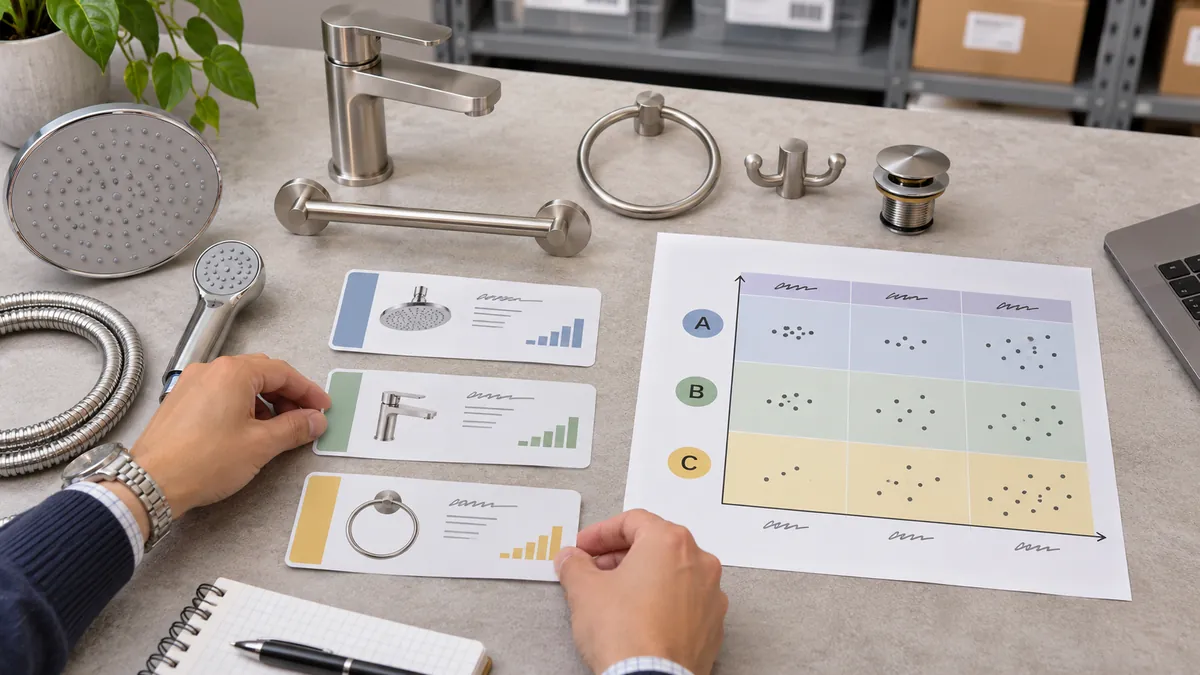
Illustrative matrix; segment names, thresholds and data are company-defined.
How should a buyer read the combined matrix?
The matrix combines the two dimensions but does not prescribe the response. A common visual layout places ABC classes on one axis and XYZ classes on the other. The labels create a compact way for planning, merchandising and sourcing teams to discuss differences. They are not a universal factory schedule.
| Combined view | What it may indicate in the selected data | Useful buyer question | What it does not prove |
|---|---|---|---|
| AX | Higher selected contribution with relatively regular observed demand | What repeat quantity and finish schedule should be reviewed against current stock and open orders? | That a purchase order should be released now |
| AZ | Higher contribution with irregular observed demand | Which spikes relate to projects, promotions, availability or channel changes? | That future demand will repeat the largest period |
| CY | Lower selected contribution with some variation | Is the pattern real, seasonal, or driven by small sample size? | That the SKU has no strategic or customer value |
| CZ | Lower selected contribution and irregular observed demand | Is this SKU an active range item, a launch, a replacement part or an occasional order? | That discontinuation is automatically appropriate |
The table uses common shorthand only as an illustration. If a company uses different labels or different thresholds, document those definitions. Some systems use letters differently, calculate variability differently or add additional categories. The buyer should avoid transferring a matrix from one software tool or company policy into another without understanding the method.
Review both axes together. An A-class item with a variable sales pattern may need more explanation than an A-class item with steady sales. A C-class item with repeatable demand might still be easy to include in a consolidated factory order. A lower-contribution product may also support a coordinated range, serve a replacement need or be required by a project specification. Commercial rank alone cannot capture every assortment role.
Avoid treating all items in one cell identically. Two AX products may have very different packaging, finish, assembly or supplier lead-time constraints. A shared label does not make their production plans interchangeable. Conversely, two SKUs in different cells may be produced in one coordinated campaign if their physical construction and finish process allow it. That possibility must be confirmed with the supplier; it should not be assumed from the data classification.
How can the analysis become a supplier conversation?
A factory needs a clear product and order brief, not simply a screenshot that says “AX” or “BZ.” The buyer should translate the analysis into questions the supplier can answer about the physical SKU, quantity, finish, packing and timing. The supplier can discuss manufacturing feasibility within its confirmed capabilities; it cannot validate the buyer’s sales data or choose the buyer’s inventory policy.
For each SKU under review, create a handoff record with:
- Exact buyer SKU and product description, including finish, size and pack configuration.
- Approved drawing, sample, photo or revision reference that identifies the current physical configuration.
- The sales metric used for ABC and the time-series method used for XYZ.
- The time window, sales unit and channel scope behind the classification.
- Known stockouts, promotions, project orders, returns, product changes or other exceptions.
- Current on-hand, reserved, inbound and open-order quantities, owned by the buyer’s inventory system.
- Requested quantity, target delivery window, shipment plan and packaging unit.
- Questions for the supplier about MOQ, order multiples, finish grouping, sample approval, pack-out and feasible production timing.
This record prevents the classification from being mistaken for an order. It also reduces ambiguity when one item name represents several physical configurations. A supplier asked to quote “black towel bar” may need dimensions, material, finish reference, mounting method, packaging and quantity before the price can be meaningfully compared.
The buyer should separate demand interpretation from manufacturing response. The buyer may state, “This is one of our higher-contribution SKUs, and the recent period appears more variable because two project orders were included.” The supplier can then clarify what product revisions, batch quantities or finishing decisions affect the requested run. The supplier should not be asked to confirm that a category is commercially important based only on the buyer’s code.
A useful follow-up can cover several product-specific questions. Does the requested quantity meet the supplier’s current MOQ? Are different finishes subject to separate production runs? Can a sample or approved reference be maintained for the next order? Does the carton pack multiple divide evenly into the requested units? Would changing a finish or adding a logo affect the sample, production sequence or packaging? These are quote-specific questions and may vary by product, process and time.
The buyer may need to reconcile quantity constraints after a supplier responds. MOQ, case-pack quantities and order multiples are different concepts and should not be collapsed into one label. Use the existing guide on MOQ, order multiples and case packs when checking those terms. For broader range roles and launch selection, see the bathroom accessories assortment planning guide. These related topics help keep the analysis focused on segmentation rather than repeat an entire purchasing calculation.
What can a hypothetical example show—and not show?
Suppose a distributor reviews two towel-bar SKUs over a six-month period. SKU A generates a larger share of the selected sales-value measure and has sales in most periods. SKU B generates a smaller share but has one large spike during a renovation project. Under the buyer’s chosen method, A might appear as higher contribution and more regular observed movement, while B might appear as lower contribution and more variable movement.
This example can guide different questions. For A, the buyer may ask whether the next order should preserve the existing finish and pack configuration, and what supplier lead-time assumption should be checked. For B, the buyer may first determine whether the project spike should be treated as repeatable, whether it belongs in a separate project forecast, and whether there is an ongoing replacement or retailer need. Neither conclusion is produced by the matrix itself.
Now suppose a newly introduced brushed finish has only two months of data. Assigning it the same stable-demand label as the established chrome finish would be an inference, not a measured conclusion. The physical products may share a design but have different target customers, prices, availability or sales channels. A buyer can temporarily group them for planning while marking the new finish “limited history” and reviewing it after more comparable periods have accumulated.
A third case is a product that records low sales while unavailable for several weeks. The observed quantity may reflect restricted availability rather than low demand. The analyst should note the stockout rather than quietly treat the series as complete. A fourth case is a large one-time order that makes an item appear highly valuable in a revenue ranking. If that order was a project with no known repeat, the buyer may choose to show project and routine trade separately.
The examples do not produce an order quantity, forecast, reorder point, safety stock or supplier commitment. Those calculations require defined assumptions and reliable data. They are included to demonstrate how segmentation changes the questions a buyer asks—not to recommend that any product be purchased, discontinued or assigned a particular production run.
What data checks should happen before classification?
First verify the SKU master. Make sure each record refers to the intended sellable configuration. A product family name can hide finish variants, different mounting hardware, pack quantities or revisions. If SKUs have been merged or renamed, maintain a mapping so the time series does not jump between physical products unnoticed.
Second inspect the unit of measure. A sales system may count pieces, pairs, sets or cartons. A buyer might compare units sold in one channel with sets sold in another and interpret the difference as demand variability. Normalize or clearly label the measure before ranking. The same applies to returned quantities, canceled orders and bundle components.
Third define the contribution formula. If using revenue, clarify whether the amount is gross or net of discounts, returns, tax or freight. If using margin, identify which cost definition applies and whether the cost data are current. If using units, note that unit counts do not distinguish price or profitability. Do not label the metric simply “value” if team members could reasonably read it several ways.
Fourth inspect time coverage. Are the periods equal? Were all sales channels included for every month? Did one channel begin reporting halfway through the analysis? Did product availability change? A basic chart of the raw series often reveals gaps that an aggregate class hides.
Fifth annotate known events. Promotions, assortment changes, catalog replacements, projects, stockouts, price revisions and supply interruptions can all affect observations. An annotation does not automatically justify removing a data point. It records context so the buyer can choose whether a separate view is needed.
Finally record the calculation version. Include the date exported, software or worksheet, formula, threshold rules and owner who approved the method. If the classification is refreshed next quarter with a different window or threshold, old and new labels may not be comparable. A simple method note can prevent teams from treating a changed model as a changed product.
How should a team use the result over time?
ABC-XYZ should be reviewed when the buying decision needs it, not refreshed mechanically just to keep a dashboard busy. A range review before seasonal planning may be different from a monthly purchase-order review. The buyer can define a review cadence based on the business’s data cycle and supply planning needs, but the article does not prescribe one universal interval.
Use versioned snapshots if classifications inform discussions across departments. Store the data period, segmentation method and exceptions with each snapshot. Then sales, merchandising, finance and procurement can see whether an item’s label changed because its commercial contribution changed, because its variability changed, or because the analytical rules changed.
Review exceptions explicitly. A high-contribution, irregular item may need closer human attention because large changes can affect availability or working capital. A low-contribution, regular item may be suitable for a simple replenishment process if other constraints are modest. These are possible implications, not compulsory policies. Product lifecycle, customer commitments and strategic range roles can override a purely numerical label.
Keep the supplier discussion tied to what the supplier controls. The supplier can clarify whether an item has a separate finish run, whether a requested pack is feasible, what sample approval is needed, and which information is missing from the RFQ. The buyer owns market demand, available-stock records, customer commitments, cash allocation and purchase authorization. This division of responsibility avoids outsourcing a forecast to a manufacturer that does not have the buyer’s channel data.
What mistakes should buyers avoid?
The first mistake is treating the ABC label as a profit statement. A revenue-based A item is not necessarily the highest-margin item. If the decision concerns contribution margin, use a margin-based measure and define its cost basis.
The second mistake is treating XYZ as a forecast. Variability is a description of observed behavior under a selected method. It may help identify where additional review is warranted, but it does not predict exactly what will happen next.
The third mistake is applying fixed thresholds without documenting them. Thresholds can be useful within a company’s planning system. They should be explicit, reviewed for fit and interpreted consistently, not presented as universal buyer rules.
The fourth mistake is combining product variants without checking their identities. A new finish, changed pack, revised mounting plate or product substitution can break the meaning of a historical series. Keep the actual SKU and physical revision clear.
The fifth mistake is allowing one unusual event to define a product’s entire history. A project order, campaign or stockout can be important, but the buyer should make the event visible and decide whether a separate view is appropriate.
The sixth mistake is asking a supplier to act from a matrix without a released quantity and specification. The supplier needs an approved SKU configuration, requested quantity, target timing and packaging requirements to give a useful response.
The seventh mistake is using a low-priority classification to discontinue an item without checking customer commitments, service parts, range completeness or project obligations. A ranking tool cannot represent every commercial reason to retain a product.
How can a small-batch OEM factory support the conversation?
A family-owned factory and specialized OEM manufacturer can help the buyer clarify production-related questions once the intended product, revision, quantity and requirements are defined. For bathroom and home storage hardware, a drawing or physical sample can provide a shared reference for dimensions, construction, mounting points, surface finish and package configuration. If the project uses an existing product as a starting point, the buyer should identify the exact reference and any requested change.
A factory discussion can identify whether a requested batch appears to require a separate finish, whether several SKUs may share a production step, whether a sample is needed after a design revision, and whether the packaging concept is clear enough to review. These are feasibility topics that depend on product design and the actual order. A supplier cannot promise that all finishes can be grouped, that every small quantity is economical, or that the requested date is feasible before the details are reviewed.
Koitor Hardware’s stated role is custom metal bathroom and home-storage hardware production with direct factory communication and small-batch OEM flexibility. Buyers can send drawings or physical samples, specify dimensions and finish expectations, and ask which product details should be resolved before quotation. The buyer should still own the ABC-XYZ calculation and purchase decision.
Buyer checklist before a replenishment RFQ
- Confirm the exact SKU, finish, dimensions, pack contents and approved revision.
- State the ABC measure and XYZ method, including thresholds and time window.
- Attach the underlying sales period or a buyer-approved summary; identify known stockouts and project orders.
- Separate observed facts from assumptions, especially for new variants and interrupted availability.
- Confirm the requested quantity, target delivery window and shipment plan.
- Ask the supplier to clarify MOQ, order multiples, finish-run implications and sample needs.
- Check whether the carton or retail pack configuration divides evenly into the requested quantity.
- State private-label, logo, barcode and packaging requirements separately.
- Keep customer demand, inventory availability and order authorization under the buyer’s control.
- Record who approved the method and who released the purchase order.
For an ABC XYZ inventory analysis, first choose the contribution measure and the time series before assigning labels. Finally, record the method version so an ABC XYZ inventory analysis can be reproduced consistently. ABC-XYZ analysis
Häufig gestellte Fragen
Is ABC-XYZ analysis the same as demand forecasting?
No. ABC-XYZ is a segmentation or classification approach. It organizes items by a selected contribution measure and a selected demand-variability measure. A forecast estimates future demand using a method and assumptions. Some teams use segmentation to decide how much attention to give a forecast, but a class label is not itself a forecast.
Does an A item always deserve more stock than a C item?
No. “A” depends on the chosen ABC measure and comparison group. Stock decisions also depend on available inventory, open orders, service requirements, supply lead time, budget and lifecycle. A lower-class SKU may be needed for a customer contract or as part of a complete assortment.
How much sales history is enough for an XYZ class?
There is no universal duration that makes a classification reliable for every product. The buyer should consider sales frequency, seasonality, data quality, product changes and the method’s requirements. Mark short histories as limited evidence and avoid presenting a provisional class as a stable pattern.
Can a factory calculate ABC-XYZ from my SKU list?
A factory can review product and order details it is qualified to assess, but it ordinarily does not hold the buyer’s complete channel sales, inventory or margin data. The buyer should own the segmentation and send only the relevant, approved result and RFQ information needed for a production discussion.
Should I discontinue a CZ hardware SKU?
Not from the class alone. Check customer commitments, replacement demand, assortment role, product lifecycle, project sales, availability interruptions and the business’s retention policy. The matrix can flag an item for review; it does not make the decision.
Arbeiten Sie mit Koitor Hardware zusammen
Use ABC XYZ inventory analysis as a defined comparison in the buyer record, and keep its assumptions visible when the specification changes.
Review the Product Behind Your Replenishment Plan
Send Koitor the approved hardware drawing or sample, finish, requested quantity and packaging requirements. The team can discuss product-specific OEM feasibility after you have made your demand and purchase decisions.
For a useful ABC XYZ inventory analysis review, record the product identity and the decision the measure is meant to support.
OEM / EIGENE MARKE
Verwandeln Sie diesen Beschaffungsleitfaden in ein Produktdossier
Teilen Sie uns Ihr Zielprodukt, die Größe, die Oberflächenausführung, die Bestellmenge und Ihre Verpackungsanforderungen mit. Ihr Team erhält vor der Angebotserstellung eine praxisorientierte Prüfung der Herstellbarkeit.


 English
 Español
 Português
 Français
 Deutsch
 العربية