
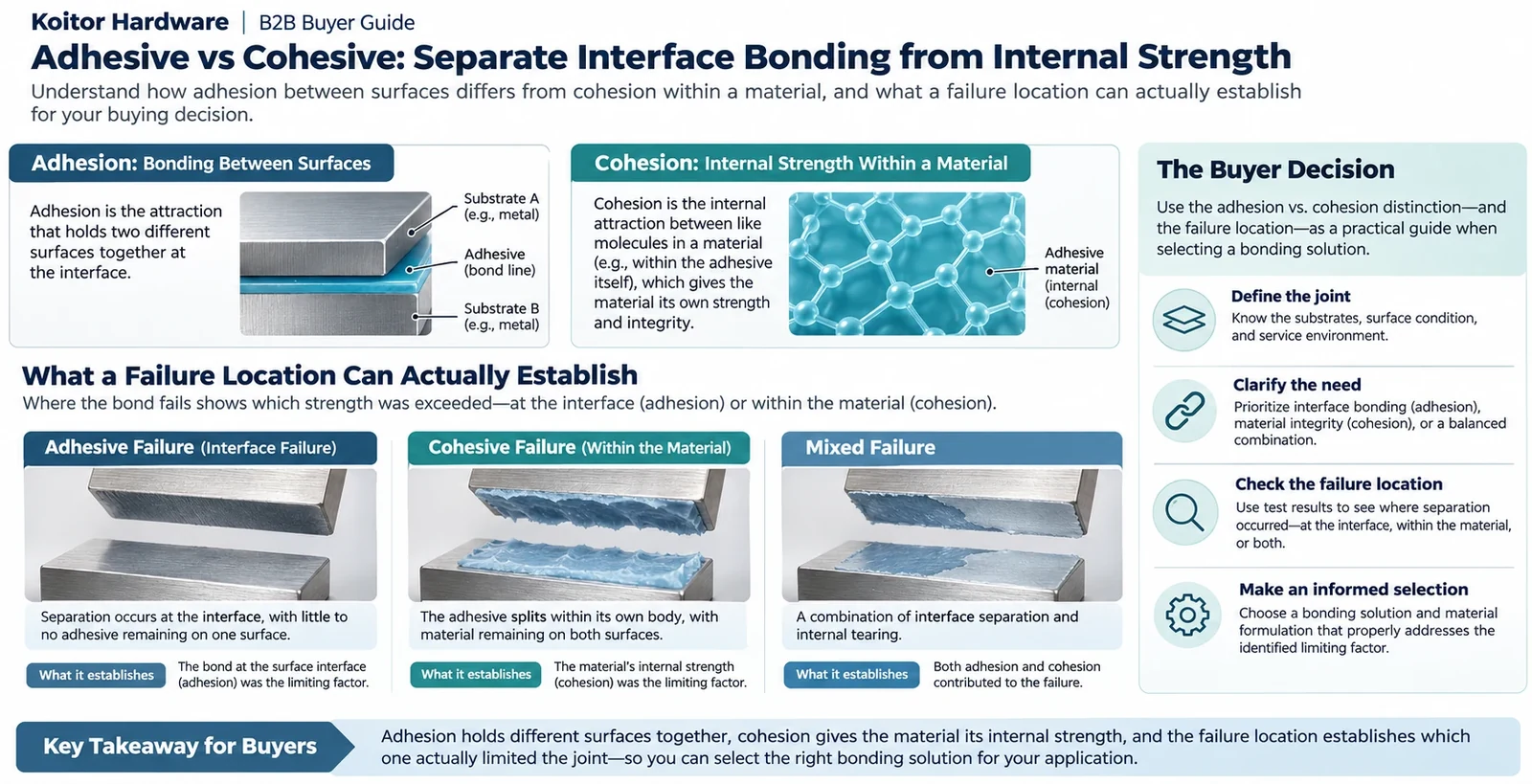
Adhesive vs cohesive describes two different locations or interactions in a bonded system, not two competing types of glue. Adhesion concerns the bond or interaction between different surfaces, such as an adhesive and a substrate; cohesion concerns attraction or internal strength within one material, such as the adhesive layer itself. An adhesive separation and a cohesive fracture describe different observed locations, while mixed or substrate failure can also occur. The appearance of a fracture alone does not establish its root cause, a safe load, or whether a joint is acceptable.
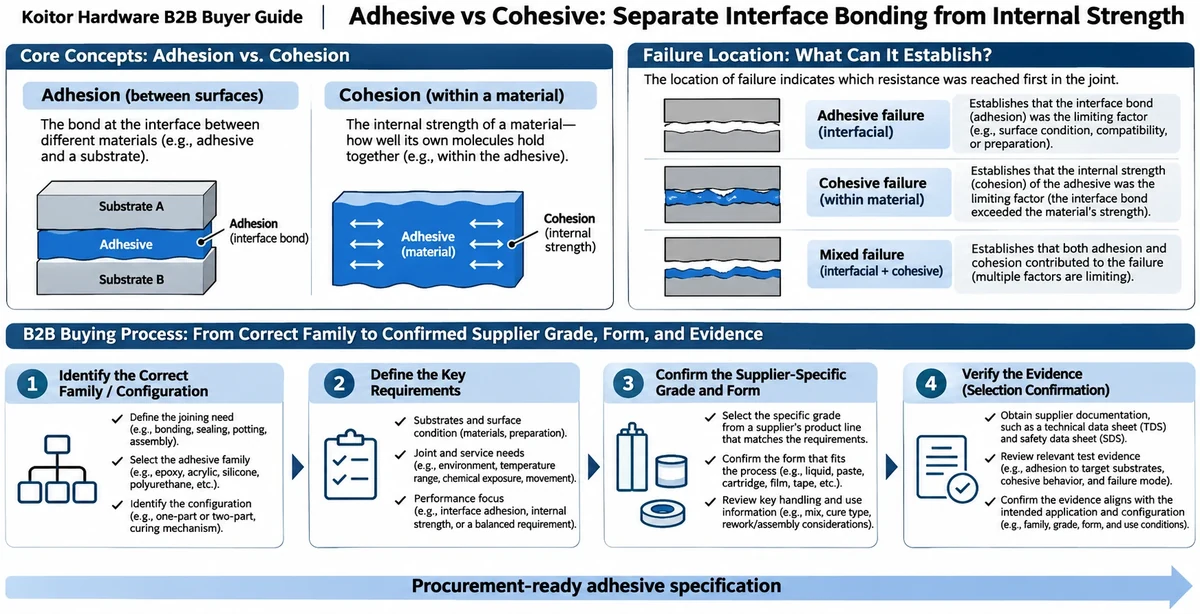
What is the difference between adhesion and cohesion?
Adhesion refers to interaction between unlike surfaces or materials at an interface. In a bonded joint, the interface may be between the adhesive and one substrate, or between the adhesive and a second substrate. Cohesion refers to forces or integrity within a material. In a simple adhesive joint, cohesion concerns the adhesive layer itself.
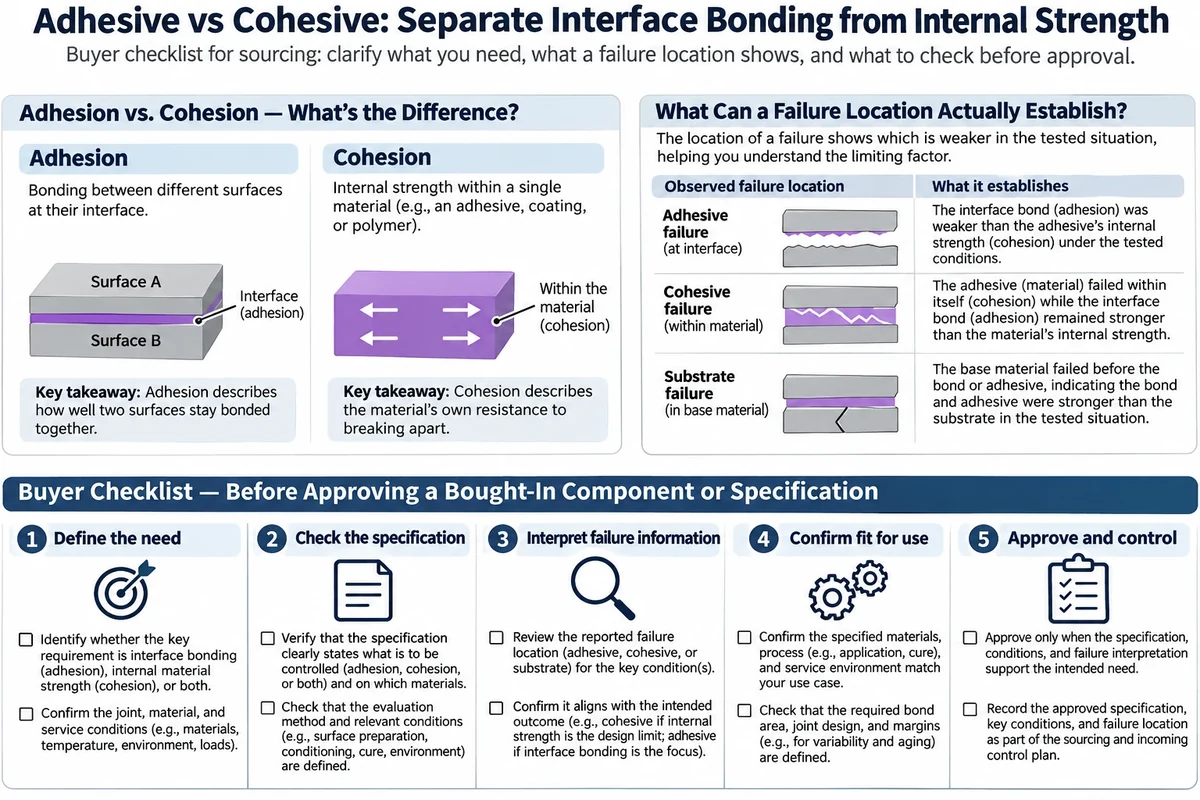
These concepts can help a buyer interpret a supplier’s description of a fracture. If separation appears along an adhesive-substrate interface, the observed location is often described as adhesive failure. If the adhesive layer appears to split internally, the location may be described as cohesive failure. A fracture can also involve more than one location, or the substrate itself can fail. Real observations may be mixed rather than fitting a clean binary label.
The words are related to the mechanics of a joint, but they do not identify a glue category such as epoxy, acrylic, pressure-sensitive, or hot-melt. They are not a simple stronger-versus-weaker ranking. A joint’s outcome depends on the actual materials, surfaces, geometry, application, loading, and evaluation method. The buyer should first understand what was observed and then determine what additional evidence is needed.
Why does failure location matter to a buyer?
When a bonded component separates, the fracture location can help describe the observation and guide further investigation. It can distinguish whether separation appears at an interface or within a material layer. That is useful information, but it is only one piece of a failure review.
A hypothetical pad attached to a coated metal surface illustrates the distinction. The pad may detach cleanly from the metal, split within its own adhesive layer, tear within the pad, or remove some substrate coating. These observations identify different locations in the joint. They do not, by themselves, prove why the failure happened. Surface condition, contamination, adhesive selection, application, cure, geometry, aging, loading direction, and test method may all be relevant.
A careful report therefore separates observation from interpretation:
| Record field | Example of what to note | What it does not prove alone |
|---|---|---|
| Observed separation location | At interface, within adhesive, within substrate, or mixed | Root cause or responsibility |
| Joint configuration | Substrate materials, bond area, and orientation | Suitability of every similar design |
| Sample identity | Part number, revision, supplier, and date | Production-wide consistency |
| Loading or handling context | Method and conditions used in evaluation | A safe design load without a validated criterion |
| Surface appearance | Visible residue, transfer, coating removal, or tear | Chemistry or process condition without further evidence |
| Evaluation method | The agreed method or inspection sequence | Universal acceptance across different procedures |
This classification makes a quality conversation more precise. It avoids turning “cohesive failure” into an automatic pass or “adhesive failure” into proof that a supplier used the wrong glue.
What is adhesive failure?
In common failure descriptions, adhesive failure means separation at an interface between different materials, often between the adhesive and one substrate. The observed fracture surface may show that one side has little or no adhesive remaining, but appearance can vary with the materials, layer thickness, transfer, contamination, and test method.
An interface separation is a description of where the joint appears to have separated. It does not alone identify the cause. Possible factors can include surface condition, preparation, adhesive choice, application, geometry, loading, or environmental history, but a visual image cannot determine which factor caused a particular event. A failure investigation needs context and appropriate evidence.
For buyers, the useful next step is to document the actual materials and joint configuration and ask the responsible technical party to review the evidence. A photograph can help preserve the observation, but it should show both fracture faces and identify the sample. If the bond is part of a product function, the buyer should refer to the specified requirement and evaluation method rather than infer acceptance from the term “adhesive failure.”
What is cohesive failure?
Cohesive failure describes fracture within a material layer rather than at the interface between two materials. In an adhesive joint, the adhesive layer may appear split so that material remains on both substrates. However, the precise interpretation depends on the actual materials, layer, and method used to examine the failure.
The label does not prove that the joint is strong enough, that the adhesive was properly applied, or that the product meets its intended use. A cohesive fracture can occur under an unsuitable load or test condition. It may be acceptable under one agreed evaluation and unacceptable under another. The buyer needs the joint requirement, test context, and acceptance criterion to determine what the observation means for the product.
It is also important not to overread residue. Material remaining on both surfaces may be consistent with a cohesive fracture, but other layers or substrates may have failed. The report should identify where the observed fracture lies and what evidence supports that classification. If the location is uncertain, label it uncertain or mixed instead of forcing a simple category.
Can one joint have mixed failure?
Yes. A fracture can travel through more than one region. Part may separate at an interface, while another area splits within the adhesive or substrate. A mixed pattern should be described as mixed, with the approximate areas or locations recorded where practical. Reducing a complex fracture to a single adjective may hide useful evidence.
A mixed failure also does not settle root cause. The pattern can be affected by the stress distribution, bond geometry, specimen preparation, loading direction, and material condition. The buyer should retain the sample and document how it was tested or handled. If further investigation is warranted, the technical reviewer can decide what additional analysis is appropriate.
For an incoming quality discussion, a concise record can include:
- The part and drawing revision.
- The adhesive or bonded component supplier and product identity if known.
- The two substrates and their surface or coating descriptions.
- The observed fracture path on each side.
- Whether adhesive, substrate, coating, or pad material remains.
- The loading or test context and method.
- Photographs of both fracture faces.
- Whether the classification is adhesive, cohesive, substrate, mixed, or uncertain.
- The requirement against which the result is being reviewed.
This record supports a more informed discussion without inventing a failure mechanism.
Does cohesive failure mean a joint is acceptable?
No automatic pass follows from the word cohesive. The term describes an observed fracture location, not the product’s acceptance rule. A joint may fail internally at a load that is below the buyer’s requirement, or it may show an internal fracture after a test that was not designed to represent the product’s use. Without a defined requirement and method, the label cannot decide acceptance.
Likewise, adhesive failure does not automatically mean the whole design is defective. A test may apply a loading direction or condition outside the agreed use, or the sample may not reflect the approved process. The buyer should compare the observation with the specified test, product function, and contractual acceptance criteria.
The evaluation should distinguish three questions:
- What happened? Describe the visible fracture location and sample condition.
- Under what conditions? Record the loading method, direction, duration, and sample preparation as defined by the responsible procedure.
- What does the requirement say? Compare the evidence with the agreed acceptance criterion.
If any part of that information is missing, the result may remain inconclusive. Do not infer a safe shelf or bracket load from a fracture label or a single unqualified sample.
What factors can influence a bonded joint without proving a cause?
Bond behavior can depend on substrate identity, finish, cleanliness, surface preparation, adhesive product, application sequence, geometry, bond area, layer thickness, cure or setting conditions, and the way force is applied. Environmental exposure and time can also be relevant. The presence of these possible factors does not mean any one caused a specific failure.
A buyer should use them as investigation questions, not as a checklist for assigning fault. For example, if a pad separates from a coating, the observation may prompt a review of the metal finish, adhesive product documentation, sample process, and joint design. It does not prove the coating was contaminated, the adhesive was wrong, or the supplier skipped an instruction.
A project-specific analysis may require qualified engineering or laboratory input. This article does not prescribe surface-treatment recipes, cure instructions, pull-off procedures, design loads, or bond qualification criteria. The actual supplier documentation and agreed test method govern those decisions.
How should a failure report be written?
A failure report should use neutral language and distinguish fact from inference. It can say, “The pad separated from the coated metal surface during the specified evaluation; adhesive residue was visible on the pad side; classification pending review.” That wording records what was observed without claiming the coating, adhesive, or process caused the event.
Where the evidence supports a classification, the report can identify the observed location and confidence. If the pattern is mixed or unclear, say so. Include the sample identifier, date, part revision, method, loading condition, photos, and the requirement being assessed. Keep any hypothesis about cause in a separate section and label it as a hypothesis until verified.
The report should also identify the next action: retain the sample, obtain supplier records, compare an approved reference, repeat an agreed test, or request technical review. The responsible parties should decide what evidence is appropriate. A failure description is a starting point for that review, not the final root-cause conclusion.
How can an OEM factory support bonded-component communication?
Koitor Hardware is a family-owned custom metal hardware factory focused on bathroom and home storage products. In a confirmed OEM project, a buyer can share the drawing or sample and identify where a supplied pad, liner, tape, or other bonded component interfaces with the metal assembly. Clear drawings, approved samples, finish requirements, and packaging details can help the buyer and responsible suppliers discuss the component within the full product context.
Koitor’s approved scope does not establish adhesive manufacturing, structural adhesive engineering, chemical analysis, or laboratory bond qualification. If a bonded component is supplied by another party, the buyer should identify who selects the adhesive, who controls application instructions, who performs testing, and who approves the finished joint. Those responsibilities should not be inferred from the name of a metal hardware factory.
For an RFQ or sample review, the buyer can ask each responsible party to identify the component supplier, material or product identity where available, application responsibility, and the evidence used for any stated performance requirement. The purpose is not to request a particular chemistry or process recipe without engineering review. It is to make ownership and acceptance criteria visible before the project depends on them. If the bond is not part of Koitor’s confirmed supply scope, the purchasing record should say who supplies and approves it. Treat adhesive vs cohesive as descriptive failure-location language within that wider record, rather than as a substitute for a product specification. When comparing adhesive vs cohesive notes from different suppliers, check that both describe the same layer boundaries and evaluation context; shared terminology without a shared method can create false agreement.
For product scope, review Fertigung von maßgefertigten Badbeschlägen and share a drawing or physical sample through the contact page. Any bond claim or load requirement must be supported by the responsible supplier and project-specific evidence.
Buyer checklist when reviewing an adhesive or cohesive failure description
- Identify the two substrates and the adhesive product if known.
- Record the part, drawing revision, supplier, and sample identity.
- Photograph both fracture faces before cleaning or altering them.
- Describe the observed location: interface, internal layer, substrate, mixed, or uncertain.
- Record the evaluation method and loading context.
- Compare the observation with the agreed requirement and acceptance criterion.
- Separate the visible fact from any proposed root cause.
- Do not treat cohesive failure as an automatic pass.
- Do not treat adhesive failure as automatic proof of supplier fault.
- Escalate uncertain classifications to the responsible technical reviewer.
- Retain the sample and relevant supplier documentation.
- Document who owns product selection, application, and verification.
What should be retained after a bonded sample is evaluated?
Retain the tested sample in a way that preserves both fracture faces and any material transfer. Label it with the test or inspection reference, part revision, supplier, and date. If the sample is cleaned, cut, or handled further, record that action because it may change the visible evidence. Store photographs with the sample record and include views that show the overall joint as well as close details of the separation.
If several samples were evaluated, avoid combining observations into a single conclusion without identifying which sample showed each pattern. Differences can arise between locations or specimens. A reviewer should be able to connect every image and observation to a particular sample and method. If the classification remains uncertain, preserve that uncertainty and request qualified review instead of writing a definitive cause into the purchasing record.
Retention does not itself qualify the joint or prove production consistency. It supports later comparison and helps the buyer and supplier discuss what was seen. The project’s specified acceptance criteria and responsible technical review still determine whether additional investigation or corrective action is needed.
How should a buyer compare a supplier’s failure classification?
When two suppliers describe a fracture, compare the evidence and terminology they used rather than the label alone. One report may classify failure by the visible location, while another may use a test-specific coding scheme. Ask each party to identify the surfaces, layers, and sample faces represented by its term. If possible, keep the actual sample available so the reviewer can compare both sides of the joint.
The buyer should also confirm whether the classification is based on visual examination, microscopy, a standardized procedure, or another method. This guide does not prescribe one method or declare one description universally correct. The record should identify the method and its limits. A photograph can support discussion, but lighting, residue, transparent layers, and substrate damage may make a close classification difficult from an image alone.
If the reports disagree, do not average the labels or choose the more favorable one. Ask a qualified reviewer to reconcile the observed location against the sample and method, then document the conclusion and any uncertainty. The reviewer may recommend further analysis if the distinction matters to a design decision. Until then, treat the root cause and acceptance status as unresolved rather than converting a terminology disagreement into a supplier score or product claim.
How should teams turn a failure observation into a useful review record?
Begin with the observed location and preserve the part in the condition in which it was found. A note such as “the pad came off” describes an outcome, but it does not say whether separation occurred at the pad-to-metal boundary, inside the pad, within a coating, or through a transferred residue layer. If pieces remain on both sides, record that as well. The purpose is to make the observation reproducible, not to assign blame from a photograph.
Identify the product, component, sample or lot, drawing revision, and the relevant interface. Describe the examination method in plain terms: whether the separation happened during ordinary handling, installation, a specified evaluation, or after an uncontrolled event. Record any known storage, cleaning, temperature, or aging history only when it is documented. If those conditions are unknown, label them unknown instead of filling gaps with assumptions.
Next, separate three statements in the review: what was seen, what the evidence supports, and what remains to be established. “The pad separated from the metal surface during the recorded evaluation” may be an observation. “The interface was the separation location” may be an evidence-based classification if both surfaces were examined. “Insufficient surface preparation caused the failure” is a causal conclusion and requires additional evidence about the materials, process, condition, and alternative explanations. Keeping these statements apart makes later supplier discussions more precise.
Agree on the decision that the review must support. A buyer may need to determine whether a sample should be held, whether a requirement needs clarification, whether additional evaluation is appropriate, or whether the event can be accepted under the applicable specification. Those decisions depend on the contract, product use, agreed method, and evidence; this article does not establish a universal pass/fail threshold. Where the result is disputed or safety-relevant, use the appropriate technical or quality reviewer and preserve the physical evidence for examination.
This record also helps distinguish a terminology problem from a product problem. If two parties use “adhesive failure” to mean different things, first describe the actual surfaces and material layers, then agree on the vocabulary. A shared label is useful only after the observed failure path is clear. It cannot replace a drawing, acceptance criterion, or investigation into cause.
Häufig gestellte Fragen
Are adhesion and cohesion types of glue?
No. Adhesion and cohesion describe different interactions or locations in a bonded system. Adhesion concerns an interface between materials; cohesion concerns integrity within a material.
Does cohesive failure alone prove a joint is acceptable?
No. It describes an observed fracture location, not whether the joint met the product requirement. Acceptance depends on the agreed method, conditions, and criterion.
Can a fracture involve more than one location?
Yes. A failure can be mixed, involving an interface, adhesive layer, or substrate. Record the observed pattern instead of forcing it into one category.
Does adhesive failure identify the root cause?
No. It identifies an apparent separation location. Root cause requires additional context and evidence.
Can a photograph classify every failure?
Not always. Images can document appearance, but material layers, lighting, residue, and the evaluation method may affect interpretation. A qualified review may be needed.
Review a Bonded Component in Your Hardware Assembly
Share the product drawing or sample to discuss metal interfaces, finish, packaging, and the responsibilities of the suppliers involved.
OEM / EIGENE MARKE
Verwandeln Sie diesen Beschaffungsleitfaden in ein Produktdossier
Teilen Sie uns Ihr Zielprodukt, die Größe, die Oberflächenausführung, die Bestellmenge und Ihre Verpackungsanforderungen mit. Ihr Team erhält vor der Angebotserstellung eine praxisorientierte Prüfung der Herstellbarkeit.

 English
 Español
 Português
 Français
 Deutsch
 العربية