
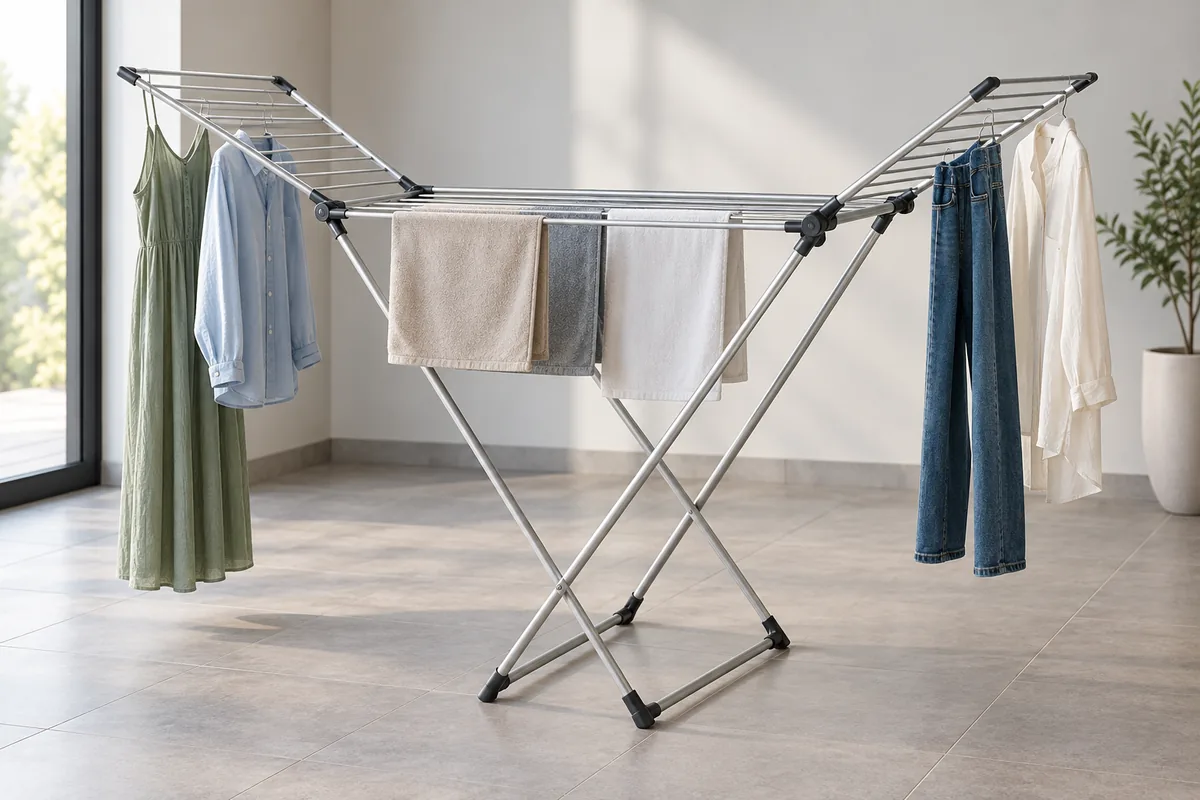
For drying rack wing height long garments clearance, approve the garment drop and rack geometry together at every intended wing position. Record the distance from each rail to the garment’s lowest point, then check lower bars, the floor, adjacent garments, opening footprint, and folded envelope on a finished sample. A listing may describe adjustable wings or long-garment use, but that feature label alone does not show whether a buyer’s assortment clears the rack’s lower frame.
Why should buyers treat wing height as a garment-clearance specification?
Buyers should treat wing height as part of a complete clearance specification because the rail position is useful only in relation to the garments, lower frame, floor, and rack footprint. A raised wing can create more drop space while changing the open envelope or the way a rack occupies a room. Review these effects together rather than approving one position from a product photo.
For importers and private-label brands, the practical question is not only “Does the rack have adjustable wings?” It is “Which garment lengths should fit at each approved wing position, and what parts of the rack sit below those garments?” A shirt, dress, pair of trousers, or long textile can hang from the rail and still touch a lower crossbar or the floor. The result depends on the geometry and the hanging method used for review.
The search expression “drying rack wing height long garments” compresses several separate checks: rail height, garment drop, lower-frame clearance, and floor space. Treat those as individual sample observations so a buyer can see which dimension drives the fit decision.
Manufacturer examples show that wing height is a real product feature. Brabantia’s HangOn drying-rack data sheet identifies adjustable wing heights for different laundry sizes. Costway describes an adjustable-wing clothes rack with a stated height range and long-garment use. Those are model-specific examples, not universal dimensions or a specification for another supplier’s rack. Buyers should use them to frame the question, then define target clearance for their own assortment and market.
An approval record should connect the rack drawing, garment envelope, and tested wing position. If the buyer changes the garment mix or the frame geometry, an earlier sample decision may no longer answer the new fit question. This makes wing-height review relevant during range planning, drawing approval, sample testing, and later product changes.
What garment dimensions should buyers measure first?
Measure the garment’s hanging drop from the point where it rests on the wing rail to its lowest point, then identify the lower bars or floor that could interfere. Include the way the garment is hung—such as on a hanger, draped over the rail, or clipped—because the contact point changes the effective drop.
Create a representative set rather than relying on one short sample. A buyer may include a long shirt, trousers, and the longest intended garment for the product line. Record garment length or drop in the intended hanging method, and note whether garments should hang from a hanger or directly over a rail. These are assortment inputs, not claims that every garment of a named type has the same length.
For each garment, map the lowest point against the rack frame. The critical clearance may be beneath the wing rail, between the wing and a lower shelf or brace, or between adjacent hanging items. Identify every part that could touch fabric: a crossbar, leg, brace, connector, or the floor. If the rack offers several settings, make a separate observation for each position the buyer expects to advertise or supply.
| Buyer input | How to capture it | Why it affects approval |
|---|---|---|
| Garment type and length | Use representative items from the planned assortment | A short sample cannot represent the longest intended drop |
| Hanging method | Note hanger, drape, or clip and its rail contact point | Different methods change the effective vertical drop |
| Wing position | Identify each height setting and locking condition | Clearance depends on the selected position, not just maximum height |
| Lower-frame geometry | Mark bars, braces, shelves, and legs under the garment | Fabric may touch the frame even when the rail is high enough |
| Floor and nearby space | Review the fully opened rack in its intended footprint | Frame and garment clearance must be checked in the use configuration |
Avoid turning one observed gap into a universal “long garment” limit. The buyer can set a product-specific minimum clearance after reviewing actual sample garments. If no numeric threshold is defined, state which garment and configuration were checked and what interference was observed.
How do alternate wing positions change the usable drop?
Each approved wing position creates a different garment drop and may change the rack’s usable configuration. Buyers should request side-view drawings showing the wing rail, lower frame, hinge or stop positions, and fully open profile at every position intended for sale.
The drawing should clarify how the wing is held in place. A rack might use a limited set of fixed positions or another adjustment arrangement; do not infer a mechanism from marketing copy. Identify stops, hinge points, and user-operated locks only from the actual design. Confirm that the sample reaches its intended position consistently and can be adjusted according to the supplier’s instructions.
Review both sides and any asymmetry in the frame. If the product permits different wing settings, state whether both wings must match or can be set independently. Check whether adjustment changes the support points, open width, or contact with another component. The goal is to approve a repeatable configuration, not to write an unnecessary mechanism description.
| Configuration | Buyer question | Evidence to record |
|---|---|---|
| Lowest wing position | Which target garments clear lower bars and floor? | Garment sample, rail position, observed lowest point |
| Highest wing position | Does drop improve without creating new interference? | Side-view drawing and sample observation |
| Both wings raised | Is the open rack usable and symmetrical as shown? | Position pairing and open footprint |
| One wing adjusted | Is asymmetric adjustment part of intended use? | Approved setting and usage limitation |
| Folded state | Do wings close without catching frame or accessories? | Folded envelope and contact review |
Do not infer an adjustment range from another brand’s listed range. Brabantia’s published data and Costway’s product description apply to their named models. Request dimensions for the proposed rack and confirm them on a sample with the intended frame and hardware.
How should buyers check open and folded rack envelopes?
Check the fully open footprint and folded envelope as separate product states. A wing setting that clears a long garment may occupy more space when open, while the folded rack has its own storage and transport requirements.
On a side-view drawing, mark the rail height, garment drop, lower crossbars, legs, and floor reference. On a top or front view, record maximum open width and wing projection. For the folded state, identify dimensions that matter for retail storage, assortment planning, or carton fit. Measurements should refer to a named drawing revision and sample; a listing photo cannot reliably establish them.
Review component contact during opening and closing. Confirm whether the wings clear lower bars, whether stops engage, and whether intended adjustment can be completed without forcing the mechanism. This is a sample function review, not a claim about hinge life or cycle durability. If the buyer requires a cycle test, agree on method, cycle count, load condition, and acceptance criteria for the specific project.
Consider the frame and garment together. Fabric may fit at the rail but swing into a nearby brace or another hung item. For an assortment with multiple garments, check the intended spacing and loading pattern. Record the sample condition and avoid implying that every possible arrangement has been tested.
How can buyers validate clearance on a production-intent sample?
Validate clearance by using representative garments on a finished sample in each approved wing position, then recording contact, clearance, adjustment, and folding observations. A product-specific sample test is more informative than a generic measurement because it includes the actual frame, joints, finish, and adjustment hardware.
Before review, confirm the sample drawing revision and identify which wing positions are intended for sale. Use the same hanging method planned for the product instructions. Place the rack on a flat floor, open it according to supplier instructions, and position each representative garment without adding an unapproved load. Record whether fabric contacts a lower bar, brace, leg, or floor, and whether an adjacent garment changes the result.
Review adjustment and folding as well. Note if the wing reaches and remains at the intended position, whether its stop or support is engaged, and whether the frame closes without interference. If a pinch-point, stability, or load test is required, define it separately with the product owner and supplier. Do not treat a garment-clearance check as a safety certification or load-capacity result.
Capture observations in an approval table: rack model and revision, garment sample or dimension, wing position, lower-frame clearance, floor contact, adjustment result, folded envelope, and disposition. If the buyer revises the frame, hinge, wing rail, or garment assortment, determine whether the change affects the earlier review and repeat relevant checks.
What should the OEM RFQ include for an adjustable-wing rack?
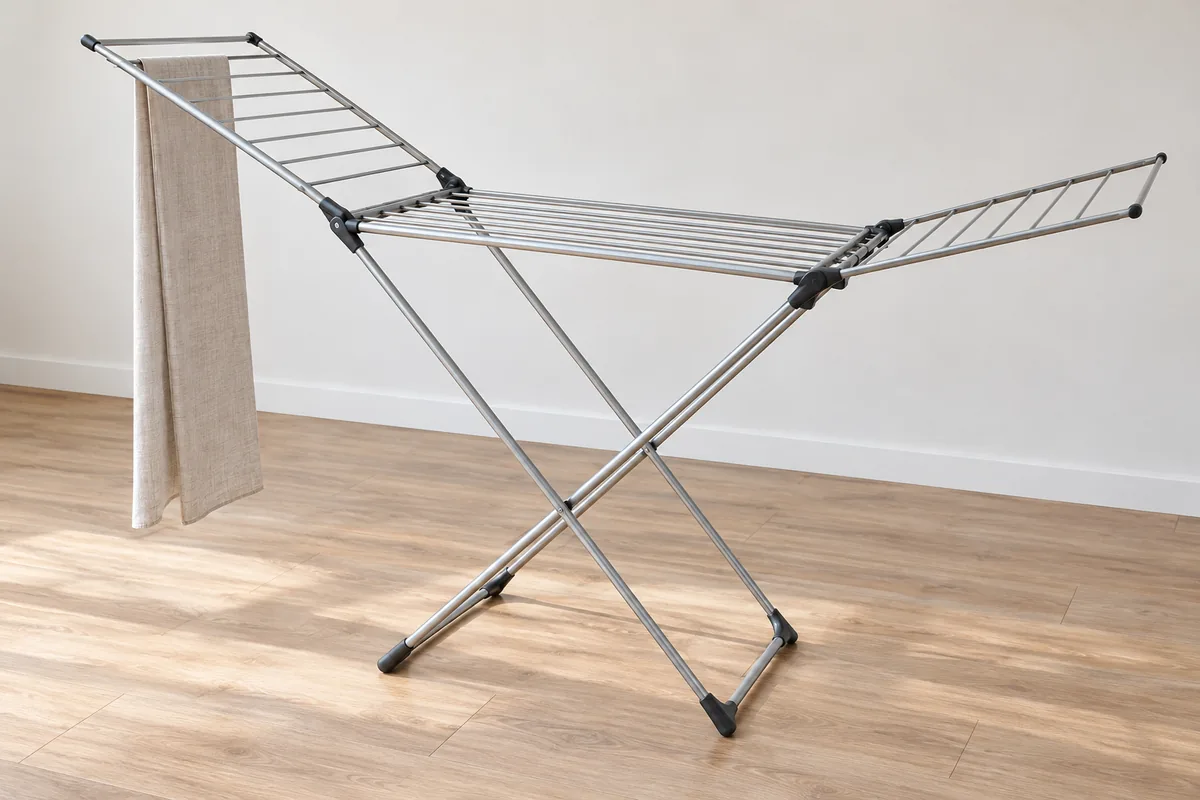
An OEM RFQ should describe the target garment mix, intended wing settings, open and folded envelopes, and sample evidence required for approval. Include drawings or physical references where available, and distinguish confirmed requirements from decisions that remain open.
- Product outline and frame drawing with revision identifier.
- Number of wing positions and intended setting for each side.
- Representative garment types, lengths, and hanging methods.
- Required clearance points above lower bars and floor, if numerically controlled.
- Open width, wing projection, folded size, and packaging envelope.
- Adjustment, stop, folding, and handling observations required at sample stage.
- Material and finish preferences for the frame, based on project requirements.
- Any approved load, safety, stability, or cycle-test method and acceptance criteria.
- Carton and packaging requirements for the frame and moving wings.
- Change-notification and reapproval requirements for frame or mechanism revisions.
Do not state target load, lifetime, cycle count, or garment capacity unless the buyer has defined a test and the supplier has agreed to the requirement. If a number is missing, mark it as an open point. This prevents a product description from turning an untested assumption into a contractual claim.
For a related metal-frame discussion, buyers can review Koitor Hardware’s Informationen zur Herstellung von OEM-Hardware für die Heimspeicherung. Koitor is a family-owned custom metal hardware factory with home-storage and bathroom accessory experience; current adjustable-wing laundry-rack production and hinge-mechanism capability must be confirmed for the individual project. The page is context for a sourcing conversation, not proof that a specific drying rack is currently offered.
What sourcing mistakes can create a poor garment-clearance decision?
The main mistakes are approving a wing-height feature without defining garment drop, reviewing only the highest setting, and ignoring the lower frame or folded state. Buyers can avoid them by tying each clearance statement to a sample, configuration, and drawing revision.
- Using a photo instead of garment measurements: perspective hides the true rail-to-floor relationship.
- Checking one wing setting only: other settings may be advertised without being reviewed.
- Ignoring lower bars: a rail can be high while the garment still touches a brace or shelf.
- Assuming one garment represents the range: longer or differently hung items may behave differently.
- Overlooking adjacent items: fabric can contact another garment or frame member during intended use.
- Mixing open and folded dimensions: display footprint and storage envelope are different configurations.
- Treating adjustment as a durability claim: one movement check does not establish cycle life or structural performance.
- Copying another brand’s dimensions: supplier data applies to the named model, not a universal standard.
These are specification and evidence gaps, not proof of a defect in any product category. The correction is to show the intended setting and garment on a finished sample, record the result, and update approval if the geometry or assortment changes.
Frequently asked questions about drying-rack wing clearance
Does a higher wing always fit longer garments?
Not necessarily. Garment drop, hanging method, lower bars, braces, adjacent items, and floor all affect the result. Review representative garments in each proposed wing position on the actual sample.
Should buyers specify one minimum clearance number?
Only after selecting the garment envelope and measurement method. A numeric clearance should name reference points, wing position, floor or lower-frame datum, and sample configuration.
Can a retail listing’s height range be used as an OEM specification?
No. A listing describes a particular model and may not state the full measurement method or all clearance conditions. For a “drying rack wing height long garments” requirement, request the supplier drawing and verify relevant settings on the proposed product.
Does a successful sample fit check prove load capacity or hinge life?
No. It documents only the sample and checks performed. Load, stability, safety, and cycle durability require separate product-specific methods and acceptance criteria.
What should be repeated after a drawing change?
Repeat the checks affected by the change. A new wing rail, hinge, stop, lower brace, or garment assortment may alter drop or open/folded envelope, so compare the revised drawing and sample before approval.
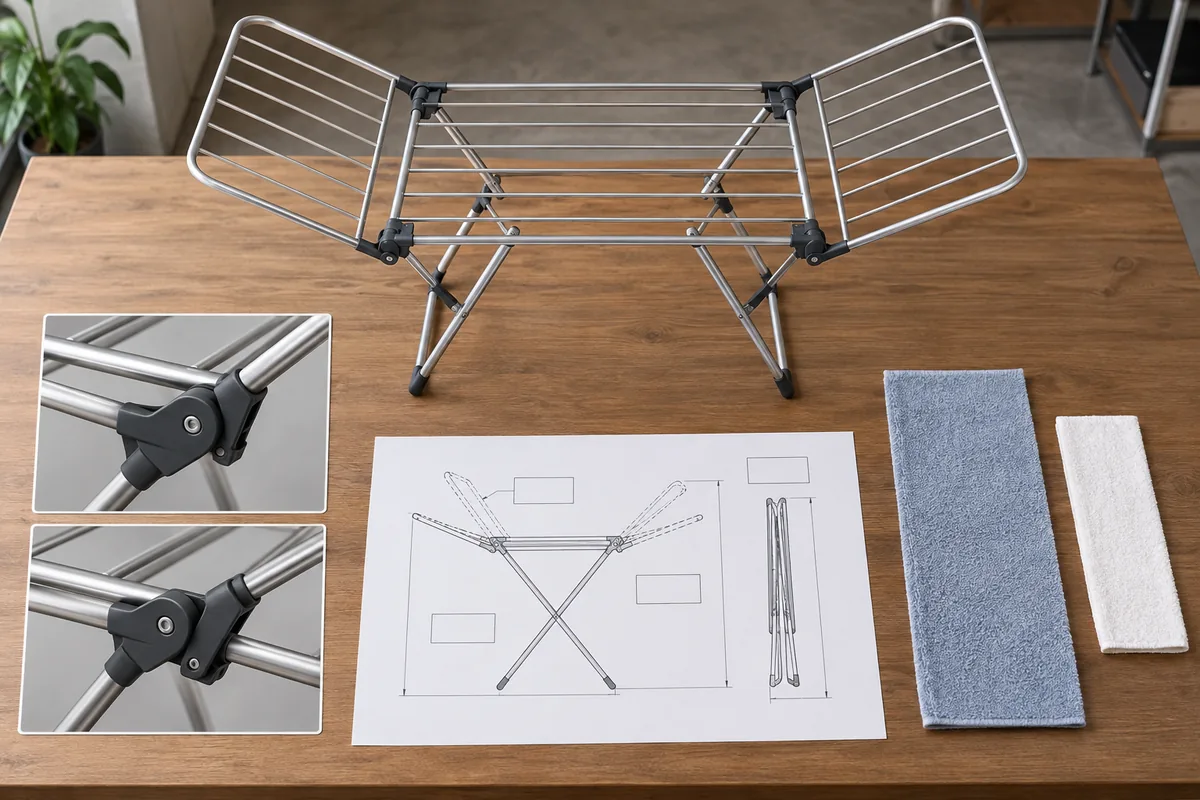
Review a Metal Storage Frame Concept With Koitor
Share the intended garment mix, frame drawing, wing positions, and packaging envelope for a practical sourcing discussion. Adjustable-wing rack production and mechanism scope must be confirmed project by project.
OEM / EIGENE MARKE
Verwandeln Sie diesen Beschaffungsleitfaden in ein Produktdossier
Teilen Sie uns Ihr Zielprodukt, die Größe, die Oberflächenausführung, die Bestellmenge und Ihre Verpackungsanforderungen mit. Ihr Team erhält vor der Angebotserstellung eine praxisorientierte Prüfung der Herstellbarkeit.
 English
  Español
  Português
  Français
  Deutsch
  العربية