
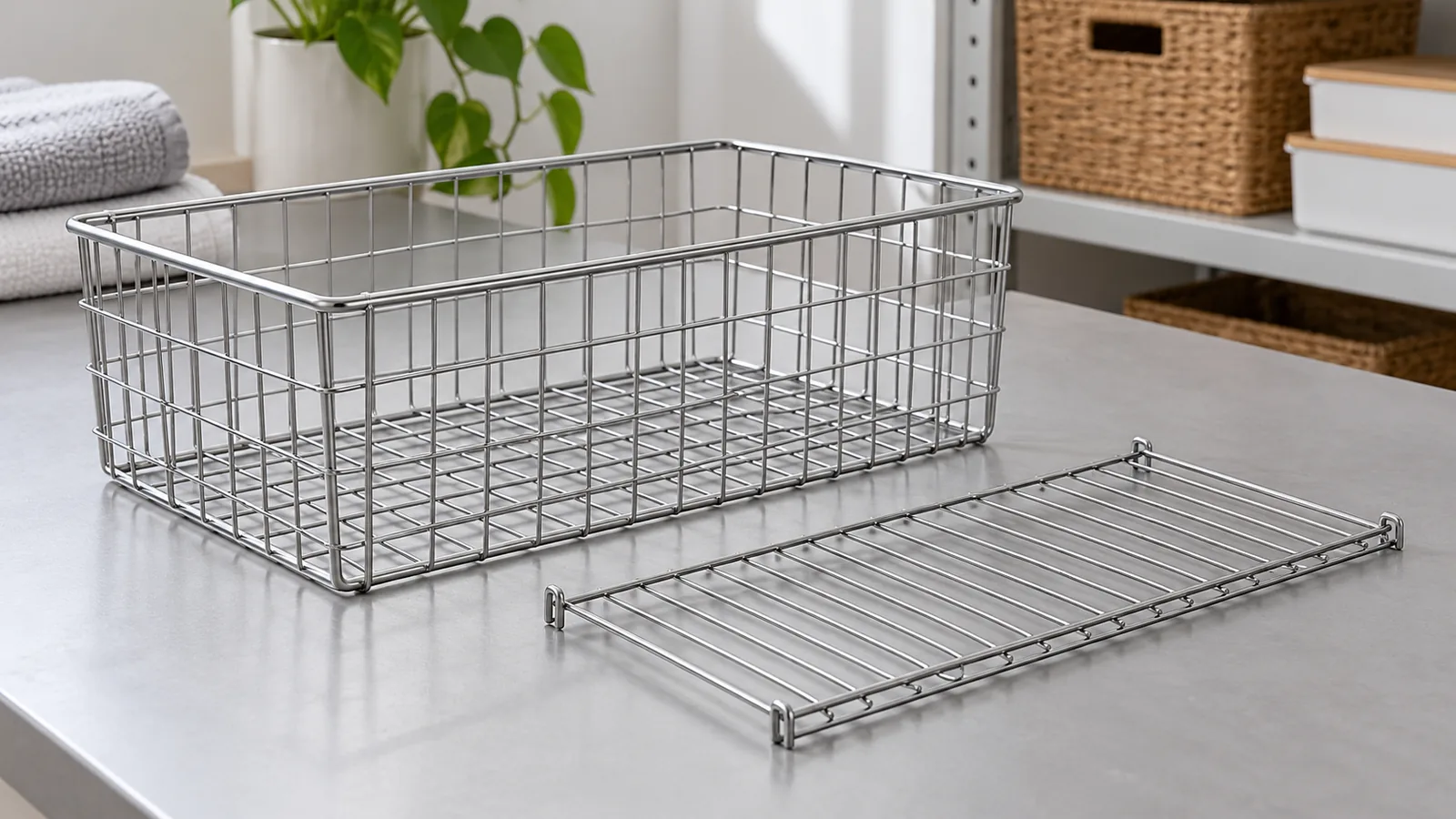
Anping wire mesh suppliers should be judged by the exact finished product; a regional label alone is not a capability audit. A buyer looking for an Anping wire mesh storage basket manufacturer may find suppliers offering raw wire, woven mesh, welded panels, fencing, display racks, baskets, or products assembled from several sources. These are different deliverables. A supplier that can provide one stage may still need a partner to bend, weld, finish, assemble, inspect, label, or pack the finished retail SKU.
The sourcing question is therefore not simply “Is this company in Anping?” It is: “Can this specific supplier deliver the exact home-storage product and revision that I intend to buy, and can it show how each required step is controlled?” That question protects the importer from assuming that geographic proximity, a catalog category, or an equipment photograph proves finished-product readiness.
This guide gives buyers a practical way to qualify the product chain before issuing a detailed RFQ. It makes no claim that every supplier in Anping has the same capabilities, equipment, quality systems, or trading status.
Start with the finished product, not the regional label
Write a one-page product brief before contacting a supplier. Identify whether the target is a wire basket, shelf, organizer, trolley, display rack, or a combination. Include overall dimensions, usable internal dimensions, wire or mesh form, perimeter treatment, mounting or stacking interfaces, finish, included components, packaging state, and destination. State whether the buyer needs a standard item, a modified catalog model, or a custom product developed from a drawing or sample.
Anping wire mesh suppliers should be compared by the finished SKU and each production step the buyer needs, not by location alone.
Separate home-storage use from other wire products. Industrial fencing mesh, a welded panel, a storage basket, and a retail display rack may share material terms but differ in geometry, joining, finish, edge safety, load expectations, assembly, and pack-out. A company name or web listing that includes “wire mesh” does not show that it has already made the buyer’s finished SKU.
Describe the buying unit. Does the importer want a finished, assembled basket with protective feet and a barcode? A shelf and a separate mounting kit? A wire component that another factory will finish? If the item will be combined with plastic clips, screws, pads, labels, or an outer carton, list who supplies and installs each part. The supplier’s offer should say whether the quote covers components, finishing, assembly, inspection, pack-out, and export-ready labeling.
Map the SKU to the buyer’s sales channel. A wholesale carton, private-label box, e-commerce parcel, and retail shelf pack may have different labeling and protection expectations. This does not require the buyer to specify every production detail at the first email. It does require enough information for each supplier to identify what is included and what remains outside its offer.
Trace the production path for the exact model
Ask the supplier to map the actual route for the proposed SKU. The process may include wire or sheet procurement, drawing or cutting, straightening, welding or weaving, bending, grinding or deburring, surface finishing, assembly, inspection, packaging, and shipment preparation. Not every item uses every step, and the exact order varies. The buyer should ask which stages this supplier performs, which are subcontracted, and which are supplied as purchased parts.
Then connect each stage to a physical feature in the drawing. A basket’s corner, rim, handle, mounting tab, weld location, or surface can be a control point. Ask who is responsible for it and how the final buyer can review it. If a supplier describes itself as a manufacturer, ask for evidence related to the exact product family and stage rather than assuming the label covers every operation.
A useful RFQ conversation separates three things:
- Company role: factory, assembler, exporter, agent, or a combination for this order. Ask for the contracting entity and invoice/export roles.
- Process responsibility: which operation is performed at the supplier’s site, by a named partner, or by a component source.
- Finished-product responsibility: who owns drawing revision, quality records, final inspection, pack-out, and change notifications for the SKU.
These questions are not accusations. They help the buyer assign responsibility and compare offers fairly. A supply chain with subcontractors may be workable if the supplier controls the revisions, inspections, traceability, and corrective action. The presence of a subcontractor does not by itself prove weak capability; the lack of a clear handoff can make it difficult to resolve a product issue.
| Buyer question | Anzufordernde Nachweise | What the evidence can establish |
|---|---|---|
| Is the supplier offering the finished SKU or one process? | Written scope, drawing and quotation line items | Boundaries of the offer, not quality by itself |
| Which operations are internal or external? | Process map and named responsibility by stage | Production route for the quoted model |
| How is the revision controlled? | Drawing, BOM, approval and change records | Identity of the version being sampled |
| How are critical features checked? | Inspection plan tied to dimensions or visual criteria | Whether controls address buyer-defined requirements |
| Who packs and labels the retail unit? | Pack-out instruction, label proof and sample photo | Responsibility for the delivered SKU |
| How is a substitution approved? | Written change-control workflow | Whether changes can be reviewed before shipment |
For an Anping wire mesh supplier, ask for the route that applies to the buyer’s specific basket or shelf, not a generic factory tour presentation.

Check whether the sample proves the required capability
A sample should be traceable to the proposed model and revision. Record its date, drawing version, materials stated by the supplier, finish, included components, and packaging. Compare the physical sample with the drawing. Note what is measured, what is observed visually, and what remains unverified. A showroom sample or marketplace image may not reflect the current export configuration.
Define critical-to-fit and critical-to-function characteristics before the sample arrives. For a wire basket, these may include usable width and depth, edge treatment, mounting interface, component fit, drainage or ventilation openings if relevant, and the relationship between the basket and its shelf or bracket. Buyers should decide which dimensions are acceptance limits and how they will be measured. Do not treat a generic “standard tolerance” as agreed unless it is written into the specification.
Inspect the features the buyer will sell or rely on: exposed wire ends, alignment, visible welds, finish consistency, contact points, accessory fit, and assembly. Record the lighting and viewing distance for appearance observations. If a measurement or performance claim matters, define the test method, conditions, sample quantity, and acceptance threshold with a qualified reviewer. A sample that appears acceptable does not prove that future production will match it without process controls and revision management.
Ask the supplier to explain how the sample will be transferred into production. Is a fixture or tool needed? Are any purchased components order-specific? Does the finish supplier need a separate approved color sample? What should trigger a re-sample? The answers reveal whether the supplier has translated the buyer’s product definition into a controlled production record.
Distinguish regional industry evidence from supplier-specific facts
Public reporting about Anping can help buyers understand why the area appears in wire-related searches. Government and industry material describes a broad cluster with multiple product families and a range of company profiles. This context can justify a supplier search; it cannot confirm that a particular company can make a specific home-storage SKU. Likewise, marketplace listings can identify potential suppliers and product examples, but listing categories and role descriptions should be verified directly.
Use evidence in layers. A company registration or address helps confirm identity and location. A catalog can show the products the company publicly lists. A process discussion can establish the supplier’s claimed role. A sample, drawing, records, and an appropriate verification visit can reveal more about the model and controls. A laboratory report or inspection record supports only its stated scope. None of these alone answers every supplier-qualification question.
Avoid using company scale, a claimed machine count, or an “Anping factory” label as a proxy for quality. A buyer should connect capability to needed geometry, material, finish, order quantity, revision control, inspection, packaging, and communication. A smaller specialist may offer relevant flexibility; a larger supplier may have a wider process network. The relevant question is whether the specific offer meets the buyer’s brief and risk controls.
Compare quotations without hiding process gaps
Send the same drawings, finish reference, quantity assumptions, packaging plan, destination details, and required documents to each supplier. Ask for a response matrix that separates included and excluded operations. A low quotation for mesh panels is not comparable with a finished, labeled, assembled home-storage basket. If a supplier proposes a different route or material, ask for the deviation, reason, impact, and approval required.
When shortlisting Anping wire mesh suppliers, request a model-linked account of who forms, joins, finishes, inspects and packs the exact item.
Compare the following commercial items:
- Unit configuration and bill of materials
- Material description and traceability available for the product
- Cutting, forming, joining, deburring, finishing, and assembly scope
- Purchased or subcontracted components and responsible party
- Inspection records tied to the buyer’s drawing
- Packaging, labels, barcode handling, and carton assumptions
- Sampling, tooling, minimum-order, and change-control conditions
- Shipment handoff and documents the supplier will provide
Do not presume that every process is performed in the same building. Instead, confirm who controls the interfaces and how the exact revision follows the product through the route. If the supplier cannot answer a stage, record it as unknown and decide whether the gap matters before award. Do not let “full service” replace an itemized scope.
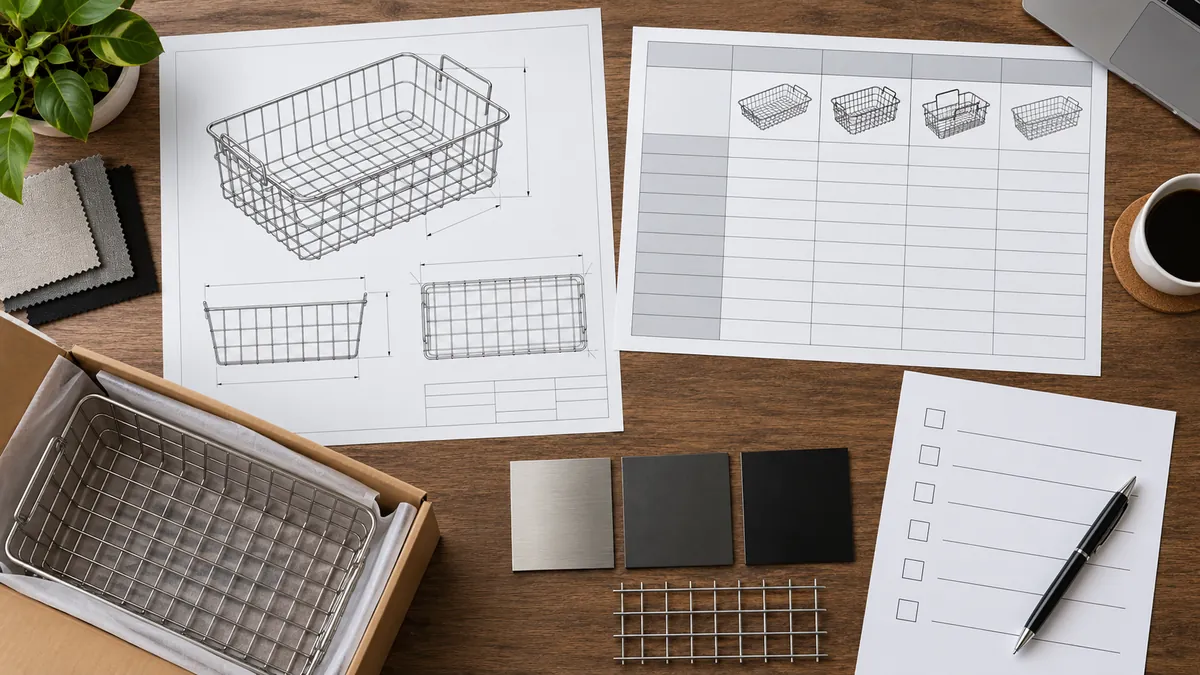
Build an RFQ checklist and qualify the supplier
The buyer’s RFQ should include a controlled drawing or reference sample, product use, target buyer channel, dimensions, material and finish requirements, reference colors, included parts, packaging, order quantity, destination, required documentation, sample stages, and acceptance method. State the model revision and ask the supplier to mark every assumption. Ask what it needs clarified before quotation rather than inviting it to fill gaps silently.
An RFQ to Anping wire mesh suppliers should name the basket or shelf, drawing revision, finish, acceptance checks, packaging and responsibility for any outsourced step.
During qualification, record evidence as verified, supplier-stated, or unknown. For example, a physical sample can be observed; a public catalog statement is supplier-stated; an unvisited subcontract process may remain unknown. This simple distinction prevents a marketing statement from being mistaken for an independent audit.
Does Anping location mean a supplier can make a finished wire basket? No. The regional cluster is diverse. Confirm the specific supplier’s role and product route for the exact retail-ready configuration.
Should a buyer reject a supplier that subcontracts finishing? Not automatically. Clarify which party controls the finish specification, approved sample, lot identification, inspection, nonconformance handling, and changes. Evaluate the actual control plan.
Can a marketplace page prove factory status? It can be a lead, not a complete verification. Check the legal entity, product scope, contracting party, export role, process responsibilities, and the sample for the model you intend to buy.
What should be checked on the wire-product sample? Use the buyer’s drawing and intended use. Common review points include dimensions, fit, edge condition, joints, finish, mounting interface, included parts, assembly, and packaging. Choose the required acceptance method before the review.
Can equipment photos prove quality? No. They may show equipment exists but not the process capability, operator control, maintenance, material condition, or results for the buyer’s SKU. Ask for model-specific evidence and sample checks.
Keep capability statements tied to the evidence
Koitor’s documented scope includes bathroom and home-storage metal hardware, with OEM communication and sample development. This article is a buyer-side guide to regional supplier qualification; it does not claim that Koitor is located in Anping or that it supplies every wire-basket process described. Buyers should compare documented capability to the requested SKU and ask suppliers to confirm unverified operations.
For information about Koitor’s established scope, see OEM home-storage hardware. To discuss a drawing or sample, use the Kontaktseite and identify the product, desired supply scope, target quantity, finish, pack-out, and any process that must be verified.
Sources and context
- Jincheng Government repost of a 2026 Anping industry report
- Xiong’an Government report on Anping’s wire-mesh industry
- Anping supplier product group listing wire baskets and home-storage carts
- Anping County HuaYang wire and mesh product categories
Government reports describe regional context; supplier pages describe their own catalog. Neither verifies the capability of a different supplier or proves that it can deliver the buyer’s particular model.
Discuss a home-storage metal product brief
Share the product drawing, target finish, order scope, responsible process steps, sample requirements, and export pack. A sourcing discussion should separate documented Koitor capabilities from items that still need confirmation.
OEM / EIGENE MARKE
Verwandeln Sie diesen Beschaffungsleitfaden in ein Produktdossier
Teilen Sie uns Ihr Zielprodukt, die Größe, die Oberflächenausführung, die Bestellmenge und Ihre Verpackungsanforderungen mit. Ihr Team erhält vor der Angebotserstellung eine praxisorientierte Prüfung der Herstellbarkeit.

 English
 Español
 Português
 Français
 Deutsch
 العربية