

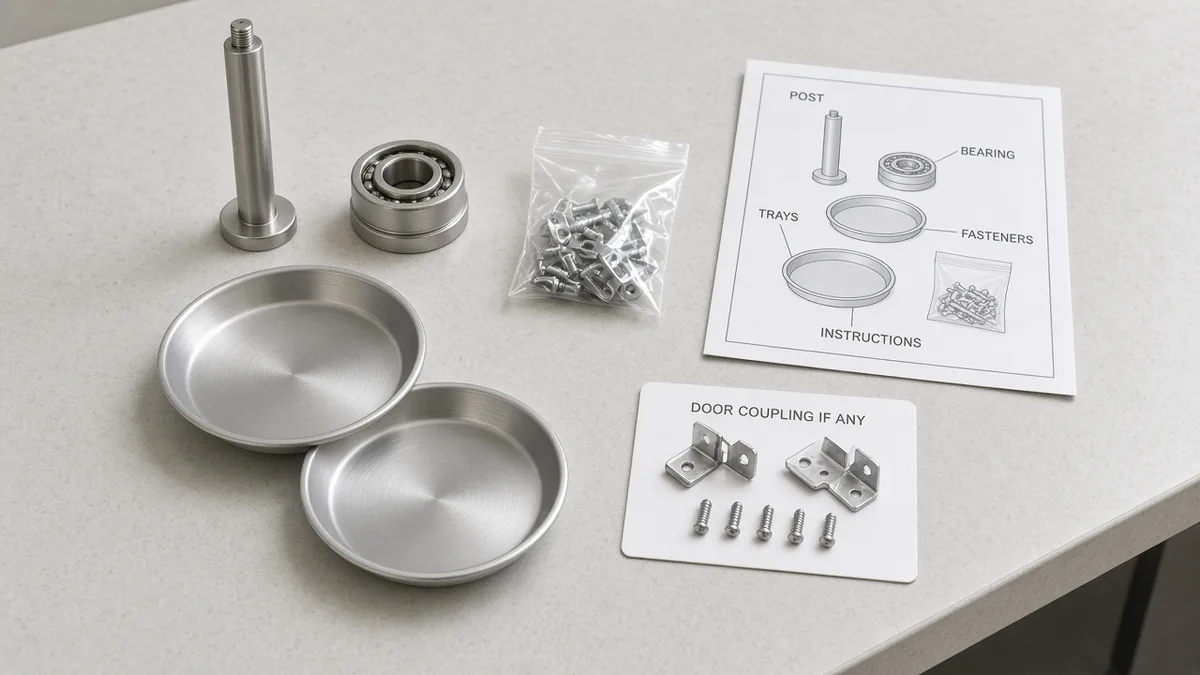
A lazy susan installation sheet is ready to print only after the mounting architecture and the complete kit are named. The architecture is a full-circle post, a kidney unit, or a pie-cut door-coupled unit. The kit is the post, the bearing, the trays, any door-coupling hardware, the fasteners, and the instructions that belong to that architecture.
Tray-shape selection against a cabinet opening belongs on the live shape-versus-opening file. Replacing a shelf on a retained pole, hub, or bearing belongs on the replacement-interface file. Neither of those decisions is a first-install sequence, and neither should be rewritten as one.
This guide is for importers, distributors, and private-label teams approving first-install wording and kit scope for lazy-susan hardware as an adjacent kitchen-storage line. Koitor Hardware is a family-owned China OEM manufacturer of custom metal bathroom and home storage hardware. Adjacent lazy-susan OEM pages already sit in that published library. That fact is not a claim that Koitor currently manufactures a named lazy-susan SKU or a complete cabinet box.
Send the intended architecture, the cabinet interface, the kit list, the market, and any project rule the install sheet must mention. We can review the wording and the kit scope. We will not issue a cabinet-box method, a timed install standard, or a universal millimetre chart.
What does a lazy susan installation file actually freeze?
It freezes the first-install architecture and the kit that architecture can support. It does not freeze tray geometry versus a cabinet opening, replacement-shelf compatibility on a retained interface, or a carpentry method for building a complete corner cabinet.
Searchers often ask for lazy susan installation instructions because they want a sequence for a corner cabinet, or because they landed on one brand’s hardware video. That demand is real. For an importer, the usable decision is whether a listing or an install sheet may say the unit is ready to install, and which architecture and kit are being promised.
A hardware set for an existing cabinet and a complete lazy-susan cabinet box are different products. If the sheet does not say which one is in the carton, an easy-install line will be applied to the wrong job. This file is not a cabinet-box carpentry tutorial, and it is not a product listing.
Corner-cabinet use does not, by itself, name the architecture. A kidney unit and a pie-cut door-coupled unit are both used in corners, and they do not share a kit. A full-circle post may also be specified for a corner or for another opening. Write the architecture in plain language before any install sentence is printed.
Brand-navigational phrases, including phrases built around another company’s model name, are not this page’s target. Describe the hardware in architecture and kit terms. Do not borrow a competitor’s install video, or that video’s search volume, as a Koitor standard.
Ein OEM home storage hardware manufacturer can review whether a kit list and an install-sheet sentence stay together. Matching a metal finish or a tray diameter to a collection is not the same as inventing a default architecture, a default cabinet box, or a timed install method. If you are screening this adjacent line, bring the intended kit list with the drawing.
A published “includes everything” claim is only as complete as the named list. If the photograph shows a door-coupling arm and the bag does not, the sheet has already failed, even if the trays look familiar. The same is true of a bearing, a bottom mount, or a set of instructions that belong to a different architecture.
This file can precede an RFQ. It should not be turned into a catalog page, a shape-selection essay, or a replacement-shelf fit chart. Those jobs already have, or should keep, their own files.
Which architecture must be named before any install sentence?
Name the architecture first: full-circle post, kidney, or pie-cut door-coupled. Do not start with a step sequence, and do not start with a tray-shape preference that has not been tied to a cabinet interface.
A full-circle post is a center-post design whose trays rotate as complete circles. The sheet should say so, and it should say how the post is captured at the top, at the bottom, or at both, if that capture is part of the design. “Round trays” is not a complete architecture line if the mount is left unnamed.
A kidney unit is a different architecture, even when the finish matches a full-circle set. The tray form and the way the unit sits in a corner opening are part of the architecture, not a later styling choice. If a kidney unit uses a post, a door clearance, or a stop that a full-circle post does not use, those parts belong in the named kit for that architecture.
A pie-cut door-coupled unit is not “a round lazy susan with a slice missing.” It is a door-coupled architecture. The door, the coupling hardware, and the way the trays move with the door are part of the first-install promise. If those parts are not named, an install sentence written for a free-spinning post will be applied to a door-coupled unit, or the other way around.
Do not treat “corner cabinet” as a fourth architecture. It is a location. The same corner can accept more than one of the three architectures, and each architecture still needs its own kit. A listing that says only “for corner cabinets” has not yet frozen the install file.
If a program uses more than one architecture, keep a separate kit and a separate install sheet for each one, or make the difference unmistakable on a shared sheet. A mixed photograph that shows a pie-cut door and a full-circle post in the same “easy install” panel is how the wrong bag is packed for the wrong SKU.
Framed and frameless cabinets can change the interface even when the tray architecture stays the same. If the sheet mentions a frame condition, name the condition and the parts that go with it. Do not turn that note into a carpentry tutorial, and do not invent a universal opening size as a factory rule.
Top-mount, bottom-mount, and telescoping or adjustable posts are mount details inside an architecture, not a reason to skip the architecture line. If the post adjusts, the sheet should say that the adjustment belongs to this kit, without printing a millimetre chart that the project has not supplied.
What belongs in the first-install kit, and what stays out?
The kit should include every part the install sentence assumes. For a first install, that usually means the post, the bearing or hub, the trays, the fasteners, the instructions, and any door-coupling hardware the architecture requires.
Write door-coupling hardware as included or as not applicable, in plain language. Leaving the line blank is how a pie-cut carton is packed like a full-circle post, or how a full-circle carton grows a door arm that the architecture does not use. “Door coupling if any” is a complete field only when the chosen architecture has been named first.
Fastener counts should be obvious from the list. If a bottom plate, a top plate, or a door bracket uses a different fastener than the post, say so. Do not invent a screw size, a torque, or a cabinet-material rule as a Koitor standard. If a later brand file or project specification names a fastener, the sheet can carry that fastener as a cited project requirement.
Instructions packed in the carton should match the named architecture. A generic “how to install” leaflet that mixes kidney, pie-cut, and full-circle steps is not a complete kit document. If two architectures share a factory but not a leaflet, pack the leaflet that belongs to the carton.
When the first-install kit is packed as a bagged set, review it against a hardware kit packing inspection checklist so the bag matches the named list. That check is packing hygiene. It is not an architecture decision, and it is not a cabinet-box method.
Replacement shelves, retained poles, and “fits existing hardware” claims stay off this kit list. Those sentences belong on the replacement-interface file. A first-install carton that quietly adds a replacement-shelf promise will be used on a pole the buyer already has, and the kit will be judged against an interface this file never froze.
Tray-shape selection also stays off the first-install kit list. The sheet may name the tray that is actually in the carton. It should not turn that name into a geometry-versus-opening decision, and it should not print a nominal cabinet-width chart as a substitute for the live shape file.
| Architecture or claim | What must be named | What belongs in the kit | What this row is not |
|---|---|---|---|
| Full-circle post | Center-post architecture, and how the post is captured at the top, bottom, or both, if that capture is part of the design | Post, bearing or hub, full-circle trays actually packed, fasteners, and matching instructions; door-coupling marked not applicable if it is not used | A kidney or pie-cut sequence copied onto a free-spinning post, or a cabinet-box build |
| Kidney unit | Kidney architecture, including any stop, clearance, or post detail that belongs to this form | The kidney trays and the mount parts that unit actually uses, plus fasteners and matching instructions | A full-circle kit with one tray edge described as “cut,” or a shape-versus-opening essay |
| Pie-cut door-coupled unit | Door-coupled architecture, including the door relationship and the coupling method | Trays, coupling hardware, fasteners, and instructions that belong to the door-coupled design | A free-spinning post leaflet, or a door-hanging carpentry tutorial |
| Complete lazy-susan cabinet box | That the product is a cabinet, not only a hardware set, if that is truly what is being sold | Whatever the cabinet program packs; this hardware file should not pretend to be that program | A first-install hardware kit rewritten as box carpentry, glue, or cam-lock assembly |
| Brand or dealer install video | The video, if cited, as a third-party example only | Nothing unless the named kit independently matches the carton | A Koitor standard, a timed install method, or a substitute for the architecture line |
Lifestyle photographs should not show door-coupling arms, extra trays, or cabinet boxes the carton does not include. If a photo stylist adds a complete corner cabinet, the listing will be read as if the box were part of the kit. Either the photograph stays illustrative and the sheet is complete, or the photograph is corrected.
If two markets share a tray finish but not a kit, do not force one carton into both programs. It is cleaner to keep one tray family and two named kits than to print a blended “ready to install” line that is true for neither bag.
When a packed list changes, revise the install sentence in the same change. A later decision to omit the door-coupling arm, or to stop packing a bearing that the leaflet still mentions, can leave an old ready-to-install line stranded on the carton. Record that as a kit revision, not as a silent packing tweak.
Why are brand and dealer install videos not a factory standard?
Consumer and dealer videos are useful as demand evidence. They show that buyers want a sequence, that pie-cut and kidney units are often asked about together, and that some viewers are installing a complete cabinet rather than a hardware set. That is not permission to print one of those sequences as a Koitor method.
A brand video is written for one hardware set, one cabinet condition, and one set of fasteners. If that video is copied onto a private-label sheet, the sheet inherits steps, tools, and cabinet assumptions that the carton may not support. Label the video as a third-party example if you need to mention it. Do not present it as factory data.
The same caution applies to cabinet-maker manuals and to “easy way” blog sequences. They can remind you that first-install questions are real. They cannot supply a universal install time, a universal millimetre opening, or a glue-and-cam-lock method for a hardware kit this factory has not frozen.
Do not invent a minute-count to compete with a video title. Install time depends on the cabinet, the architecture, and the site, none of which this file can standardize. A sheet that promises a short install has already gone beyond the kit.
If a buyer asks for “the usual way” because a video looked simple, return to the named architecture and the packed list. The useful answer is which kit is in the carton, not a retelling of someone else’s steps. If the project has adopted a named brand manual as a requirement, cite that manual as a project rule, and then check whether the packed kit still matches.
Do not use a video as a back door into shape selection or replacement-shelf fit. A pie-cut install clip may spend most of its time on door coupling. That is still not a reason to rewrite the live shape-versus-opening file, and it is not a reason to treat a retained-interface replacement as a first install.
Which neighboring lazy-susan files should stay out of this sentence?
The live full-circle, kidney, and pie-cut shape file already freezes tray geometry versus the cabinet opening. That file tells a buyer not to select only by a nominal width. This first-install file may point to that decision in prose. It should not reprint the shape-versus-opening argument, and it should not turn a kit list into a dimensions page.
The live lazy susan replacement shelf compatibility file freezes a different job: fitting a new shelf to a retained pole, hub, or bearing. A replacement buyer already has an interface in the cabinet. A first-install buyer does not. Mixing those sentences is how a “ready to install” carton is opened on an old post, or how a replacement order is packed with a new post the cabinet cannot use.
If a listing must mention both a first-install kit and a later replacement path, keep the sentences separate. The first-install sentence names the architecture and the packed kit. The replacement sentence, if it appears at all, should send the reader to the retained-interface file rather than borrowing that file’s checks.
This file also stays out of cabinet-box assembly: glue, cam locks, face-frame joinery, and finished-box install sequences. Those may appear in third-party cabinet manuals. They are not a hardware-kit standard, and they are not a reason to claim that Koitor supplies a complete lazy-susan cabinet.
Height, load, and “soft-close” claims, if a project later asks for them, need their own named source. This article does not invent a tray-load rating, a soft-close cycle count, or a mounting-height figure. Leave those fields blank, or carry a cited project requirement, rather than printing a plant default.
Today’s other install-sheet files on closet rods, robe hooks, and medicine cabinets are useful only as a reminder that a first-install file should freeze a kit and an interface. They are different products and different decisions. Do not copy their sentences onto a lazy susan, and do not link those pages from this file unless a live official record already supports the href.
What should be checked before a listing says the unit is ready to install?
Use the checklist below as an artwork, carton, and install-sheet review, not as a field-install script. Koitor’s practical manufacturing insight here is that a small-batch OEM can pack a post, a bearing, and trays to match a drawing, but it should not be asked to print “ready to install” until the architecture and the complete kit have been named.
During sample and packing review, the useful questions are simple. Does the bag match the photograph? Does the sheet name full-circle post, kidney, or pie-cut door-coupled? Are door-coupling parts included, excluded, or marked not applicable? Do the packed instructions belong to that architecture? That is kit hygiene. It is not an install-time study, and it is not a cabinet-box test.
If a later buyer file names a required fastener or a required cabinet interface, the install sheet may repeat that requirement and cite the source. Until such a source exists, keep the field named and leave the value blank. Do not fill it with a plant default.

- Name the architecture in plain language: full-circle post, kidney, or pie-cut door-coupled, before any install sentence is printed.
- Say whether the carton is a hardware set for an existing cabinet or a complete cabinet box, and do not let a photograph blur that line.
- Name every part the ready-to-install sentence assumes: post, bearing or hub, trays, fasteners, instructions, and door-coupling hardware if the architecture uses it.
- Mark door-coupling hardware as included, excluded, or not applicable; do not leave the field blank.
- Pack instructions that belong to the named architecture, not a mixed leaflet that treats kidney, pie-cut, and full-circle units as one sequence.
- Keep tray-shape selection versus the cabinet opening on the live shape file; this kit file may name the tray in the carton, but it should not reprint that decision.
- Keep replacement-shelf compatibility on the retained-interface file; do not add a “fits existing hardware” promise to a first-install carton.
- Do not print a brand or dealer video, or a cabinet-maker blog sequence, as a Koitor standard or as a timed install method.
- Do not invent a load, a universal millimetre opening, a screw torque, or a factory install test.
- Revise the ready-to-install line whenever the packed list, the architecture, or the packed instructions change.
Translations on a bilingual carton should follow the same named fields. A door-coupling exclusion that appears only in one language is not an exclusion in the other market. Review both languages against the same packed list before the ready-to-install line is translated.
Incoming sample checks can use a simple bag-to-sheet comparison: open the box, lay out the parts, and tick the named list. That check is not a spin test with a published load, and it is not an install-time study. It only asks whether the carton can be believed.
If a later order adds a kidney SKU beside a full-circle SKU in the same finish, treat that as a new kit, not as a sticker change on the same bag. The trays, the instructions, and the door-coupling field may all change. A full-circle ready-to-install sentence left on a kidney carton will be believed, and it will be wrong.
The same discipline applies when a hardware-only program later adds a complete cabinet offering, or the reverse. The metal may look familiar. The packed list is a new list. Reprint the architecture and kit fields before the carton reuses an old ready-to-install line.
Häufig gestellte Fragen
Can the listing say the lazy susan is easy to install?
Only after the architecture and the complete kit are named, and only if the sentence does not go beyond that kit. An easy-install line is not a substitute for missing door-coupling hardware, missing instructions, or an unnamed architecture. This article does not supply a minute-count.
Does a corner-cabinet job need a different first-install file?
No. A corner is a location, not an architecture. Name whether the unit is a full-circle post, a kidney unit, or a pie-cut door-coupled unit, then pack the kit that belongs to that architecture. “Lazy susan installation corner cabinet” is a real search, and it is not a fourth architecture.
Should this sheet also tell buyers how to choose pie-cut versus kidney trays?
No. That decision sits on the live shape-versus-opening file. This first-install file may name the tray that is actually packed. It should not reprint the geometry-versus-opening argument, and it should not treat a nominal cabinet width as the answer.
What if the buyer already has a pole and only needs a new shelf?
That is a replacement-interface question, not a first install. Use the retained-interface replacement file, and do not pack or promise a complete first-install kit unless that is truly the order.
Can a brand video be printed on the install sheet?
Only as a labeled third-party example, and only if you have checked that the packed kit still matches. A brand or dealer video is demand evidence, not a Koitor standard, and not a timed install method.
Does Koitor currently offer a named lazy-susan catalog SKU?
This article does not assert a current named production SKU, and it does not claim that Koitor supplies a complete cabinet box. Adjacent lazy-susan OEM pages already sit in the published library. If you are screening this line, send the intended architecture, kit list, and cabinet interface for review of wording and kit scope.
Arbeiten Sie mit Koitor Hardware zusammen
Need a lazy-susan install kit reviewed?
Send Koitor the intended architecture, the cabinet interface, the kit list, the market, and any project rule the install sheet must mention. Our team can review the wording and the kit scope, without issuing a cabinet-box method, a timed install standard, or a universal millimetre chart. MOQ can start from about 100 pcs depending on the product; samples usually take 5-7 working days after details are confirmed; bulk production usually takes 4-6 weeks depending on the project.
OEM / EIGENE MARKE
Verwandeln Sie diesen Beschaffungsleitfaden in ein Produktdossier
Teilen Sie uns Ihr Zielprodukt, die Größe, die Oberflächenausführung, die Bestellmenge und Ihre Verpackungsanforderungen mit. Ihr Team erhält vor der Angebotserstellung eine praxisorientierte Prüfung der Herstellbarkeit.

 English
 Español
 Português
 Français
 Deutsch
 العربية