
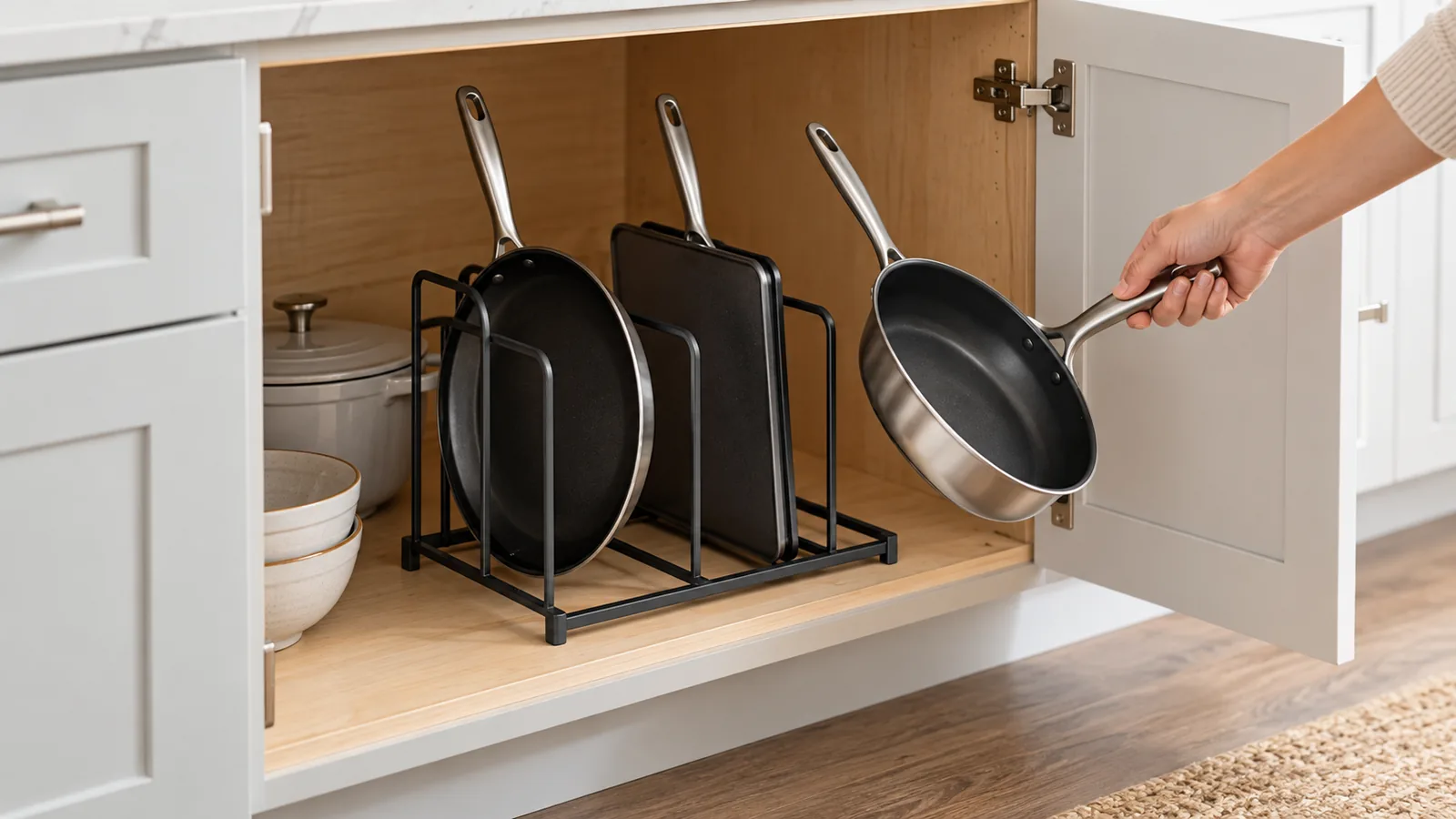
Cabinet pan rack skillet handle spacing specification should begin with the buyer’s actual cookware envelopes and cabinet opening, then confirm divider pitch, handle direction and the path for removing each pan. Nominal pan diameter alone is not enough: long handles can collide with cabinet sides, neighboring cookware, doors or other stored items. Buyers should provide representative pan sizes and review a loaded sample in a defined cabinet configuration. This is an adjacent-category product-development guide, not a claim that Koitor currently manufactures a pan organizer.
Why do skillet handles create fit problems in a cabinet organizer?
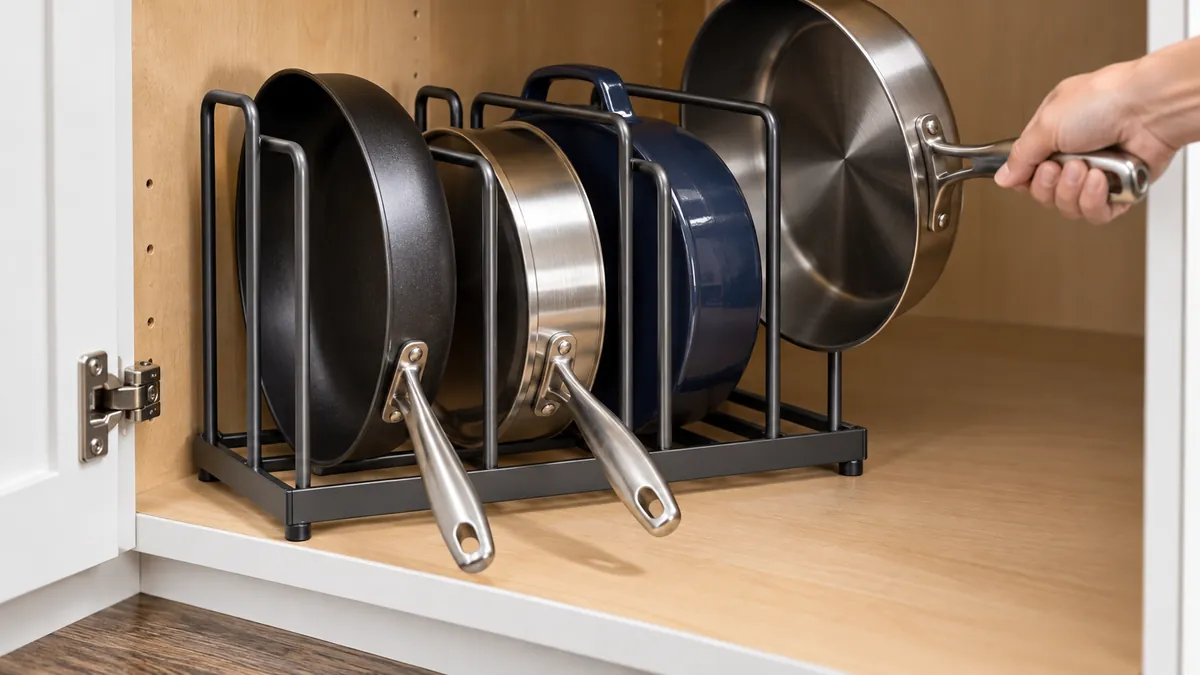
Cookware has two interacting envelopes: the body that occupies a divider bay and the handle that projects into the surrounding space. Two pans may fit side by side by body diameter while their handles overlap or block a neighboring pan from being lifted. The issue becomes harder to see when handles are angled or when cookware is stored in alternating directions. A buyer should document the intended orientation and assortment rather than assume every pan can be placed in any slot.
Cabinet geometry limits the available space around the rack. Interior width and depth, shelf height, cabinet opening, door hinges and nearby plumbing or appliances can all reduce usable clearance. A handle that fits when the door is removed may contact the hinge or door panel in normal use. If the organizer sits on a pull-out shelf, travel and front clearance introduce additional interfaces. The specification should reflect the actual cabinet concept; a freestanding rack should not be described as a sliding organizer unless the slide is part of the approved design.
The pan body also affects divider spacing. A shallow skillet, deep pan, lid or griddle may have a different center of gravity and contact height. A divider that supports a broad pan may allow a smaller item to lean or slide. Where cookware sizes vary, group the set into representative envelopes and show which item occupies each bay. This helps buyers decide whether fixed positions, adjustable dividers or a different organizer layout deserve sample development, without asserting that one layout is universally stable.
Online product feedback and buyer questions can reveal collision and retrieval problems, but anecdotal reports do not establish a standard slot width or an expected load. Use those signals to make the RFQ more specific. Ask whether the selected pans can be inserted and removed without striking handles or adjacent cabinet surfaces, and whether the organizer stays in its intended location during that action. Keep a functional requirement separate from a capacity claim, which would need its own defined method and project evidence.
What cookware and cabinet measurements should the RFQ include?
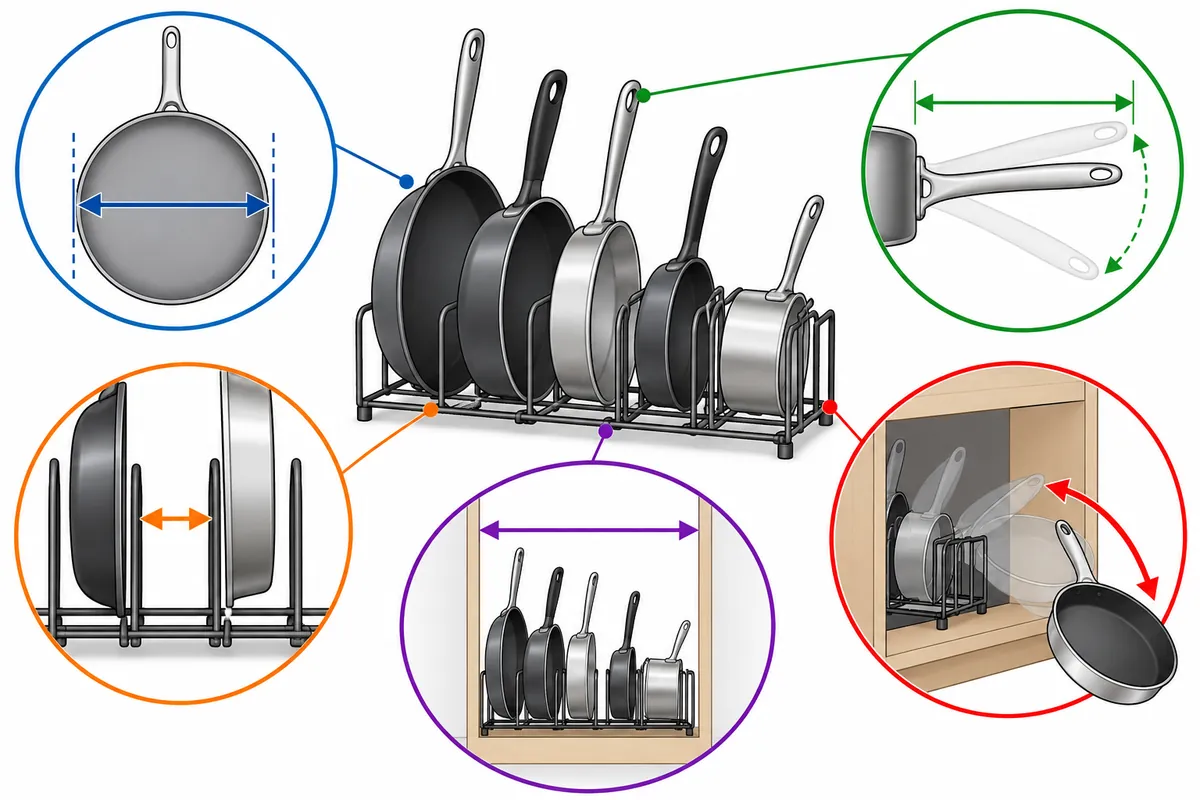
For each representative pan, record body diameter or width, depth, rim profile, handle length, handle width and the angle at which the handle leaves the body. Note whether the handle is fixed, removable or has a loop that changes the envelope. Lids and griddles may need separate positions. The buyer should identify the largest, smallest and most awkward combinations in the target assortment, then describe the intended storage orientation. These dimensions are inputs for a design review, not universal specifications for every cookware family.
For the cabinet, provide clear internal width, depth and vertical opening, plus shelf thickness, front lip, back panel and door/hinge intrusion where relevant. State whether measurements are taken before or after installation and whether an adjacent appliance or wall reduces access. Show the route the rack takes into the cabinet and the path a pan follows when removed. If a shelf or door is adjustable, indicate its approved setting. A simple plan and side view can prevent a supplier from optimizing for a cabinet envelope that does not match the buyer’s market.
The drawing should make divider locations and adjustment options visible. Identify the base footprint, dividers, contact points, stops or adjustment holes and any assembly interfaces. Clarify whether the dividers are fixed, repositionable or removable, and how a buyer expects them to remain in the selected position. If a coated metal organizer is under consideration, identify whether finish buildup at sliding or contacting interfaces needs review, but do not invent a universal clearance or assume a particular coating system is confirmed for the project. The cabinet pan rack skillet handle spacing specification should show the handle corridor separately from the pan-body bay so a supplier can see which clearance is controlled by each feature.
Define which dimension controls each decision. Pan-body spacing may come from the divider faces, while handle clearance may be controlled by cabinet depth and direction. The buyer’s drawing can distinguish nominal envelope dimensions from sample-fit observations and identify the revision used for approval. When multiple suppliers quote different organizer layouts, compare them against the same cookware set and cabinet opening. Without that common reference, a larger nominal capacity may simply reflect a different assortment assumption rather than a better design.
| Layout option | Potential buyer value | Point to validate |
|---|---|---|
| Fixed divider bays | Simple intended positions | Does the whole cookware set fit those positions? |
| Repositionable dividers | Can adapt to different body widths | Do settings remain clear and repeatable after adjustment? |
| Removable dividers | Can open a wider bay when needed | Where are loose parts stored and how is reassembly controlled? |
| Alternating handle directions | May reduce handle overlap in some assortments | Is loading intuitive and does every pan remain retrievable? |
| Single-direction handles | May simplify user instructions | Is cabinet width sufficient for the full handle corridor? |
How should buyers compare divider layouts and handle directions?
Fixed dividers can make a simple, repeatable set of bays, but they limit changes to the cookware mix. Adjustable dividers offer flexibility, yet the adjustment method and repeatable positions need review. Removable dividers may help accommodate wide pans but create loose-part and packout questions. Buyers should compare these approaches against the number of pan sizes, cabinet envelope, expected handling and price target. The choice should be made on the sample and intended assortment, not from a product image that shows empty bays.
Handle direction can be consistent or alternating. Alternating handles may reduce collisions in some layouts, but it can make loading less intuitive or require more cabinet reach. A consistent direction may simplify use but consume a wider handle corridor. The right arrangement depends on actual handle angles and neighboring objects. Put the intended pan set in the sample and mark the sequence so reviewers can repeat it. If the organizer is designed to hold both skillets and flat bakeware, treat those as separate envelopes and confirm which slots are dedicated to which items.
Divider height and support shape affect the body’s contact points. Too little separation can let rims touch; a divider that is too tall may complicate removal or interfere with a lid. A base rail or stop may help locate the pan but can also catch a handle or create a snag. Discuss the functional support surfaces with the manufacturer and ask for a sample where the real cookware or faithful dimensional surrogates are available. The guide does not endorse a single wire, sheet or coated construction for every project.
How can a representative sample check fit and retrieval?
Place the organizer in the target cabinet or a dimensionally controlled mock-up that includes the opening, side walls and door hardware. Load the specified assortment in the approved order, including the widest body and longest handle. Check that each divider is in its intended position and that cookware does not lean into a neighbor in a way that blocks access. Open and close the cabinet door, then remove and replace each item along the expected path. Record any contact with the hinge, face frame, adjacent pan or cabinet wall.
Test middle positions as well as the end bays. An end pan may lift out easily while a central item is trapped by overlapping handles or a divider that prevents tilting. Pay attention to the motion needed to clear the cabinet opening: a pan may need to rise, rotate or move forward before it can be removed. Ask reviewers to follow the same sequence and record when contact occurs. These observations are project-specific fit checks; they do not establish a general consumer safety or load rating.
If the organizer moves during retrieval, first document the cabinet shelf, base footprint, product configuration and action. Do not jump immediately to a heavier base or a performance claim. A change to divider location, support direction or base geometry may address the actual interaction, but it must be checked with the full cookware set. Inspect surfaces after the agreed sample actions for visible contact or coating damage where it matters to the buyer. Any formal durability or load test should be separately defined and supported by the responsible engineering team.
Keep a record that links the accepted sample to the cookware list, cabinet dimensions, divider setting and drawing revision. If the assortment later adds a pan with a longer handle or a larger diameter, decide whether the old layout still applies. A new handle projection can change spacing even when the body fits. Change control should trigger a targeted fit recheck rather than relying on the old approval as proof for a different cookware set. This is especially important when retail packaging describes a number of pans or a cabinet range the team has not reviewed.
What should private-label buyers specify before production?
A sourcing brief should include the cookware assortment, cabinet envelope, organizer footprint, divider type, finish expectation, assembly method and package configuration. Identify the target market and any cabinet assumptions that narrow compatibility. Ask the supplier to state which product dimensions are proposed and which are confirmed after sample review. For an adjacent-category concept, the brief should clearly identify what remains subject to engineering confirmation. Buyers should not request a universal fit statement when the organizer has been evaluated against only one cabinet and pan set.
At sample stage, agree who provides the cookware or dimensional surrogates and how fit will be recorded. Confirm that the rack, dividers and any feet or pads match the intended production configuration. Review all bay positions, handle directions, cabinet door operation and retrieval paths. If dividers move, capture the approved settings and instruction sequence. If the sample uses a temporary component or finish, record the difference and identify the follow-up validation required before release.
Before repeat orders, connect the approved drawing and sample with the finish, parts list, instructions, carton layout and any buyer-approved product statements. A change in divider pitch, base width or coating can affect fit or movement even if the organizer looks similar in a listing photo. Koitor’s custom kitchen storage rack manufacturer page provides category context for a discussion of metal kitchen-storage projects. Broader OEM-Hardware für die Heim-Datenspeicherung information is also relevant, but neither establishes current production of this exact pan-rack concept.
Buyer approval checklist
The phrase cabinet pan rack skillet handle spacing specification should lead to an agreed configuration record, not a single spacing figure detached from context. Store the cookware list beside the approved drawing and sample notes, including which pans were placed together and how each was removed. If the buyer later changes the SKU mix, compare the revised handle and body envelopes before treating the former sample as representative. A brief mark-up can show the bay order and direction of each handle, making supplier and buyer reviews repeatable. That record also helps explain why two visually similar racks may have different practical capacity in the same cabinet.
- List pan-body dimensions, handle projection, handle angle and lid/griddle envelopes.
- Measure cabinet interior, opening, shelf, hinges and the full insertion/removal path.
- Show divider positions, adjustment method, base footprint and any contact surfaces on the drawing.
- Review all bays with the buyer’s actual assortment and test middle-position retrieval.
- Tie approval to the cookware list, cabinet setup, organizer revision and any stated fit range.
Häufig gestellte Fragen
Should divider spacing be based only on pan diameter?
No. Handle length and angle, body depth, rim shape, cabinet opening and retrieval movement also influence fit. Provide representative cookware envelopes and review them together.
Do alternating skillet handles always save space?
Not always. It may reduce collisions for one assortment but can make loading or removal less intuitive. Validate the complete set and expected user sequence.
Can one sample prove fit for every cabinet?
No. It proves only the documented setup. Define a fit range and test representative boundary conditions before making broader compatibility statements.
Is an adjustable divider automatically better?
No. It adds flexibility but also adjustment, retention and instruction questions. Compare it with fixed or removable alternatives using the buyer’s real assortment.
Does this article confirm Koitor manufactures pan organizers?
No. This is an adjacent-category product-development guide. Exact production scope and capability must be confirmed for a specific project.
Plan a buyer-ready product specification
Share your drawing, product range and sample requirements so the project team can review the relevant manufacturing questions.
OEM / EIGENE MARKE
Verwandeln Sie diesen Beschaffungsleitfaden in ein Produktdossier
Teilen Sie uns Ihr Zielprodukt, die Größe, die Oberflächenausführung, die Bestellmenge und Ihre Verpackungsanforderungen mit. Ihr Team erhält vor der Angebotserstellung eine praxisorientierte Prüfung der Herstellbarkeit.
 English
  Español
  Português
  Français
  Deutsch
  العربية