
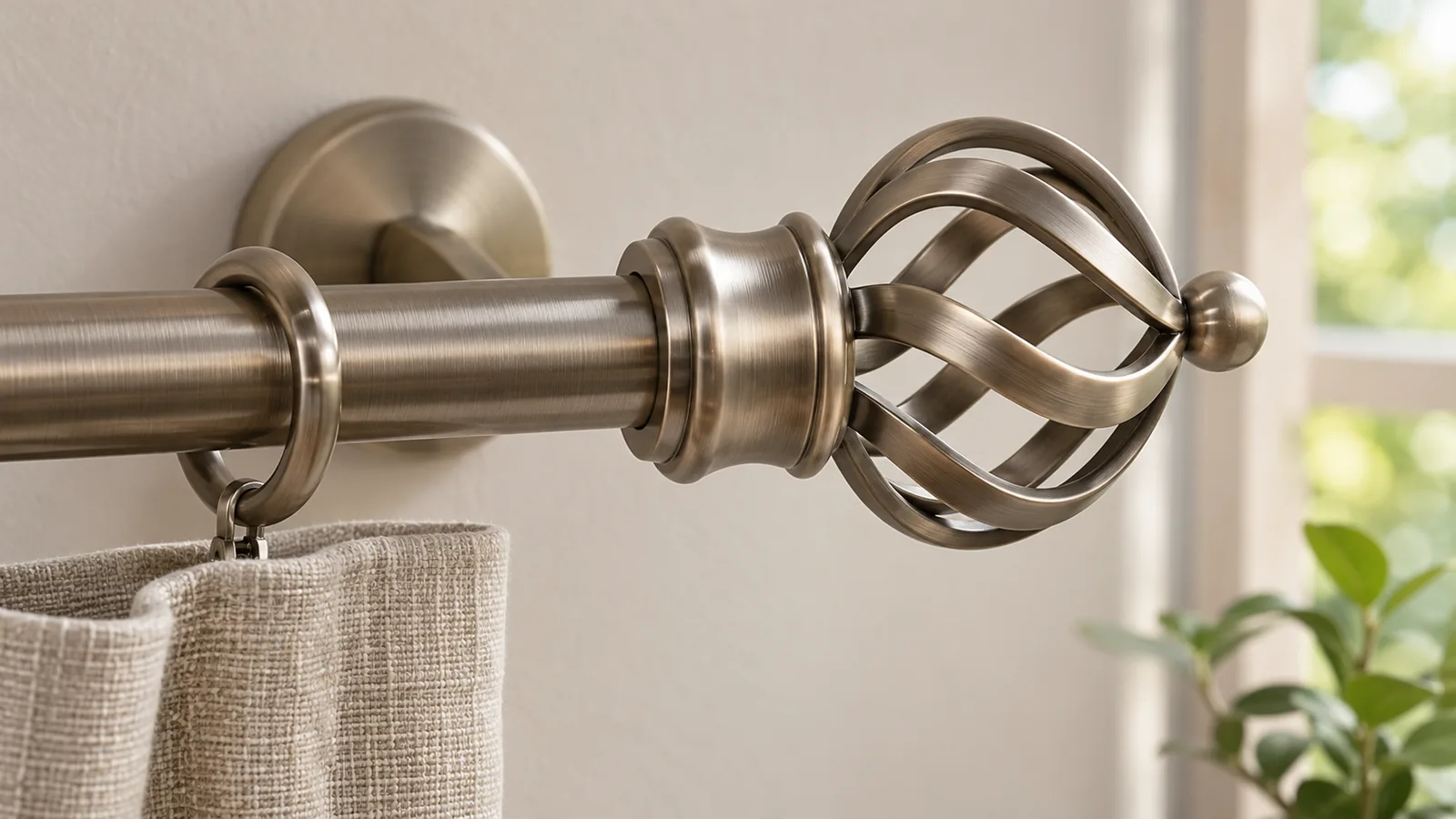
For a distributor, curtain rod finial compatibility means matching the exact rod family, end connection, insert or adapter, finish and replacement kit contents. A finial that can be removed is not automatically interchangeable with another model, even if both products appear to use the same nominal rod diameter. Buyers should obtain the maker’s current compatibility statement and approve a paired sample or controlled drawing before building a replacement cross-reference.
This guide is for home-hardware importers, window-accessory distributors, hospitality buyers and private-label product managers. It addresses sourcing and replacement-part identification. It is not a curtain installation guide and does not establish thread dimensions, attachment torque, pull-off strength, universal adapter geometry or retention performance. Use current instructions from the exact rod and finial supplier. Do not force a mismatched part, cut or rethread a rod, or improvise a connector. For buyers assessing curtain rod finial compatibility, the controlling record is the approved configuration, supporting evidence, and named approval owner.
Removable Does Not Mean Interchangeable
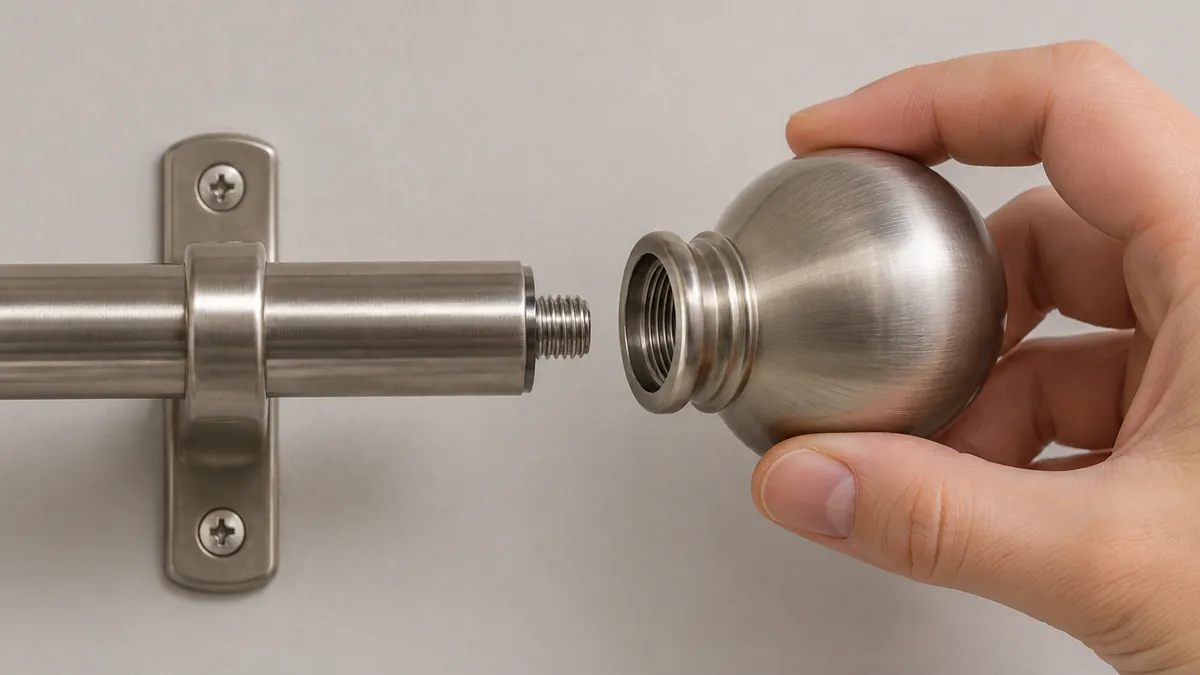
The ability to remove a finial describes a connection or product feature; it does not establish that another maker’s finial fits. A rod end may use a thread, plug, insert, set screw, adapter or another supplier-defined arrangement. The interface should be identified from the actual model information, not inferred from the decorative shape or a photograph.
Umbra’s first-party curtain rod guide separately addresses taking finials off and substituting a customer’s own finial. Its compatibility policy is specific to the manufacturer’s products and does not establish a general industry rule. Umbra also offers a named Cappa replacement kit that includes finials and threads and is specified for a named 1-inch Umbra rod family, with the complete rod sold separately. Those two statements can both be true: an approved replacement kit may serve a named family while arbitrary cross-model substitution is not confirmed. See the maker’s curtain rod guide and its Cappa finial replacement kit for the exact named items and current conditions.
A separate IKEA product page for Raffig finials identifies its own supported rod families and lists a plastic body with a galvanized-steel screw. That source illustrates why buyers should not assume a decorative finial is all metal or transfer material descriptions between brands. It does not establish that the product fits another rod system.
A buyer should begin with:
- Rod manufacturer, collection, model and revision.
- Rod end identity and whether both ends use the same interface.
- Finial maker, exact model and finish reference.
- Any insert, plug, connector or adapter included in the replacement kit.
- The maker’s compatibility list and exclusions.
- Whether the replacement kit includes one finial, a pair, connectors or other parts.
- The source and revision of each statement.
- A physical sample or controlled drawing for the exact pair.
Do not treat “screw-on,” “threaded” or “removable” as a complete specification. Those words may omit thread identity, insert geometry or the maker’s eligibility rule. If the supplier cannot identify the interface, keep the replacement cross-reference unresolved and ask for written confirmation. A successful fit between two unapproved samples does not create a general approval for other models.
Identify the Rod-End Connection and Included Parts
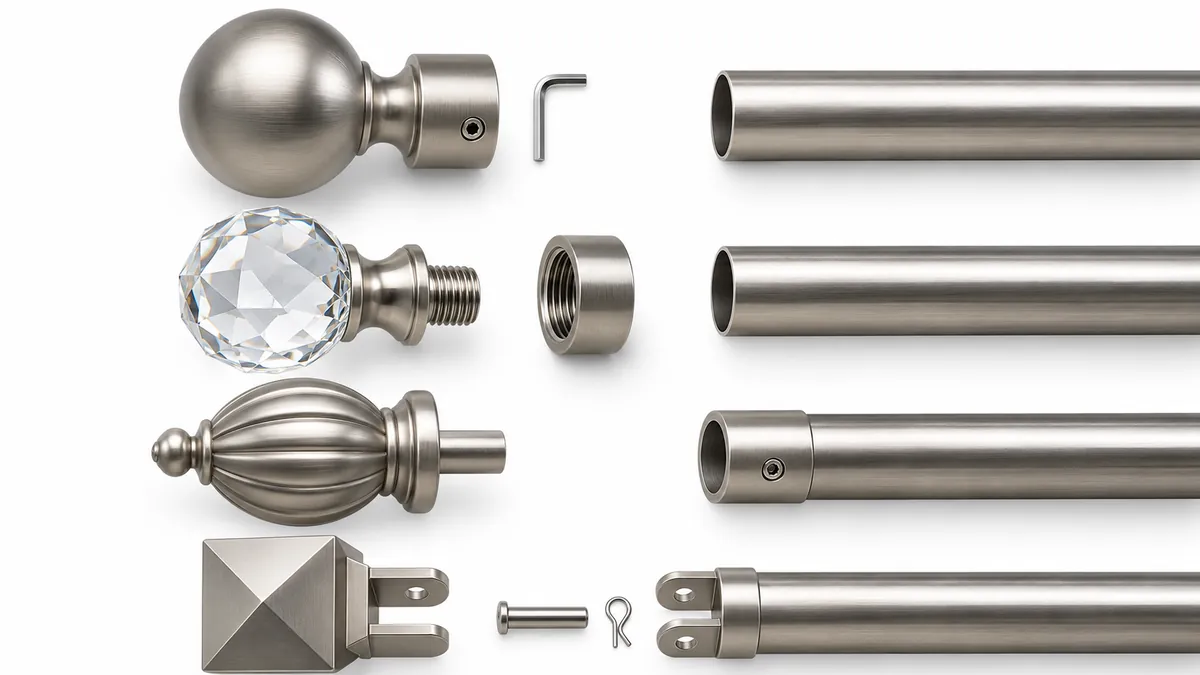
A finial can be sold with its connector, with a separate insert, or as a replacement piece that depends on a specific rod family. The kit contents need to be visible in the quotation and product record. Ask whether the connector is attached to the finial, supplied loose, already installed in the rod, or sold as a separate service part. Do not assume all finial kits include identical hardware.
The product record can distinguish:
- Rod tube and end plug or insert.
- Finial body and connector.
- Any adapter or fastener.
- Whether parts are included in the quoted replacement kit.
- Whether the buyer or customer must retain an original component.
- Which end of the rod is in scope.
- The supplier instruction for removal or reassembly.
- Any limitations or excluded rod families.
Use the actual supplier’s terminology. If a catalog calls a component a “thread,” record the name and the model to which it belongs. Do not infer the thread size, pitch, material, engagement depth, torque or strength from the word alone. If the buyer needs dimensions for a replacement project, request a controlled drawing or measurement method from the responsible maker.
A sample review should be non-destructive and follow supplier guidance. Compare the proposed finial, connector and rod end as one pair. Observe whether the supplied parts correspond to the drawing and whether the supplier’s stated assembly method applies. If the parts do not appear to mate as described, stop and ask for clarification. Do not force them together or alter either part to make a sample fit.
| Part or relationship | Buyer record | What requires maker confirmation |
|---|---|---|
| Rod | Brand, model, collection and revision | Which end interfaces are approved |
| Rod-end insert | Part identity and whether included | Replacement eligibility and compatibility |
| Finial body | Model, finish and quantity | Exact connector supplied with the body |
| Adapter or thread | Part number and source | Model-specific pairing and instructions |
| Replacement kit | Complete package contents | Which rod family and revisions it serves |
| Finish pairing | Rod and finial finish references | Availability of the exact combination |
Use the Exact Replacement Family, Not a Diameter Guess
A nominal outside rod diameter can help a buyer narrow the search, but it is not a complete connector declaration. The finial may seat by an interface at the end of the tube that cannot be determined from the tube’s outside diameter alone. A maker’s model-family compatibility list is more relevant than a generic “fits one-inch rods” phrase unless the supplier confirms the complete interface and eligible models.
The Cappa replacement example in the research pack is explicitly associated with a named Umbra rod and a particular kit. That is a replacement-family statement. It is not a universal thread size or a license to use the same kit with other rods of a similar diameter. A buyer should keep the named product pair intact and ask about revisions before extending it.
A replacement cross-reference should include:
- Original rod SKU and collection.
- Rod revision or age range where the maker specifies one.
- Finial and connector kit SKU.
- Whether the kit covers one end or a pair.
- Any maker-listed exclusions.
- Current availability or status as confirmed by the supplier.
- Current instruction source and revision.
- Whether the cross-reference was reviewed with a physical sample.
- The individual responsible for product-data approval.
If the rod model is unknown, do not sell a finial as a confirmed match based only on a customer photograph or measured diameter. Ask for a model label, purchase record or supplier identification. If the maker offers a support path, use it. Where the original product is discontinued, the buyer should request a current replacement recommendation from the responsible manufacturer rather than infer interchangeability from a similar product.
A private-label distributor may want to consolidate finials into fewer replacement SKUs. That can be a sensible inventory question, but it requires evidence. Ask whether a single connector is approved for multiple named rod families and obtain the maker’s response. Keep each pairing in the matrix, including any limitations. Do not turn an unconfirmed possibility into a universal replacement claim.
Separate Cosmetic Matching From Interface Approval
A finial’s shape and finish affect how a window accessory looks, but appearance does not prove fit. A finial can be visually close to the original while using a different connector. Conversely, a compatible replacement may have a finish that differs from the existing rod. Buyers should maintain separate fields for interface compatibility and cosmetic selection.
Record the rod finish and finial finish using their exact supplier labels. Do not assume that “brushed nickel,” “satin nickel,” “silver” or another retail description means the finish is identical across manufacturers. The source should identify the specific combination or state that color matching has not been evaluated. Lighting and photography may change appearance; if visual match matters, review an actual sample under agreed conditions.
A product page should not imply that a finish match means a mechanical match. If a replacement is compatible only with one model family, state that accurately even when it looks similar to a broader range. If a finial is offered in multiple colors with one connector, confirm whether all variants use the same supplied parts. The buyer should not assume the finish process changes no other component.
Likewise, material descriptions should remain model-specific. The IKEA Raffig source distinguishes a plastic main body and galvanized-steel screw. This is not an all-metal part and is not a claim about Umbra or any other finial. For the buyer, the lesson is to list the body and connector separately when the supplier identifies different materials. Koitor’s confirmed metalworking capability does not establish finial casting, machining, plastic insert manufacture or drapery hardware production.
Review a Paired Sample and the End Projection
A sample review can help confirm that the buyer has the correct pair and kit contents. It should not create a new engineering standard. Use the supplier’s approved assembly and removal instructions, and record the exact rod and finial references. If the product team needs a measurement or retention criterion, the responsible supplier must specify it and define how it is evaluated.
A review record can include:
- Rod maker, collection, model and revision.
- Finial model, finish and replacement kit reference.
- Connector or insert identity and source.
- Parts present in the kit versus separately ordered.
- Supplier instruction revision used for the sample.
- Whether the sample is the actual rod or a representative end section.
- The assembled relationship and any visible projection beyond the rod end.
- Any nearby obstruction or layout detail relevant to the buyer’s product.
- Open questions, supplier responses and approval status.
- Change triggers for rod, insert, finial or finish.
If a curtain bracket, wall, window trim or adjacent surface matters to the design, use the actual project reference and request the relevant supplier review. This article does not specify a universal finial projection or installation clearance. A photo or tabletop sample may omit the curtain, bracket and surrounding geometry. If the review uses only a rod-end cut section, label it as a component review rather than a complete window-treatment approval.
The buyer should also distinguish a short sample assembly from a durability or retention evaluation. A finial that appears to attach during a quick sample review does not prove long-term retention, load capacity or repeated-use performance. Do not specify a pull-off load, torque or cycle count without a justified maker-defined criterion. If a retention claim is needed, request the evidence from the responsible supplier and limit the claim to the tested product and method.
Control Replacement Kits, Packaging, and Future Reorders
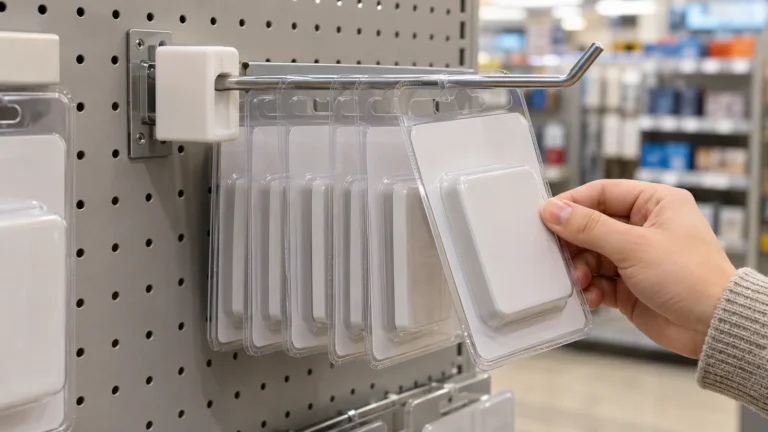
A replacement kit is a small assortment with important identity details. The carton or product page should state what is included: finial count, connectors, inserts and any other parts. If the rod is sold separately, say so. If the kit applies only to a named family, keep that eligibility visible. Buyers should also decide how a customer or distributor will identify the original rod before placing a replacement order.
A kit file can track:
- Buyer-facing SKU and supplier’s replacement reference.
- Rod-family list confirmed by the maker.
- Finial model, finish and part count.
- Connector or insert parts and whether they are included.
- Instruction sheet and current revision.
- Known exclusions and unresolved models.
- Packaging label and barcode reference.
- Replacement support route.
- Review date and change-control owner.
If a supplier revises the connector, the finial body, thread or insert, ask which previous rod models remain approved. Do not assume a kit remains compatible because its decorative body has the same shape. Keep old and new revisions separate until the supplier confirms interchangeability. A changed carton label, finish, insert, or pair count should also be reflected in product data.
For multi-channel distributors, the web listing, catalog, package and customer-support script should all describe the same eligible rod family. If an item has multiple finish options, ensure each finish variant uses the right kit and product reference. A product image showing the finial installed on a rod is illustrative unless the maker confirms that exact combination. Avoid product copy that uses “universal” or “fits all standard rods” without evidence covering the intended market range.
This record also supports returns. If a customer reports that a replacement does not fit, the service team can compare rod and kit references rather than repeat a diameter estimate. It can then route the case to the correct maker with the source data. Do not instruct customers to rethread, cut or force-fit a part. Any repair or modification must come from the responsible supplier and its qualified service guidance.
Route replacement requests through a repeatable identification path
A distributor can make finial replacements easier to manage by using the same intake fields for phone, email and ecommerce inquiries. Ask for the rod brand and model if the customer has it, a label or order reference, the finial kit name, and a clear photograph of the rod end only when the part is already safely removed. Do not tell a customer to force a finial off or disassemble a rod. If the product identity remains uncertain, the correct next step is supplier identification rather than a guess from the outside diameter.
The service team can then match the request against the approved compatibility matrix. A named replacement kit should point to the exact rod family and included connector. A buyer-provided sample that has not been identified by the maker should remain a provisional case, even if it resembles a listed product. Keep the original customer evidence separate from the supplier’s authoritative compatibility statement so that the service record does not turn a photo into technical approval.
For a distributor with several rod collections, record unsupported pairings as explicit exclusions. This is useful when a customer asks to substitute a decorative finial from a different collection: the sales representative can explain that appearance alone does not confirm fit and request a manufacturer response. If the maker confirms an additional pairing, add that exact model and revision to the cross-reference. If it does not, do not add a broad cross-brand claim.
A replacement workflow can use statuses such as confirmed, excluded and awaiting maker confirmation. The status should be attached to the rod/finial/connector tuple, not just the finial style. A confirmed pair for one connector revision should not automatically approve a later revision. This controlled process lets customer service answer common inquiries consistently while preserving the limits of the available evidence.
Compare quotes by the complete end assembly
When comparing suppliers, list the rod-end insert, connector, finial, finish and kit quantity separately. A quote that includes a pair of decorative bodies but no connector is not equivalent to a kit that includes the mating threads. Ask whether the rod is part of the quoted sale and whether it is sold separately. Confirm which party supplies the installation or removal instructions and how spare parts are referenced.
The named Umbra replacement kit provides a concrete example: the maker lists finials and threads for its named Cappa rod family while selling the complete rod separately. A buyer should record that exact relationship rather than interpret the kit as a general replacement set. The separate Raffig product page identifies a different product’s plastic body and galvanized-steel screw; that composition must not be transferred to Umbra or another supplier. These examples illustrate the fields that a purchaser should capture, not a recommendation to select one brand or a promise that the components are interchangeable.
For private-label development, request a controlled drawing that names the rod end and the included connector. If the product uses purchased inserts, record their supplier and change-control owner. Ask whether a connector substitution changes which rods are covered. Keep finish samples and interface samples in separate approval records if their evidence differs. This helps the importer compare commercial offers without mistaking a decorative-body quotation for a complete replacement kit.
Keep online product data revision-aware
A replacement listing often outlives a supplier’s first document, so a category manager should periodically confirm that the compatibility page still applies to the current kit. Record when the maker’s source was checked and what model or revision it named. If the web page changes, the brand discontinues a kit or a connector reference is revised, review the listing and cross-reference before replenishing inventory. Do not treat an old search result, customer review or marketplace photo as a current maker statement.
When information is updated, keep the older approved combination available in the service record for customers who already own it, but distinguish it from the replacement configuration currently sold. That lets the distributor handle legacy inquiries without claiming that current and former parts interchange. Route a truly uncertain legacy case to the maker rather than proposing a force fit.
Buyer Questions Before Ordering
Does a removable finial fit every rod with the same nominal diameter? No. The maker’s compatibility policy and exact end connection determine eligible pairings.
Can a similar-looking finial be treated as a replacement? No. Cosmetic similarity does not establish interface compatibility.
Does a named replacement kit apply to all products from that maker? Not automatically. The documented Cappa kit is specified for a named rod family. Confirm the current list and exclusions.
Can a buyer assume the finial is entirely metal? No. Review the exact component materials. The Raffig product, for example, identifies a plastic body and galvanized-steel screw; this is model-specific.
Should a distributor infer compatibility if a sample can be forced onto a rod? No. Use the maker’s approved pairing and instructions. Do not force or modify a mismatched part.
Can Koitor be assumed to manufacture curtain finials or plastic inserts? No. Current drapery hardware, decorative finial, casting and plastic insert capabilities are unconfirmed. Qualify any adjacent metal-part request first.
A Replacement-Family Record
Before quoting or ordering, identify the original rod family, finial and connector parts, confirm the kit contents and maker-approved compatibility, then review a paired sample under current instructions. Keep finish selection separate, list exclusions and define what product change requires reapproval. If the rod is unidentified, route the request for supplier identification instead of offering a diameter-based promise.
A clear curtain rod finial compatibility record helps importers keep replacement SKUs accurate and avoid universal claims based on appearance. It does not establish a thread standard, retention strength or Koitor’s current drapery-hardware capability. Koitor’s OEM home-storage hardware information describes its verified product scope. For an adjacent metal component, share the exact rod-end drawing and a paired sample through the contact page so the team can assess whether the request fits confirmed capabilities.
Arbeiten Sie mit Koitor Hardware zusammen
Discuss an Adjacent Metal Hardware Scope
Koitor’s confirmed focus is bathroom and home-storage metal hardware. For an adjacent product, share a controlled drawing, representative sample and any bought-in component scope so the team can assess whether the request fits its confirmed capabilities. This review does not imply that the complete product is currently manufactured.
OEM / EIGENE MARKE
Verwandeln Sie diesen Beschaffungsleitfaden in ein Produktdossier
Teilen Sie uns Ihr Zielprodukt, die Größe, die Oberflächenausführung, die Bestellmenge und Ihre Verpackungsanforderungen mit. Ihr Team erhält vor der Angebotserstellung eine praxisorientierte Prüfung der Herstellbarkeit.
 English
 Español
 Português
 Français
 Deutsch
 العربية