
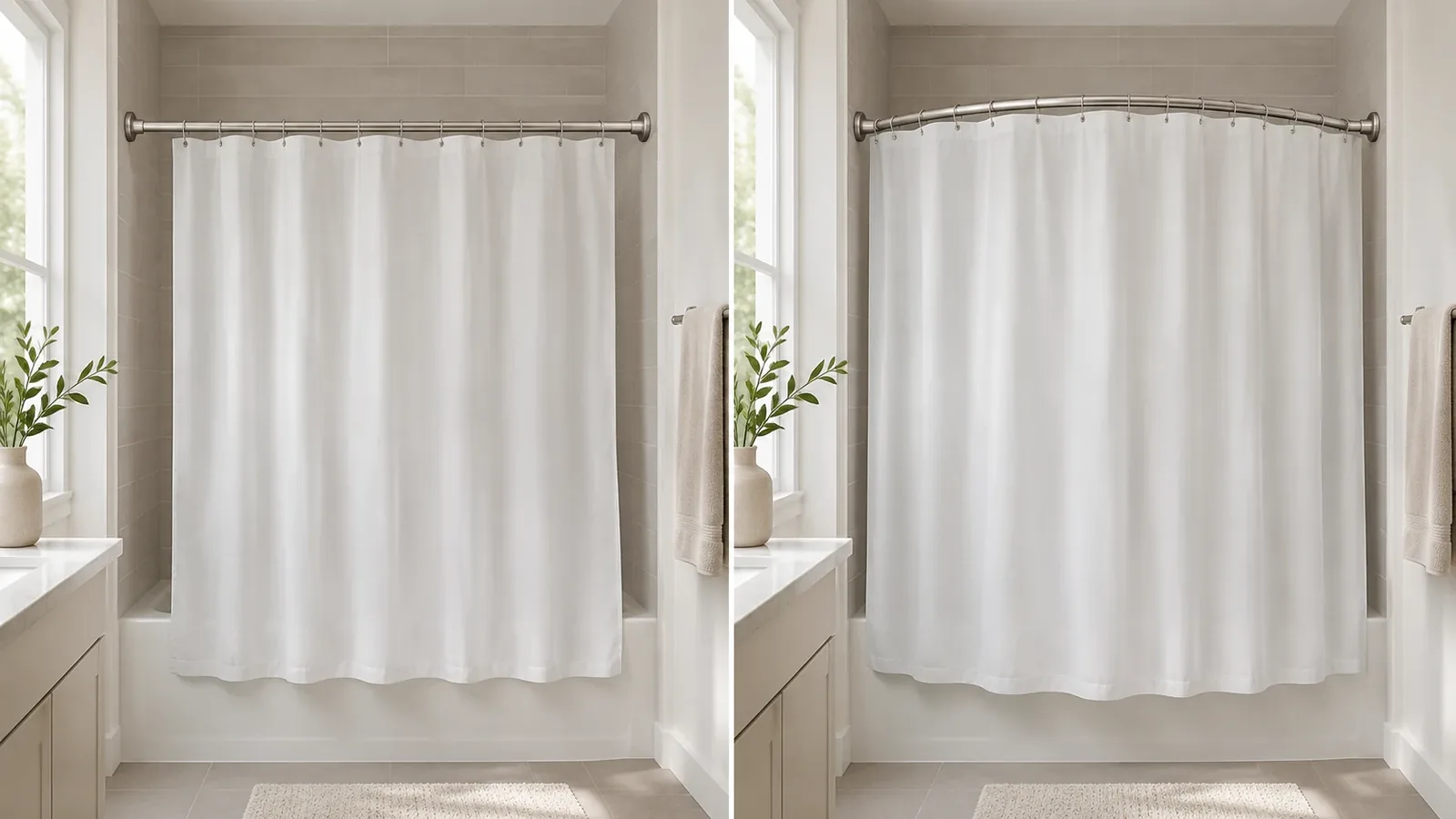
A curved vs straight shower rod decision is a comparison of the curtain path and the space on both sides of it. With the same two wall endpoints, an outward curve moves part of the curtain farther into the bathroom while creating more clearance on the shower side; it does not create new floor area or enlarge the tub. A straight rod keeps the curtain closer to the line between the endpoints. Choose from the full room layout, curtain envelope, wall attachment, and actual product assembly rather than from a “luxury” label or an assumed minimum bathroom size.
How Should Buyers Compare Curved vs Straight Shower Rods?
“Straight” and “curved” describe the rod’s path between its two end connections. They do not, by themselves, describe how the rod attaches, what material it uses, how much weight it supports, how it resists corrosion, or whether it fits a particular opening. Those details require the selected product’s own specifications and the installation surface.
A straight rod holds the curtain along a relatively direct path between its wall endpoints. An outward-curved rod bows away from the shower or tub area and into the room. When both alternatives use the same endpoints, the bow shifts the curtain boundary: the curtain can sit farther from a person inside the shower, while the curved portion uses some clearance on the bathroom side.
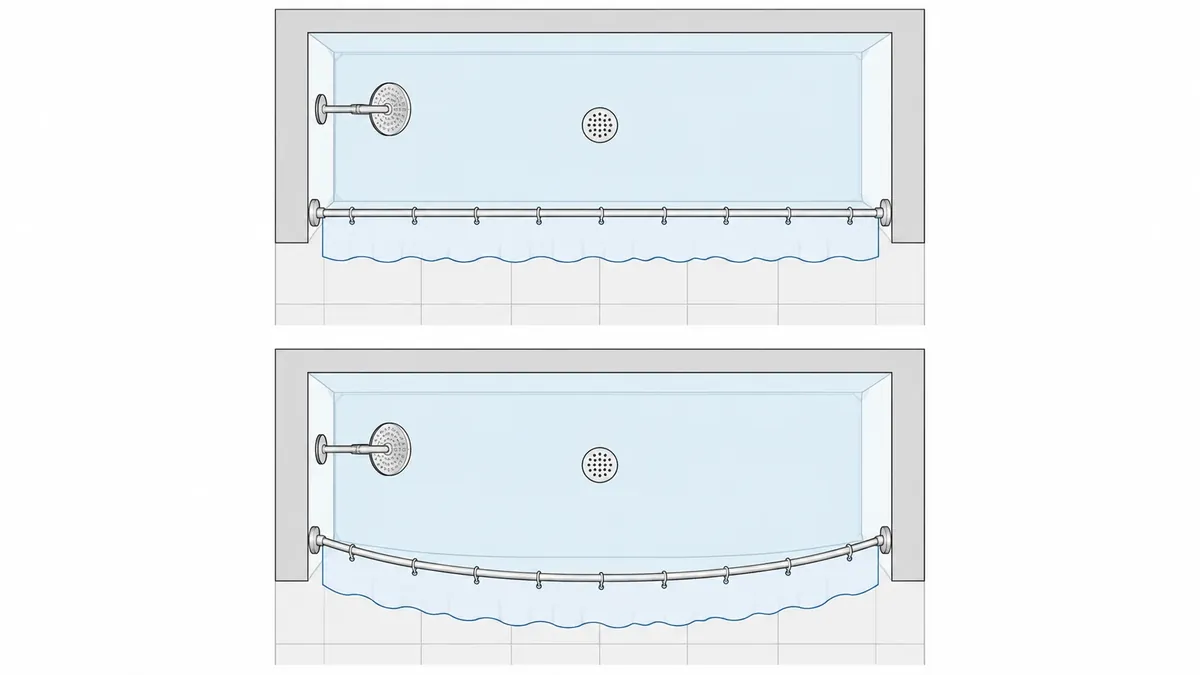
This geometry is best understood as a redistribution. If a buyer sketches the plan view with the same left and right endpoints, the straight path is a chord between them. The curved path bows out from that line. The shower-side region may gain space where the curtain moves outward, and the room-side region loses some. The bathroom floor and tub footprint have not changed. This simple same-endpoint comparison is an authored explanation of geometry, not a measurement of comfort or a guarantee that any given curved model provides a particular amount of extra space.
A rod can also be curved inward, have a nonuniform profile, use telescoping sections, or include distinct end fittings. Do not assume every product sold as curved follows the same radius or offset. The catalog drawing, physical sample, and installation instructions establish the actual path and interfaces.
How Do the Two Rod Shapes Change the Curtain Envelope?
The curtain envelope is the space occupied by the rod, hanging curtain, hooks or rings, and any motion needed to open or close it. A shape comparison that considers only the metal bar can miss what the user and nearby fixtures actually encounter. Curtains may hang differently depending on their header, rings, stiffness, drape, and how far the fabric extends below the rod.
With a straight rod, the curtain typically remains nearer the line between the end brackets. This may suit a compact room where every inch of bathroom-side clearance matters, where a shower enclosure is aligned closely with adjacent fixtures, or where the product was designed around a straight track. The straight path may also simplify alignment with the existing mounting points, though the selected model and installation conditions still control fit.
A curved path can give a curtain more room on the shower side at the bow. That can be useful when the intended layout benefits from moving the fabric away from the user. But the outward bow needs space beyond the wall-to-wall endpoint line. The bathroom side may have a vanity, toilet, door swing, towel rail, cabinet, grab bar, or traffic route that cannot be ignored. The curve may also change where the curtain edge rests relative to a tub or floor. These conditions need to be checked for the actual bathroom, not inferred from a product name.
For a buyer evaluating a product assortment, map the whole intended envelope:
- Mark both wall connection points and the clear span between them.
- Draw the actual straight path and the offered curved path using the manufacturer’s drawing.
- Mark the shower-side area and room-side area separately.
- Add the expected curtain or liner path, including any movement at the ends.
- Mark nearby fixtures, doors, shelves, and walking space.
- Confirm the selected curtain length, hook or ring arrangement, and bracket position against the same layout.
The purpose is not to predict a universal best shape. It is to make the choice traceable to the buyer’s layout and product configuration.
How Should a Buyer Compare a Curved and Straight Rod on the Same Plan?
Use one plan with fixed endpoints, then compare the paths without changing the room. First draw the wall-to-wall line at the intended mounting positions. That line is a visual reference for a straight rod. Next draw the actual bow from the product drawing or measured sample. Label the inward shower side and outward room side. The bowed segment should be shown on the side where the selected product actually projects.
In the same sketch, mark two clearance areas: the space between the curtain and the shower user, and the space between the curved rod/curtain and nearby bathroom features. This forces the buyer to consider both sides. If the bow provides a shower-side clearance benefit, it necessarily uses a portion of the room-side envelope relative to the straight reference. The drawing should not represent that shift as added room area.
| Layout check | Straight path | Outward-curved path | Evidence to confirm |
|---|---|---|---|
| Endpoint positions | Use the intended mounting points | Use the same points for a fair comparison | Dimensioned wall layout or verified installation points |
| Shower-side curtain position | Stays nearer the endpoint line | Bow can move part of the curtain outward from the shower | Rod path and curtain/hook arrangement |
| Room-side clearance | Often uses less space beyond the endpoint line | Bow occupies additional room-side envelope | Nearby fixture and door-swing plan |
| Nominal rod length | Not necessarily equal to the straight endpoint span | Path length may differ from endpoint span | Manufacturer’s dimensions and measuring convention |
| Mounting method | Separate product attribute | Separate product attribute | Actual kit, brackets, and installation instructions |
Do not use a generic sketch with an arbitrary bow dimension as if it described a selected product. The research supporting this guide does not establish one universal curved offset, suitable minimum bathroom size, or performance number. If the product drawing does not show the curve clearly, ask the supplier for the path dimensions or a drawing with reference points.
Which Dimensions Must Stay Separate?
Four measurements are easy to confuse: wall-to-wall span, rod-path length, end-fitting engagement, and curtain compatibility. A quoted nominal length may refer to one of these, but not necessarily all four. Check the drawing and instructions to learn how the manufacturer defines each dimension.
Wall-to-wall span is the distance between the intended mounting references. A buyer should specify whether the measurement is between bracket centers, finished wall faces, or another datum. Uneven surfaces, tile thickness, trim, or offset mounting positions can change the usable distance.
Rod-path length follows the centerline or other defined path of the rod. A curved path can be longer than a straight line between its endpoints. A nominal length should not automatically be read as the clear wall span. Ask whether the listed measurement means the rod’s overall length, adjustable range, or distance between end connections.
End-fitting engagement is the portion that enters, attaches to, or overlaps the end hardware. It affects the assembled span and must be interpreted according to the product design. The visible rod length may not equal the total installed reach.
Curtain compatibility concerns rings, hooks, gliders, header openings, curtain width, and the rod or track interface. It is possible for a rod to fit the measured endpoints but not match the user’s curtain hardware or intended opening behavior. Confirm the complete system rather than the bar alone.
For an OEM or private-label request, share a drawing that labels the endpoint datum, curve direction, path dimensions, bracket details, and intended curtain interface. If the buyer is comparing alternatives, keep those fields constant where possible. This prevents a shape decision from becoming confused with a length or mounting change.
Does Curved Mean Tension-Mounted or Permanently Bracketed?
No. Rod shape and mounting method are separate attributes. A curved rod may be offered with a fixed bracket system or another arrangement depending on the actual product, and straight rods can also come in different mounting families. Do not infer mounting type from curvature.
A tension-mounted rod and a bracket-mounted rod present different installation interfaces. The relevant guide to tension versus bracket-mounted shower curtain rods covers that distinct choice. This article does not establish which wall fixing is acceptable for a particular substrate, how much load a particular rod can carry, whether an installation is safe, or whether a given bracket will remain secure.
Review the selected kit’s installation documentation and verify the intended wall surface, fixing method, end fittings, and actual assembly. A supplier drawing can identify the hardware package; it does not replace the site-specific installation instructions. Where a project depends on a specific fixing or construction, state it in the specification and have the responsible installer assess the actual wall and product.
When Is a Straight Rod a Better Layout Fit?
A straight rod can be a better fit when the intended curtain boundary should stay close to the mounting line or when bathroom-side clearance is constrained. It may also be the intended replacement when existing mounting points and the selected product are designed around a straight span. These are layout reasons, not universal product-performance claims.
A buyer can start with a straight option when the plan shows that an outward bow would conflict with a door, vanity, toilet, towel bar, cabinet, or circulation path. A straight path may also simplify the comparison if the room’s desired curtain line is already established by a tub edge or enclosure. Still, confirm the product’s endpoints and curtain interface; “straight” alone does not guarantee the exact installed line.
For a product collection, standardizing on a straight configuration may be appropriate when the assortment’s target layouts share a relatively compact room-side envelope. The decision must be based on the actual customer segment and installation contexts, not on a general assumption that all bathrooms are small. If the buyer’s target market includes multiple layouts, listing a straight and curved option may be worth evaluating as an assortment decision. That is a commercial choice, not evidence that either rod is inherently better.
The straight version should still be reviewed for rod length, bracket arrangement, curtain width, finish, package protection, included parts, and installation guidance. The buyer should test or inspect the actual intended construction where the product’s fit, appearance, or user interaction matters to the assortment.
When Is an Outward Curve Worth Considering?
An outward curve is worth considering when the buyer wants to move part of the curtain away from the shower user and the room-side envelope can accommodate that shift. The benefit should be stated precisely: the curtain boundary moves outward relative to a straight path between the same endpoints. It is not a promise of extra bathroom floor area, wider tub, guaranteed comfort, better water containment, or a particular price tier.
A curved option can also be a relevant product variant if the intended buyers value the different curtain geometry and their layouts provide the needed clearance. Before adding it to an assortment, compare its actual bow, assembly parts, mounting system, package size, instruction requirements, and compatibility with the intended curtain. A product that is described as curved but shown without clear reference dimensions is difficult to specify consistently.
Check the end regions as carefully as the center. A bowed centerline may place the curtain farther out in the middle while the ends remain at the same mounting points. Curtain movement, rings, returns, brackets, and the fabric’s own drape all contribute to the effective envelope. Do not assume a nominal center offset predicts the complete curtain position.
The bathroom-side check should include items that are fixed and items that move. A vanity cabinet may be fixed, while a door, drawer, shower screen, or cabinet door occupies changing space. Sketch the positions that matter for actual use. If the outcome is uncertain, measure the fixture clearances and review a full-size drawing or representative mock-up before final selection.
What Should Buyers Ask About Existing Support and Height Guides?
A curved rod’s support and sag are separate engineering questions from choosing a curved or straight path. The existing curved shower curtain rod sag and bracket support specification guide addresses support considerations that should not be replaced by a generic claim about rod shape. Likewise, the shower curtain rod height planning guide covers mounting-height planning, which is not answered by this shape comparison.
When those questions arise, use the relevant owner page and the actual product instructions. Do not infer that a curved rod needs a certain bracket, center support, height, load rating, material, or installation method solely because it curves. The needed arrangement depends on the product design and the stated use conditions.
For sourcing, ask the supplier to identify the offered configuration and any supporting parts in the quotation. If a support component is not included, do not assume it is. If the product has a center support, ask how it interacts with the actual ceiling or wall condition and how that part is represented in the installation information. The buyer should compare documented assemblies rather than general category labels.
What Mistakes Lead to a Poor Rod Selection?
Looking only at the shower-side clearance. An outward bow also consumes space on the bathroom side. Evaluate both sides of the curtain line.
Assuming a curved rod makes the room larger. The curve reallocates clearance across the curtain boundary; it does not add floor area or change the tub footprint.
Using nominal length as the endpoint span. The label might describe rod path, extension range, or overall size. Confirm the manufacturer’s measuring convention.
Treating shape as a mounting method. Curved versus straight does not establish tension versus bracket mounting or identify wall-fixing suitability.
Ignoring the curtain and hooks. The rod bar alone does not define the complete curtain envelope. Include the curtain width, header, rings, and travel that the actual product supports.
Assuming every curved model has the same bow. Different products may use different paths and end designs. Obtain the relevant drawing or sample dimensions.
Inferring water containment or safety from shape. The sources reviewed do not support a universal claim that curved rods keep water inside, improve safety, or carry a particular load.
Choosing by a luxury label. Marketing descriptors do not resolve layout fit. Select from dimensions, assembly, documentation, and buyer requirements.
Changing multiple variables at once. If rod shape, mounting method, length, finish, and curtain system all change, the buyer cannot identify which difference drove fit or preference. Hold variables constant in a comparison wherever possible.
How Can a Buyer Prepare a Reliable Comparison?
Create a one-page comparison with a plan view and a specification table. The plan view should show mounting points, rod path, curtain position, the shower side, the bathroom side, and adjacent fixtures. The table should list endpoint span, rod-path measurement, fitting engagement, mounting method, curtain interface, material and finish description, packaging scope, and the source drawing revision.
For product development or private-label sourcing, give the supplier a real layout or a clearly dimensioned target envelope. A photo may help explain context but cannot replace dimensions when fit is critical. If the buyer asks for a curved version, specify the outward direction from a defined viewpoint so the supplier does not interpret the curve inconsistently. Include which surfaces or positions are constrained by nearby fixtures.
Ask the supplier to flag information it cannot determine from the available drawing. An unresolved clearance should remain an open decision. A conceptual sketch is useful for discussion but should not be presented as an approved production drawing. A sample review can confirm the actual shape and interfaces, but it does not independently prove load, corrosion, installation safety, or long-term performance.
Koitor Hardware is a family-owned custom metal bathroom and home-storage hardware factory. Buyers may share drawings or physical samples to discuss customization, component arrangement, finish, packaging, and a small-batch OEM request. That capability statement does not mean Koitor currently offers a specific shower-rod model or mounting system, nor does it establish that an adjacent accessory is part of a present product range. Confirm the exact project scope before quotation.
Buyer Checklist Before Requesting a Quotation

- Are the two wall endpoints and their measuring datum defined?
- Does “length” mean endpoint span, rod path, adjustable range, or overall reach?
- Is the curve direction stated from a clear room-side or shower-side view?
- Is the actual bowed path dimensioned or shown on the correct product drawing?
- Have both shower-side and bathroom-side clearances been checked?
- Are moving fixtures, door swings, screens, cabinets, and curtain travel shown?
- Are rings, hooks, curtain width, and end fittings compatible with the intended assembly?
- Is the mounting family stated separately from the rod shape?
- Are height, bracket, and support questions being answered by the correct specification or owner guide?
- Are material, finish, included parts, packaging, and drawing revision clear?
If the room layout or product dimension is unresolved, record it as pending. Do not let a general label decide the fit. The buyer can return to the choice after receiving the missing plan, product drawing, or installation information.
Häufig gestellte Fragen
How should buyers compare a curved vs straight shower rod?
It moves part of the curtain farther outward from the shower when the curve bows into the room. That can change the usable clearance on the shower side, but the same bow occupies room-side space. It does not enlarge the floor or tub footprint.
Is a straight rod always better for a small bathroom?
No universal room-size rule is supported here. A straight rod can keep the curtain nearer the endpoint line and may suit a constrained room-side envelope. The actual bathroom dimensions, fixtures, mounting points, and selected rod determine fit.
Are curved rods always permanently mounted?
No. Shape and mounting method are different product attributes. Confirm the actual model, kit, bracket, and installation instructions rather than inferring attachment from curvature.
Does nominal rod length equal the wall-to-wall distance?
Not necessarily. A nominal value may describe a path, adjustable range, overall length, or another measurement. Check the drawing for the actual endpoints and the supplier’s definition.
Does the curve keep water inside the shower?
This guide does not make that claim. Water behavior depends on the complete installation and use conditions, and the reviewed evidence does not establish a universal containment result from rod shape alone.
Sources
- Kingston Brass: Straight vs. Curved Shower Rods
- Koitor: Curved Rod Sag and Bracket Support
- Koitor: Shower Rod Height Planning
Arbeiten Sie mit Koitor Hardware zusammen
Discuss a Custom Bathroom Hardware Layout
Share the drawing, endpoint dimensions, intended curve direction, finish, mounting concept and target order quantity. Koitor Hardware can review the stated scope for a custom bathroom or home-storage hardware project.
OEM / EIGENE MARKE
Verwandeln Sie diesen Beschaffungsleitfaden in ein Produktdossier
Teilen Sie uns Ihr Zielprodukt, die Größe, die Oberflächenausführung, die Bestellmenge und Ihre Verpackungsanforderungen mit. Ihr Team erhält vor der Angebotserstellung eine praxisorientierte Prüfung der Herstellbarkeit.


 English
 Español
 Português
 Français
 Deutsch
 العربية