

Demand planning vs supply planning compares two connected but different jobs. A demand plan describes the expected customer requirement over a stated horizon; a supply plan translates that requirement into a feasible response using available inventory, procurement, production, timing, and other constraints. If current supply cannot meet the expected quantity, keep the demand figure visible and record the constrained response separately instead of quietly reducing demand to match what can be supplied. For buyers, demand planning vs supply planning is the concise label for the distinction explained in this guide.
Demand Planning Vs Supply Planning: buyer guide and process boundaries
Demand planning estimates what customers may need or buy during a defined period. It may use sales history, known orders, market assumptions, promotions, customer inputs, or other approved information. The demand view should state its product scope, horizon, units, and assumptions. It is an expectation for planning, not automatically a confirmed order or a supplier commitment.
Supply planning asks what actions and resources could respond to that expected need. Depending on the business, that can include available stock, replenishment orders, supplier lead times, production sequence, material availability, capacity windows, inbound timing, and allocation rules. It does not rewrite the customer requirement; it explains a possible way to serve it.
| Planning question | Demand plan | Supply plan |
|---|---|---|
| Hauptfrage | What requirement should be anticipated? | What response can be arranged under the current constraints? |
| Typical output | Expected quantities by item and time period | Procurement, production, inventory, allocation, and timing actions |
| Key inputs | History, customer orders, market events, product scope, assumptions | Inventory, open orders, supplier timing, materials, production resources, constraints |
| What it is not | A guaranteed customer order or confirmed supplier slot | Proof that the original requirement no longer exists |
| Useful review | Is the demand view supported and current? | Are the proposed actions feasible and explicitly conditional? |
Netstock’s discussion of the two planning terms describes demand as expected customer requirements and supply planning as the operational response involving purchasing, materials, and production. Its software recommendations and performance claims are outside the scope of this article. The distinction itself is useful for importers and OEM buyers: planning teams should connect the two views while preserving what each one represents.
A demand plan can change when new information arrives. A supply plan can change when stock, supplier availability, material timing, or a production constraint changes. Their revision histories should show which input changed. If a buyer updates expected need because a customer order changed, that is a demand update. If the buyer updates feasible delivery timing because a supplier’s current schedule changed, that is a supply response update.
How to build a paired demand and supply record
A clear record starts with one product identity, one unit, and one time horizon. Keep the expected requirement as its own row, then show the existing stock and the possible supply response beside it. Do not combine all numbers into a single total unless the calculation and purpose are stated.
Consider a purely hypothetical hardware SKU for a distributor:
| Planning field | Illustrative entry | Status |
|---|---|---|
| Expected customer requirement for the planning horizon | 500 pieces | Demand assumption for this example |
| Usable inventory already on hand | 120 pieces | Inventory record requiring a current count or approved system source |
| Open supplier order expected in the horizon | 180 pieces | Order record; timing and quantity still need confirmation |
| Remaining requirement before new supply response | 200 pieces | Arithmetic under the stated assumptions |
| Proposed new supply response | 160 pieces by the preferred date | A constrained scenario, not a production commitment |
| Uncovered expected requirement | 40 pieces | Remains visible as an unresolved gap |
The example uses basic arithmetic to keep the two views distinct. The expected requirement remains 500. A proposed response of 160 does not make the requirement 460. It means that the plan currently describes 160 of the additional 200 pieces as a possible response, leaving 40 unresolved before considering any other approved changes or receipts.
The example does not establish that a 160-piece quantity is realistic, that a factory has a production slot, or that the open order will arrive on time. A real plan would need the item’s current specification, inventory basis, purchase-order status, supplier confirmation, lead time, and relevant operational constraints. If those data are not confirmed, mark them as assumptions or open questions.
A paired record can include:
- Product code, specification, finish, packaging, and revision.
- Planning horizon and period granularity.
- Expected demand quantity and the source of the assumption.
- Existing stock and the date or system source for that balance.
- Open purchase orders and status of supplier confirmation.
- Proposed purchase or production response.
- Timing constraints and their owners.
- Uncovered requirement, surplus, or allocation decision.
- Date, owner, and reason for each change.
This layout is deliberately simple. It is meant to preserve what the numbers mean before a team uses a more detailed planning tool or process.
Why an unmet supply constraint must not erase demand
A planning record becomes misleading when the supply side is used to cap or overwrite the demand side without documenting that decision. Suppose a distributor expects 500 units but can currently identify only 300 units of inventory and supply over the relevant horizon. Those 300 units may describe the response currently believed feasible. They do not establish that customers will need only 300 units.
A constrained plan should show the gap and its treatment. The buyer may choose to seek another supplier window, change allocation, split delivery, identify substitute products for approval, adjust a launch date, or accept a documented shortfall. Each option has consequences and requires the appropriate decision owner. The planning record should state which option is under review rather than encode a guess as a final customer requirement.
A common failure mode is to revise a forecast down because the supplier cannot meet it. That can make a later report appear to show that the supply plan matched demand, even though the original need was not met. Keep the original demand scenario and any revised demand scenario separate. For example, mark one as “expected customer need” and another as “approved commercial change after allocation.” The reason and approval date should be visible.
Feedback between plans is still useful. Supply constraints can prompt the team to examine the demand assumption, split an order, or discuss a substitute. But that is a review loop, not proof that demand has vanished. Netstock describes these plans as related and iterative; the practical point for a buyer is to keep the source and type of each revision traceable.
This distinction protects communication with a manufacturer. A buyer may say, “Our current requirement remains 500 pieces; we are reviewing a supply scenario for 300 before the requested date.” That statement is clearer than “The demand is now 300” if the 200-piece difference is only a supplier timing constraint. If the buyer later approves a smaller order because commercial plans changed, record that decision separately.
What importers should confirm before relying on a supply plan
A feasible supply response depends on more than the headline quantity. The buyer should confirm which product revision, finish, packaging, and delivery location the plan covers. A quantity that can be supplied only after a design change or with different packaging is not automatically equivalent to the original requirement.
Check these inputs before using the response as an operational plan:
- Item identity: Do the forecast, inventory record, purchase order, and supplier quote use the same SKU and specification?
- Revision state: Is the plan for the approved design, finish, color, logo, and mounting kit?
- Quantity basis: Are quantities individual pieces, sets, cartons, or another unit?
- Stock status — Is on-hand inventory available, quarantined, already allocated, or counted from an old snapshot?
- Open-order status — Is the order accepted, in production, shipped, or only requested?
- Timing: What date event does the plan use—production completion, shipment, warehouse receipt, or customer delivery?
- Constraints: Are material, packaging, labor, tooling, or changeover issues explicitly named and assigned?
- Alternatives: Does a proposed substitute require product, quality, or customer approval?
- Decision ownership: Who can approve an allocation, split shipment, revised forecast, or substitute?
- Next review: When will the team replace assumptions with confirmed information?
A supply response should distinguish a confirmed action from a planning scenario. “Supplier expects to review capacity next week” is not the same as “160 units are committed by May 10.” Dates and quantities should be labeled with their status. Do not represent an unapproved estimate as a delivery promise.
The relationship between expected demand patterns and supplier questions is covered separately in Koitor’s guide to ABC/XYZ replenishment questions. That page owns demand-pattern classification. The broader planning distinction here is about the different purpose and output of a demand plan and a supply plan.
How the plans connect to forecasts, orders, and inventory
A forecast, sales order, purchase order, receipt, and inventory balance are related but distinct records. A forecast expresses an expectation; a sales order may represent a customer commitment under a defined commercial process; a purchase order requests supply from a supplier; a receipt records goods arriving; and inventory records the stock state under a company’s rules.
Combining them without labels can create double counting. For example, an order may already be included in a demand forecast, or an open purchase order may already be included in the supply projection. A buyer should identify which records are included and avoid adding the same expected quantity twice. Koitor’s guide to forecast consumption and sales orders addresses that separate double-counting question.
Inventory planning can also constrain a buying decision. Available-to-buy calculations, stock balances, and receipt timing need their own basis. A separate Koitor guide explains open-to-buy receipt headroom. The supply plan may use those inputs, but that does not make them synonyms for supply planning.
Likewise, “capacity” can mean different things depending on whether a team is discussing output over time, a process cycle, or available production resources. A supplier’s machine count or short sample run does not independently confirm the quantity and timing in a plan. Koitor’s guide to supplier capacity, takt time, cycle time, and changeover covers those measurement boundaries.
A helpful planning note might say: “Demand scenario: 500 pieces across the next two periods based on the current customer plan. Supply response: 160 pieces proposed in period one, subject to supplier confirmation; the remaining 340 pieces are not yet allocated.” This wording keeps the requirement and the response separate. It does not claim that a given quantity is confirmed until the authorized supplier record says so.
Common demand-planning and supply-planning errors
Mistake 1: Treating a forecast as a confirmed order.
An expected requirement can guide planning, but it does not automatically create a contractual order or reserve production time.
Mistake 2: Treating an unconfirmed supply estimate as a commitment.
A scenario should be labeled as proposed, under review, or confirmed according to the actual evidence. Do not turn tentative dates into promises.
Mistake 3: Reducing demand to match limited supply.
If supply is constrained, show the gap. Change the demand view only when the customer or responsible planning owner approves a genuine change to the requirement.
Mistake 4: Mixing product revisions.
Different finishes, dimensions, packaging, or mounting components may require separate SKU records. Aggregation can hide the fact that supply is feasible for one revision but not another.
Mistake 5: Double-counting orders already inside the forecast.
State whether open orders are included in the demand or supply figure and how they are treated.
Mistake 6: Ignoring the time horizon.
A quantity without dates cannot show whether the proposed response arrives before the need. Keep the period and date event explicit.
Mistake 7: Treating supplier capacity as the whole plan.
Available production resources are only one input. Materials, stock, purchase orders, processes, quality release, packaging, and delivery timing may also matter.
Mistake 8: Hiding unresolved assumptions in a single total.
If inventory is old or a supplier date is tentative, keep that status visible. A neat total can still rely on uncertain inputs.
These errors are usually corrected by labeling the data, clarifying ownership, and preserving the original requirement. A spreadsheet or planning application cannot make an ambiguous field accurate merely by calculating with it.
How to run a practical planning review
A short review meeting works best when the team reads demand and supply as separate views of the same item. Start by confirming the product code, revision, and time horizon. Ask the demand owner what the quantity represents and what changed since the previous version. Then ask the supply owner which stock, order, supplier response, and production assumptions are current. This order prevents the group from treating a feasible quantity as if it were the customer requirement.
Next, list the uncovered amount and the next decision. It may be possible to allocate existing stock, request a revised supplier date, split a delivery, or seek approval for a substitute. Those are choices, not automatic calculations. Record who owns each choice and when the team will revisit it. If no decision can be made because the material specification or order status is unknown, keep the item marked open rather than forcing a numeric answer.
Use a small status vocabulary consistently, such as observed, requested, supplier-confirmed, proposed, approved, or unresolved. The labels should describe evidence status, not confidence that the plan will succeed. A “supplier-confirmed” date should be traceable to an actual supplier communication or order record; an internal target date is not the same evidence.
At the end of the review, save the demand scenario and supply scenario with a version date. If the customer requirement later changes, revise the demand record and preserve the earlier view. If only the feasible response changes, update the supply record while keeping the original demand visible. This record trail makes later conversations about delays or reorders more concrete and reduces the temptation to reconstruct intent from a single rolled-up spreadsheet cell.
For a supplier handoff, keep the request and the response in separate fields. A useful request can state the SKU and revision, required quantity, delivery window, packaging configuration, and any known order reference. The response can state the quantity currently supported, the assumptions behind it, the earliest confirmed date, and the unresolved items. If the supplier proposes a split shipment or substitute, record it as a proposal until the buyer approves it. This simple separation makes it easier to compare the original need with the available response without silently changing either one.
Buyer checklist for a paired planning review
Before using a demand and supply plan to make a sourcing decision, confirm:
- Does the demand plan state its horizon, units, product scope, and input assumptions?
- Are confirmed customer orders separated from forecasts?
- Does the supply view list on-hand stock, open orders, planned purchases, and proposed production separately?
- Are order quantities and inventory balances tied to the same SKU and revision?
- Are existing orders already included in the forecast or supply total?
- Does each proposed quantity have a date and status?
- Are material, process, packaging, or capacity constraints visible?
- Is any unmet requirement shown rather than hidden?
- Are substitutes, split deliveries, or allocation changes approved by the right owner?
- Does the next review date identify when assumptions will be updated?
- Are the final purchasing decisions recorded separately from the planning scenario?
The checklist supports a clear conversation. It does not replace a company’s authorized planning system, financial controls, supplier agreement, or customer commitment process.
Häufig gestellte Fragen
What is the main difference between demand planning and supply planning?
Demand planning describes expected customer requirements over a stated horizon. Supply planning describes how inventory, purchasing, production, timing, and constraints could respond.
Does a supply plan change the demand forecast?
Not by itself. A supply constraint may trigger a review, but it does not prove that customer need has changed. Record a demand revision only when the responsible owner approves it.
Is a supplier production date part of demand planning?
No. It is a supply-side timing input. Demand planning describes expected need; a production date helps describe a possible response.
Can an open purchase order be treated as available inventory?
Not automatically. The buyer should check its status, quantity, date, product revision, and whether it has been counted elsewhere in the planning record.
Does a forecast guarantee a supplier slot?
No. A forecast is a planning input. Supplier capacity, material availability, order acceptance, and agreed timing need separate confirmation.
What should remain visible when supply is constrained?
Keep the expected requirement, currently available supply, proposed response, constraint, uncovered quantity, and decision owner visible. Do not collapse them into one number without a stated rule.
Sources and related reading
Netstock’s demand planning versus supply planning overview supports the general distinction between expected customer requirements and operational purchasing, material, and production responses. Its software and outcome claims are not adopted here. For separate concepts, see Koitor’s guides to forecast consumption and sales orders, open-to-buy receipt headroom, and supplier capacity and cycle-time measures.
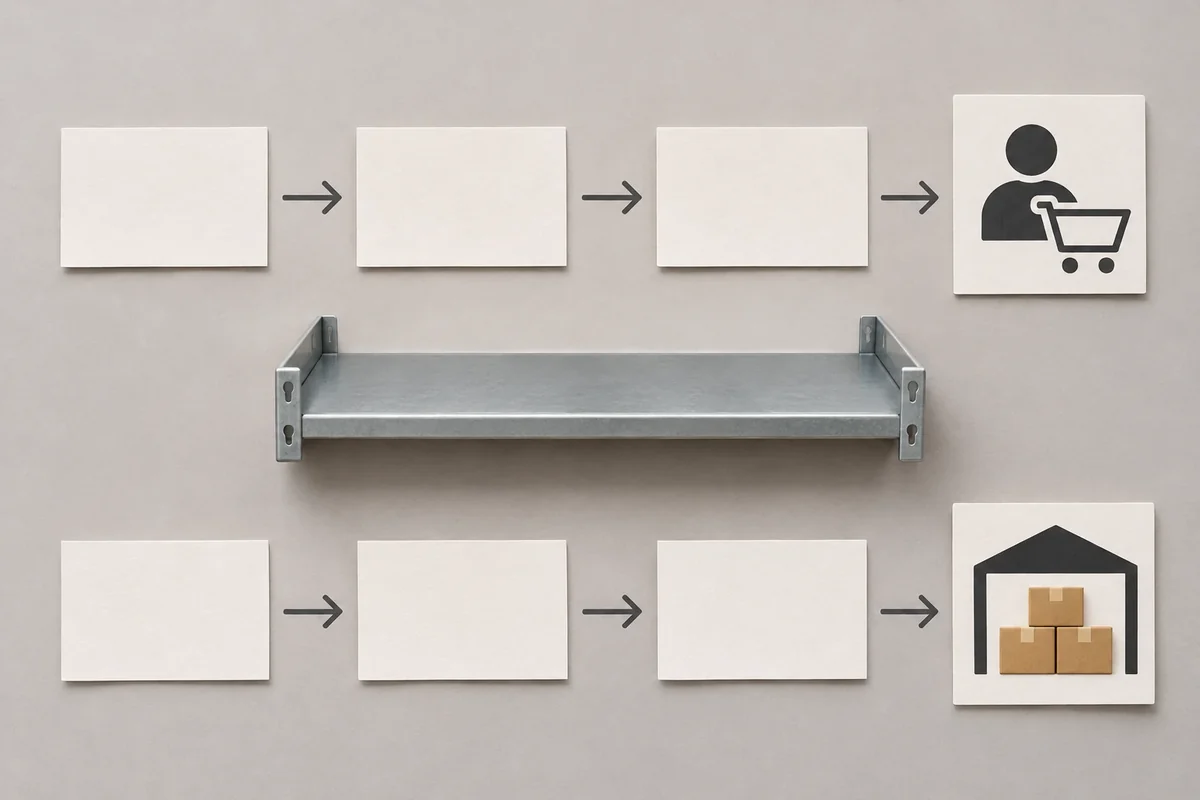

A useful planning handoff also identifies which assumptions have an owner. The demand owner can confirm the customer requirement, forecast horizon, known promotion, and open orders included. The supply owner can confirm stock status, incoming purchase orders, supplier dates, production constraints, and inspection or packing steps that affect availability. When an input is uncertain, label it and give a review date instead of silently treating it as confirmed. This makes the gap between requirement and response visible to the person who can resolve it. A buyer may then decide whether to change timing, split a shipment, seek a substitute, or keep the original request open. None of those options should be recorded as approved until the responsible party agrees. A planning snapshot should retain its revision date so later changes can be compared without rewriting the earlier assumption.
Häufig gestellte Fragen
What should a buyer confirm first?
Start with the exact product, process, or measurement scope and the applicable drawing or specification.
Does one sample or record prove every production condition?
No. Keep the part, revision, method, and evidence scope attached to each conclusion.
What if the requirement is unclear?
Record the open question and ask the responsible supplier or technical owner before approval.
Discuss a related hardware project with Koitor
Share the relevant drawing or sample, product revision, finish, order quantity, and packaging scope to clarify the manufacturing discussion. Confirm project-specific processes and evidence with the responsible supplier.
OEM / EIGENE MARKE
Verwandeln Sie diesen Beschaffungsleitfaden in ein Produktdossier
Teilen Sie uns Ihr Zielprodukt, die Größe, die Oberflächenausführung, die Bestellmenge und Ihre Verpackungsanforderungen mit. Ihr Team erhält vor der Angebotserstellung eine praxisorientierte Prüfung der Herstellbarkeit.


 English
 Español
 Português
 Français
 Deutsch
 العربية