
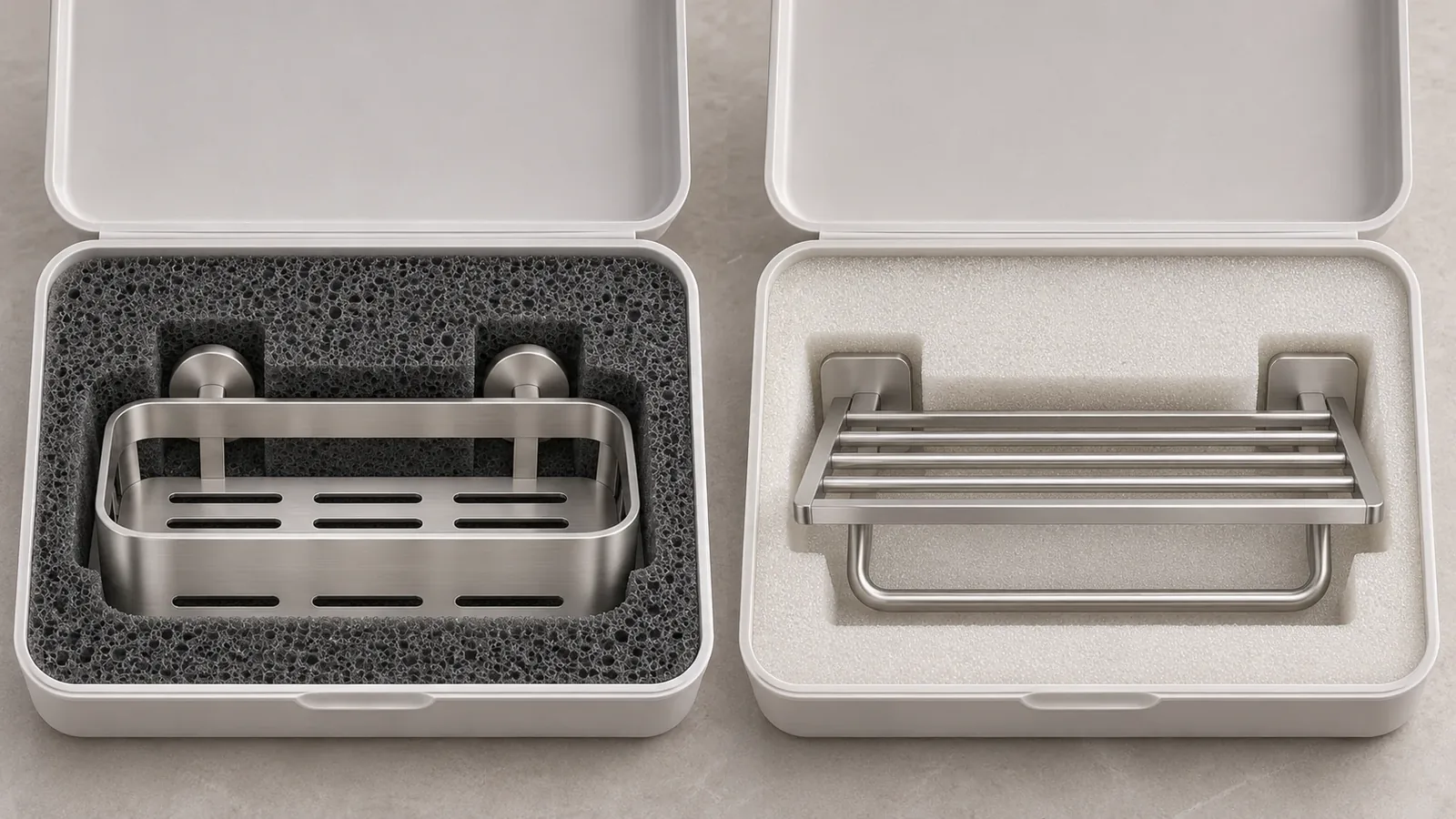
EVA vs polyethylene foam is a comparison between two polymer families used in a variety of foam products, but the family name alone does not identify the performance of a finished protective insert. EVA is an ethylene-vinyl-acetate copolymer; PE foam is based on polyethylene. Crosslinking, density, cell structure, formulation, supplied form, and the converted insert design are additional descriptors that buyers need to review. For a metal hardware package, select an actual supplier grade and evaluate the completed insert and carton instead of choosing a material from a generic claim that one family is always softer, tougher, safer, or better.
EVA vs Polyethylene Foam: How Are the Material Names Related?
For a packaging buyer, the question is whether the supplier connects the named polymer and grade to the exact insert offered. A material declaration, a grade code, and a finished insert drawing answer different parts of that question. Keep them together in the quotation record so a later substitution can be checked against the approved product and pack-out rather than judged from color or feel alone.
EVA and PE identify different polymer chemistry. Flextech describes EVA foam as a copolymer of ethylene and vinyl acetate. Polyethylene is the base polymer in the EVA copolymer, while vinyl acetate changes the composition and can affect the resulting material behavior. PE foam is a polyethylene-based foam product. These labels are not interchangeable, but they also do not provide a complete insert specification.
The important distinction is a layered map:
polymer family → supplied foam grade and structure → sheet, roll, or other supplied form → cut or fabricated insert → packed product and carton
Each step adds information. The polymer family names what the base material is; the grade and structure describe the particular material offered; the supplied form describes how the converter receives it; and the insert design determines where the product sits, what it touches, and how the package closes. A buyer can know the polymer family while still not knowing whether a proposed insert is suitable for the product.
A manufacturer’s technical information sheet for its own foam products illustrates why codes may include distinct descriptors such as polymer, density, variant, cell size, crosslinking, and color. That is a product-family example, not a universal code system for every foam supplier. Buyers should ask each supplier to decode its own part or grade designation instead of interpreting an unfamiliar code by analogy.
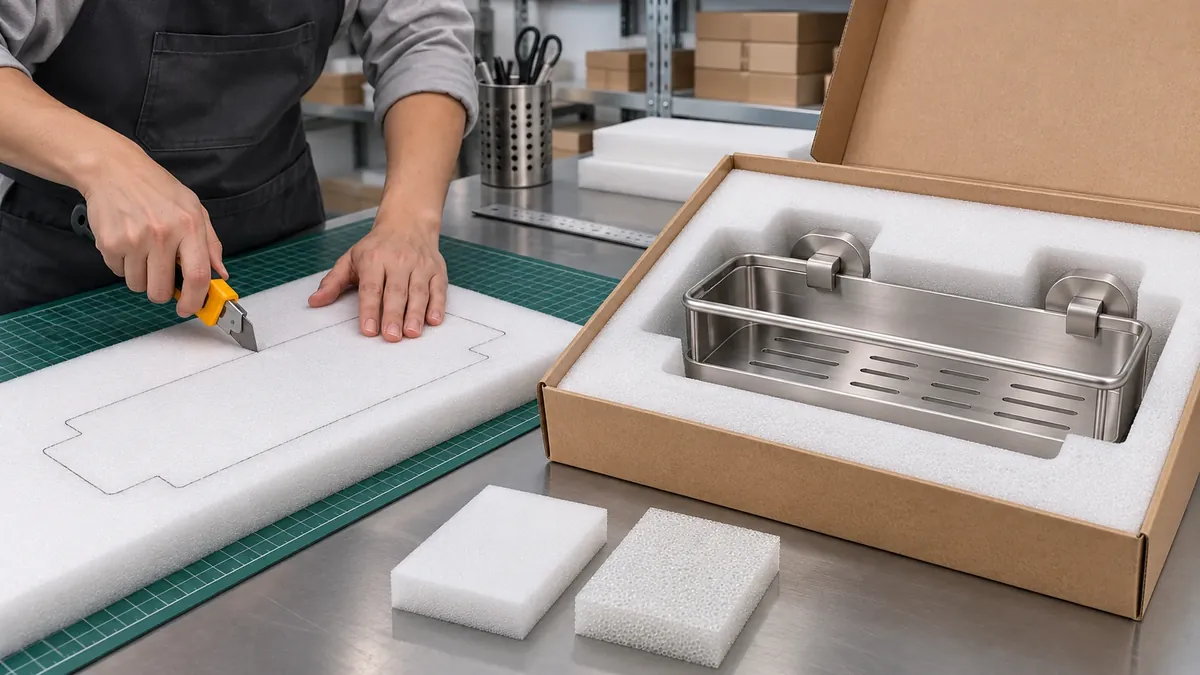
How Are EVA and PE Foam Related—and Different?
PE and EVA should not be presented as “two unrelated ingredients.” EVA is a copolymer that includes ethylene and vinyl acetate; PE foam is based on polyethylene without the vinyl acetate copolymer relationship used to identify EVA. This chemistry distinction helps a sourcing team understand what the material names mean. It does not rank the materials for cushioning or predict a package outcome.
The relationship can be summarized without assigning a winner:
| Comparison level | EVA foam | PE foam | What a buyer still needs |
|---|---|---|---|
| Polymer identity | Ethylene-vinyl-acetate copolymer | Polyethylene-based foam | Supplier’s exact grade and product family |
| Crosslinking | May be supplied as a crosslinked foam, depending on the product | May be supplied in different product families and forms | Whether and how the exact offered product is crosslinked |
| Cell and density descriptors | Product-specific | Product-specific | Supplier’s grade definition and applicable data |
| Supplied form | Sheets, rolls, buns, or other forms depending on maker | Sheets, rolls, or other forms depending on maker | The actual form and thickness offered |
| Insert construction | Cut, laminated, molded, or otherwise converted depending on supplier | Cut, laminated, molded, or otherwise converted depending on supplier | Cavity geometry and finished insert drawing |
| Pack-out result | Not established by chemistry name alone | Not established by chemistry name alone | Evaluation of the real product, insert, and carton |
The terms in this table are review questions, not a universal ordering of properties. The fact that a supplier offers both families in packaging applications does not mean that every grade has the same compression response, recovery, tear behavior, surface contact, temperature behavior, odor, price, or weight. No material in this comparison is declared the default winner.
Does EVA Mean “Soft” and PE Mean “Firm”?
No simple family-name rule can reliably say that all EVA is softer than all PE, or that all PE is firmer than all EVA. The cited EVA source notes that material behavior varies with composition and grade. Product families also differ by manufacturing route and physical form. A broad marketing adjective can be useful as an initial conversation prompt, but it cannot replace the actual product code or data for the proposed material.
Density alone is not a complete performance specification either. Zotefoams’ product specification sheet distinguishes multiple product descriptors and cautions that mechanical properties are not determined solely by polymer and density. That statement is specific to the maker’s portfolio, but it reinforces a practical buyer rule: do not treat equal density as proof of equal compression behavior or protective performance across different suppliers or grades.
A useful two-offer exercise makes the missing information visible:
| Supplier offer | What the offer establishes | What remains unknown |
|---|---|---|
| “PE foam insert” | The supplier describes the family as PE-based | Exact grade, crosslinking, cell form, density, supplied skin, insert geometry, and agreed protection evidence |
| “EVA foam insert” | The supplier describes an EVA family or grade | Exact copolymer grade, structure, supplied form, insert geometry, and agreed protection evidence |
Both offers contain a material family name. Neither establishes that the two inserts will contact a metal part in the same way, fit the same cavity, protect a surface to the same agreed criteria, or pass a particular shipment test. The buyer must fill the gap with supplier-grade information and an appropriate packaging review.
What Is the Difference Between Polymer, Crosslinking, and Insert Design?
These terms answer separate questions. Polymer identity describes the chemistry family. Crosslinking describes a feature of how a foam product is produced or structured. Insert design describes the physical packaging component that surrounds or supports a product. A buyer should not convert one descriptor into another.
For example, “EVA versus PE” does not automatically mean “crosslinked versus uncrosslinked.” Both chemistry families may appear in different supplied foam families, and a specific maker may offer product ranges with their own structure and grade definitions. A supplier’s own documentation should state which description applies to the exact material being quoted.
The same separation applies to an insert shape. Two material grades could be cut to the same nominal cavity shape and still differ in their documented behavior. Conversely, a change of polymer family does not automatically require a new outer carton if the insert design and packed arrangement remain suitable. Those are project questions to verify, not general conclusions based on a polymer label.
For a metal bathroom accessory, draw the sequence explicitly:
- Polymer identity: EVA copolymer or PE-based foam.
- Supplier grade: the actual manufacturer’s designation and product data.
- Foam structure: crosslinking and other descriptors stated by that supplier.
- Supplied form: sheet, roll, block, or other form and its dimensions.
- Converted insert: cavity, wall thickness, support surfaces, and assembly method.
- Finished pack-out: contact with the product, movement allowance, carton layout, and agreed evaluation.
This sequence is the central comparison framework. It shows why neither polymer name nor density alone can answer whether an insert is appropriate. It also avoids pretending that a new article can establish a foam grade for a buyer without that supplier’s actual product information.
For an EVA vs polyethylene foam decision, compare identified supplier grades in the supplied insert form; the family names frame the comparison but do not establish equivalent protection or fit.
How Should a Buyer Evaluate an Insert Around Metal Hardware?
The buyer should evaluate the final relationship between the actual insert and the actual product, not select solely by the foam name. A polished metal accessory, a wire basket, or a detachable bathroom component may have cosmetic faces, protrusions, fasteners, or edges that affect where the insert touches and how it holds the item during handling. The exact surface and product geometry matter.
Start with a drawing or sample of the hardware. Mark:
- visible surfaces that must remain free from unacceptable contact marks;
- projecting hooks, screws, ends, or brackets that affect the cavity;
- product orientation in the package;
- areas where an insert wall supports or restrains the component;
- the way the pack is closed and placed inside the outer carton.
Then request the supplier’s actual material identification, the proposed insert design, and any agreed evidence for the packaging objective. Do not imply that a material family guarantees scratch prevention or a particular shipment outcome. If the buyer needs to demonstrate protection, define the project’s packaging evaluation method with the responsible packaging and product suppliers.
The insert is only one layer in the package system. Product arrangement, protective film or bags if specified, retail box, inner packing, carton configuration, and shipment handling may all matter. An insert can fit the product yet fail to fit the box; it can fit the box yet allow an accessory to move; it can hold a part while touching a surface the buyer intended to protect. Those are observable design and pack-out questions, not properties that follow from “EVA” or “PE.”
What Supplier Evidence Should Buyers Request?
Request documentation that lets you trace the offered material to the supplier’s exact grade. A general foam brochure may help explain a family, but it may not identify the particular grade used for the quoted insert.
Useful records can include:
- exact material supplier and product or grade code;
- the supplier’s definitions for its code and product descriptors;
- the supplied foam form, dimensions, and any agreed material variant;
- the proposed insert drawing or sample;
- the conversion source and responsibility for changes, where relevant;
- the packaging arrangement showing the hardware, insert, and carton together;
- any project-specific data or test report the buyer explicitly requires and the supplier provides;
- the agreed sample approval and change-control record.
Do not treat typical properties as guaranteed specification limits without a supplier agreement. Zotefoams’ technical information sheet distinguishes its own product descriptors and discusses general specification terms for its portfolio. Its tables should not be copied into a different supplier’s offer or converted into a universal grade comparison. If a buyer needs a specific property requirement, the buyer and material supplier should identify the applicable method, sample, grade, and acceptance terms for that project.
The buyer should also avoid asking the hardware factory to certify foam performance when the factory does not manufacture the foam. Koitor Hardware’s approved role is to discuss its metal bathroom and home-storage products, structure, finish, sample development, packaging preparation, and sourcing communication. Foam chemistry, foam production, conversion, and performance testing belong to the actual material or packaging supplier unless the project documents establish otherwise.
How Can Buyers Compare Two Material Proposals?
A practical comparison should hold the product geometry and pack-out context steady while listing what each proposal actually identifies. If Supplier A proposes a PE insert and Supplier B proposes an EVA insert, compare the evidence field by field instead of comparing generic adjectives.
| Review field | Proposal A | Proposal B | Buyer action |
|---|---|---|---|
| Polymerfamilie | Exact supplier wording | Exact supplier wording | Confirm how each source defines the family |
| Grade code | Part or grade number | Part or grade number | Request supplier-specific code explanation |
| Foam structure | Crosslinking and structure if documented | Crosslinking and structure if documented | Do not infer from the family name |
| Supplied form | Sheet, roll, block, or fabricated item | Sheet, roll, block, or fabricated item | Confirm the actual converted input |
| Insert design | Drawing, sample, or CAD revision | Drawing, sample, or CAD revision | Compare cavities and contact surfaces |
| Produktpassform | Orientation and component fit | Orientation and component fit | Review with the real hardware component |
| Package fit | Box and carton arrangement | Box and carton arrangement | Review the complete pack-out |
| Evidence | Current applicable source data | Current applicable source data | Separate typical data from agreed acceptance |
| Änderungskontrolle | Supplier and approval path | Supplier and approval path | Record the accepted material and insert revision |
A source-bounded comparison does not declare a winner. A buyer may find that one supplier offers a clearer grade definition, a more appropriate insert conversion, or a better documented change process for the project. Those are observable sourcing distinctions. They do not establish that EVA or PE is categorically better.
If a supplier offers a lower-cost option, request the revised material identity and insert drawing along with the quotation. If a supplier proposes a new grade without changing the drawing, ask whether the complete pack-out has been reviewed. If the product is changing, confirm whether the current cavity still supports the new geometry and whether the package needs to be re-evaluated. The purchasing decision should follow the documented requirement, not a generalized material ranking.
What Common Procurement Mistakes Should Be Avoided?
Choosing by material family alone
An EVA label or a PE label is only the start of a comparison. It does not define a grade, insert, or agreed protection criterion. Add supplier identity and exact grade details.
Assuming crosslinked means the same thing for every grade
Crosslinking is one product descriptor. It does not make products identical across suppliers or replace the need to identify the specific grade and form.
Treating density as the sole performance predictor
A density figure can be one relevant descriptor in a product specification. It does not, by itself, prove that two different foam grades have the same mechanical response or pack-out behavior.
Replacing one family without reviewing the insert
Changing polymer family while retaining the same cavity may be acceptable for some projects, but that cannot be assumed from the label. The material, insert fit, contact, and complete pack should be reviewed.
Relying on adjectives instead of supplier definitions
Terms such as soft, firm, resilient, premium, or protective can mean different things in different commercial contexts. Ask what material and grade the supplier means and request the information tied to the product.
Treating a generic material sheet as a product approval
A broad technical brief can explain the family, but it may not identify the actual material or finished insert. Confirm the exact grade and design.
Skipping pack-out review
A foam sample on a desk does not show the complete product, retail package, inner packing, and outer carton relationship. Review the assembled pack with the actual hardware where practical.
Making the foam converter responsible for product claims—or vice versa
The material source, packaging converter, hardware factory, and importer may have different responsibilities. Record who supplies the foam, who fabricates the insert, who approves the product contact, and who owns any required packaging evidence.
What Should an Importer Put in a Foam Insert RFQ?
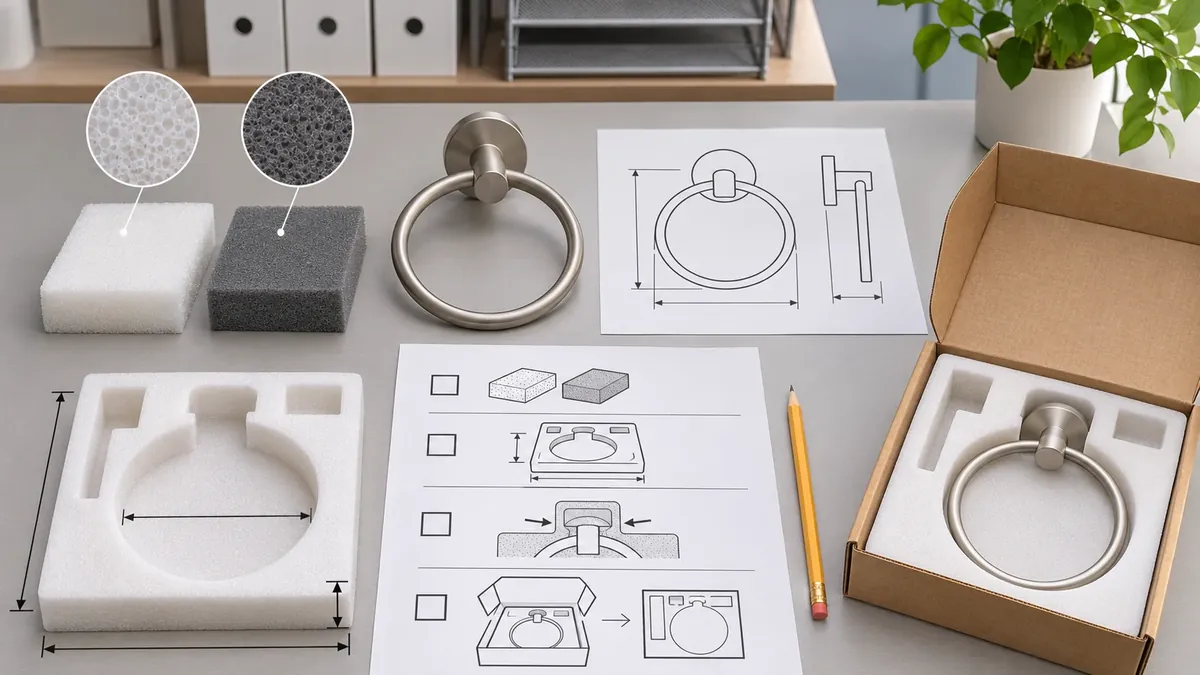
The RFQ should distinguish material selection from insert geometry. If the buyer has already selected a grade, name its source and code. If the buyer wants the supplier to propose one, define the hardware and packaging context and ask for the proposed grade and evidence.
Include:
- product drawing, sample, revision, finish, and packed orientation;
- cosmetic faces or features where contact is sensitive;
- current box and carton dimensions, if set;
- target insert arrangement or a request for a supplier proposal;
- the material family or grade only if the buyer has evidence to specify it;
- supplier-defined grade code, form, and relevant technical data;
- the complete sample pack-out for review;
- any project evaluation method that has been explicitly agreed;
- responsibility for converting, revisions, and material substitution;
- the approval contact and the timing of sign-off before bulk production.
A buyer can state a requirement in plain terms, such as “prevent the metal part from moving into contact with another part in the closed package,” then ask the supplier to propose an insert design and explain what evidence is available. This is more useful than declaring an unmeasured foam property as the only outcome. If a specific test is contractually required, name the test method and the party that will conduct and document it; do not rely on a generic marketing statement.
Buyer Checklist Before Approving an EVA or PE Insert
- Is the material family stated precisely?
- Does the quotation identify the supplier and exact foam grade?
- Are grade descriptors such as density, cell structure, variant, and crosslinking defined by that supplier?
- Is the supplied form clear?
- Is the insert drawing or sample identified by revision?
- Does the insert fit the actual product, visible faces, and projecting features?
- Has the metal hardware been placed in the complete retail package and carton?
- Are any performance properties tied to the exact offered grade and source document?
- Are typical values separated from agreed acceptance limits?
- Who owns foam conversion and notification of material changes?
- What sample or complete pack-out will be approved?
- Are the foam supplier, packaging converter, and hardware supplier responsibilities clear?
Häufig gestellte Fragen
What is the main difference between EVA and polyethylene foam?
EVA is an ethylene-vinyl-acetate copolymer, while PE foam is based on polyethylene. That chemistry distinction does not determine every property of a supplied foam or finished protective insert.
Is EVA always softer than PE foam?
No universal softness ranking follows from the family names. Composition, grade, structure, and supplied product matter. Compare the actual manufacturer grade and applicable data.
Does PE foam always provide better protection for metal parts?
No. A PE label does not prove an insert will protect a particular part. Review the exact grade, insert design, product contact, and agreed packaging evaluation.
Are EVA and PE foam grades interchangeable at the same density?
Equal density alone does not establish equivalence. The exact grade, structure, material data, insert conversion, and complete package should be reviewed.
Does “crosslinked” tell me whether an insert is EVA or PE?
No. Polymer identity and crosslinking are separate descriptors. A buyer should obtain both from the supplier for the quoted product.
Should buyers compare only a foam sample?
A foam sample helps identify the material appearance and handling, but it does not show the complete insert geometry or package arrangement. Review the actual converted insert with the product and packaging.
Can a hardware manufacturer guarantee the foam insert’s performance?
That responsibility depends on the documented supply scope. The foam manufacturer or packaging converter should provide material and conversion evidence for the item it supplies. Koitor can discuss metal-product and packaging requirements within its approved scope but does not claim to manufacture or test the foam.
Technical Sources and Further Reading
- Flextech Foam’s EVA technical brief explains EVA as an ethylene-vinyl-acetate copolymer and discusses how composition and grade relate to the supplier’s material family.
- Zotefoams Technical Information Sheet 01 shows product-specific descriptors for one manufacturer’s foam families and distinguishes general product information from agreed specifications.
- Envirolite’s crosslinked PE and EVA comparison discusses two supplier product families; broad performance rankings from one supplier should not be transferred to all grades.
- For a metal hardware packaging project, contact Koitor through the verified Koitor-Kontaktseite with the hardware sample and packaging requirements.
Arbeiten Sie mit Koitor Hardware zusammen
Discuss Protective Packaging for Metal Hardware
Send Koitor the product drawing or sample, finish requirement, insert proposal, retail-pack dimensions, and target order details. Koitor can discuss metal-product structure and packaging preparation; foam material selection, conversion, and specialist performance evidence remain with the responsible foam and packaging suppliers.
OEM / EIGENE MARKE
Verwandeln Sie diesen Beschaffungsleitfaden in ein Produktdossier
Teilen Sie uns Ihr Zielprodukt, die Größe, die Oberflächenausführung, die Bestellmenge und Ihre Verpackungsanforderungen mit. Ihr Team erhält vor der Angebotserstellung eine praxisorientierte Prüfung der Herstellbarkeit.

 English
 Español
 Português
 Français
 Deutsch
 العربية