

Dunnage rack load capacity should be checked against the exact rack model, its stated rating conditions and the way the actual load contacts the deck. A quoted maximum is not automatically valid for a concentrated foot, an off-center stack, a moving rack or a different size. Foodservice buyers should record the package or container footprint, how weight is distributed, whether the rack is stationary, which deck function is needed, and what clearance the storage area requires before comparing offers.
What decision does a dunnage rack specification support?
A dunnage rack is a low storage support used to keep goods above the floor in some foodservice and other storage settings. A buyer choosing a model must check more than the total weight of the goods. The rack’s footprint, deck design, support structure, height, rating basis, cleaning access and location all affect whether the offered configuration matches the application.
The key buyer question is: “Does this exact rack support the actual package contact pattern and fit the space, and what evidence applies to this model and use?” This is different from asking whether the rack is “heavy duty” or whether its product page shows a large capacity number. A product rating can be meaningful only within the conditions described by the manufacturer.
Two manufacturer examples show why buyers should read model-specific evidence. Metro’s product listing qualifies the rating for a particular heavy-duty dunnage model as distributed and static, with different listed values by length. Cambro’s dunnage range distinguishes solid and slotted top formats and describes different functional considerations. These statements describe those manufacturers’ products only; they cannot be transferred to another rack or treated as a general industry standard. Review the current Metro model listing und Cambro dunnage rack information for their own configurations.
This article is a procurement guide, not a structural calculation, food-safety certification, load approval or engineering instruction. It does not establish that Koitor manufactures commercial foodservice dunnage racks, polymer racks or any product with a stated capacity.

Match the deck and footprint to the actual package contact pattern.
Why does the load footprint matter as much as total mass?
A rack rating may be based on a stated load distribution over a stated support surface. The actual goods may contact the deck differently. A broad carton resting across a larger area does not create the same contact pattern as a bin on narrow feet, a small container on a few hard edges, or a stack with weight concentrated near one end.
Buyers should describe the footprint of each item or stack, not just provide a total weight. Relevant details include the base dimensions, contact points, any rails or feet, whether the bottom is flat, and how multiple packages are arranged. A container may bridge across deck openings, rest on a few supports or overhang the rack. Each arrangement needs to be compared to the manufacturer’s model-specific guidance.
Do not calculate an allowable load from a product photo or from one capacity statement. A buyer can identify the actual use and ask the supplier to confirm whether the described loading arrangement falls within the rating conditions. If it does not, the buyer should obtain a qualified design review or select a different configuration. This article does not provide a formula for converting a distributed rating into a point rating.
The buyer should also distinguish static placement from movement. A stationary rack supporting goods in one location may have a different rating basis from a rack with casters or a rack that will be moved while loaded. A stationary rating cannot be assumed to cover movement, impact, pushing over uneven floors or transport through a facility. If mobility is required, ask for the exact mobile model and its own documentation.
| Actual load pattern | What the buyer should describe | Warum das wichtig ist |
|---|---|---|
| Broad-bottom cartons | Base dimensions, number of cartons, stacking and overhang | Contact area and distribution affect how the manufacturer rating applies |
| Totes or bins with feet | Foot locations, spacing and footprint | Load may transfer through a few concentrated points |
| Bags or flexible packages | How the contents settle and how the base is supported | The contact pattern can change as the load is placed or moved |
| Several mixed items | Weight and location of each group, not only the total | One side or area may carry more than the rest |
| Load on a mobile rack | Whether movement occurs loaded, route and exact caster model | Static and moving conditions should not be treated as equivalent |
These examples are questions to bring to the rack supplier, not conclusions about whether a specific load is acceptable.
How should buyers choose a solid or slotted deck?
Deck choice depends on the goods, storage environment, cleaning approach and supplier documentation. A solid top and a slotted or open top have different physical features. The right choice depends on the actual need, not a universal statement that one format is safer, cleaner or stronger.
A solid surface can provide continuous support for some packages and may help contain a spill on the deck. It can also change drainage, airflow and cleaning access beneath or around the stored goods. A slotted or open deck can provide openings and may affect how a package is supported or how the surface is cleaned. Buyers should check actual package bottoms, not infer suitability from the deck name.
Cambro’s product information, for example, distinguishes solid-top and slotted-top versions and describes their intended differences. Those attributes are specific to its product range and materials. They do not establish that every solid top is easier to sanitize, that every slotted top provides a particular airflow rate, or that either configuration complies with a specific local code.
Buyers should ask:
- Is the base of the stored carton, bin or bag supported as intended across the deck?
- Do the openings or gaps interact with small feet, flexible packaging or narrow bases?
- Does the buyer need a surface that contains spills, allows drainage or provides another function?
- What does the supplier’s current model documentation say about the chosen deck?
- How will staff access the floor and rack surface for the buyer’s defined cleaning procedure?
- Does the package or stored item obscure openings or create a separate cleaning concern?
- Is the deck removable, and if so, what maintenance or inspection steps are documented?
Do not claim that a deck feature proves food-contact suitability, contamination prevention, hygiene compliance or a cleaning result. Those claims require applicable evidence and buyer or regulatory review. If the project has food-safety or sanitation requirements, the purchaser should identify the relevant rules and obtain qualified confirmation for the exact model and use.
How should buyers match rack dimensions to a storage layout?
Measure the actual goods and the usable storage space. A rack’s nominal width and depth should be compared with the package base, access path, wall and aisle conditions. The listed exterior dimension may not be the same as a usable deck dimension or the clear opening available to place a container.
Record the package footprint and any handles, flanges or overhangs. If a carton stack extends beyond the rack edge, ask the supplier or qualified reviewer whether that configuration is acceptable. Do not infer safe overhang limits from the rack’s overall dimensions. If packages need to be loaded by hand, consider the path staff use to set them down and remove them.
Height should be considered with floor condition and cleaning access. Some products include leveling elements or caps that affect overall height. The buyer should confirm how the manufacturer’s stated dimension is measured and whether site conditions change the usable elevation. A value from a product sheet should not be repurposed as a regulatory clearance statement.
A site plan can show rack placement, but it should not substitute for the actual product drawing. If several racks are connected, verify the manufacturer’s specified connector and configuration. A connector between racks does not automatically increase the permitted load or make a new combined structure equivalent to a tested model. Treat each joined configuration according to the supplier’s current documents.
| Dimension or condition | Buyer evidence to collect | Owner to confirm |
|---|---|---|
| Load footprint | Base dimensions and contact points of actual goods | Buyer and rack supplier |
| Rack width/depth | Current model drawing and usable deck reference | Rack supplier |
| Overall height | Measurement basis, feet/caps/leveling parts | Rack supplier and site planner |
| Floor layout | Clear area, access, cleaning path and adjacent equipment | Facility/project team |
| Connector arrangement | Exact connector part and approved rack combination | Rack manufacturer |
| Movement | Stationary or mobile use and movement condition | Rack manufacturer and facility team |
What evidence should support the stated capacity?
Ask for the capacity of the exact model and size being quoted, including how the load is applied and whether the condition is static or mobile. Record the manufacturer’s document date or model reference and preserve the source with the purchase record. If there is a test report or technical basis, check which product configuration and method it covers. A rating from a similar product in a different length or material should not be copied.
The buyer should distinguish a manufacturer-published product rating from an independently witnessed test, certification or project-specific engineering approval. The word “capacity” may appear in marketing copy, a product table or a technical document; the evidentiary basis and conditions can differ. Ask what the supplier is actually providing and avoid upgrading a general statement into a stronger claim.
If the order requires a specific rating, specify it before quotation and ask the supplier to state the rating basis. Include the exact rack model, dimensions, deck and support arrangement. If a supplier proposes a different deck or construction, confirm whether the rating still applies. Do not assume an alternate is equivalent because its nominal dimensions match.
A buyer should also check whether the stated capacity applies per rack, per shelf, per deck or to a specific combination. For a low standalone rack, a capacity statement from an unrelated shelving assembly or pallet rack should not be applied. Likewise, a rating for evenly distributed static load does not automatically apply to point loads, impact, repeated movement or an unapproved stacked configuration.
The buyer should not ask a manufacturer to validate a load based on incomplete information. Send package footprints, contact patterns, total quantities, arrangement and movement expectations. If the intended load condition is outside the published scope, seek a qualified assessment or choose a documented alternative.
What should an importer request before approving a dunnage rack?
The RFQ should identify the exact application and evidence needed. Provide the goods’ base dimensions, package type, the number of packages, how they contact the deck, whether the rack remains stationary, desired deck function, storage location and cleaning access needs. State whether the buyer has a required model, material, finish, dimension or rating.
Ask the supplier to return:
- Manufacturer, product code and exact size.
- Exterior dimensions and any stated usable deck dimensions.
- Deck construction and available top format.
- Published rating and the conditions attached to it.
- Whether the model is stationary or mobile and what use the documentation covers.
- Connector or accessory details if multiple units are joined.
- Cleaning and maintenance instructions for the exact product.
- Packaging and shipment configuration.
- Any certifications or compliance documents specifically required by the project.
- Written deviations from the buyer’s requested configuration.
If the supplier does not provide a rating for the exact configuration, record that as an open item. Do not fill the gap with a number from a similar listing. If a project requires a regulated or certified product, ask which standard, model and scope the evidence covers. A category-level statement is not enough to establish that every size, deck or accessory is included.
For commercial kitchen shelving certification context, Koitor’s existing importer checklist for NSF/ANSI 2 commercial kitchen shelving covers how buyers should check certification scope by model and use. Do not assume that checklist or a standard applies automatically to every dunnage rack. The buyer should verify the relevant requirements for the specific product and jurisdiction.
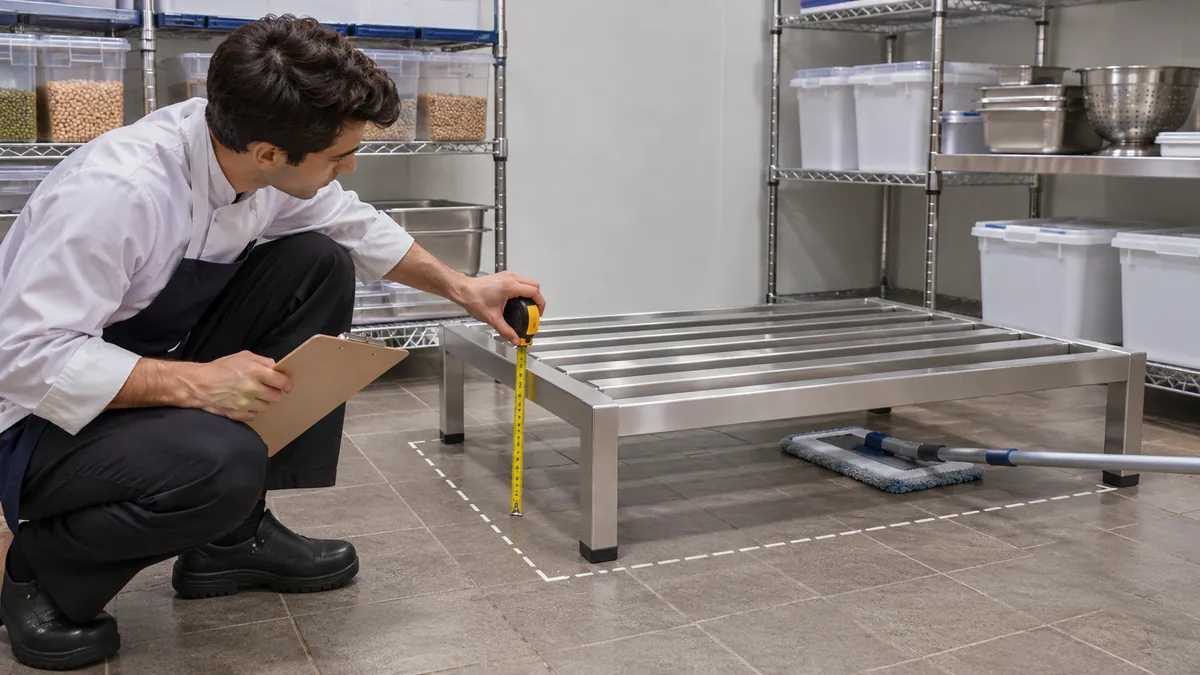
Record goods, support points, placement and cleaning access for the exact application.
What should the buyer record about loading and cleaning?
A storage worksheet can prevent a quote from omitting important assumptions. It should record the actual item, not only an abstract “load.” For example, note whether inventory is in cartons, lidded tubs, bags, trays or equipment. Include dimensions and support points, anticipated number of packages, stacking arrangement and any expected movement.
Cleaning access also needs a defined question. Does the buyer need to sweep or wash the floor beneath the rack? Is the rack moved for cleaning? Can the deck be reached without unloading? Is the surface removable under the manufacturer’s instructions? These are buyer workflow requirements. The buyer should not assume that a product page’s “easy to clean” phrase is equivalent to a validated sanitation procedure.
Avoid promising a cleaning result based on a deck format alone. Solid or slotted construction may affect access and contact, but staff procedure, detergents, local rules and stored goods all matter. The buyer should consult its facility and food-safety roles for the actual cleaning plan and any applicable standards.
If moisture or spills are expected, state the conditions and ask what the selected product’s documents say. Do not assert that metal is corrosion-proof, that a polymer product never changes shape, or that a particular finish is suitable for a freezer or washdown environment unless model-specific evidence supports that statement. Material and finish statements are supplier- and model-specific.
What are common dunnage rack sourcing mistakes?
Mistake 1: comparing one capacity number without the conditions. The model, length, deck and load distribution may matter. Request the rating basis.
Mistake 2: using total load only. Describe the package footprint and contact points; one concentrated support may not match a distributed-load condition.
Mistake 3: treating stationary and mobile use as equivalent. Movement introduces different conditions and needs a documented mobile model and rating.
Mistake 4: choosing deck format from a generic label. Check package support, spill needs and cleaning access for the actual goods.
Mistake 5: treating “off the floor” as proof of regulatory compliance. Height alone does not establish food safety or local code compliance.
Mistake 6: applying a rating from one product family to another. A similar size, material or marketing phrase does not establish equivalent performance.
Mistake 7: assuming connected racks share one rating. Verify the exact connector and arrangement; do not infer capacity from joining.
Mistake 8: ignoring cleaning workflow. Staff access, product handling and surface design affect whether a layout works for the facility.
Mistake 9: assuming a low rack can serve as a lifting pallet. Similar low-to-floor appearance does not establish suitability for forks, jacks or material handling equipment.
How can a supplier conversation remain evidence-based?
Ask the supplier to answer the application question using the exact product documents. For example: “The stored carton base is 500 by 350 millimeters, and the load rests on four narrow feet. The rack is stationary. Does your published rating for model X cover this contact condition? If not, what reviewed configuration do you recommend?” This avoids asking for a generic “heavy-duty” product and makes the missing evidence clear.
If the supplier proposes an alternate model or deck, compare its dimensions, support layout, rating basis and cleaning access. Keep the alternative separate until the buyer approves it. Do not label it equivalent solely because the listed capacity number appears similar.
Record the answer in writing and preserve the product document. If the supplier provides no documented answer, do not invent one on its behalf. The buyer may need to select a different model or seek independent design review.
Koitor is a bathroom and home-storage metal hardware manufacturer, not an established dunnage rack supplier based on the current approved company facts. Its manufacturing background in metal hardware does not confirm commercial foodservice rack capacity, food-contact suitability, heavy-duty design, certification or polymer molding. Any adjacent product inquiry would need an explicit capability review before the company is described as a source.
Buyer checklist before ordering
- Identify the actual goods, package base and support points.
- State the number and arrangement of packages on each rack.
- Confirm whether use is stationary or mobile.
- Select a deck based on package support and defined cleaning workflow.
- Obtain exact exterior and usable dimensions from current model documents.
- Confirm the published capacity conditions for that model, size and deck.
- Do not convert or extrapolate ratings across models.
- Verify connectors and multi-rack arrangements with the manufacturer.
- Assign site clearance, food-safety and code review to responsible project roles.
- Request model-specific evidence for any certification or compliance requirement.
- Record deviations and open questions before purchase approval.
- Keep food-contact, hygiene and durability claims within the actual evidence.
Häufig gestellte Fragen
Does a dunnage rack’s total weight rating apply to any load shape?
Not necessarily. The manufacturer may qualify the rating by load distribution, size or use. Describe the actual contact pattern and obtain confirmation for the exact model.
Is a distributed static rating the same as a mobile load rating?
No. A stationary rating should not automatically be applied while moving the rack. Check the exact mobile product documentation and conditions.
Is a solid top always better for foodservice?
No universal conclusion follows from the deck name. Compare the goods’ support needs, spill workflow, cleaning access and the supplier’s model-specific information.
Does a slotted deck prove better airflow or sanitation?
Not by itself. A deck design can have openings, but airflow, cleaning and compliance depend on the exact product, layout, procedures and applicable requirements.
Can two racks be connected to increase the load rating?
Do not assume so. Confirm the exact connector, arrangement and rating with the manufacturer. Joining units does not automatically change their approved capacity.
Does storing goods off the floor establish food-safety compliance?
No. It may be one element of a storage setup, but compliance depends on applicable rules and the facility’s full process. Obtain qualified review for the jurisdiction and application.
Arbeiten Sie mit Koitor Hardware zusammen
Use dunnage rack load capacity as a defined comparison in the buyer record, and keep its assumptions visible when the specification changes.
Discuss Metal Hardware Requirements with Koitor
For confirmed bathroom or home-storage metal hardware, share the drawing, sample, material, finish, quantity and packaging scope. Koitor’s ability to supply any adjacent foodservice rack must be confirmed separately; no load rating or certification is implied.
For a useful dunnage rack load capacity review, record the product identity and the decision the measure is meant to support.
OEM / EIGENE MARKE
Verwandeln Sie diesen Beschaffungsleitfaden in ein Produktdossier
Teilen Sie uns Ihr Zielprodukt, die Größe, die Oberflächenausführung, die Bestellmenge und Ihre Verpackungsanforderungen mit. Ihr Team erhält vor der Angebotserstellung eine praxisorientierte Prüfung der Herstellbarkeit.



 English
 Español
 Português
 Français
 Deutsch
 العربية