
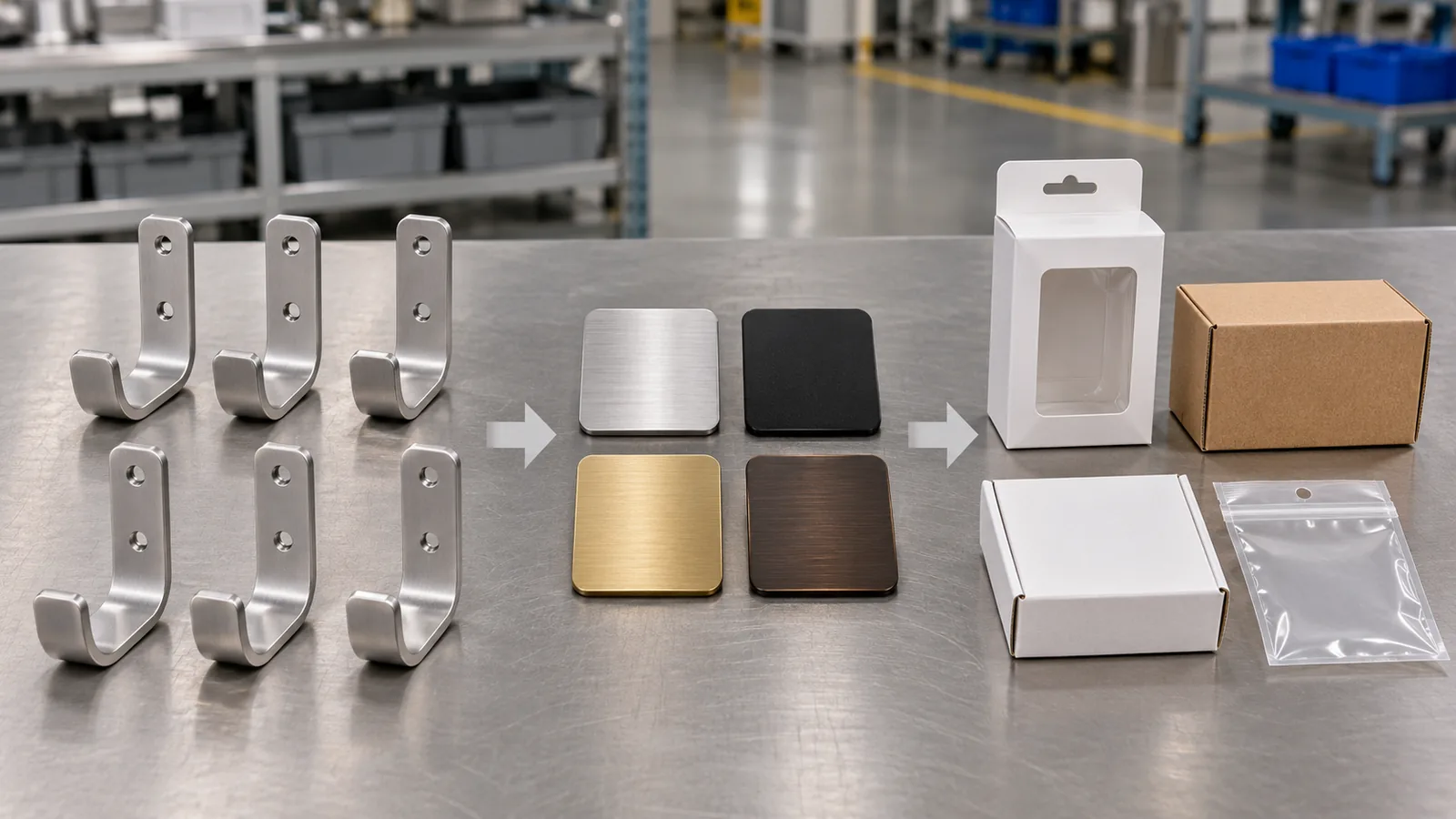
For buyers assessing hardware finish postponement shared components, feasibility depends on confirming which operations can remain common and which must be completed before a finish or pack choice is made. The decision is not simply “stock one blank part, then finish it later.” Material, geometry, surface preparation, coating or plating route, assembly sequence, inspection, labeling and order timing can all affect where a variant becomes distinct. Treat postponement as a process design question to validate, not a guaranteed inventory or lead-time benefit.
How to assess hardware finish postponement shared components
Postponement is the deliberate delay of a product differentiation decision until later in the supply or production process, where that delay remains technically and commercially workable. In a hardware context, the buyer might ask whether several sellable finish variants can share an earlier component or subassembly. That question can help a team identify where commonality ends and variant-specific work begins.
The first task is to map the actual route. A product might move through material preparation, cutting or forming, joining, deburring, polishing, surface finishing, assembly, inspection, packing and dispatch. Another product may use a different sequence. A finish may be applied to individual parts before assembly, after assembly, or at another point; those alternatives have different constraints and cannot be presumed interchangeable.
Create a part-and-operation map for each proposed SKU. Mark which components are identical, which dimensions or interfaces differ, when the finish is applied, and whether a finish change affects later operations. Include packaging and labeling in the map because a shared finished product can still become variant-specific through retail inserts, color codes or carton configuration.
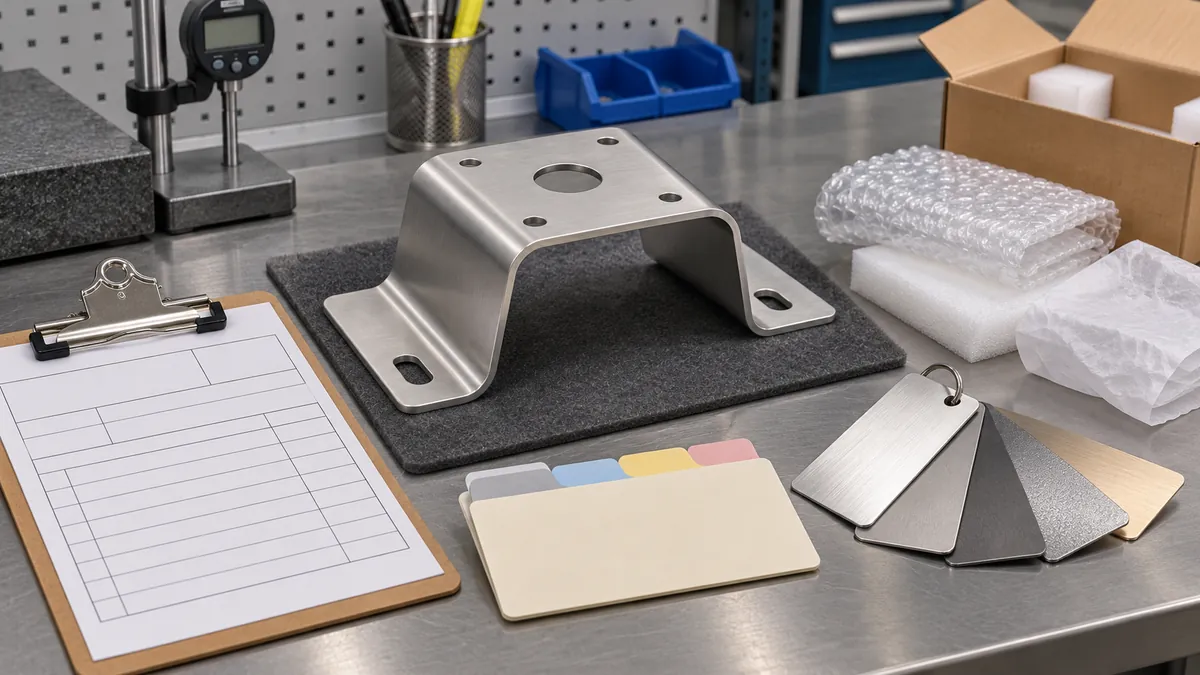
The goal is not to delay every possible decision. The useful question is: “At what point must this buyer’s final variant be committed so the remaining verified operations can be completed in the required time?” That point depends on the product, process, supplier schedule, order pattern and agreement on responsibility for unfinished or variant-specific goods.
Which operations determine the latest feasible variant decision?
Map the critical path in the actual production process, then identify when finish, assembly and packaging choices constrain the next step. The buyer should ask the manufacturer to show the operations affected by each finish and to identify any parts that cannot be treated as a shared blank. A common drawing or base material does not prove that the same unfinished part can take every finish or remain stable through each route.
Use a feasibility matrix like this:
| Decision point | Anzufordernde Nachweise | Question to resolve |
|---|---|---|
| Common geometry | Approved drawing and revision | Are interfaces and dimensions genuinely identical across variants? |
| Material and surface condition | Material record and finish requirements | Does the proposed base material support each specified route? |
| Variant-specific operations | Process flow for each finish | Where does the path split, and what operations remain? |
| Assembly | Component and joint sequence | Is assembly before or after finishing suitable for each SKU? |
| Prüfung | Acceptance points and records | How will finish and fit be verified for each variant? |
| Verpackung | SKU label, insert and carton definition | Which pack choices must be committed earlier? |
| Order release | Forecast, firm order and cutoff | What information must arrive before the supplier can schedule remaining work? |
The matrix should distinguish a technical possibility from a commercial service. A process may permit late differentiation, while the supplier may not offer finished-to-order processing, hold unallocated inventory or promise an accelerated response. Each point requires explicit agreement. Do not describe a proposed route as available until the supplier confirms process, ownership, minimum quantities and timing assumptions.
Can common components support multiple finishes?
Sometimes the product architecture permits a common component before a later finish step; in other cases, the finish choice affects material selection, preparation or assembly details upstream. The buyer should ask for a part-by-part assessment rather than assume that every finish can be applied to one shared blank. Even when the visible design is the same, a finish requirement may change pretreatment, masking, contact points, cosmetic inspection or protective packaging.
Academic operations guidance describes the customer order penetration point as a coordination choice between the time customers will accept and the cumulative time required for the remaining product and process design. That framework helps buyers ask where a configuration becomes order-specific. It does not establish that any particular metal finish can be postponed. The ETH Zurich operations guidance is useful for understanding the planning concept.
Supplier examples in decorative hardware show that some businesses distinguish stocked finishes from special finishes made to order. These examples demonstrate that commercial models vary, not that every item shares identical unfinished stock or that a bathroom hardware manufacturer can apply a selected finish on demand. Buyers can review Gerber Hinge’s business information und SWS Hardware’s special finish description as examples, then verify their own product route with the relevant supplier.
If the buyer wants to pool components, identify the exact commonality: same grade or material specification, wall thickness, formed shape, joint geometry, machining, masking surfaces and final assembly interface. Any finish that changes a dimension, fit, appearance or downstream assembly should be treated as a controlled variant. The production drawing, finish reference and sample approval should match the proposed late-stage path.

Do not infer a cost reduction from postponement alone. A shared earlier step may reduce duplicated handling in one scenario, yet create extra storage, sorting, tracking or finish-specific setup elsewhere. Only a supplier quotation and documented process review can establish the commercial effect for a specific product and volume mix.
What inventory and ownership questions must be settled?
Before discussing pooled or unfinished inventory, assign responsibility for every item at each stage. Decide who owns base components, who authorizes conversion, what quantity is allocated to each finish, how obsolete or slow-moving variants are treated, and who bears the risk if a forecast is not converted into a firm order. A buyer should never assume that an OEM will hold material or semi-finished goods without a written agreement.
Clarify these terms in the sourcing discussion:
- Unallocated quantity: what portion, if any, remains common rather than tied to one buyer or SKU.
- Ownership transfer: when title or commercial responsibility shifts, if applicable to the contract.
- Allocation cutoff: when the buyer must provide final variant quantities.
- Minimum conversion quantity: whether a finish or pack option requires a separate batch quantity.
- Revision control: how changes to finish, label or packaging are recorded after the cutoff.
- Aging and storage: who evaluates condition and suitability during any agreed holding period.
- Shortfall or excess: how quantity differences are reconciled when variants are released.
- Forecast classification: which planning numbers are nonbinding and which order documents authorize production.
These are contract and operational questions, not assumptions that follow automatically from a postponement concept. Specific payment, legal or inventory terms should be reviewed by the parties responsible for the agreement. The article does not establish a universal inventory model or make claims about Koitor’s stock.
How should a buyer compare lead-time scenarios?
Compare complete end-to-end scenarios rather than a phrase such as “finish to order.” For each route, list the variant decision date, remaining operations, queue or setup assumptions supplied by the manufacturer, inspection and packing time, shipment handoff, and the buyer’s required availability date. If the supplier cannot provide a verified time estimate, keep it as an open item instead of substituting an invented number.
A scenario table can make the decision auditable:
| Scenario | Buyer commits | Supplier must confirm | Main trade-off to evaluate |
|---|---|---|---|
| Fully specified at order | Finish and pack details in the initial release | Standard process and variant schedule | Earlier certainty versus less late flexibility |
| Common early stage, later finish choice | Geometry/material and allocation cutoff | Feasible finish route and capacity window | Potentially later choice versus more coordination |
| Separate variant batches | Final quantity per finish before each batch | Minimum batch and setup assumptions | Clear variant control versus fragmented quantities |
The buyer’s decision should include service and data readiness. Can the team forecast demand by finish? Are product labels and marketplace pages prepared? Can the receiving system identify mixed finishes? Does the supplier have an approved appearance sample for each option? If those pieces are not ready, delaying the physical finish may simply shift the bottleneck to a later stage.
Run the comparison against at least one realistic order pattern instead of a single annual total. A stable high-volume finish mix may not benefit from the same release model as an uncertain launch assortment. Use the buyer’s own historical or planned quantities, identify which assumptions are estimates, and ask the supplier to explain how variant allocation affects scheduling. Do not use a hypothetical model to announce savings; it is a way to decide whether a controlled pilot is worth discussing.
What should be documented before trying a pilot?
Start with a limited, clearly bounded trial only after the manufacturer confirms that the proposed process is supported. Identify one product family, the common components, the candidate finish options, any separate pack configurations and the acceptance criteria. Agree what the pilot will measure: allocation accuracy, variant record completeness, finish conformity, pack correctness or another defined outcome. Do not claim inventory savings or faster replenishment unless the pilot data supports those conclusions.
The approval packet should include a revision-controlled drawing, bill of materials or component list, finish references, process map, inspection criteria, labeling and packaging instructions, variant-release deadline and responsibility matrix. Keep the approved physical sample linked to the exact combination. If a finish or assembly sequence changes, determine whether the commonality premise still holds before repeating the pilot.
The image above is an abstract process illustration; it does not depict actual Koitor stock, production software, factory inventory or a current finish-to-order service. Koitor’s verified scope is a family-owned manufacturer of bathroom and home storage hardware with drawing and sample-based OEM work. Specific postponement, unfinished inventory, finish-to-order, storage and lead-time services are not confirmed by that general positioning. Ask the company through its Kontaktseite whether a defined project is feasible; the custom bathroom hardware page provides general product context only.
Buyer checklist before requesting a quotation
- Identify the product family and the actual common components.
- Attach the current drawing and state which revisions are controlled.
- List every finish and pack variant under consideration.
- Ask the supplier to map the operation route and exact variant split point.
- Confirm whether the same base material and geometry are suitable for every route.
- Define quantity allocation, cutoff date, inventory ownership and risk treatment.
- Separate nonbinding forecasts from firm purchase-order commitments.
- Request supplier-confirmed schedule assumptions for remaining operations.
- Specify inspection, label and packaging approval for every released SKU.
- Treat cost, stock, shorter lead time and availability as unproven until agreed.
For buyers assessing hardware finish postponement shared components, feasibility depends on confirming which operations can remain common and who owns each variant decision.
Häufig gestellte Fragen
Does hardware finish postponement always reduce inventory?
No. It changes when a product becomes variant-specific, but storage, sorting, setup, allocation and ownership still have to be managed. The effect depends on product design, demand pattern, process and commercial agreement.
Can buyers request finish-to-order from any OEM supplier?
They can ask, but the supplier must confirm whether the process is technically supported and commercially offered. Do not infer the service from the existence of multiple finish samples or from another company’s business model.
Are shared components the same as interchangeable components?
Not necessarily. Commonality means some earlier component or operation is shared. Interchangeability requires the relevant dimensions, interfaces, revisions and acceptance criteria to be confirmed.
What information must be fixed before the finish stage?
That depends on the actual route. The supplier should identify required material, geometry, masking, preparation and assembly inputs before the buyer sets a late-variant cutoff.
Does postponement guarantee a shorter order lead time?
No. It may shift the timing of a decision, but remaining work, queues, finish-specific setup, inspection and packaging still determine completion. Compare complete scenarios using confirmed supplier assumptions.
Arbeiten Sie mit Koitor Hardware zusammen
Review a Multi-Variant Hardware Brief
Share the component drawing, finish options, pack variants and quantity split. Koitor can first confirm the product scope and which manufacturing assumptions need to be resolved for a quotation.
OEM / EIGENE MARKE
Verwandeln Sie diesen Beschaffungsleitfaden in ein Produktdossier
Teilen Sie uns Ihr Zielprodukt, die Größe, die Oberflächenausführung, die Bestellmenge und Ihre Verpackungsanforderungen mit. Ihr Team erhält vor der Angebotserstellung eine praxisorientierte Prüfung der Herstellbarkeit.

 English
 Español
 Português
 Français
 Deutsch
 العربية